

Most people think motivation requires grand gestures. At Global Positive News Network, we believe tiny daily positivity reminders are what actually move the needle on your mental health and resilience.
Small moments of positivity compound over time. This guide shows you exactly how to build them into your day, from morning routines to evening reflections, so consistency becomes automatic rather than forced.
Why Small Positivity Moments Actually Work
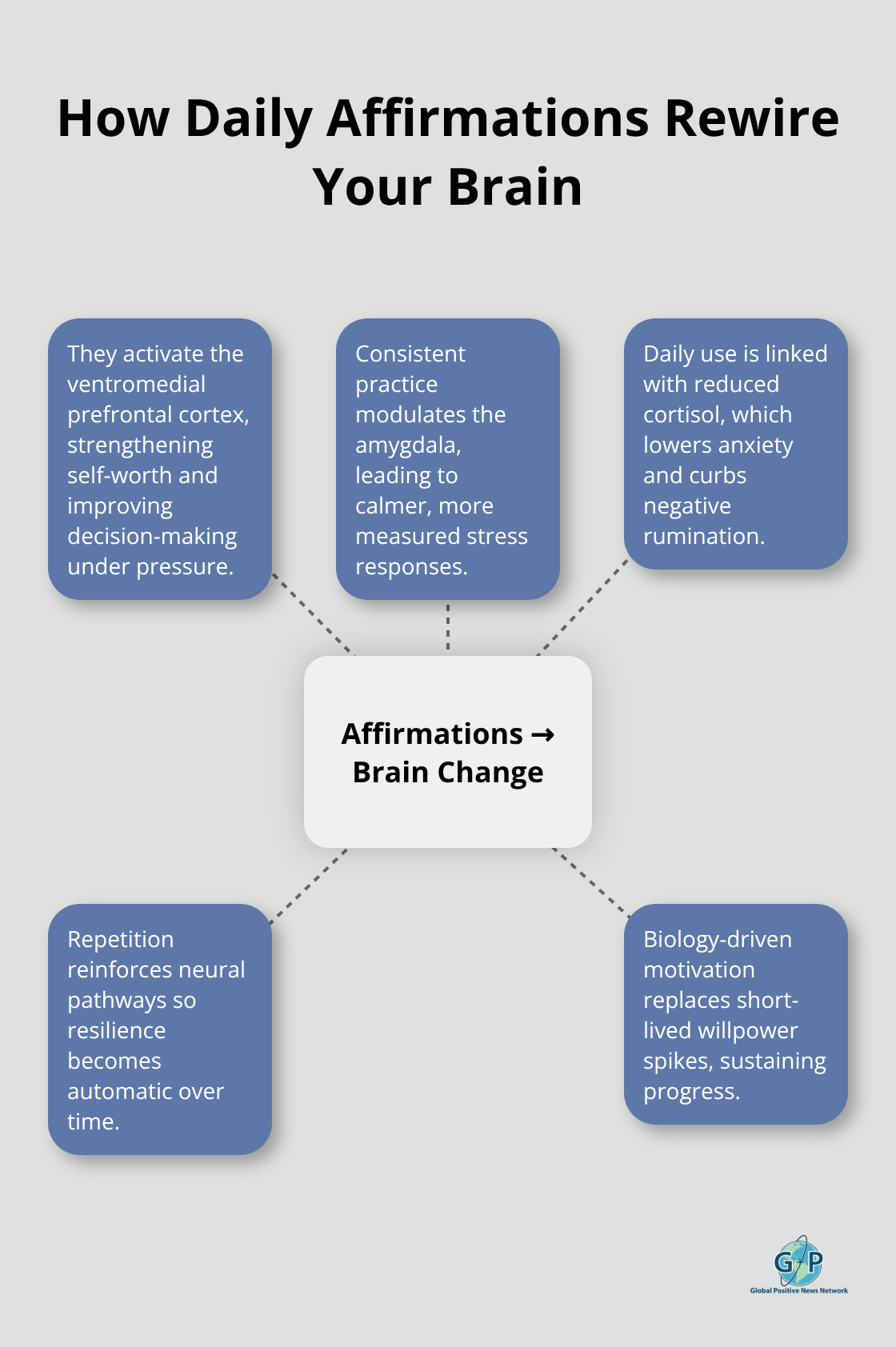
Brief affirmations rewire how your brain responds to stress and self-doubt. Research from Social Cognitive and Affective Neuroscience shows that affirmations activate the ventromedial prefrontal cortex, the part of your brain responsible for self-worth and decision-making. When you repeat phrases like “I got this” or “I am enough,” you physically change neural pathways that make resilience automatic. A study published in that same journal found that consistent affirmation practice modulates the amygdala, your brain’s emotional control center, which means you handle stress better under pressure. The impact is measurable: people who practice daily affirmations show reduced cortisol levels, the hormone that drives anxiety and keeps you stuck in negative thinking patterns. This isn’t motivation through willpower; it’s motivation through biology. When you say an affirmation every morning for two weeks, your brain stops treating every setback as evidence of failure and starts treating it as information. That shift creates lasting change, not occasional bursts of inspiration.
Small Wins Build Real Resilience
Consistency beats intensity every single time. A person who says one affirmation daily for a year outperforms someone who does a week of intensive motivation work and then stops. The National Institute of Mental Health confirms that regular self-care practices, including daily positive reminders, reduce emotional exhaustion and burnout across all age groups. When you celebrate tiny wins-finishing a task you’ve been avoiding, having one good conversation, completing your morning routine-you activate your brain’s reward centers and reinforce the neural pathways that keep you motivated. This is why setting micro-goals that align with bigger ambitions works better than waiting for inspiration to strike. You build momentum through repetition, not through occasional heroic effort. Three minutes of journaling about what went well today produces measurable improvements in mood and resilience when done consistently. One affirmation paired with one small action (like taking a five-minute walk or calling a friend) creates exponentially more impact than affirmations alone. The science backs this: people who combine positive self-talk with concrete action steps show higher success rates in achieving goals compared to those who use only mental strategies.
Why Daily Repetition Changes Everything
Your mind either works for you or against you, and repetition determines which one. Affirmations work because they counter the brain’s natural negativity bias, the tendency to focus on threats and problems. Without daily practice, your brain defaults back to scanning for danger. With consistent practice, it learns to notice opportunities and strengths instead. A person who spends ten minutes daily on positive affirmations combined with visualization practices (where you imagine yourself handling a challenge successfully) shows measurably higher confidence and focus than someone who relies on occasional motivation. The Greater Good Science Center research shows that regular gratitude practice, another form of daily positivity work, boosts self-esteem, creativity, and resistance to burnout while enhancing motivation for self-improvement. What makes this work at scale is that you don’t need motivation to start a small daily habit; you need a trigger. Link an affirmation to something you already do-brushing your teeth, pouring your morning coffee, starting your car-and the practice becomes automatic within three weeks. At that point, skipping your daily reminder feels wrong, like you’re missing something. That’s when tiny moments of positivity stop being a chore and become part of who you are.
How to Move From Understanding to Action
The science is clear, but knowledge alone changes nothing. You need a system that turns these insights into daily behavior. The next section shows you exactly which positivity reminders work best at different times of day and how to anchor them to your existing routines so they stick without extra effort.
What Positivity Reminders Work Best at Each Point in Your Day
Morning Affirmations Anchor to Your Existing Routines
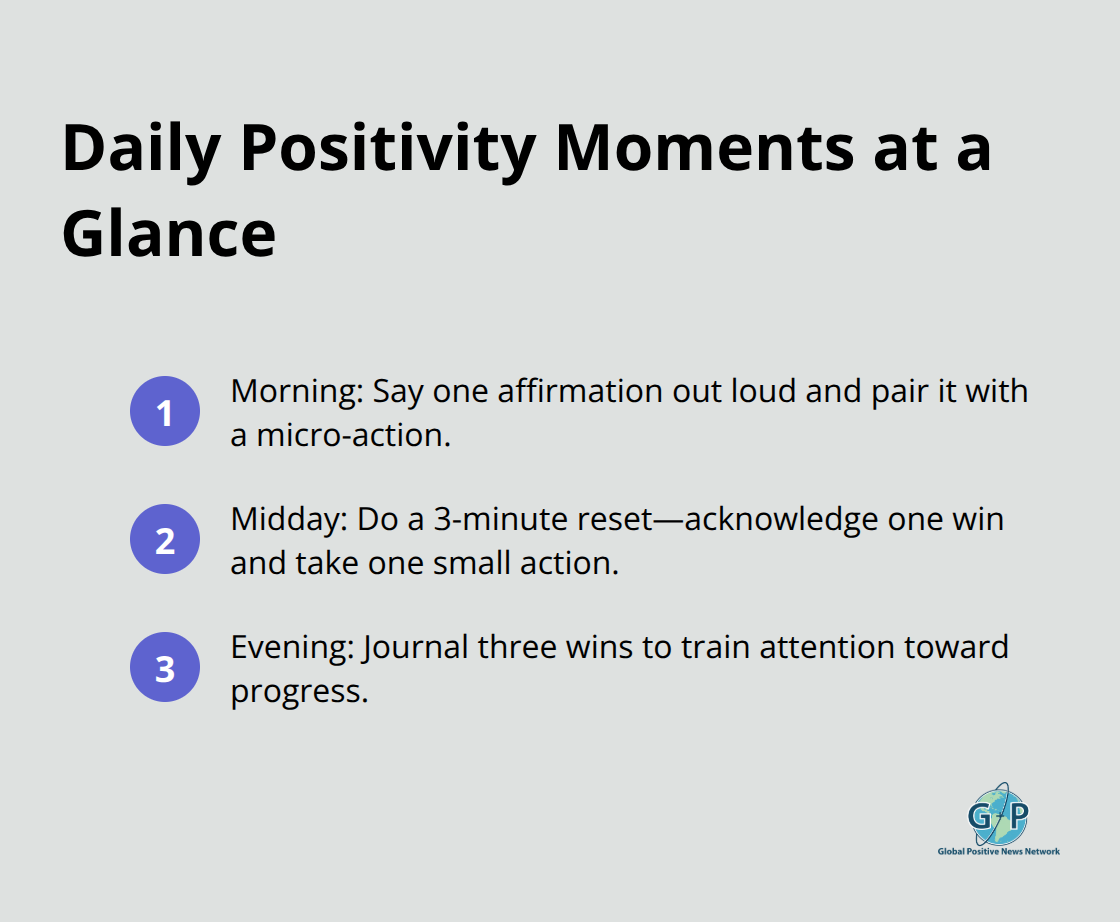
Start your morning with a specific affirmation tied to an existing habit. The moment you pour your first coffee or step into the shower, say one phrase out loud: “I am capable today,” “I choose to focus on what I control,” or “I handle challenges with clarity.” Research shows that affirmations paired with a physical trigger become automatic because your brain links the existing routine to the new behavior. Speaking it aloud, not just thinking it, activates different neural pathways than silent thought and creates stronger neural imprinting.
Pair this with one micro-action: a two-minute walk, five deep breaths, or writing one sentence about what you want to accomplish. This combination activates both your emotional regulation system and your action-oriented prefrontal cortex, setting momentum that carries through your morning. Do this for fourteen consecutive days and your brain stops treating the affirmation as optional; it becomes part of your identity.
Midday Resets Combat the Afternoon Energy Crash
Midday energy slumps hit hardest between 2 PM and 4 PM when cortisol naturally dips. Instead of reaching for caffeine or scrolling social media, use a three-minute confidence reset. Stand up, take five deep breaths, and state one affirmation tied to something you’ve already accomplished today-“I finished that report,” “I had a good conversation,” or “I made progress on my goal.” Research on gratitude practice confirms that acknowledging a single win shifts your brain’s neurochemistry toward dopamine production, which directly combats the afternoon energy crash.
Follow this with a concrete action: send one email, complete one small task, or call someone for two minutes. This prevents the affirmation from floating as empty positivity and grounds it in real behavior.
Evening Reflections Train Your Brain Toward Resilience
Evening reflection should happen within thirty minutes of finishing your workday. Spend three minutes writing three things that went well, no matter how small-a task completed, a kind interaction, a moment you handled stress differently. Journaling about positive moments reduces rumination and retrains your brain’s attention away from what went wrong toward what went right. People who log daily wins for thirty days report higher resilience when facing setbacks compared to baseline.
The consistency of this practice matters far more than the depth; three hastily written sentences beat one lengthy reflection that happens sporadically. Your evening reflection becomes the foundation for tomorrow’s morning affirmation because you train your brain to notice evidence of your capability every single day. This daily cycle-morning intention, midday reset, evening reflection-creates a feedback loop that strengthens your resilience without requiring willpower or motivation.
The next section shows you the specific tools and systems that make these three daily moments stick, even when life gets chaotic.
Making Your Daily Positivity Stick Without Extra Effort
Anchor Affirmations to Actions You Already Do
Most people abandon positive affirmations because they treat them as separate tasks instead of integrating them into existing behavior. Successful people anchor their daily reminders to actions they already perform automatically. Your morning coffee, your shower, or the moment you start your car all work as perfect triggers-activities that require zero motivation to do. Calm and Headspace both offer guided affirmation features, but the real power comes from linking affirmations to unavoidable routines. This removes friction entirely.
Research on habit formation shows that linking new behaviors to existing cues reduces the cognitive load required to maintain them. Your brain stops treating positivity as optional work and starts treating it as part of your identity. Set one phone reminder for 2 PM as your midday reset trigger, but don’t rely on push notifications alone. Instead, tie your affirmation to something unavoidable: the moment your laptop opens, when you sit at your desk, or when you check email.
Use Apps as Backup Systems, Not Primary Drivers
Apps like Calm and Headspace work best when they support your existing routine rather than replace it. A single phone reminder at midday functions as a backup trigger, not your main anchor point. The apps provide structure and guided content, but your brain forms stronger habits through physical environmental cues than through notifications alone.
A written trigger word posted on your bathroom mirror or desk creates a visual anchor that works throughout your day. This combination of app support and environmental cues creates multiple reinforcement points without overwhelming your system.
Build Accountability Through Weekly Check-Ins
Tell one specific person your three daily moments-your morning affirmation, your midday reset, and your evening reflection-and share your wins with them weekly rather than daily. Weekly check-ins prevent accountability from becoming burdensome while maintaining the social reinforcement that keeps motivation alive. People who report their progress to someone else show stronger commitment and follow-through compared to those working alone.
Text your evening reflection to this person once weekly. This creates a natural reporting rhythm that sustains motivation without creating extra burden. The social element transforms your positivity practice from a solitary activity into a shared commitment.
Create a Three-Part System That Requires Minimal Time
The most effective system combines a single phone reminder at midday, a written trigger word posted on your bathroom mirror or desk, and one person you text your evening reflection to once weekly. This three-part approach requires less than ten minutes daily while creating multiple reinforcement points that make the habit stick.
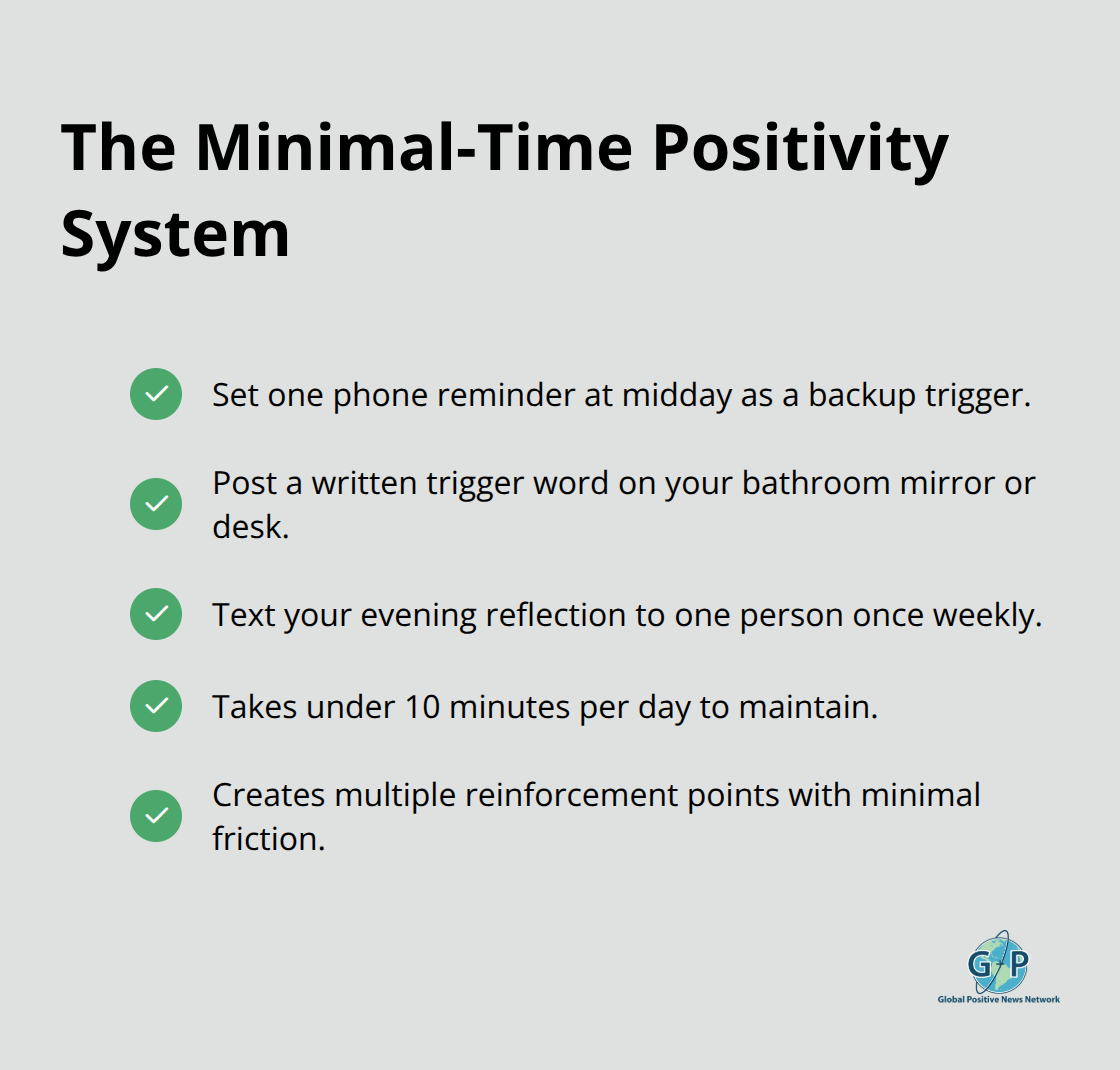
Each component serves a specific function: the phone reminder catches you during the energy dip, the written trigger reinforces your morning intention, and the weekly text maintains accountability without friction.
Final Thoughts
Three months from now, you won’t recall the specific day you started your morning affirmation. Instead, you’ll notice that setbacks feel less devastating, that your energy stays steadier through the afternoon, and that you handle stress with more clarity. Tiny daily positivity reminders work through repetition that rewires your brain’s default response to challenge, not through inspiration or willpower.
One affirmation paired with one action, repeated daily, creates measurable changes in how you think, feel, and perform. People who practice this system for thirty days report higher resilience, better focus, and stronger confidence than those who rely on occasional motivation bursts. Your first step is simple: choose one existing routine tomorrow morning, say one affirmation out loud, and pair it with one micro-action.
Then repeat it the next day. The momentum builds quietly at first, then becomes undeniable. Visit Global Positive News Network to explore resources, connect with a community committed to positivity, and discover how others build their own daily practices.
Having a hard day?
The 2 Minute Hope Reset is a short free guide with three small practices for the days that feel heavy. Two minutes each, nothing to keep up with.
Get the free guideExplore more positive news:
Enjoying stories like this?
Global Positive News Network is reader-supported. If you’d like to support the mission, you can visit the Official GPNN store.