
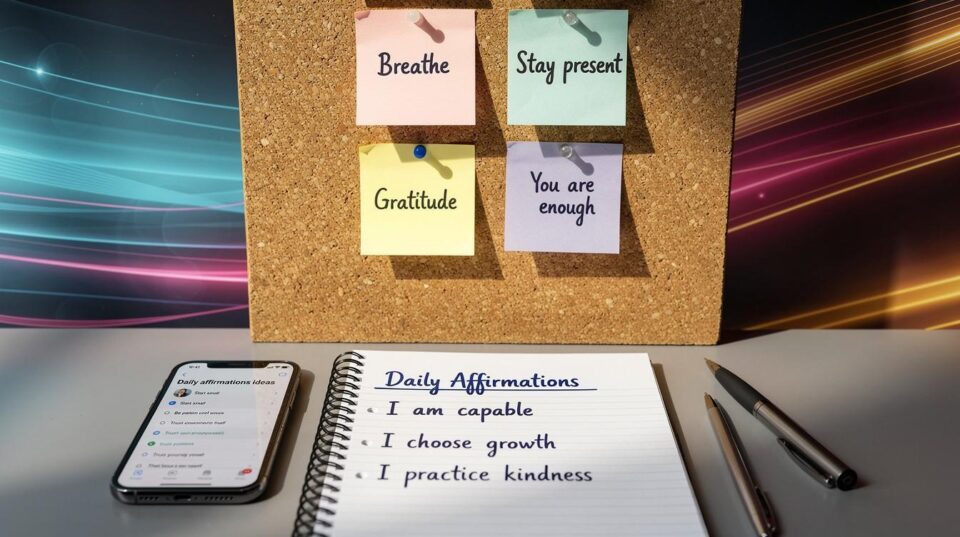
Most people repeat the same negative thoughts every day without realizing how deeply these patterns shape their reality. At Global Positive News Network, we’ve found that daily affirmations ideas work because they directly rewire how your brain processes information.
This guide shows you exactly how to craft affirmations that stick, integrate them into your life, and actually see the mindset shifts you’re after.
How Your Brain Rewires With Repeated Affirmations
Your brain physically changes when you repeat affirmations consistently. Neuroplasticity-the brain’s ability to form new neural connections-means that repetition literally reshapes your neural pathways. When you say an affirmation daily, you activate the same neural circuits repeatedly, and according to research summarized by Psychology Today, this process strengthens those circuits over time. The more you repeat a thought, the more your brain treats it as truth.
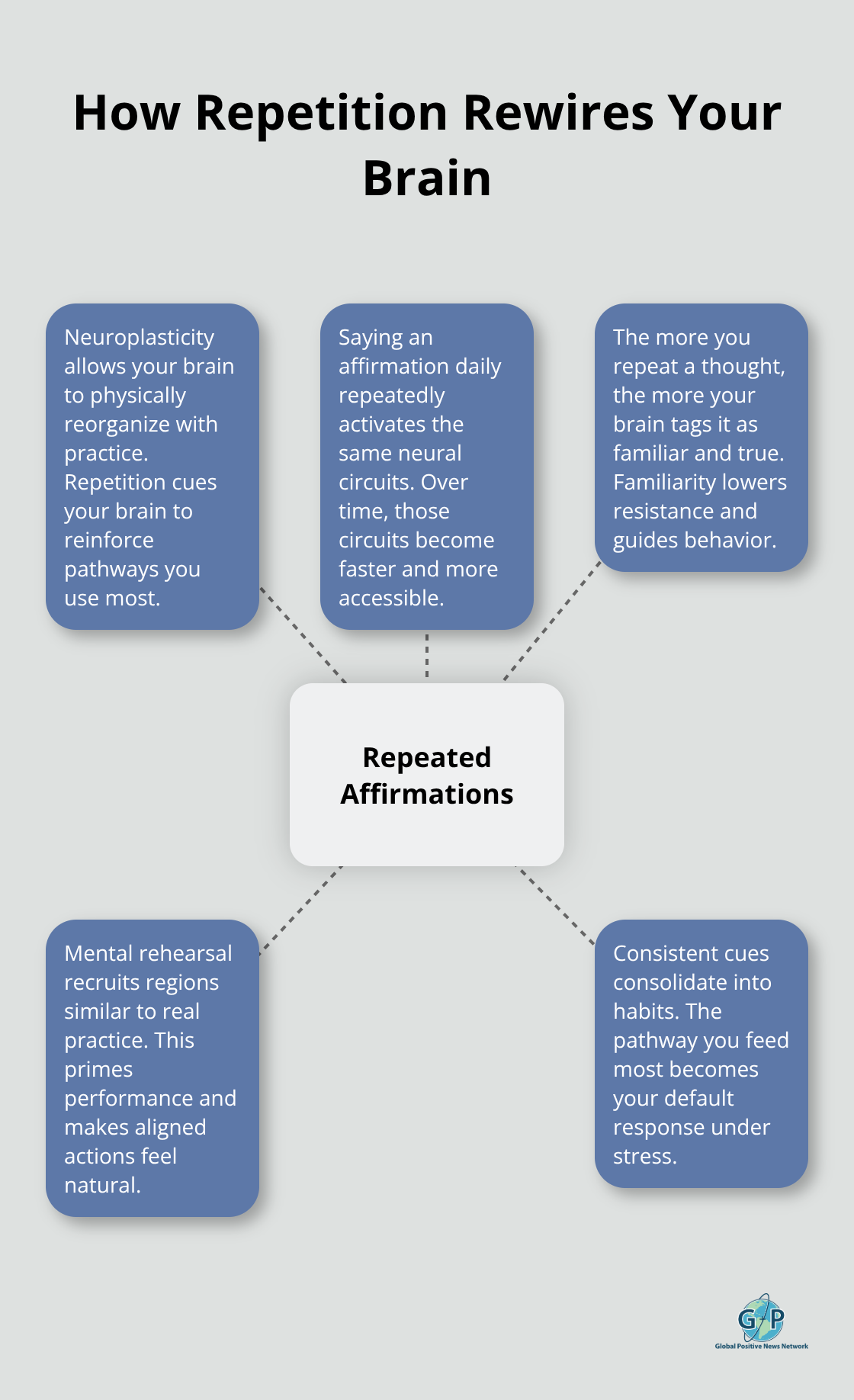
Brain imaging shows that repeated mental practice activates the same regions as actual physical practice.
Self-affirmation theory, developed by Claude Steele, explains that positive affirmations help when facing threats by restoring your sense of adequacy and integrity. This means affirmations work best when they address real challenges you’re experiencing, not generic statements disconnected from your life. Your inner dialogue directly shapes your actions and ultimately your life outcomes, so what you tell yourself matters far more than most people realize.
Why Believability Determines Whether Affirmations Stick
Many affirmations fail because the statements feel too distant from your current reality. Your brain resists big leaps, so starting with statements that feel like a believable next step works dramatically better than extreme positive claims. Research shows affirmations can reduce stress, improve health-related behaviors, boost academic performance, and support stable mood and relationships-but only when they feel achievable.
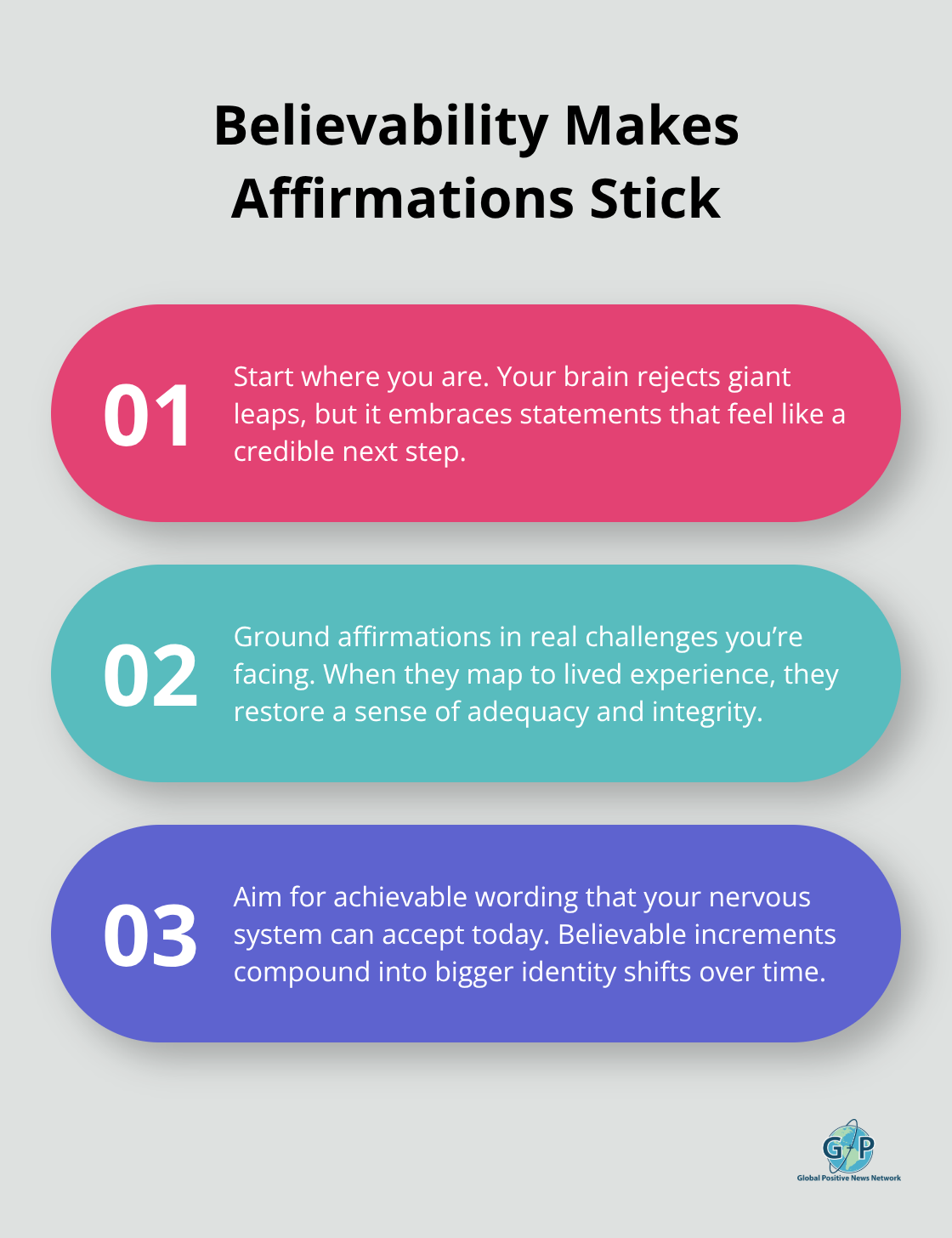
If you currently earn $50,000 annually and repeat “I am a millionaire,” your brain rejects this as false and the affirmation backfires. Instead, try something like “I am capable of earning more money” or “I make smart financial decisions.” This believable increment approach allows your brain to accept the statement and build from there.
The Power of Daily Practice and Supporting Habits
Frequency matters significantly-daily practice outperforms sporadic use. Pair affirmations with a morning routine, an open-minded attitude, and supporting habits to increase their impact substantially. For deeply rooted negative beliefs, write the negative thought, explain why it’s negative, then counter with why it isn’t true.
This foundation of how affirmations work in your brain sets the stage for the next critical step: learning how to craft affirmations that actually resonate with your specific situation and goals.
Crafting Personalized Affirmations That Actually Work
Your limiting beliefs are the invisible ceiling on your affirmations. Before you craft affirmations that work, you need to identify limiting beliefs and the specific negative thoughts sabotaging your progress. Start by picking one area of your life where you feel stuck-your career, finances, relationships, or body image. Write down the negative thought that appears most often in that area. If you struggle with job stress, your limiting belief might be “I’m not good enough for a promotion” or “My boss doesn’t respect my work.” Get specific. Generic negative thoughts like “I’m not successful” are too vague to counter effectively.
Uncover the Root of Your Self-Doubt
Once you write the limiting belief, explain why you hold it. Did a past experience create this belief? Is it something someone told you? Understanding the root matters because it helps you craft an affirmation that directly addresses the threat. When you write the negative thought, explain why it’s negative, and then counter with evidence of why it isn’t true, you address the core of self-doubt. This isn’t about positive thinking alone-it’s about building a logical case against your own self-doubt.
Your affirmation should directly oppose the limiting belief. If your belief is “I’m not good enough for a promotion,” your affirmation becomes “I deserve a workplace that treats me with respect” or “I make smart decisions that advance my career.” Notice the difference: these statements feel achievable because they’re grounded in real capability, not fantasy.
Use Present Tense and Positive Language
Present tense is non-negotiable for affirmations. Use “I am,” “I feel,” “I choose,” or “I can” as your opening. Avoid future tense like “I will be confident” because your brain treats this as something that hasn’t happened yet. Instead, “I am building confidence in my abilities” anchors the statement in what’s happening now.
Positive language matters equally-frame what you want, not what you’re avoiding. “I am free from anxiety” still keeps anxiety in your mind. “I am calm and focused” directs your brain toward the actual state you’re pursuing. Present tense affirmations broaden your perspective and reduce the effect of negative thinking. Make your affirmation specific to your real situation and your genuine goal. “I am successful” is meaningless. “I am growing my skills in project management” connects to something measurable and real.
Channel Your Future Self
Channel your future self when you write affirmations. Ask yourself: what would the confident version of me say right now? What would someone who’s already achieved this goal tell me? If you struggle with asking for help, your future self might say “I deserve support from people I trust” or “Asking for help is an act of self-respect.” This perspective shift makes affirmations feel less like wishful thinking and more like you’re stepping into an identity you’re actually building.
Test your affirmation’s believability by visualizing yourself achieving the outcome. Spend one to two minutes imagining life as if the affirmation is already true. If the image feels impossible, adjust the affirmation toward something more credible. Progress happens through believable increments, not magical leaps. The affirmations you craft now become the foundation for how you’ll integrate them into your daily life-and that’s where the real transformation begins.
Practical Strategies for Integrating Affirmations Into Your Routine
Anchor Affirmations to Your Morning Routine
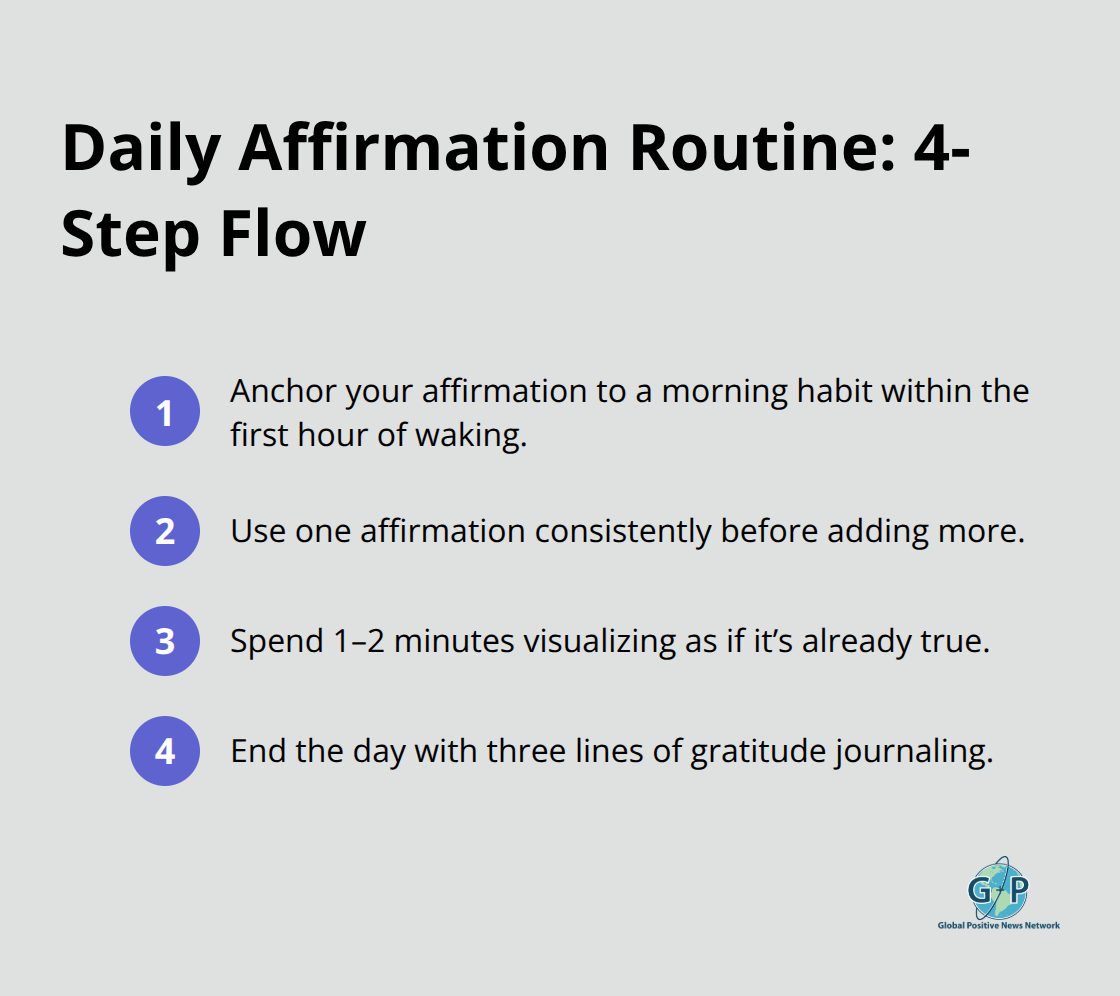
The timing of your affirmation practice matters far more than most people assume. Morning practice outperforms every other time of day because your brain is most receptive after sleep, before external stress floods in. Start your affirmation within the first hour of waking, ideally before checking your phone or email. This 30-second to two-minute window gives your subconscious mind fresh neural territory to work with.
Pair your affirmation with an existing habit you already do without thinking-brushing your teeth, making coffee, or showering. This attachment method works because you attach affirmations to something automatic rather than creating a new habit from scratch. Frequency matters significantly, and daily practice outperforms sporadic repetition. A single affirmation repeated once daily for 30 days produces measurable shifts in mood and self-perception, according to research on habit formation and neural adaptation.
Start With One Affirmation, Not Five
If you struggle with consistency, start with just one affirmation rather than five. One affirmation practiced religiously beats five affirmations practiced randomly. Write that single affirmation on a sticky note and place it where you’ll see it first thing-your bathroom mirror, your coffee maker, or your bedside table. The visual reminder reinforces the neural pathway you’re building and makes skipping the practice harder.
Visualization Activates the Same Brain Regions as Real Experience
Affirmations work best when combined with visualization and journaling because you activate multiple neural systems simultaneously. After you speak or write your affirmation, spend one to two minutes visualizing yourself already living as if that affirmation is true. Engage all five senses in this visualization-what do you see, hear, feel, smell, and taste in this future state?
If your affirmation is “I am growing my skills in project management,” visualize yourself leading a meeting confidently, hearing your team’s respect in their responses, and feeling the satisfaction of a completed project. Visualization activates the same brain regions as actual experience, which strengthens belief and motivation simultaneously.
Gratitude Journaling Completes Your Daily Cycle
At night, shift to journaling by writing three things you’re genuinely grateful for, no matter how small. This gratitude practice complements your morning affirmation work by reinforcing a receptive mindset before sleep, when your brain consolidates memories and beliefs. Research shows that gratitude journaling before bed improves sleep quality and amplifies the effects of affirmations practiced in the morning.
The combination of morning affirmation plus evening gratitude journal creates a psychological bookend to your day that actively rewires your default thought patterns. Tools like simple notebooks work perfectly, though apps like Day One or Reflectly provide optional structure if you prefer digital tracking (the method matters less than the consistency of doing it daily).
Final Thoughts
Your affirmations shift mindsets only when you craft them specifically for your life and pair them with consistent action. The daily affirmations ideas that work best address real limiting beliefs, feel believable from day one, and connect directly to challenges you face right now. Start with one affirmation anchored to your morning routine, add visualization and evening gratitude journaling, then expand only after consistency becomes natural.
Progress happens through incremental belief shifts, not overnight personality changes. Your brain accepts new neural pathways as legitimate when you speak affirmations that feel achievable, which is why believable statements outperform extreme positive claims every single time. Adjust your affirmations whenever they stop resonating, and move your practice to a new anchor point if your routine changes (affirmations are fluid tools that evolve as your life evolves).
The real power emerges when you pair affirmations with concrete actions aligned to your goals. At Global Positive News Network, we believe mindset work shapes how you show up in every area of your life, and your consistency and intention separate affirmations that transform you from affirmations that fade into background noise.

Having a hard day?
The 2 Minute Hope Reset is a short free guide with three small practices for the days that feel heavy. Two minutes each, nothing to keep up with.
Get the free guideExplore more positive news:
Enjoying stories like this?
Global Positive News Network is reader-supported. If you’d like to support the mission, you can visit the Official GPNN store.