

You scroll past dozens of headlines every day, but which ones actually stick with you? At Global Positive News Network, we’ve found that positive storytelling-real accounts from real people-creates far deeper impact than any headline ever could.
When you read someone’s actual experience, your brain responds differently. You remember it. You care about it. That’s the power we’re exploring here.
Why Your Brain Remembers Stories, Not Headlines
Neural Coupling Makes Stories Unforgettable
When you encounter a personal story, your brain activates in ways that a headline simply cannot trigger. Research from Princeton University shows that vivid narratives cause listeners’ brain activity to mirror the storyteller’s, creating neural coupling boosts comprehension and emotional connection. This isn’t abstract psychology-it’s measurable brain activity. Information delivered as a story gets remembered approximately 22 times more than facts delivered alone, according to research. That’s not a marginal difference; it’s a fundamental shift in how your brain processes and retains information.
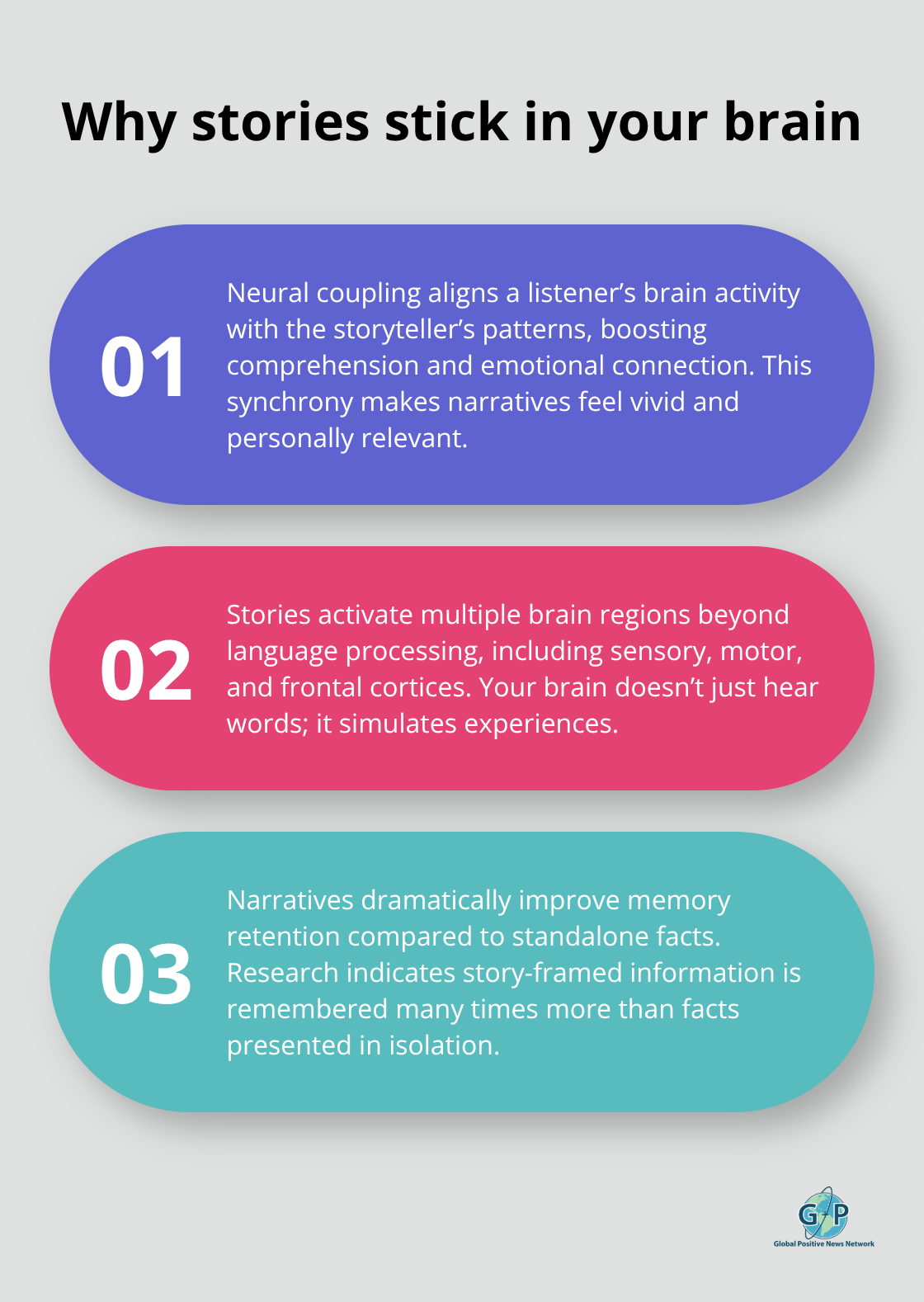
When someone shares their lived experience, multiple brain regions light up simultaneously: the language processing areas activate first, but then the sensory cortex, motor cortex, and frontal cortex engage as well. Your brain doesn’t just hear the words; it experiences them. This explains why you might forget a statistic within hours but recall a specific moment from someone’s personal journey weeks later. The practical implication is stark: if you want your message to stick, lead with the person behind the data, not the data itself.
Vulnerability Builds Trust Faster Than Credentials
Personal narratives build trust faster than any corporate statement or expert credential ever could. When someone shares a genuine struggle or a meaningful moment, they reveal vulnerability, and vulnerability signals authenticity. People detect inauthentic stories immediately-your audience has built-in radar for false narratives.
The strongest stories involve cost or sacrifice, according to research from BBH. A founder who admits they made a pricing error and paid customers back builds far more credibility than one who simply claims to value integrity. If you share a story, include the difficulty, the setback, or the choice you made that mattered. Stories without stakes feel hollow. Your audience responds to the real struggle, not the polished version.
Stories Shift How People Behave
Storytelling significantly increases employee engagement and resilience during periods of uncertainty, according to Gallup data. Personal narratives also drive actual behavior change in communities. When someone hears a story from a peer who faced a similar challenge and overcame it, they become more likely to attempt change themselves. This isn’t inspiration in the abstract sense-it’s a documented shift in how people perceive possibility.
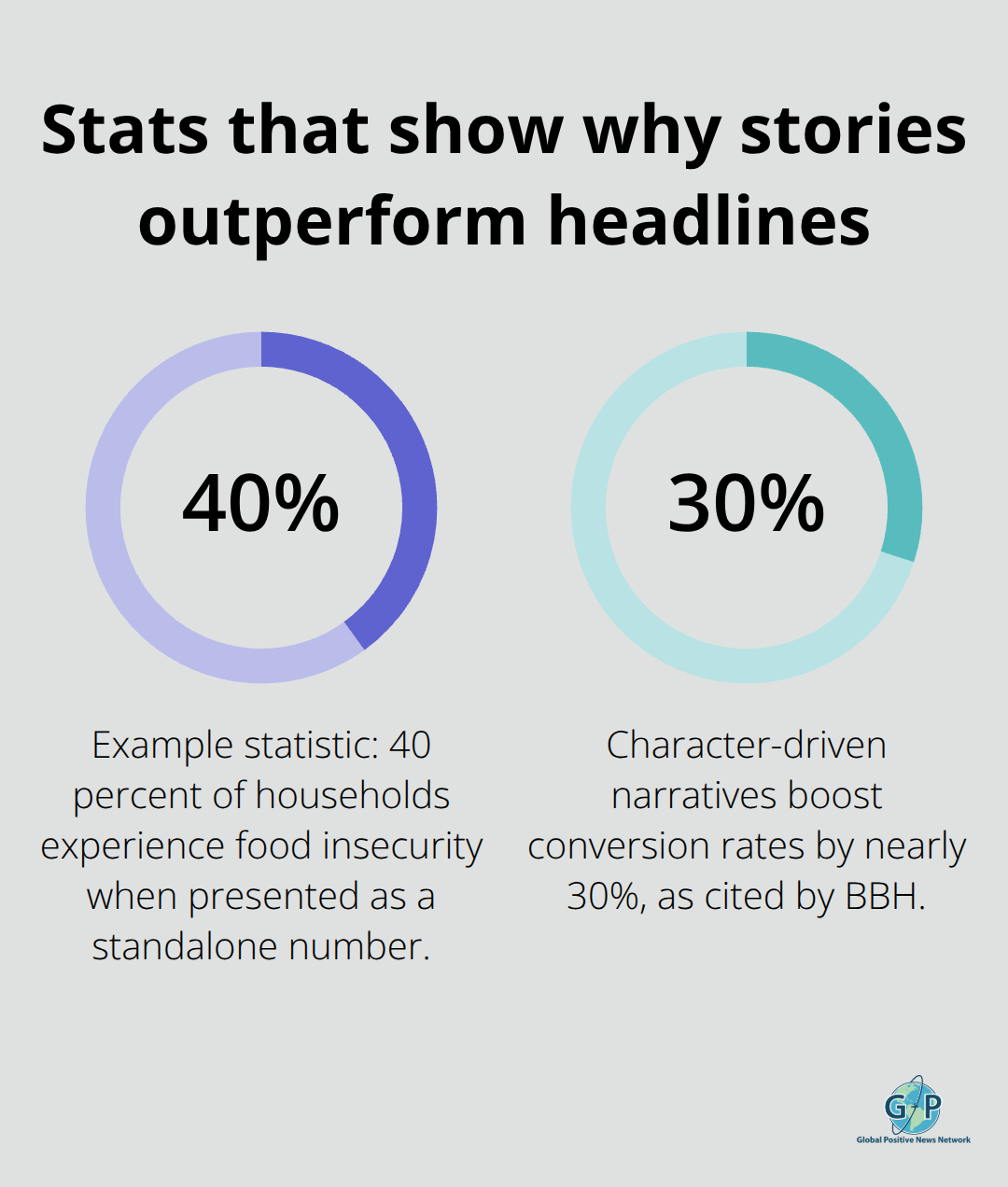
Companies using character-driven narratives boost conversion rates by nearly 30%, according to research cited by BBH. The mechanism is straightforward: people trust people, and stories make people real. A headline might inform you; a personal story convinces you to act. This power to move people toward action is precisely why the next section examines how stories amplify movements and create connections across communities that headlines alone never reach.
How Stories Transform Communities Into Movements
Stories Signal That Change Is Possible
Personal stories reshape how communities mobilize around shared challenges. When someone shares their actual experience overcoming an obstacle, it signals to others that change is possible. A single person’s account of recovery from addiction, financial hardship, or discrimination becomes a blueprint for others facing identical circumstances. The mechanism is direct: peer narratives reduce perceived risk and increase perceived feasibility.
Storytelling significantly increases employee engagement and resilience during periods of uncertainty, and this principle scales far beyond the workplace. Companies using character-driven narratives boost conversion rates by nearly 30%, because people trust the experiences of similar people far more than abstract promises. When a local food bank shares the story of a specific family it helped feed, donations increase. When a nonprofit highlights one person’s job placement success, enrollment in their training program accelerates. Stories create proof that change works, not just theoretically but in the lives of people your audience recognizes.
Multiple Voices Build Unstoppable Movements
What distinguishes movement-building stories from one-off inspiration is consistency and diversity of voices. Social movements amplify when multiple people tell complementary stories that together paint a complete picture of systemic change. The civil rights movement, environmental advocacy, and disability rights all gained momentum partly because individual testimonies accumulated into undeniable evidence of injustice and possibility.
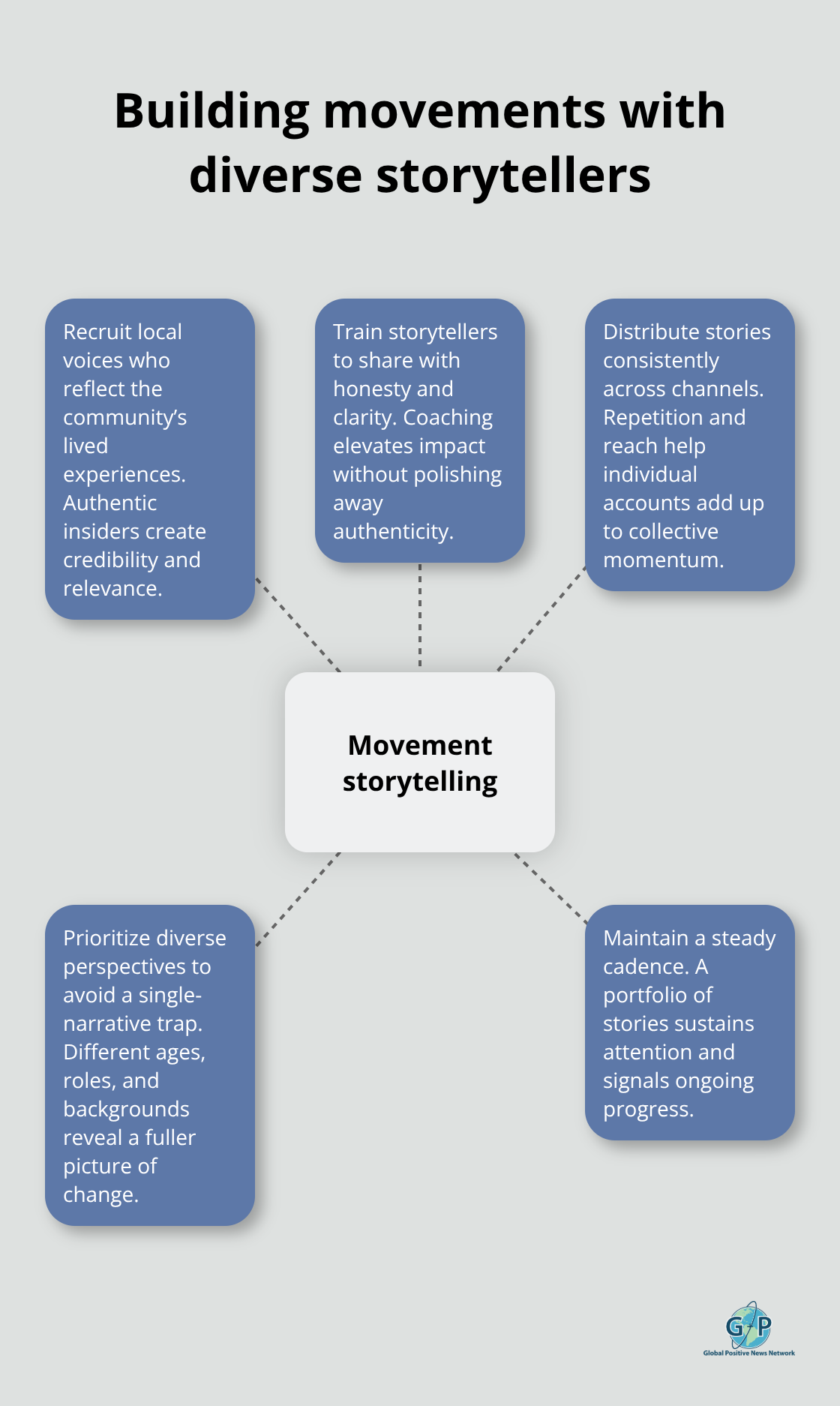
Uplifting stories become most powerful when they represent diverse perspectives and experiences rather than repeating a single narrative. The actionable implication is this: recruit storytellers from within your community, train them to share authentically, and distribute their stories across multiple channels consistently. Don’t rely on one spokesperson or one compelling account. Instead, build a portfolio where a teenager describes climate action they’re taking, a retired engineer explains how she mentors young women in STEM, and a small business owner shares how they built a sustainable supply chain.
Creating Movement Through Distributed Storytelling
Each story stands alone, yet together they create a movement narrative that feels inevitable and inclusive rather than imposed from above. Organizations serious about driving behavior change should prioritize real stories from real community members over polished messaging. This distributed approach transforms isolated experiences into collective evidence of what’s possible.
The next section examines how these movement narratives intersect with the media landscape itself-specifically, how personal stories expose the limitations of headline-driven news and why platforms that center human voices create fundamentally different outcomes than traditional news cycles.
Why Headlines Fail to Capture What Matters
The Negativity Bias That Shapes News Consumption
A McGill University study found that people consistently select negative headlines over neutral or positive ones, even when they later claim they prefer good news. Participants read disaster-focused stories at higher rates than constructive ones, and this pattern intensified among those most engaged with current affairs. The researchers identified a negativity bias: our brains treat bad news as a threat signal, making negative words like cancer, bomb, or war register faster than positive alternatives. Newspapers and television broadcasts dominate with disaster, corruption, and incompetence because these stories trigger faster neural responses and stronger engagement metrics. The result is a news ecosystem optimized for what captures attention, not what informs understanding.
How Headlines Strip Away Context and Nuance
When you scroll headlines, you consume not a representative sample of reality but what algorithms and editorial teams know will stop your thumb from swiping. Headlines inherently strip context, compress complexity into clickable fragments, and reward sensationalism over accuracy. A genuine crisis affecting thousands becomes reduced to a single alarming statement. A nuanced policy shift transforms into a binary outrage or celebration. Your brain processes these fragments so rapidly that you rarely pause to ask whether the headline reflects the full picture or just the most provocative angle.
The practical consequence is that headline consumption trains your perception toward worst-case scenarios and oversimplified interpretations. When a nonprofit shares only the statistic that 40 percent of households experience food insecurity, the number feels abstract and disconnects from urgency. When that same nonprofit shares the story of a specific parent who skipped meals to feed her children, then found stable employment through their program, your brain activates differently and you understand both the problem and the solution.
The Feedback Loop That Reinforces Crisis Coverage
The McGill researchers noted that audiences feel the media focuses too heavily on negative stories, yet that same audience continues clicking those headlines, creating a feedback loop that reinforces crisis-focused coverage. People want good news, but the systems they use train them toward bad news. This contradiction reveals a fundamental gap in how traditional news operates versus how platforms centered on human narratives function.
Breaking this cycle requires intentional consumption of deeper narratives where individual voices replace headline brevity. Stories that show how people actually navigate challenges and create change move beyond the sensational framing that dominates traditional news cycles. This approach takes longer to consume but delivers the context your brain needs to form accurate judgments and feel genuinely informed rather than merely alarmed.
Final Thoughts
Headlines fragment reality into digestible pieces, but they leave out what actually moves people to care and act. A statistic about homelessness tells you a problem exists; a person’s account of finding stable housing tells you change is possible. The difference between those two experiences shapes whether someone scrolls past or stops to understand. Positive storytelling provides the context that transforms abstract numbers into human meaning, which is precisely why personal narratives matter far more than the sensational headlines that dominate traditional news cycles.
Building a media landscape centered on human experiences requires platforms willing to prioritize depth over speed, authenticity over outrage, and individual voices over corporate messaging. When newsrooms and content platforms shift their focus from what captures attention in seconds to what creates understanding and hope, they fundamentally alter what audiences believe is possible. Stories of real people solving real problems become the dominant narrative instead of the exception buried beneath crisis coverage.
When you encounter stories that reflect human resilience and positive change, you access narratives that stick with your brain, reshape your understanding of what’s possible, and move you toward meaningful action. We at Global Positive News Network center our platform on these stories precisely because they inspire people to maintain an optimistic outlook and take action in their own lives.
Having a hard day?
The 2 Minute Hope Reset is a short free guide with three small practices for the days that feel heavy. Two minutes each, nothing to keep up with.
Get the free guideExplore more positive news:
Enjoying stories like this?
Global Positive News Network is reader-supported. If you’d like to support the mission, you can visit the Official GPNN store.