

Your mindset shapes your results. When you repeat positive statements about yourself, your brain starts to believe them-and your actions follow.
At Global Positive News Network, we’ve seen how daily affirmations for optimism transform careers, relationships, and health outcomes. This guide shows you exactly which phrases work, when to use them, and how to build a routine that actually sticks.
How Your Brain Actually Changes With Affirmations
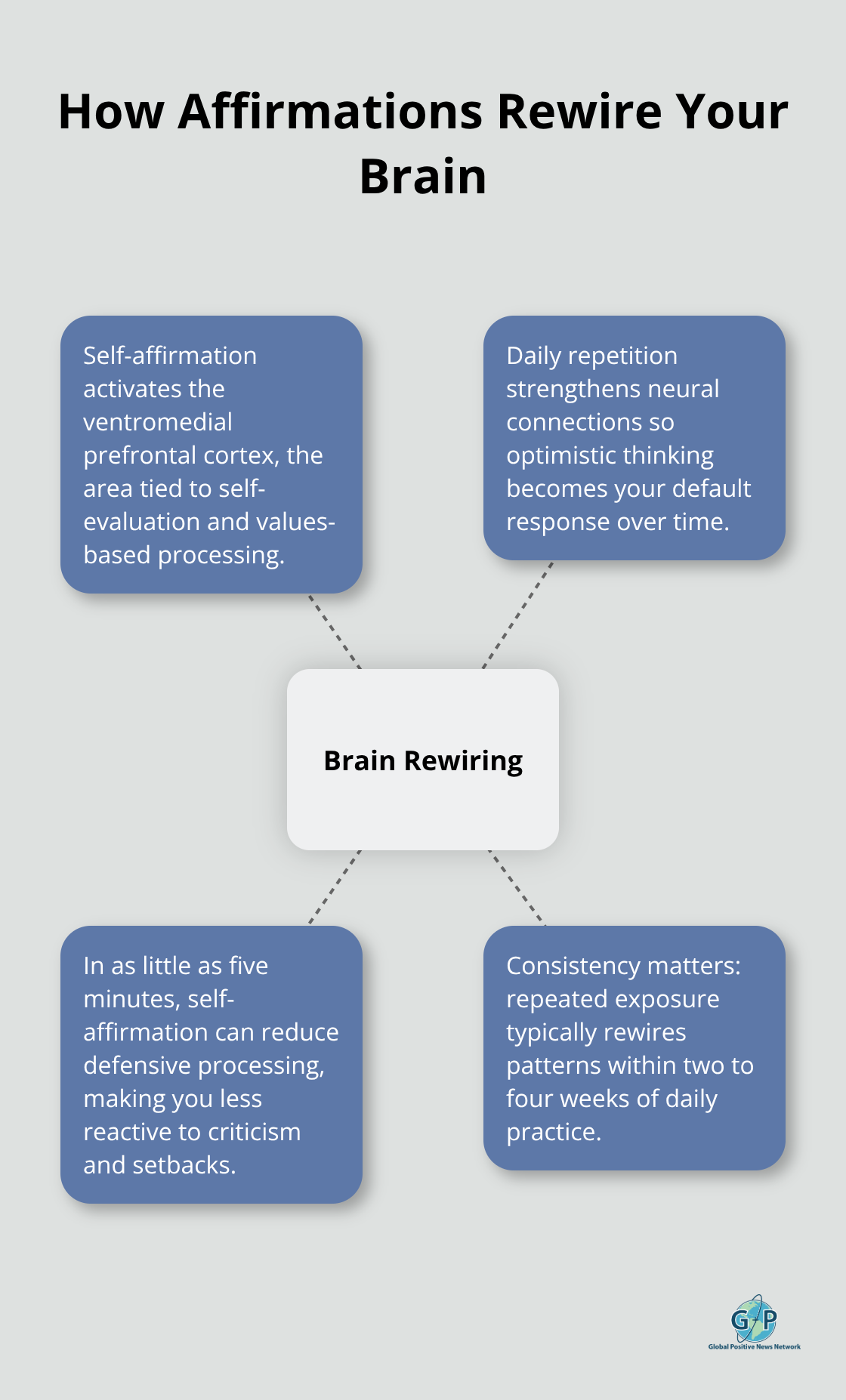
Positive self-talk works because repetition physically alters your brain’s structure. Research from Carnegie Mellon University found that self-affirmation activates the ventromedial prefrontal cortex, the region responsible for self-evaluation and processing information relevant to your values. When you repeat affirmations daily, you strengthen neural connections that make optimistic thinking your default response. This happens faster than most people expect. A 2016 study published in Social Cognitive and Affective Neuroscience showed that just five minutes of self-affirmation can reduce defensive processing in the brain, meaning you become less reactive to criticism and setbacks. The key is consistency. Your brain needs repeated exposure to these statements to rewire existing patterns, typically within two to four weeks of daily practice.
Affirmations Interrupt Your Stress Response
When stress hits, your brain defaults to familiar neural pathways. If those pathways are negative, you spiral into self-doubt and anxiety. Affirmations create new pathways that interrupt this automatic response. Instead of thinking I can’t handle this, your brain learns to activate I can handle whatever comes my way today. This shift isn’t magical-it’s neurological. Research shows that people who practice positive self-statements experience measurable reductions in cortisol, the stress hormone. They also show better problem-solving abilities under pressure because their prefrontal cortex remains engaged rather than being hijacked by fear responses.
Specific Phrases Build Real Confidence
Generic affirmations like Everything will be fine don’t work. Your brain detects inauthenticity and dismisses vague statements. Specific affirmations tied to actual challenges create stronger neural pathways. If you struggle with public speaking, I am confident and prepared for presentations activates different brain regions than I am confident alone. Pair your affirmations with micro-actions. Repeat I can accomplish what I set my mind to while completing one small task toward your goal. This combination-affirmation plus action-creates a feedback loop that builds genuine confidence. Research confirms that affirmations work best when they address your specific values and goals, not generic positive statements.
Moving From Theory to Your Daily Practice
The science is clear: your brain responds to what you tell it. Now the question becomes how to translate this knowledge into a routine that actually works for your life. The next section shows you exactly which affirmations address different areas of your life-career, relationships, and health-so you can stop guessing and start seeing real results.
Practical Affirmations for Different Life Areas
Career Growth Requires Specificity, Not Generic Confidence
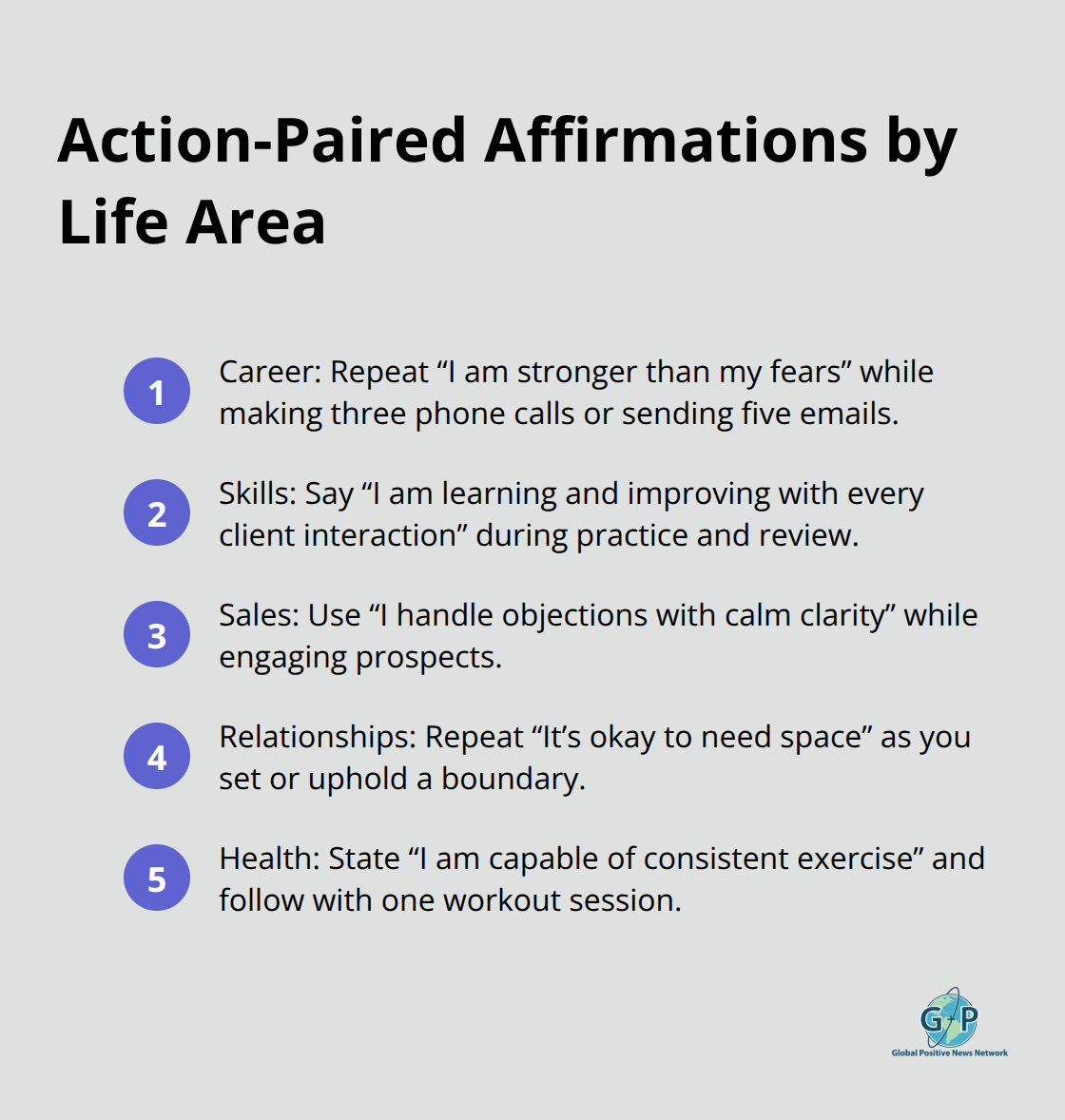
Career professionals who face rejection in sales need I am stronger than my fears paired with immediate action, not generic confidence statements. When you repeat this affirmation while making three phone calls or sending five emails, your brain connects the positive statement to tangible progress. This matters because vague affirmations like I am successful create cognitive dissonance if your reality contradicts them. Instead, use I am learning and improving with every client interaction if you’re building skills, or I handle objections with calm clarity if you’re in sales. The specificity forces your brain to accept the statement as plausible.
Relationships Thrive When Affirmations Address Real Patterns
For relationships, affirmations must address your actual patterns. If you struggle with setting boundaries, It’s okay to need space becomes your anchor phrase, not generic love statements. Research on relationship satisfaction shows that people who practice boundary-affirming statements experience less resentment and report higher relationship quality. Repeat this affirmation when you actually practice a boundary, like declining a request or taking alone time. The pairing of words and action embeds the belief.
Health Goals Shift When You Target Specific Behaviors
Health affirmations work the same way. I am capable of consistent exercise is more powerful than I am healthy because it targets the specific behavior you control. Pair this with one workout session immediately after the affirmation. A study from the American Psychological Association found that self-affirmations had positive effects on people’s general well-being, social well-being, and overall health outcomes.
The Pattern That Works Across All Three Areas
The key across all three areas is matching your affirmation to the exact behavior or belief you want to change, then proving it true through immediate action. Generic positivity doesn’t rewire your brain; targeted statements plus evidence do. This foundation prepares you to build a routine that actually sticks-one that fits your schedule and reinforces these affirmations through consistent daily practice.
Build Your Affirmation Practice Into Existing Routines
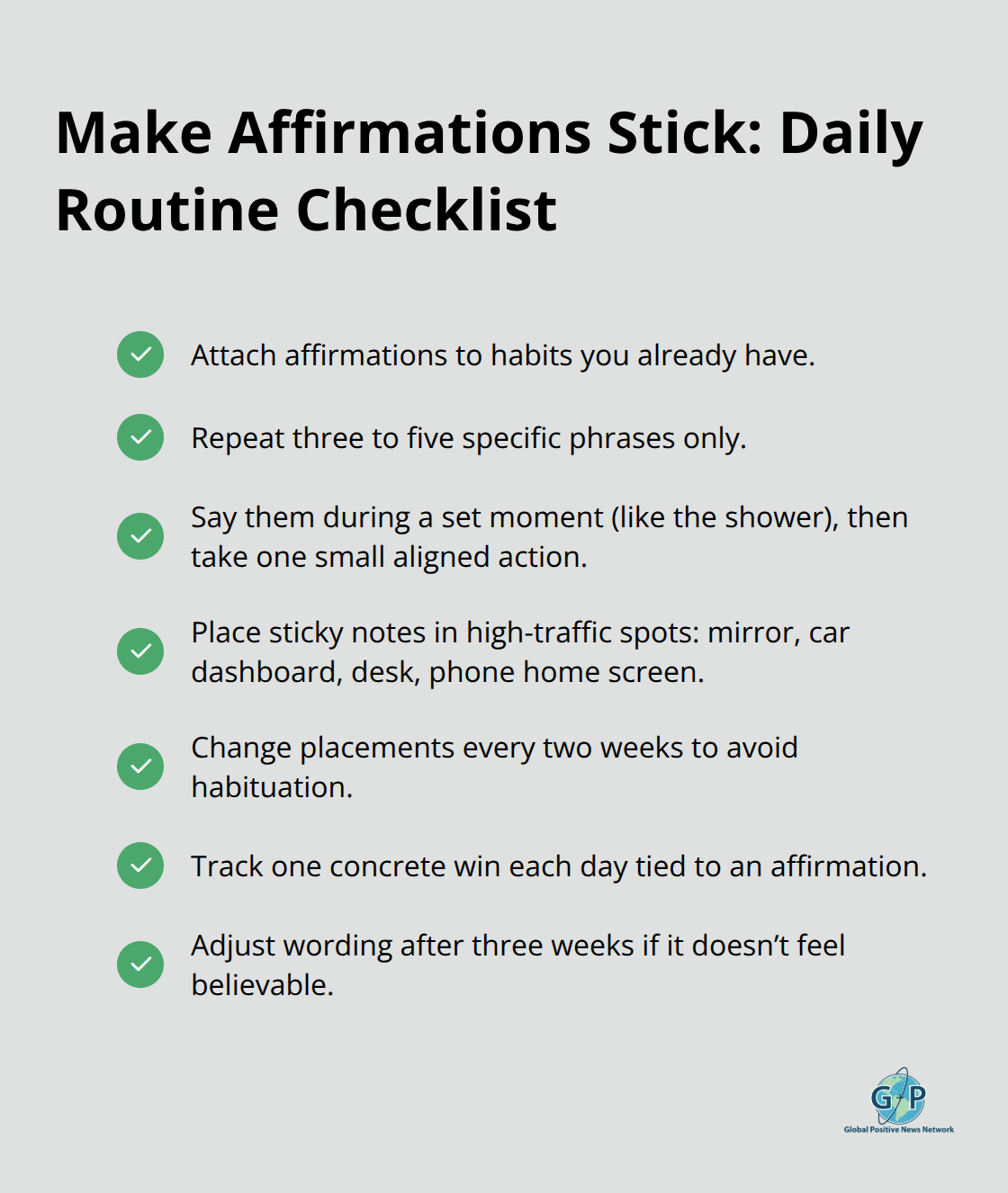
The biggest mistake people make is treating affirmations as a separate task. You don’t need a special time or a quiet room. Your affirmations work best when they attach to habits you already have. If you shower every morning, that’s your affirmation moment. Repeat three to five specific affirmations while you’re in the shower, then take one small action aligned with that affirmation before you leave the bathroom. Affirmations paired with immediate behavioral action produce measurable results, while affirmations alone show minimal impact.
Timing and Consistency Matter More Than Location
The timing matters less than the consistency. Morning works for most people because your brain is less defended and more open to rewiring, but evening affirmations before bed work equally well for reinforcing beliefs during sleep. The real requirement is daily repetition without gaps. Missing one day breaks the neural pathway reinforcement cycle, so anchor your affirmations to non-negotiable daily habits like brushing your teeth, drinking your first coffee, or sitting in your car before work starts.
Limit Your Phrases and Place Them Strategically
Your affirmation notebook or phone note should contain only three to five phrases maximum, not ten or twenty. Too many statements dilute the neurological impact and make consistency harder. Write each affirmation on a separate sticky note and place them in high-traffic spots: your bathroom mirror, your car dashboard, your desk, or your phone home screen. Change these placements every two weeks so your brain stops filtering them out as background noise.
Track Wins, Not Repetitions
Track your progress by noting one specific win each day that corresponds to your affirmation work, not by counting how many times you repeated the phrase. If your affirmation is I handle objections with calm clarity, write down one instance where you actually stayed calm during a difficult conversation. This creates the evidence your brain needs to accept the affirmation as true. Visible evidence of progress accelerates belief change more than repetition alone.
Adjust Your Phrases When They Don’t Feel Real
When your results don’t match your affirmation after three weeks, adjust the phrase to something more believable. I am becoming stronger than my fears works better than I am stronger than my fears if you’re still struggling with anxiety. The affirmation must feel plausible to your brain, or it creates resistance instead of rewiring.
Final Thoughts
Your affirmation practice works because you rewire your brain through consistent, targeted repetition paired with real action. Neural pathways strengthen when you repeat specific statements daily and prove them true through immediate behavioral steps. After two to four weeks of this practice, your brain defaults to optimism instead of self-doubt, and this shift happens through neurology, not motivation or willpower.
The pattern across career, relationships, and health remains the same: match your affirmation to the exact behavior you want to change, anchor it to an existing daily habit, limit yourself to three to five phrases, and track your wins instead of counting repetitions. When your results don’t match your affirmation after three weeks, adjust the phrase to something more believable, since your brain rejects inauthenticity and plausibility matters more than positivity. Starting today means choosing one area of your life that needs change, writing down one specific affirmation tied to that area, and attaching it to a non-negotiable daily habit (place sticky notes in high-traffic spots and write down one win each day that proves your affirmation true).
People who maintain daily affirmations for optimism report measurable reductions in stress, stronger relationships, better problem-solving under pressure, and genuine confidence in their abilities. We at Global Positive News Network believe that small, consistent practices create lasting change. Your affirmation routine is one of those practices, and your inner dialogue shapes your daily performance as much as your environment does.
Having a hard day?
The 2 Minute Hope Reset is a short free guide with three small practices for the days that feel heavy. Two minutes each, nothing to keep up with.
Get the free guideExplore more positive news:
Enjoying stories like this?
Global Positive News Network is reader-supported. If you’d like to support the mission, you can visit the Official GPNN store.