
Green technology is moving from laboratory experiments into real-world solutions that cut emissions, create jobs, and save money. We at Global Positive News Network have gathered green technology hope stories that show how innovation is reshaping industries and communities.
These breakthroughs prove sustainable change isn’t a distant goal-it’s happening now.
Real-World Green Technology Breakthroughs
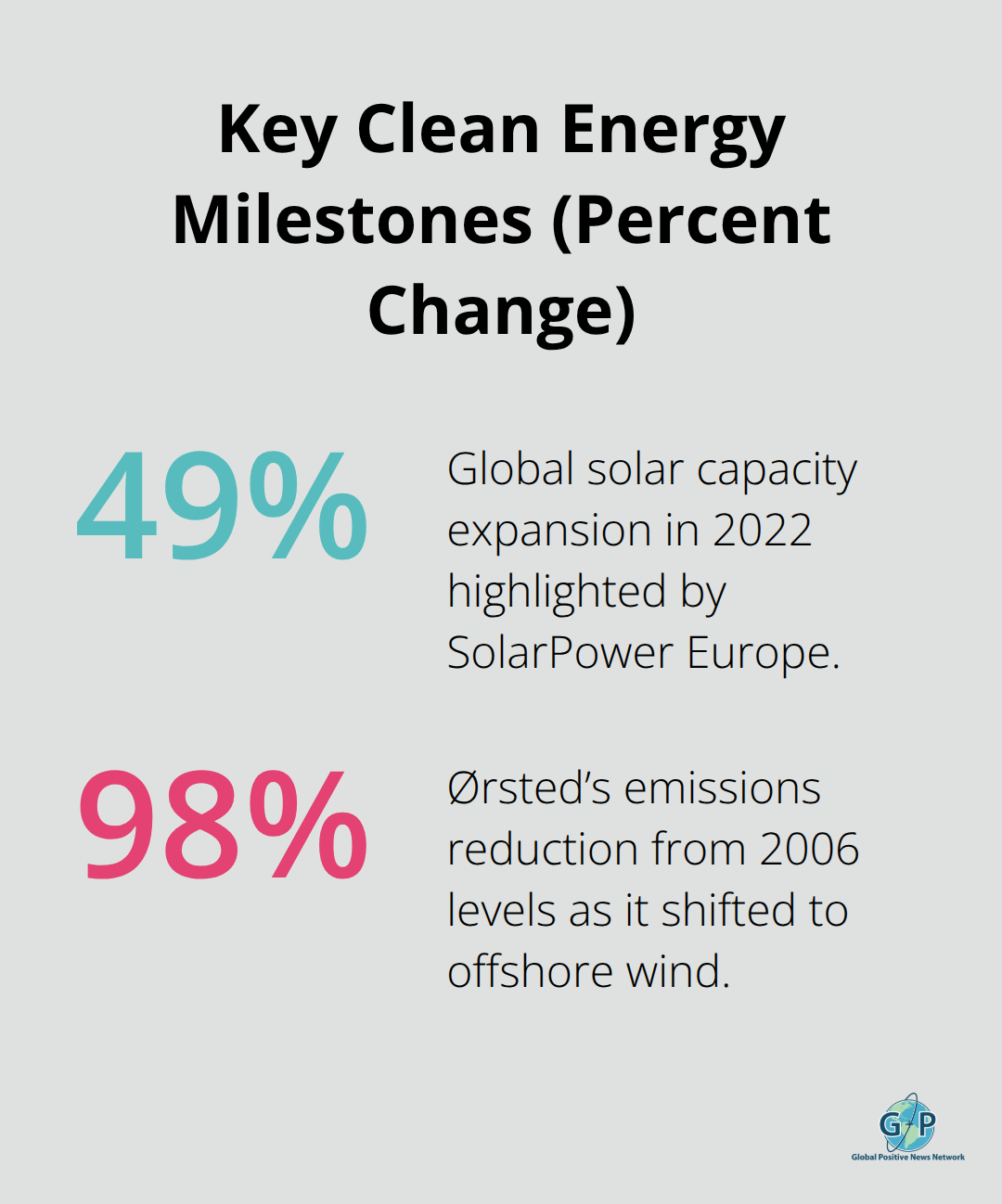
Solar capacity expanded 49% globally in 2022 and will reach 159 GW by year-end, according to SolarPower Europe. This growth matters because solar now outpaces all other renewable technologies, accounting for more new capacity than wind, hydro, or any fossil fuel alternative. The cost advantage is real: offshore wind hit cost parity with new fossil power in 2016, and solar continues dropping in price annually. Fervo Energy leads the geothermal space after securing $462 million in Series E funding with backing from Google, signaling that investors see clean energy as the dominant market opportunity. Google itself signed a 150 MW geothermal deal with Ormat, demonstrating that major corporations no longer treat renewable energy as optional but as essential infrastructure.
These aren’t theoretical projections-companies are committing billions because clean energy now delivers better returns than fossil fuel alternatives.
Solar Shifts From Subsidies to Profit
Sunrun, ranked among America’s top green tech companies by TIME and Statista in 2026, tests vehicle-to-grid technology with Ford and Tesla, allowing EV batteries to discharge stored energy back to the grid during peak demand. The company’s solar-as-a-subscription model removes upfront installation costs for homeowners, making solar accessible without $15,000–$25,000 down payments. Revenue from selling solar energy back to the grid sustains growth despite policy changes affecting solar credits. Rooftop solar capacity now powers communities directly, reducing transmission losses and grid stress while giving homeowners monthly savings on electricity bills. Solar works when it’s affordable and generates ongoing income, not just when subsidies exist.
Battery Technology Enables Transportation Transformation
Advanced battery systems power electric vehicles and grid storage simultaneously. Sunrun’s battery storage facility in Arizona illustrates how large-scale storage solves intermittency challenges that plagued earlier renewable projects. EV adoption accelerates when charging networks expand and battery costs fall below $100 per kilowatt-hour-a threshold crossed in multiple markets. Ørsted’s transformation from coal power to offshore wind reducing emissions 98% from 2006 levels shows that companies can pivot entirely to clean energy. The company’s 11 GW portfolio in development and operation across the U.S. demonstrates scale-based cost reductions that make renewables cheaper than maintaining aging fossil infrastructure.
Carbon Capture Moves Toward Commercial Viability
Carbon capture technology remains expensive, yet First Movers Coalition members committed $12 billion in purchase agreements to scale green solutions including decarbonizing cement and concrete. This demand-side commitment forces innovation and cost reduction. GreenTech Solutions’ bio-concrete, made from industrial byproducts and bacteria, absorbs CO2 during curing and reduces construction carbon footprints measurably. A city park project using bio-concrete demonstrated real-world climate benefits, proving that carbon-negative materials work outside laboratories. The strategy mirrors solar’s path: create demand through corporate commitments, scale production, reduce costs, then achieve market dominance.
Companies Turn Innovation Into Market Leadership
These breakthroughs share a common pattern. Investors back technologies that solve real problems at competitive prices. Corporations sign long-term contracts for clean energy, forcing suppliers to innovate faster and cheaper.
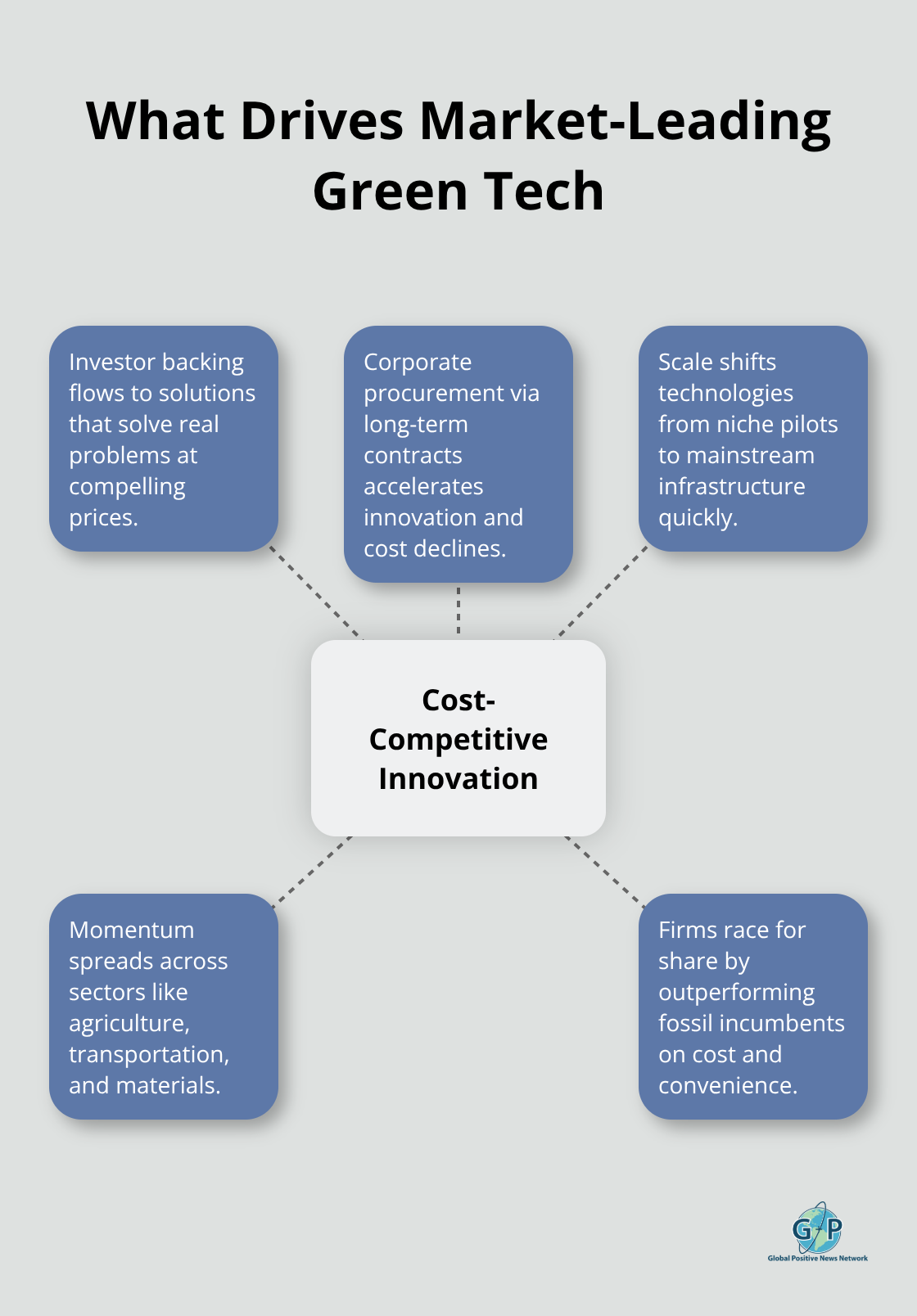
Startups and established firms alike race to capture market share in sectors where fossil fuels once dominated. The result: renewable energy, battery storage, and carbon solutions move from niche experiments into mainstream infrastructure. This momentum extends beyond energy into agriculture, transportation, and materials science, where the next wave of green technology companies is already reshaping how industries operate and compete.
Companies Leading the Sustainable Innovation Movement
Renewable Energy Giants Reshape Power Markets
Ørsted transformed from a coal-dependent utility into the world’s largest offshore wind operator, reducing emissions 98% from 2006 levels while building an 11 GW portfolio across the United States. The company cut offshore wind costs per megawatt between 2013 and 2016, hitting EUR 100/MWh and proving that renewables beat fossil fuel economics on price alone. This wasn’t theoretical repositioning-it was ruthless market competition. Fervo Energy, backed by Google’s $462 million Series E investment, now leads geothermal expansion because large corporations finally recognize clean energy as infrastructure rather than charity. Google itself acquired Intersect Power for $4.75 billion and signed a 150 MW geothermal deal with Ormat, signaling that major tech companies treat renewable procurement as competitive advantage. Sunrun operates the largest residential solar platform in America by combining rooftop installation with vehicle-to-grid technology partnerships with Ford and Tesla, enabling homeowners to discharge EV batteries back to the grid during peak demand and earn income. These companies succeeded because they solved the real problem: making clean energy cheaper and more convenient than fossil alternatives.
Circular Economy Businesses Eliminate Waste at Scale
Circular economy innovators attack waste differently than traditional recyclers. LoopTech’s reusable packaging system replaced single-use bottles for beverage companies, cutting plastic production measurably while shifting consumer behavior toward refillable containers. Pivot Bio ranked second on TIME and Statista’s 2026 list of America’s top green tech companies by using CRISPR-edited microbes to fix nitrogen in soil, reducing synthetic fertilizer dependency. Farmers using Pivot’s solution have reduced nitrogen fertilizer use through microbial solutions, lowering costs and improving soil health simultaneously. FarmConnect connects smallholder farmers directly to buyers through mobile platforms, eliminating post-harvest losses and guaranteeing fair prices that increase farmer income while securing food supply chains. The 1t.org initiative mobilized over 90 global companies to plant, conserve, and restore more than 8 billion trees across 65 countries, targeting 1 trillion trees by 2030.
What Separates Leaders From Startups
Scale separates these companies from experimental ventures. They operate in markets where millions of people benefit immediately, not hypothetical customers. Investors back companies solving problems that generate measurable returns, and sustainable businesses now deliver exactly that. Fervo’s geothermal breakthrough, Pivot’s microbial nitrogen solution, and Sunrun’s solar subscriptions all share one trait: they work because they’re cheaper and more reliable than the alternatives they replace. Corporate procurement commitments from Google, Ford, and Tesla force suppliers to innovate faster and reduce costs continuously. This competitive pressure mirrors how solar dropped from $378 per megawatt-hour in 2010 to under $50 today. The next wave of green technology companies will emerge from sectors where fossil fuels still dominate but where cost parity approaches-agriculture, aviation, shipping, and heavy manufacturing all face similar pressure to transition. Companies that crack affordability in these sectors will reshape global emissions faster than any policy mandate.
How Green Technology Benefits Communities and Economies
Green technology generates measurable income for workers, improves public health outcomes, and cuts household expenses immediately. The clean energy sector employed 13.7 million people globally in 2022, and this workforce continues expanding faster than fossil fuel jobs disappear. Solar installation, wind turbine maintenance, battery manufacturing, and grid modernization create permanent positions that require technical training but pay competitive wages without requiring a college degree.
Affordable Clean Energy Reaches Households Directly
Sunrun’s solar-as-a-subscription model demonstrates how green technology reaches people with limited capital. Homeowners avoid $15,000–$25,000 upfront installation costs and instead pay monthly subscription fees while receiving immediate electricity savings, often reducing bills by 10–30% depending on location and system size. This model works because it generates recurring revenue for companies while putting money directly into household budgets. Fervo Energy’s $462 million Series E funding and Google’s $4.75 billion acquisition of Intersect Power signal that investors expect clean energy infrastructure to produce returns comparable to or exceeding fossil fuel investments.
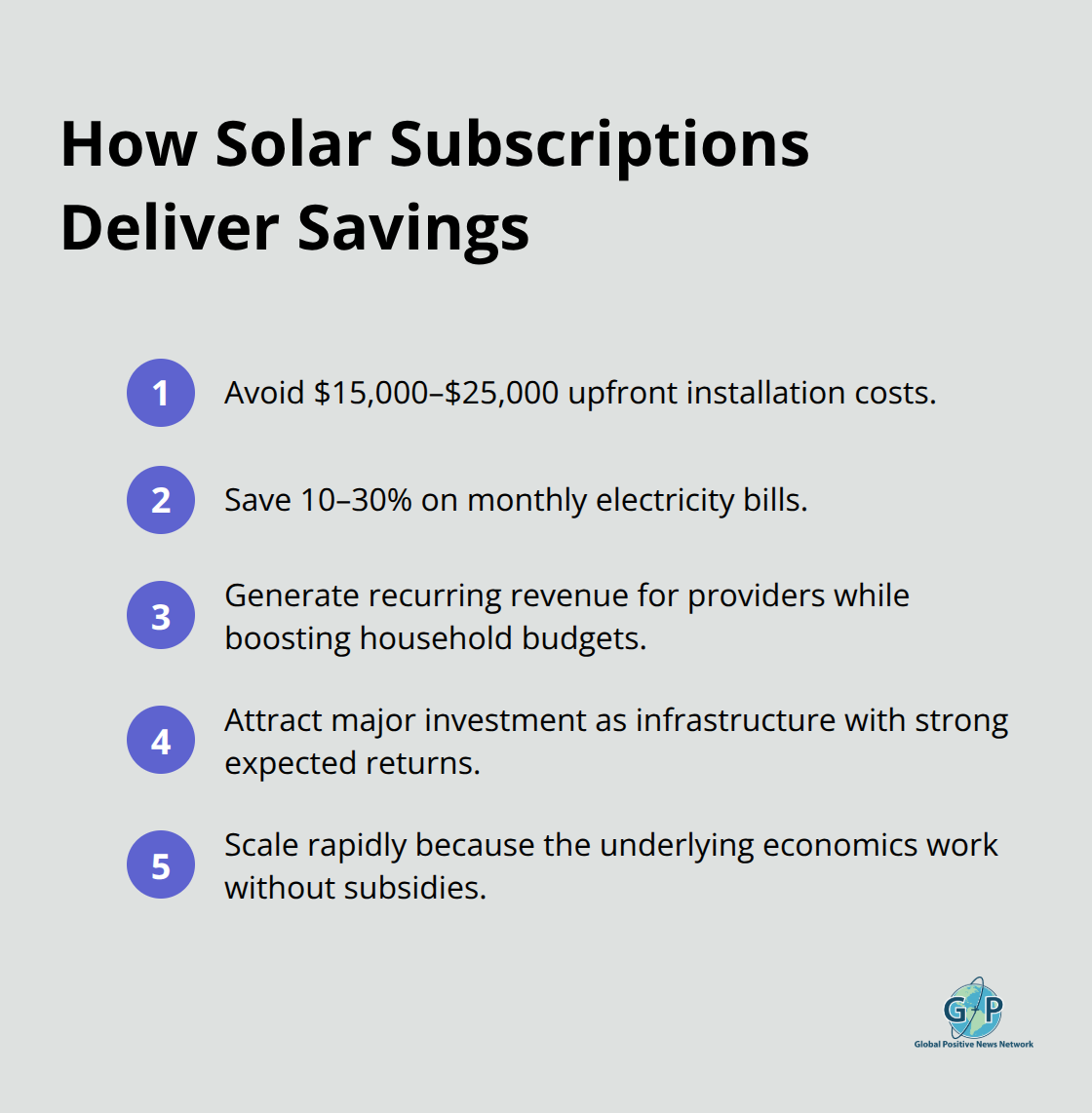
These aren’t subsidized experiments-they’re profitable businesses scaling rapidly because the economics work.
Pollution Reduction Delivers Health Benefits Now
Reduced air pollution from renewable energy expansion produces immediate health gains, not distant theoretical benefits. London’s Ultra-Low Emission Zone covers every borough of London and brings cleaner air to the capital’s nine million residents, with older polluting vehicles facing a £12.50 daily charge. Studies consistently show that air quality improvements reduce respiratory disease, cardiovascular problems, and premature deaths within months of implementation. Rural communities adopting solar energy like those using SolarShift portable panels eliminate indoor air pollution from kerosene lamps and diesel generators, reducing respiratory infections and enabling children to study after dark without inhaling toxic fumes.
Energy Transition Cuts Pollution Across Europe
In May, wind and solar together produced more energy in the European Union than all fossil fuels combined, directly lowering the particulate matter and nitrogen oxides that cause asthma, bronchitis, and heart disease. The Food Action Alliance upskilled 2.2 million farmers in Vietnam and aims to train 20 million more using sustainable practices that reduce chemical fertilizer runoff contaminating water supplies and poisoning aquatic ecosystems. Energy efficiency improvements in buildings cut heating and cooling costs by 20–40% while reducing the coal and natural gas combustion that pollutes indoor and outdoor air simultaneously.
Communities Experience Benefits Immediately
Communities don’t wait years to experience these gains-cleaner air, lower energy bills, and better health outcomes arrive as soon as renewable infrastructure operates. Workers transition into permanent positions with competitive wages, households reduce monthly expenses through solar subscriptions and efficiency upgrades, and children breathe air free from toxic fumes. The economic case for green technology strengthens as costs fall and corporate procurement accelerates innovation across sectors.
Final Thoughts
Green technology hope stories prove that sustainable innovation works economically today, not in distant futures. Solar capacity expanded 49% in 2022, offshore wind costs dropped 35–40% between 2013 and 2016, and companies like Fervo Energy, Sunrun, and Ørsted scale solutions that cut electricity bills, clean the air, and attract billions in investment simultaneously. Corporations commit to clean energy procurement because it strengthens competitive advantage-Google’s $4.75 billion acquisition of Intersect Power and its 150 MW geothermal deal with Ormat signal that major companies treat renewable infrastructure as essential, forcing suppliers to innovate faster and reduce costs continuously.
Communities experience measurable benefits immediately rather than waiting for hypothetical timelines. Households using Sunrun’s solar subscriptions cut electricity bills by 10–30% without upfront costs, London’s Ultra-Low Emission Zone brings cleaner air to millions of residents within months, and farmers using Pivot Bio’s microbial nitrogen solution reduce fertilizer costs while improving soil health. These improvements happen right now in household budgets, air quality, and agricultural productivity across real communities worldwide.
Support green technology by installing rooftop solar where feasible, participating in vehicle-to-grid programs with EV charging networks, and backing businesses prioritizing circular economy practices. We at Global Positive News Network share stories of sustainable innovation and community impact-explore our platform to discover how individuals and organizations drive meaningful environmental change through green technology hope stories.

Having a hard day?
The 2 Minute Hope Reset is a short free guide with three small practices for the days that feel heavy. Two minutes each, nothing to keep up with.
Get the free guideExplore more positive news:
Enjoying stories like this?
Global Positive News Network is reader-supported. If you’d like to support the mission, you can visit the Official GPNN store.