
Life’s hardest seasons test us in ways we don’t expect. At Global Positive News Network, we believe that building mental strength daily isn’t about becoming invincible-it’s about learning concrete skills that help you navigate setbacks with clarity and purpose.
This blog post walks you through practical strategies real people have used to rebuild after loss, adapt to change, and find strength in community. You’ll learn exactly what resilience means and how to develop it starting today.
What Resilience Actually Is
The American Psychological Association defines resilience as the process and outcome of successfully adapting to challenging life experiences. This definition matters because it separates resilience from avoidance or denial. Resilience isn’t about pretending hardship doesn’t hurt-it’s about developing specific, learnable skills that help you move forward after setbacks.
Most people confuse resilience with toughness, but they’re fundamentally different. Toughness suggests you should power through without feeling pain. Resilience acknowledges the pain exists and teaches you how to function effectively despite it. When you build resilience, you don’t become emotionally numb. You build the capacity to adapt, problem-solve, and find meaning in difficult situations.
The Real Impact on Your Problem-Solving
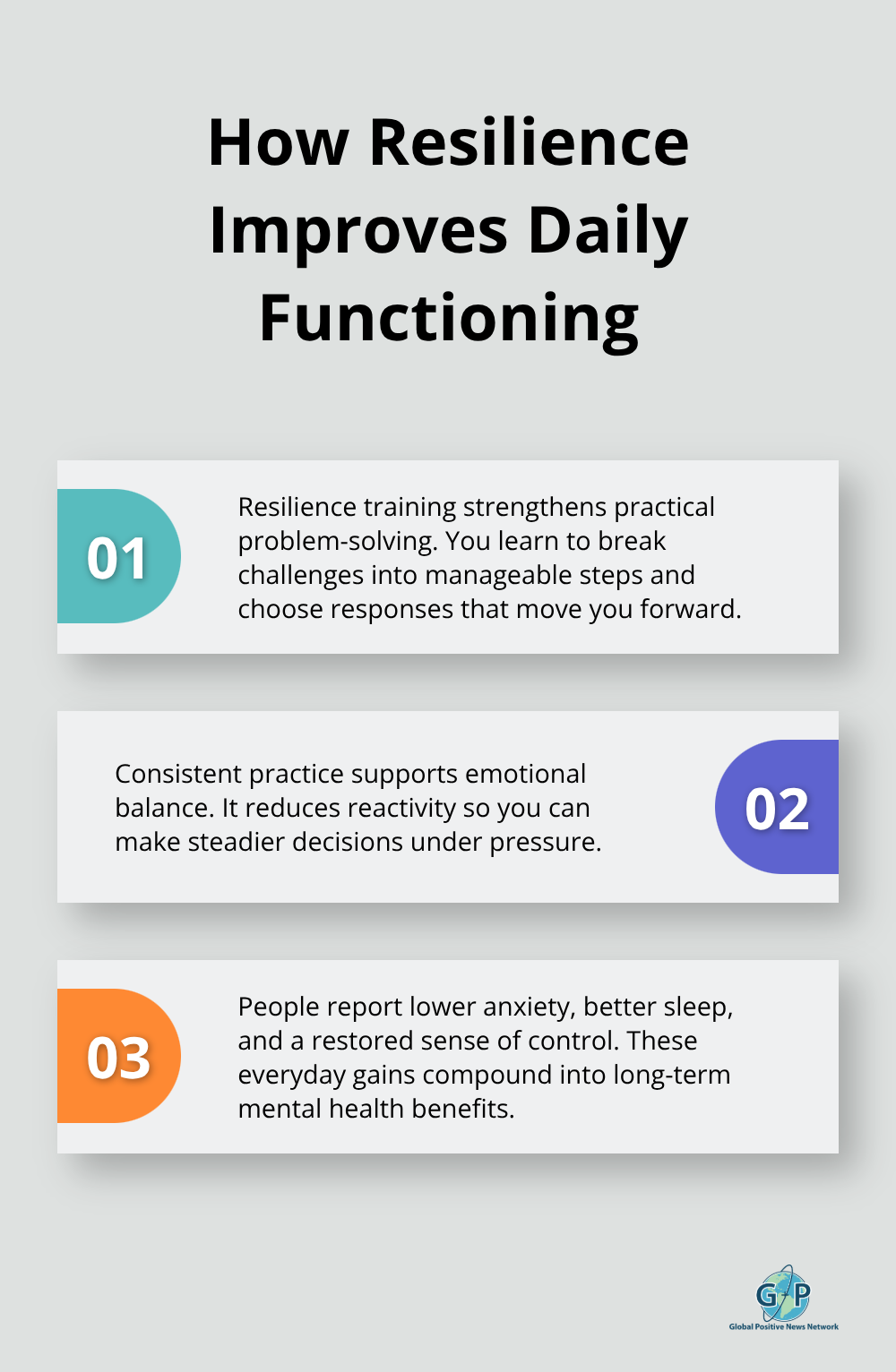
Research shows that people who practice resilience techniques develop stronger problem-solving skills that help them navigate tough situations more effectively. They also experience more balanced emotional well-being and steadier mental health over time. This isn’t theoretical-real people who have faced major adversity report that developing resilience directly reduced their anxiety, improved their sleep quality, and gave them a sense of agency when everything felt out of control.
How Resilience Protects Your Mental Health
Your mental health depends on your ability to cope with stress and adapt to change. When you lack resilience skills, stress accumulates and manifests as depression, anxiety, or burnout. Studies consistently show that people who practice resilience-building activities (maintaining routines during adversity, using gratitude practices, and seeking social support) report significantly better mental health outcomes.
The American Psychological Association emphasizes that reframing challenges as opportunities rather than purely negative events is a core resilience technique. This mental shift moves your mindset from learned helplessness to active problem-solving. Instead of asking why something is happening to you, resilience training teaches you to identify lessons, growth opportunities, and actionable next steps.
The Neuroscience Behind Mental Reframing
This mental shift alone changes your neurological response to stress. Your brain stops fixating on what you cannot control and focuses on what you can influence. People who develop this skill report feeling less overwhelmed and more capable of handling future difficulties. The shift from “why me?” to “what can I do?” isn’t just motivational-it’s a measurable change in how your brain processes adversity.
Building Your Foundation for What Comes Next
Understanding what resilience actually is forms the foundation for the practical skills you’ll develop. The next section shows you exactly how to construct a support network, adapt to change, and create routines that anchor you during life’s most difficult moments.
Building the Three Pillars of Resilience
Construct a Support Network That Sustains You
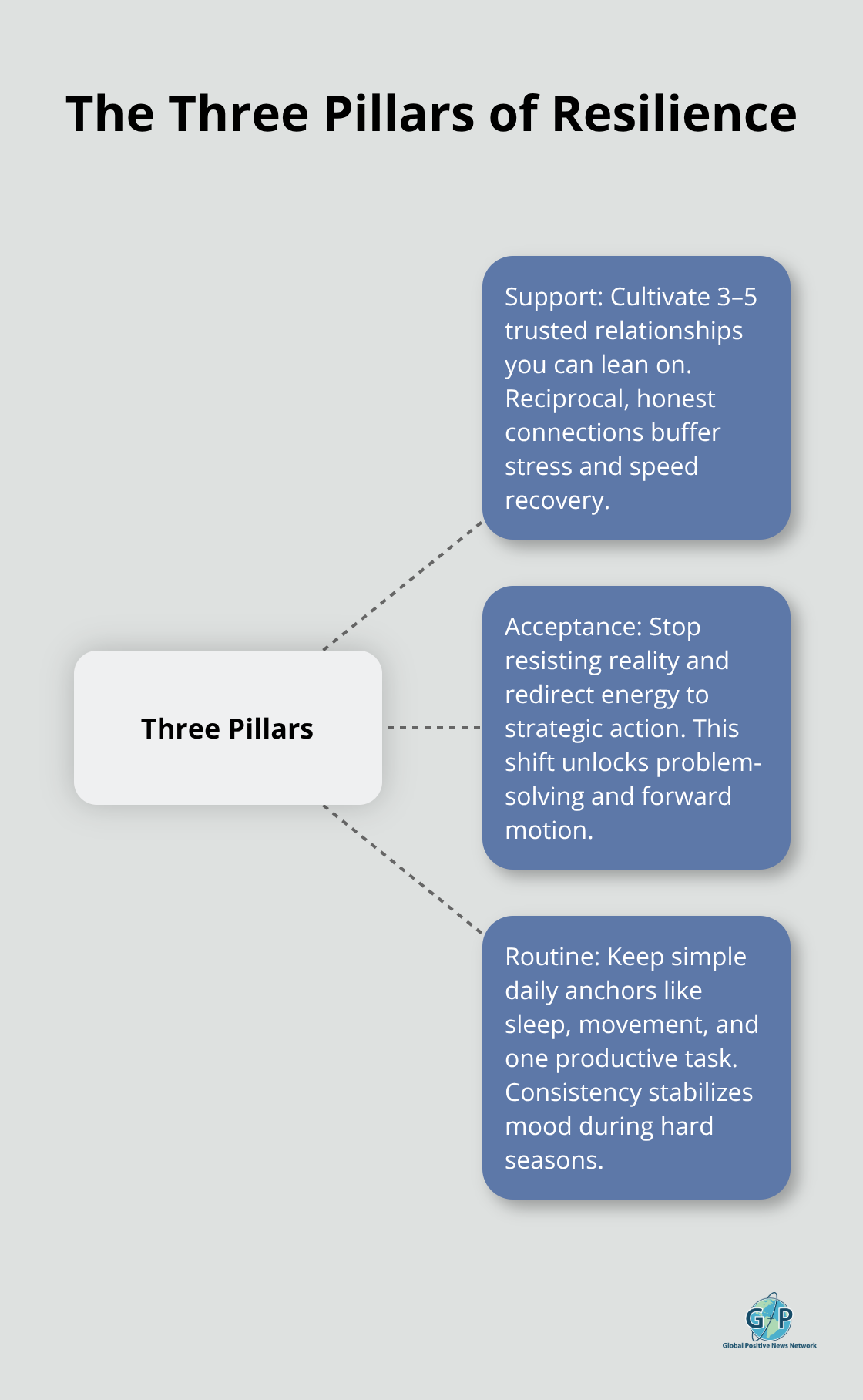
Your support network isn’t optional when facing life’s hardest seasons. Research consistently shows that people who actively maintain close relationships recover faster from adversity and report lower rates of depression and anxiety. You don’t need dozens of friends-you need three to five people you can be honest with about what you’re experiencing. These relationships work best when they’re reciprocal.
Angie Mozilo, whose story appears in Option B, emphasizes that real recovery requires letting people in and accepting help without shame. Start this week and reach out to one person you trust. Have a genuine conversation about what you’re facing. Don’t wait for a crisis to build these connections. People who establish their support network during stable times find it infinitely easier to lean on others when difficulty arrives.
Shift From Resistance to Strategic Response
Acceptance isn’t passive resignation-it’s the mental shift that allows you to stop fighting reality and start responding to it strategically. The American Psychological Association notes that shifting from “why is this happening to me?” toward identifying lessons and actionable next steps transforms how your brain processes adversity. Sana Mustafa, a refugee who rebuilt her life through education and advocacy, demonstrates this principle. She didn’t accept her displacement as final; she accepted it as her current circumstance and systematically moved forward through scholarship opportunities and continued learning.
When you practice acceptance, you free up mental energy that was spent on resistance. That energy becomes available for problem-solving and forward movement.
Anchor Yourself With Daily Routines
Create a simple daily routine during difficult times-even something as basic as a morning walk, consistent sleep schedule, and one productive task. Studies show that maintaining routine during adversity reduces anxiety and depression. This routine becomes your anchor when emotions feel overwhelming.
The three pillars-support, acceptance, and routine-form the foundation that allows you to weather life’s most difficult seasons. Real people have used these exact strategies to move through loss, displacement, and hardship. The next section shows you how individuals transformed these principles into lasting change and what their journeys reveal about building resilience that actually works.
How Real People Transformed Adversity Into Forward Motion
Education as a Resilience Lever
Sana Mustafa fled her home country as a refugee with nothing but determination to rebuild. She did not wait for circumstances to improve on their own. Instead, she pursued education aggressively, earning a full scholarship to Bard College through the MasterCard Foundation, which opened pathways to advocacy work that now shapes policy conversations around refugee rights. Her trajectory shows a concrete pattern: she accepted her displacement as her starting point, then systematically moved through education, skill-building, and leadership roles. The lesson here is tactical, not inspirational. Sana identified education as her resilience lever and pursued it with specificity. When facing economic hardship or major life setbacks, the people who move forward fastest do not wait for perfect conditions. They identify one concrete skill or opportunity and commit to it.
Sustained Action Over Time
Angie Mozilo’s story demonstrates this same principle after experiencing life-altering trauma. She shifted from asking why her crisis happened to mapping what she could actually control. She established firm boundaries with relationships that kept her stuck, negotiated financial obligations during her transition, and continued taking small forward steps even when progress felt glacially slow. Real resilience is not about dramatic transformation-it is about sustained action over years. Bobbi Huffman transformed her grief after suicide loss into purposeful action (she trained for and completed the Overnight Walk for Suicide Prevention). This was not passive healing. It was structured, measurable progress that gave her brain something concrete to work toward while processing trauma through therapy. The combination of professional support and purposeful activity accelerated her recovery in ways that either strategy alone could not achieve.
Community and Mentorship as Accelerators
Community and mentorship accelerate resilience dramatically. Akili Dada’s scholarship and leadership training program in Kenya demonstrates this: young women who received both financial support and mentorship developed not just personal resilience but became agents of change lifting others. Gloria Marina Icu Puluc received midwifery training and women’s rights education through ACOTCHI and the Global Fund for Women, transforming herself from vulnerable to powerful within her rural community. Joel Williams rebuilt his life after incarceration through legal advocacy and reentry support from Root & Rebound, preventing new charges from derailing his progress and reinforcing resilience through stable, lawful reintegration.
The Pattern That Works
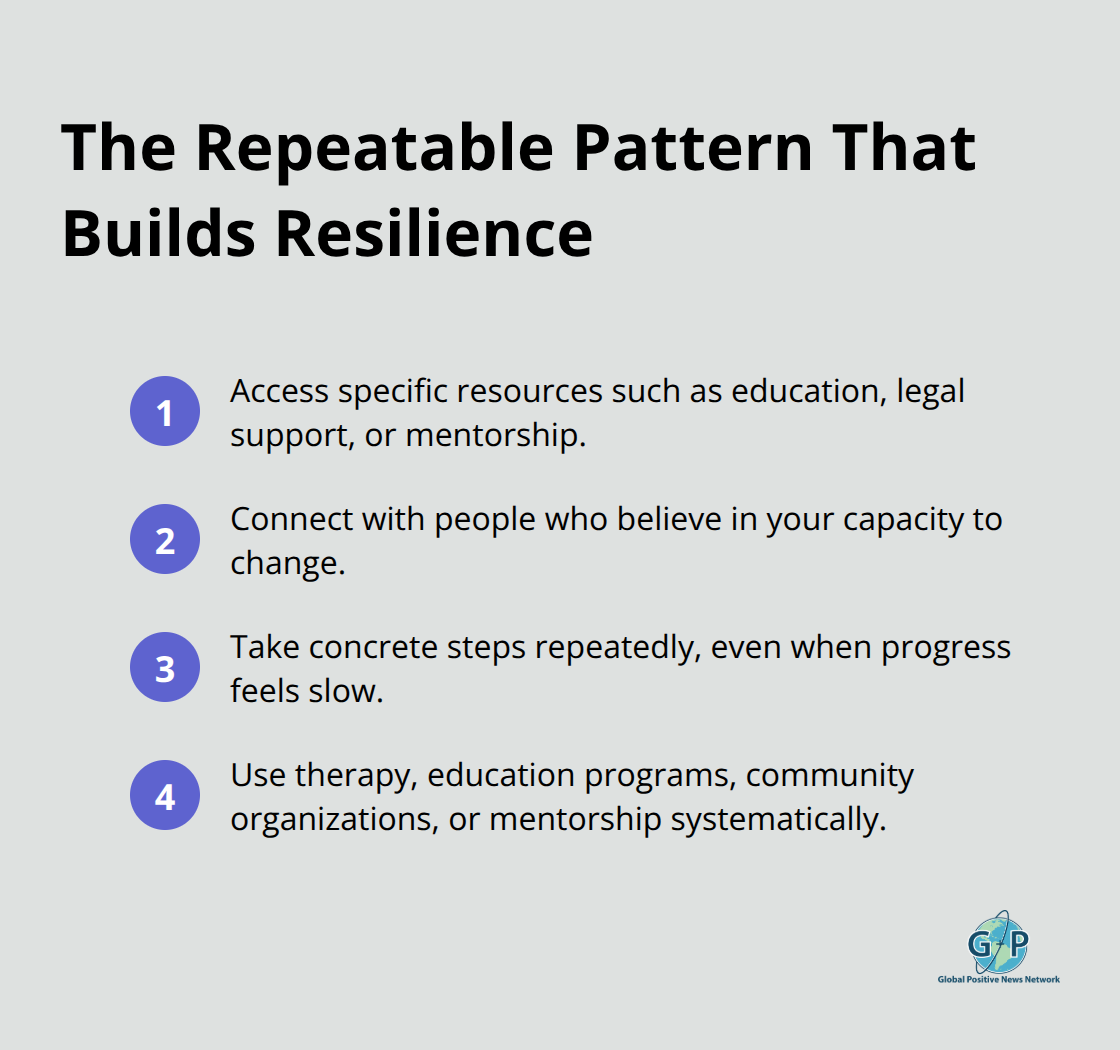
These are not abstract success stories. Each person followed a pattern: they accessed specific resources (education, legal support, mentorship), they connected with people who believed in their capacity to change, and they took concrete steps repeatedly. The people who build lasting resilience do not do it alone, and they do not rely on willpower alone. They identify concrete resources available to them-whether that is therapy, education programs, community organizations, or mentorship-and they use those resources systematically.
Your resilience will not develop from inspiration. It develops from identifying one specific action this week, taking it, and repeating that pattern across months and years.
Final Thoughts
Resilience develops through repeated, small actions over weeks and months, not through a single moment of transformation. Start this week with one concrete step: reach out to someone in your support network, establish a morning routine, or reframe one difficult situation by identifying what you can actually control. These actions compound into measurable changes in how you handle adversity, and mental strength daily becomes your foundation for facing whatever comes next.
The people whose stories appear throughout this post did not wait for inspiration or perfect conditions. They identified concrete resources available to them, connected with people who supported their growth, and took action repeatedly. You have access to the same strategies they used-therapy, education programs, community organizations, mentorship-and you can start using them this week. At Global Positive News Network, we share stories of people who rebuilt after setbacks, adapted to change, and found strength in community.
Your resilience begins now, with one decision and one action this week.
Having a hard day?
The 2 Minute Hope Reset is a short free guide with three small practices for the days that feel heavy. Two minutes each, nothing to keep up with.
Get the free guideExplore more positive news:
Enjoying stories like this?
Global Positive News Network is reader-supported. If you’d like to support the mission, you can visit the Official GPNN store.