

Most people wait for motivation to strike before building better habits. At Global Positive News Network, we believe daily positivity routines work the opposite way-small, consistent actions create the mindset shifts you’re looking for.
This guide gives you three simple frameworks to practice throughout your day, from morning to evening. Each routine takes minutes, not hours, and produces measurable changes in how you feel and think.
How to Start Your Morning with Gratitude
Getting sunlight within 30 minutes of waking cues your body clock and boosts morning energy, according to sleep research. Pair this with a gratitude practice, and you’ve built the foundation for a mentally sharper day.
Write Three Specific Things You’re Grateful For
Start with a gratitude journal and write three specific things you’re grateful for-not generic statements like “my family” but concrete details like “my partner made coffee without me asking” or “I slept through the night.” These specific entries activate your brain’s reward system more effectively than vague gratitude. After you finish writing, step outside for a brief walk while the sunlight hits your eyes. The American Psychological Association reports that 10–15 minutes of walking daily may lower depression risk, so this movement counts toward your mental health benefits. This combination of gratitude writing, sunlight exposure, and movement takes roughly 20 minutes and directly supports your nervous system’s shift into a calmer state.
Use Box Breathing to Lower Stress
Box breathing-where you inhale for four counts, hold for four, exhale for four, and hold for four again-lowers stress and sharpens focus within minutes. Spend five minutes on this practice after your walk, before breakfast or checking your phone. This matters because a 2025 study found that people with consistent sleep schedules and regular morning routines showed 38% lower depression risk compared to those without structure. Your morning isn’t about perfection; it’s about signaling to your brain that today is intentional.
Set an Actionable Intention
Set a specific positive intention for the day-not a vague goal like “be happy” but something actionable like “I’ll respond to one difficult conversation with patience” or “I’ll complete the project I’ve been avoiding.” Write this intention down immediately after your breathing practice, while your mind is calm. This written commitment anchors your focus throughout the day.
Follow the Correct Sequence
Start with sunlight exposure first, then gratitude writing, then breathing, then intention-setting. This sequence aligns with how your circadian rhythm responds to light and how your cortisol naturally peaks in the morning. Eat a balanced breakfast with protein and fiber within an hour of waking to sustain energy and prevent the midday mental crash. If you have less than 20 minutes, prioritize sunlight and gratitude writing over everything else. A study of 1.2 million US adults showed that people who exercised regularly reported about 1.5 fewer days of poor mental health per month, and morning movement counts toward this benefit. The key is consistency-doing this routine five days a week produces measurable mood shifts faster than sporadic practice.
Once your morning foundation feels solid, the next step involves protecting that mental clarity throughout the middle of your day, when stress and distractions typically pull you off track.
How to Protect Your Afternoon Mental Clarity
The Midday Movement Reset
The midday crash hits hard. Individuals who exercised had 1·49 fewer days of poor mental health in the past month than individuals who did not exercise, yet most people sit motionless through the afternoon when stress peaks. This is where intentional breaks matter more than willpower. You need to take a five-minute movement break every 90 minutes-walk to another room, do ten squats, or stretch your shoulders. This isn’t wasted time; it’s a reset that prevents your cortisol from climbing and your focus from collapsing.
Screen Time and the Afternoon Slump
Excessive scrolling worsens mood and sleep quality. Research shows that adolescents who spent more than 3 hours per day on social media faced double the risk of experiencing poor mental health outcomes, and adults face similar threats. You should set a specific rule: no social media or news feeds between 12 p.m. and 3 p.m. Instead, you can consume intentional content that delivers stories of personal triumphs and community impact without the algorithmic doom-scrolling trap. One article takes three minutes and leaves you mentally steadier than ten minutes of passive feed-scrolling. This swap directly supports your afternoon mood.
Kindness as a Cortisol Reset
Kindness redirects your brain away from stress and toward connection. When you send a specific, genuine message to someone-not a generic emoji but actual words like “I noticed you handled that situation with real grace”-you activate your reward system and lower your own cortisol simultaneously. You should do this once during your lunch break or midday. If you have fewer than five minutes, progressive muscle relaxation works: you tense each muscle group for five seconds, then release. This practice lowers stress and sharpens focus enough to carry you through the remaining hours.
Building Consistency Into Your Afternoon
The consistency matters more than the intensity. Three days a week of midday resets produces measurable changes in afternoon mood and evening sleep quality. You can start with one practice-either the five-minute walk or the screen-time swap-and add another once the first feels automatic. This foundation of afternoon clarity sets you up for the final phase of your day, where you consolidate the mental gains you’ve made and prepare your mind for the restorative sleep that locks in these benefits.
How to End Your Day with Intention
Your evening determines whether tomorrow’s morning routine actually works. Most people collapse into bed with racing thoughts, then wonder why their sleep suffers and their mood tanks the next day. A structured wind-down that starts 60 minutes before bed isn’t luxury-it’s the mechanism that locks in the mental gains you’ve built throughout your day.
Write Down Three Specific Wins From Today
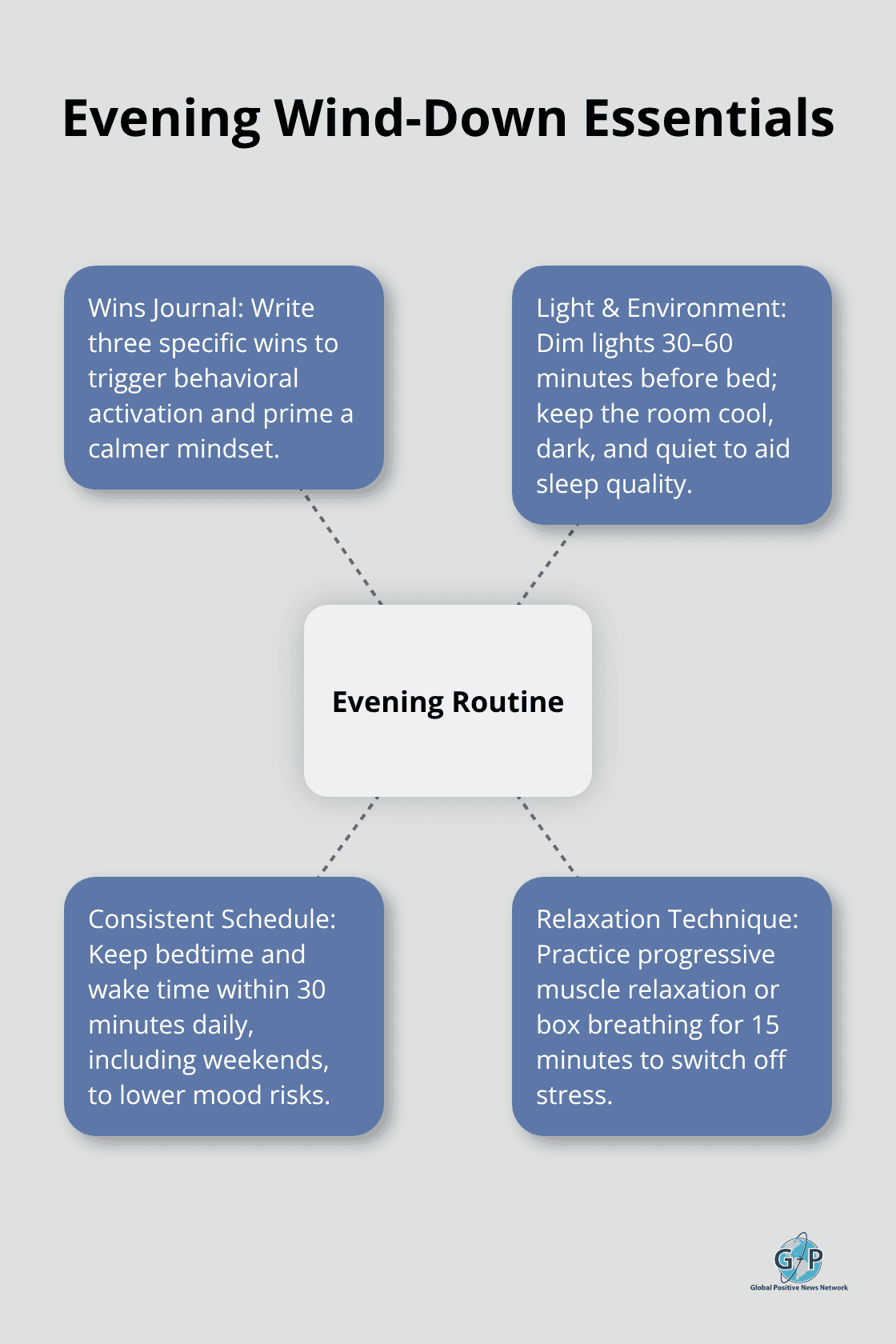
Start by writing three specific wins from today, not in vague terms like “good day” but concrete observations like “I stayed patient during that difficult meeting” or “I took my midday walk even when busy.” This practice activates what researchers call behavioral activation, a core cognitive therapy strategy where you actively acknowledge positive moments and rewire your brain toward noticing what went right instead of fixating on failures. The act of writing these wins down shifts your focus and prepares your mind for sleep in a calmer state.
Dim Your Lights and Control Your Environment
Dim your lights to signal your body that sleep approaches. Your circadian rhythm responds to light intensity, so you reduce brightness 30 to 60 minutes before bed to help your cortisol drop naturally and your melatonin rise. Set your bedroom temperature to 65-68 degrees Fahrenheit, keep it completely dark, and eliminate sound disruptions. These three environmental factors directly support sleep quality, which then supports your ability to execute your morning routine and midday resets the next day.
Clear Your Mind Before Sleep
If racing thoughts surface while you lie in bed, you write them in a notebook instead of fighting them mentally-this clears your mind without the stimulation of your phone. A consistent sleep schedule matters more than any single evening habit; you keep the same bedtime and wake time within 30 minutes every day, even weekends. This consistency is associated with lower depression and anxiety risk, so the structure itself becomes your most powerful tool.
Practice Your Relaxation Technique
The final 15 minutes before sleep should involve either progressive muscle relaxation or box breathing-the same breathing technique you used this morning. You tense each muscle group for five seconds starting at your toes, then release and move upward through your body, or you return to four-count breathing if that feels more natural. This isn’t meditation or spiritual practice; it’s your nervous system’s off switch. Your body physically cannot stay in a stress state while you practice genuine relaxation techniques, so these final minutes are non-negotiable if you want measurable improvements in both sleep and next-day mood. Many people skip this step because they think they should fall asleep instantly, but that expectation itself creates tension. Instead, you approach these 15 minutes as your reward for the day’s work-a deliberate transition where you actively prepare your brain and body for the recovery that makes everything else possible.
Final Thoughts
The three routines you’ve learned-morning gratitude, midday resets, and evening wind-downs-form a connected system where each phase builds on the last. Your morning sets your nervous system toward calm, your afternoon protects that clarity, and your evening locks in the mental gains so tomorrow’s routine actually works. Daily positivity routines work because they’re not about motivation-they’re about structure that removes decision fatigue and creates the conditions where positive thinking becomes your default.
Small daily habits create measurable change faster than most people expect. A 2025 study showed that people maintaining consistent sleep schedules experienced 38% lower depression risk, while regular exercisers reported 1.5 fewer days of poor mental health monthly. These aren’t marginal improvements-they’re the difference between struggling through your week and moving through it with intention and purpose.
Start with one or two practices, not your entire day at once (most people fail because they try everything simultaneously). Lock in your sleep schedule first, add your morning gratitude practice, then layer in midday movement once those feel automatic. We at Global Positive News Network curate stories of personal triumphs and community impact specifically to support the mental clarity you’re building through these routines, and your positivity practice needs only consistency, specificity, and the willingness to start small.
Having a hard day?
The 2 Minute Hope Reset is a short free guide with three small practices for the days that feel heavy. Two minutes each, nothing to keep up with.
Get the free guideExplore more positive news:
Enjoying stories like this?
Global Positive News Network is reader-supported. If you’d like to support the mission, you can visit the Official GPNN store.