

How you start your morning shapes the rest of your day. At Global Positive News Network, we’ve seen firsthand how a simple morning positivity routine transforms people’s mental health and productivity.
The good news? You don’t need hours or complicated practices. Small, intentional habits in the first hour after waking create momentum that carries through everything you do.
Why Morning Routines Shape Your Mental Health
Your brain operates differently in the morning than any other time of day. When you wake up, your prefrontal cortex-the part responsible for decision-making, emotional regulation, and focus-needs time to activate fully. Most people skip this activation period and jump straight into emails, news, or stress. That’s a mistake that costs them hours of productivity. Research from Harvard Business Review shows that starting your day with intentional mental practices rather than checking emails reduces cognitive load and supports a proactive mindset. Your brain’s peak time for cognitive work happens in late morning, so a routine that builds momentum early optimizes performance throughout the day.
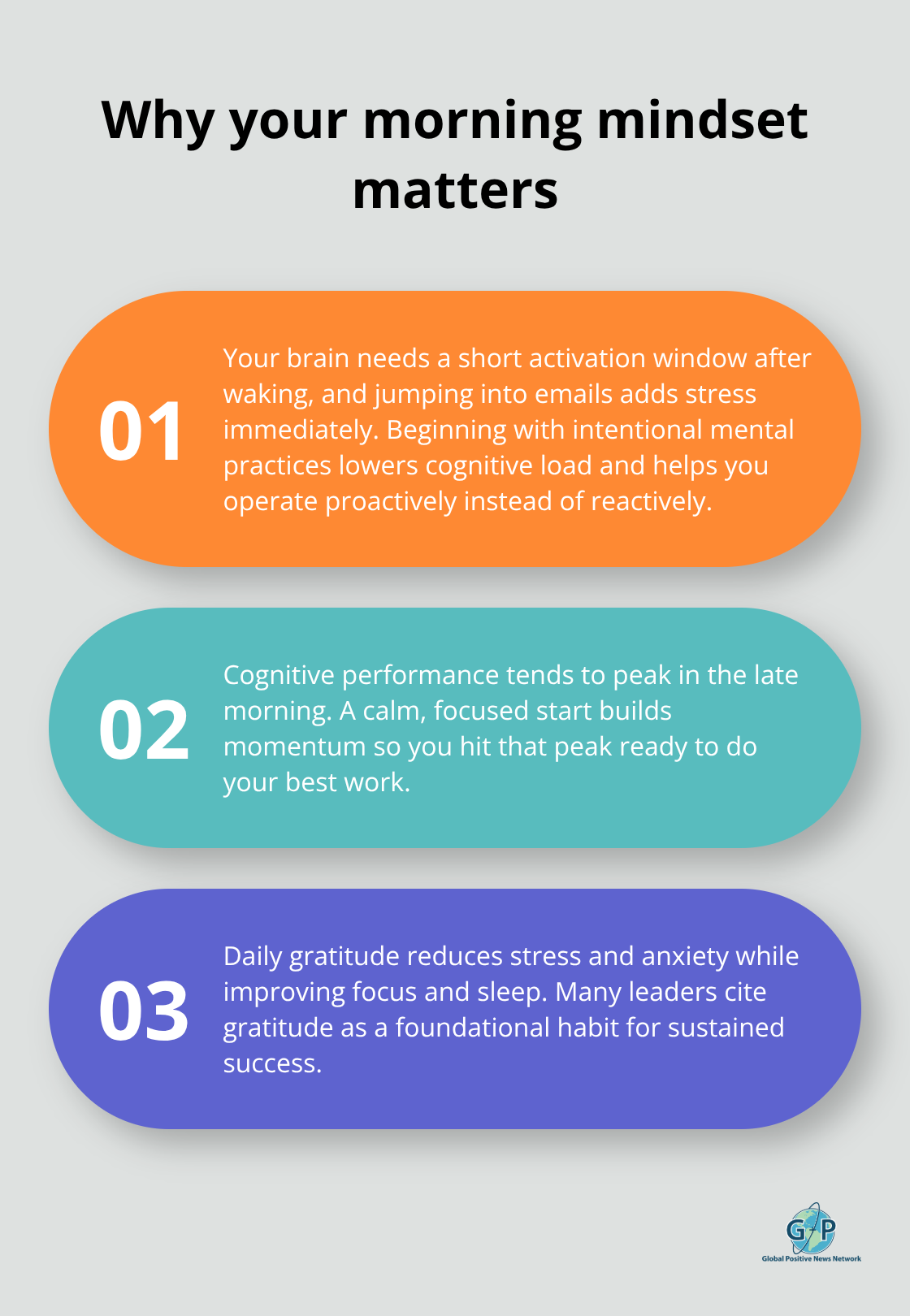
Gratitude practice alone delivers measurable results: studies link daily gratitude to reductions in stress and anxiety, improved focus, better sleep, and a more positive mindset over time. Leaders like Oprah Winfrey and Jack Dorsey credit daily gratitude as a core habit for their success.
How Your Morning Sets Your Productivity
The first hour after waking determines your energy trajectory for the entire day. Morning light exposure boosts alertness and daytime energy, which is why opening curtains immediately matters more than most people realize. Playing upbeat music stimulates your brain and lifts mood within minutes. Light stretching increases blood flow and helps you start with positive energy. Eating breakfast with water-not relying on coffee alone-provides sustained energy and prevents the mid-morning crash. According to mental performance coach Cindra Kamphoff, Ph.D., founder of the Mentally Strong Institute, a four-minute structured mental routine creates momentum that influences how you engage with people and tasks. Kamphoff has worked with Olympians, NFL teams, and Fortune 500 CEOs, proving this approach works across different roles. Morning exercise raises serotonin and norepinephrine, improving stress resilience and mood while making you more creative and productive in the two hours after exercising. Regular morning exercise associates with lower stress at work and better work-life balance, according to workplace research.
Why Purpose Matters First Thing
A clear sense of purpose boosts motivation and engagement at work and may lengthen life, according to Kamphoff. Visualizing the people you will impact today and reflecting on how your work serves that purpose takes just one minute but resets your entire mental framework. Setting daily intentions for how you want to show up-beyond just completing tasks-helps you become the person you actually want to be. Positive self-talk statements beginning with “I will,” “I can,” or “I am” build mental strength and confidence, especially for challenging moments. This isn’t optional motivation-speak. It’s a mental technique that changes brain chemistry and shapes behavior throughout your day.
The next section reveals the specific elements that transform these principles into a routine you can actually implement.
Build Your Four-Minute Mental Foundation
The Four-Minute Mental Routine That Works
The most effective morning positivity routine isn’t complicated or time-consuming. Cindra Kamphoff, Ph.D., founder of the Mentally Strong Institute, developed a four-minute structured approach that works because it targets your brain’s actual needs when you wake up. This framework consists of four one-minute steps that you can perform while drying your hair, eating breakfast, or driving to work.
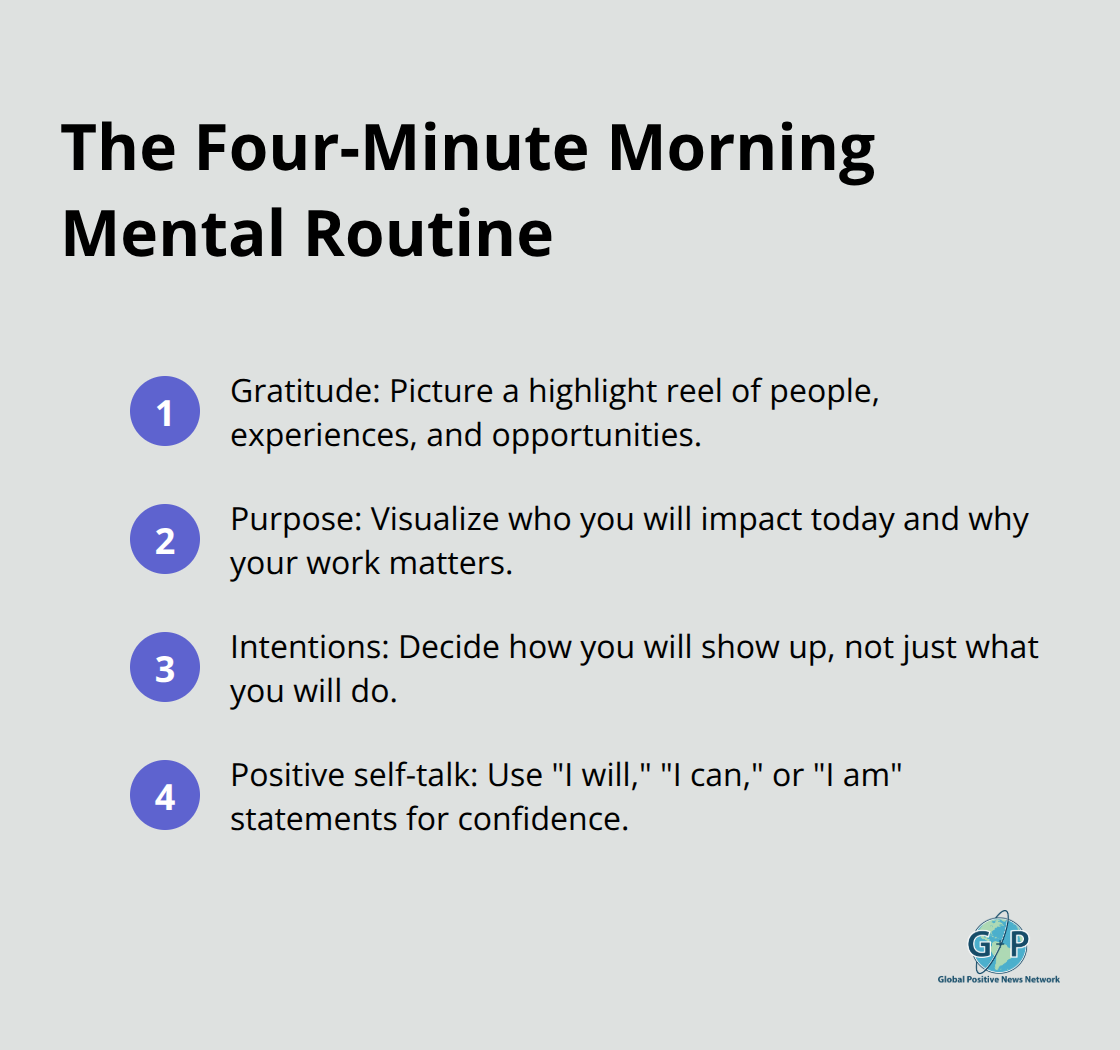
The first minute focuses on gratitude-imagine a highlight reel of relationships, experiences, and opportunities that matter to you. This isn’t vague positivity; neuroscience shows gratitude reduces stress and anxiety while improving focus and sleep quality. The second minute involves visualizing the people you will impact today and how your work serves their needs. Kamphoff emphasizes this step because a clear sense of purpose boosts motivation and engagement while potentially lengthening your life.
The third minute requires setting daily intentions about who you want to be, not just what tasks you need to complete. Examples include “I will boldly lead my team today” or “I will be fully present at meetings.” The fourth minute uses positive self-talk with statements beginning with “I will,” “I can,” or “I am.” This builds mental strength and confidence for challenging moments, particularly situations like public speaking or difficult conversations. Kamphoff has applied this method with Olympians, NFL teams, and Fortune 500 CEOs, proving its effectiveness across different contexts and stress levels.
Physical Activation Amplifies Your Mental Work
Beyond the mental framework, physical practices amplify your morning momentum significantly. Morning exercise improves stress resilience and mood while making you more creative and productive. Light stretching increases blood flow and activates your nervous system without requiring a full workout. Playing upbeat music stimulates your brain and lifts mood within minutes-research shows this effect is immediate and measurable.
Eating breakfast with protein and hydration prevents the mid-morning energy crash that coffee alone cannot sustain. Opening your curtains immediately after waking exposes you to natural light, which boosts alertness and daytime energy more effectively than any caffeine. These physical elements work together because your body and mind operate as one system in the morning. The combination of mental clarity from the four-minute routine plus physical activation creates genuine momentum that carries through your day.
What Comes Next
Your four-minute mental routine and physical practices form a powerful foundation. The next section shows you how to build these elements into a sustainable habit that fits your actual life, not some idealized version of it.
Making Your Morning Routine Stick Without Overwhelm
Start With One Element, Not Everything
Starting small is non-negotiable. Most people fail at morning routines because they try to implement everything at once-the four-minute mental routine plus exercise plus a perfect breakfast plus reading. That’s a recipe for abandonment within two weeks. Instead, pick one element from the four-minute framework and practice it for three days before adding another. Gratitude alone delivers measurable results within 48 hours according to neuroscience research, so start there. Once gratitude feels automatic, add the purpose visualization step. This staggered approach works because your brain adapts to new habits through repetition, not volume. Research shows it takes 18 to 254 days for a habit to stick depending on the person and behavior, so patience matters more than ambition.
Track Progress Without Judgment
The Mentally Strong Institute recommends tracking your practice for the first two weeks using a simple calendar where you mark each day you complete your chosen element. This visibility creates accountability without judgment. If you miss a day, you restart the count-this prevents the all-or-nothing thinking that derails most people. Apps like Streaks or Habitica gamify this process, but honestly, a calendar on your phone works just as well.
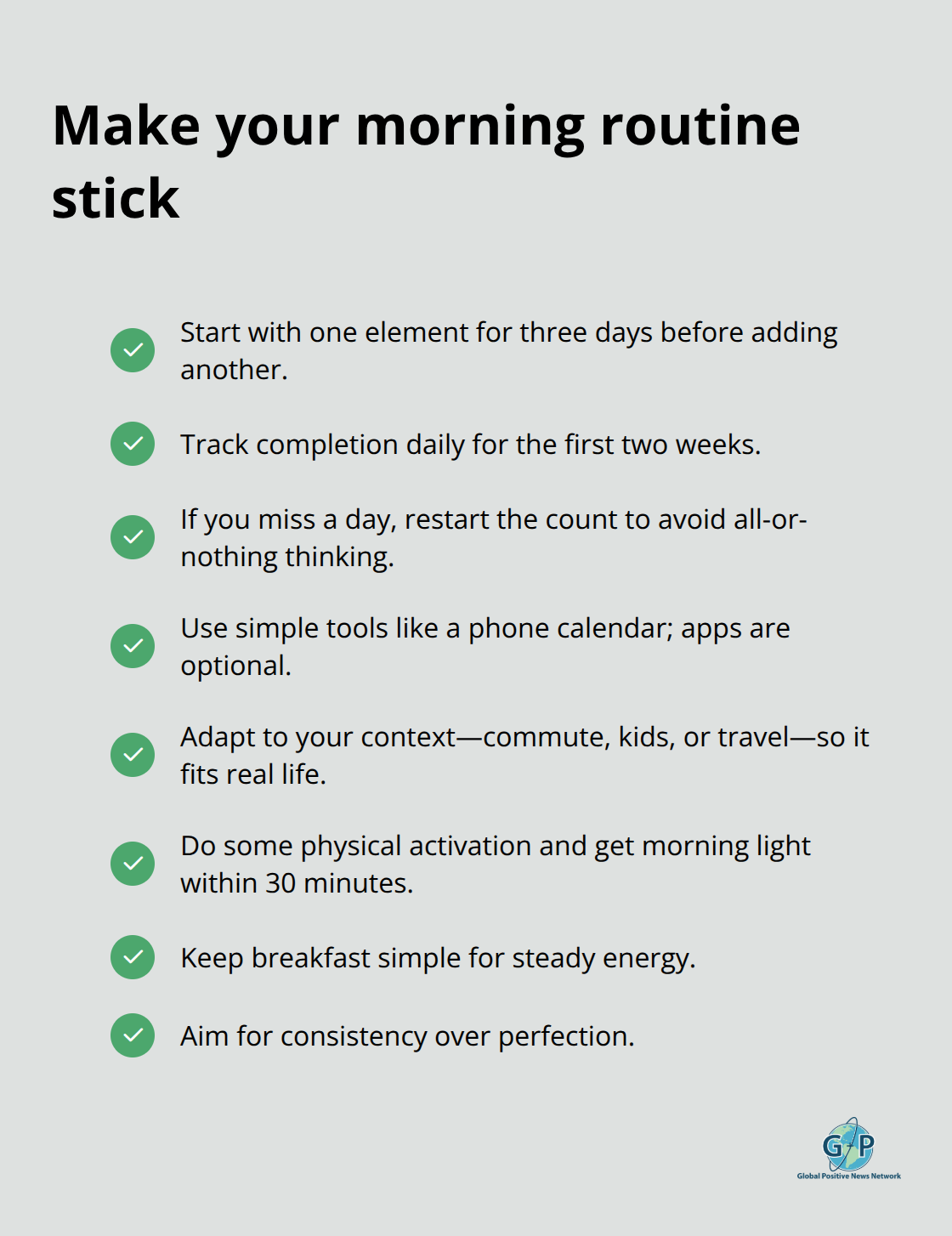
The key is seeing the chain of consecutive days, which triggers your brain’s reward system and makes continuation feel natural rather than forced.
Adapt Your Routine to Your Actual Life
Your lifestyle determines whether your routine survives long-term, so adapt ruthlessly. If you have a 30-minute commute, your four-minute routine happens during that drive with upbeat music and positive self-talk-not sitting in silence. If you have young children, the routine happens in the shower or while making coffee, not in a quiet meditation space. If you travel frequently, the routine requires zero equipment or location dependency, which the mental framework already provides.
Physical activation looks different for different people: one person does 10 minutes of stretching while another goes for a run. The non-negotiable element is that you do something that increases blood flow and exposes you to morning light within 30 minutes of waking. Eating breakfast matters, but breakfast for a parent rushing out the door looks different than breakfast for someone with a calm morning. Fruit and almonds provide quick energy and sustained fuel-this takes 60 seconds (no complicated preparation required).
Consistency Beats Perfection
The routine succeeds when it fits your actual life, not when it matches someone else’s idealized version. If your current morning includes chaos, adding a four-minute mental routine still creates measurable shifts in your stress levels and focus. A three-minute routine you actually complete beats a ten-minute routine you abandon. What matters most is that you show up tomorrow and the day after that, not that you execute the perfect version today.
Final Thoughts
Your simple morning positivity routine works because it aligns with how your brain actually functions when you wake up. The four-minute mental framework plus physical activation creates real momentum that compounds over weeks and months. Gratitude reduces stress, purpose boosts motivation, intentions shape behavior, and positive self-talk builds mental strength.
Starting today means picking one element and committing to it for three days. Not overhauling your entire morning or adding ten new habits simultaneously-just one small practice that fits your actual life. Gratitude works fastest, so start there if you’re unsure, then layer in purpose visualization, your intention statement, and positive self-talk. Research shows habits take 18 to 254 days to stick depending on the person and behavior, which means your brain rewires itself right now as you build neural pathways that make positivity feel natural rather than forced.
Your morning sets the tone for everything that follows. When you start with intention, gratitude, and purpose, you engage with people and tasks differently, make better decisions, and handle stress more effectively. At Global Positive News Network, we believe small intentional practices create lasting change, and your simple morning positivity routine is one of those practices that transforms how you show up in the world.
Having a hard day?
The 2 Minute Hope Reset is a short free guide with three small practices for the days that feel heavy. Two minutes each, nothing to keep up with.
Get the free guideExplore more positive news:
Enjoying stories like this?
Global Positive News Network is reader-supported. If you’d like to support the mission, you can visit the Official GPNN store.