

Most people think they listen, but they’re actually waiting for their turn to speak. Intentional listening-the kind that requires full attention and genuine curiosity-is rare and transformative.
At Global Positive News Network, we’ve seen how this skill reshapes relationships, improves mental health, and builds trust. The science backs it up, and the techniques are learnable.
The Science Behind Active Listening
What Happens in Your Brain When You Truly Listen
When someone talks to you, your brain does not passively record words. Mirror neurons fire in your brain, creating a neural simulation of the speaker’s emotional experience. Research from neuroscientist Marco Iacoboni shows that this mirroring system activates only when you listen with genuine attention, not when you plan your response. The difference appears measurable on brain scans. Your anterior insula and anterior cingulate cortex light up during empathetic listening-the same regions that process your own emotions. This neural activity means your brain synchronizes with theirs. When you interrupt or mentally rehearse what you will say next, these regions shut down. The speaker’s brain detects this shift instantly through tone and body language, and they stop sharing authentically. This is not philosophy; it is biology. Deep listening requires your brain to work harder than surface listening, which explains precisely why most people avoid it.
The Physical Cost of Not Being Heard
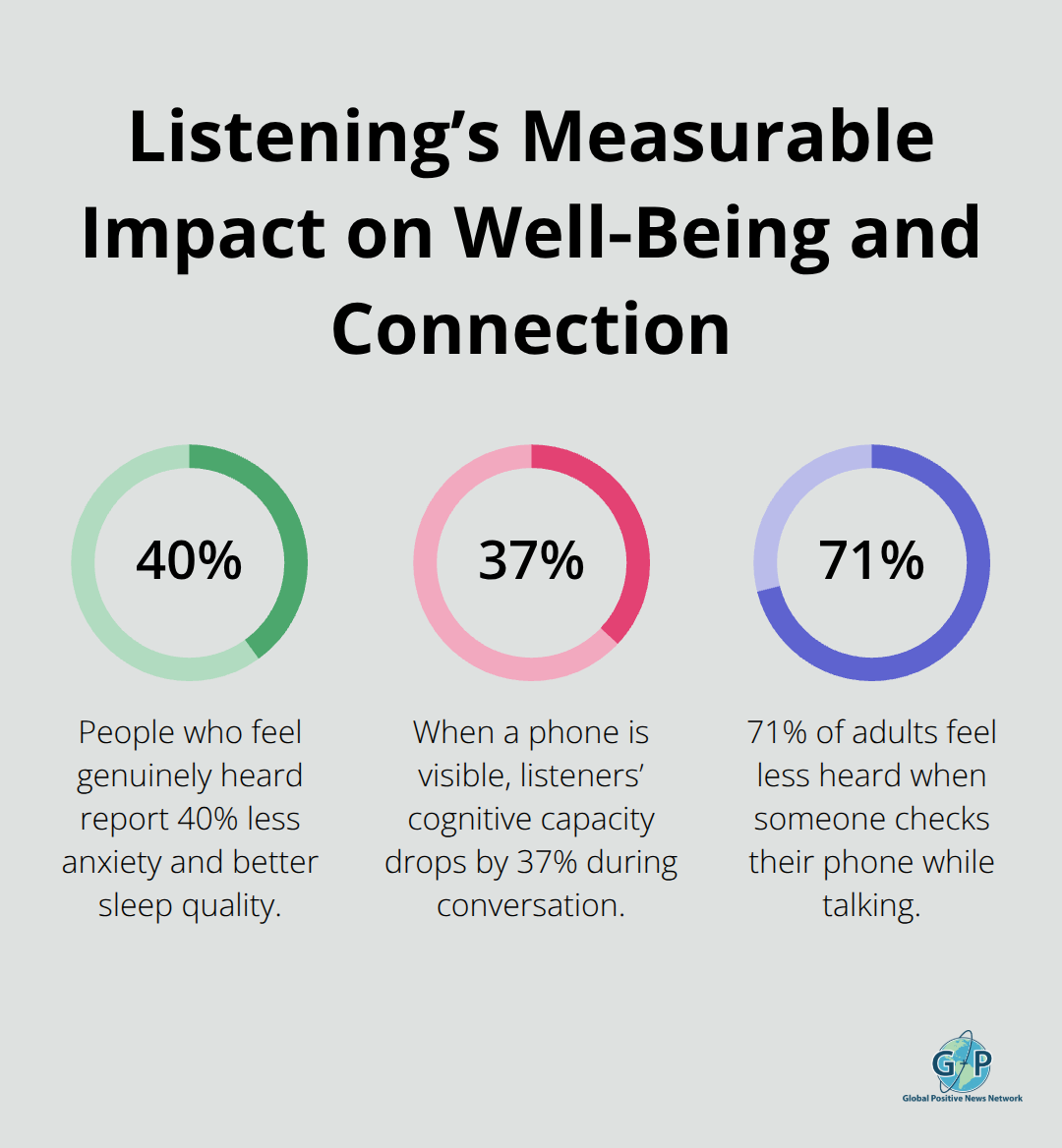
When people feel unheard, their stress hormones spike. The American Psychological Association documented that sharing joyful moments with a partner may help lower stress hormone levels, according to research on older adults. Their nervous systems remain in a low-level threat response. Over time, this chronic stress damages cardiovascular health and weakens immune function. Conversely, when someone truly listens to you, your parasympathetic nervous system activates within minutes, lowering heart rate and blood pressure. The Gottman Institute found that couples who practice genuine listening show measurable improvements in relationship satisfaction scores within three weeks. People who feel genuinely heard report 40% less anxiety and better sleep quality according to studies on social connection. Your physical health depends on whether people around you actually listen.
This means listening is not a soft skill-it is a health intervention. When you choose to truly hear someone, you literally change their biochemistry for the better.
Why Empathy Requires Intellectual Honesty
Empathy does not mean you agree with someone or fully understand their experience. Carl Rogers called this unconditional positive regard-accepting someone’s perspective without imposing your own views. This distinction matters because false empathy damages trust. Saying “I totally understand” when you do not is transparent to the speaker’s brain. Instead, genuine empathy sounds like “What I’m hearing is this, and I want to understand more.” Research on vulnerability by Brené Brown shows that people connect deepest when listeners acknowledge the limits of their understanding while remaining present. This honest approach creates safety because the speaker knows you are not pretending. The brain trusts authenticity more than perfect understanding. When you listen with intellectual humility, people share more openly, which paradoxically deepens your actual understanding over time. This stands opposite to the waiting-to-speak mentality most people practice-and it sets the stage for the practical techniques that actually transform how you connect with others.
What Actually Stops You From Listening
Your Brain’s Default Response Mode
The gap between thinking you listen and actually listening comes down to three saboteurs that operate in every conversation. First, your brain defaults to a response-preparation mode where your prefrontal cortex-responsible for genuine listening-competes with your amygdala. When the amygdala activates, it triggers your personal narrative and you start formulating counterarguments, recalling similar experiences, or planning what you will say next.
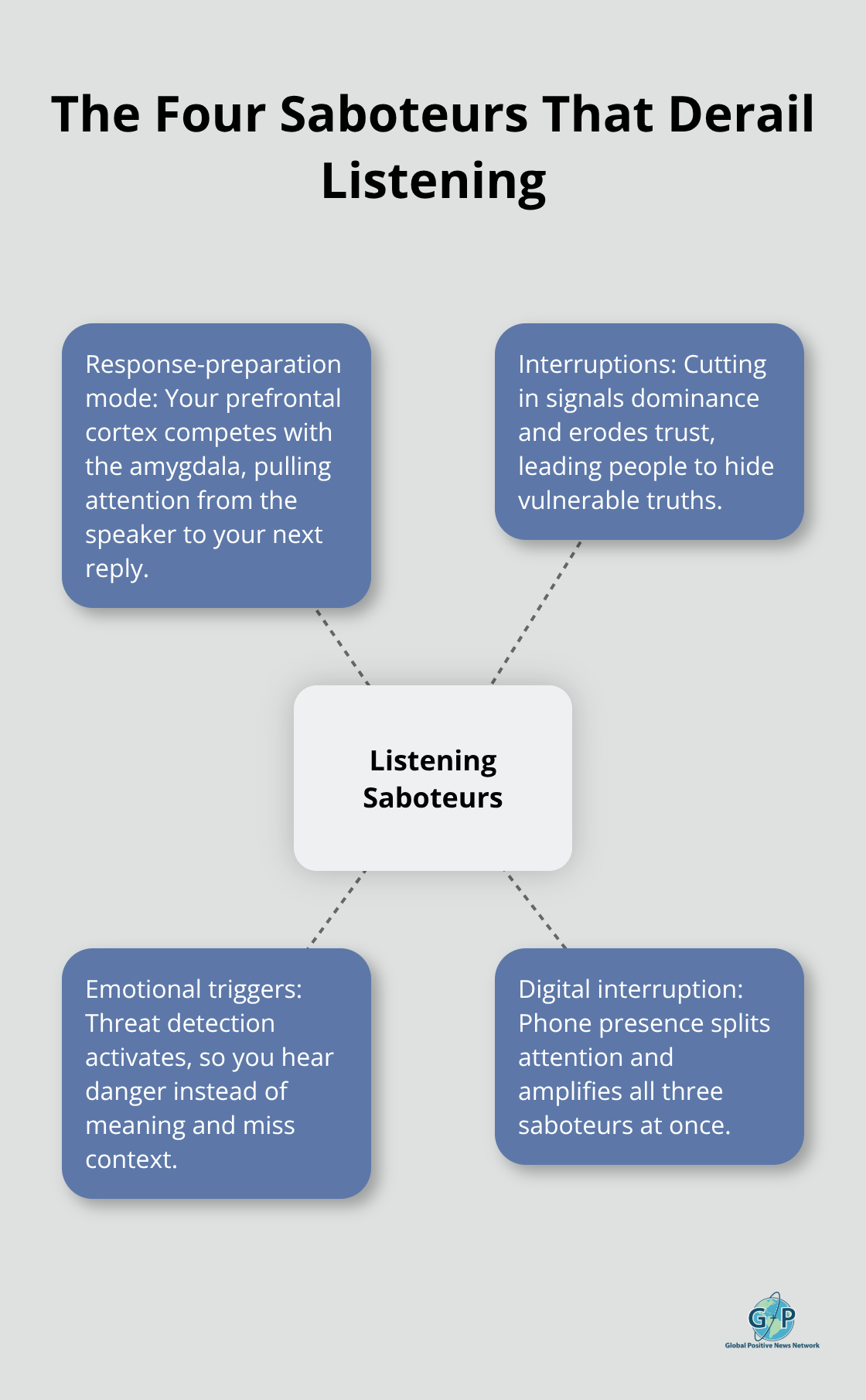
This happens within seconds, often without conscious awareness. The result is selective hearing, where you catch fragments while missing emotional context entirely. People detect this instantly. Research shows listeners who mentally prepare responses maintain eye contact but their pupils constrict-a physiological marker of inward focus rather than genuine engagement. The speaker’s nervous system reads this as rejection, even if you nod along.
How Interruptions Destroy Trust
Interruption patterns establish dominance in conversation and destroy trust faster than almost anything else. Research on workplace communication found that men are more likely to interrupt women than women are to interrupt men. Each interruption signals that your thoughts matter more than theirs. Over time, interrupted people stop sharing vulnerable truths, which means you never actually know them. They retreat into surface-level pleasantries. The damage compounds because your brain learns to expect dismissal, making future vulnerability feel unsafe. Stop waiting for your turn to talk and truly absorb what the other person is saying.
Emotional Triggers That Hijack Your Attention
Emotional triggers hijack your listening before words even land. When someone mentions a topic tied to your insecurity, past conflict, or competing value, your threat detection system activates. Your body tenses, your breathing shifts, and your ability to process their actual message collapses. You hear threat instead of content. This explains why the same conversation produces completely different outcomes depending on your emotional state that day. Your nervous system does not distinguish between physical danger and emotional discomfort-both trigger the same defensive response.
The Phone Effect on Connection
Digital interruption amplifies all three saboteurs simultaneously. Research from the University of California found that the average person checks their phone 96 times per day-roughly once every 10 minutes. When your phone sits visible during conversation, the listener’s cognitive capacity drops by 37% according to studies on phone presence effects. Your brain allocates processing power toward monitoring potential notifications rather than tracking the speaker’s nuance. People know this. A 2022 survey found that 71% of adults feel less heard when someone checks their phone during conversation. The damage extends beyond the moment. Repeated phone-checking trains your nervous system to treat human attention as unreliable, which reduces vulnerability in future interactions.
Breaking the Pattern Through Structural Change
Genuine connection requires removing these specific barriers, not just good intentions. The antidote is not willpower-it is structural change. Silence your phone entirely before conversations, not just muting notifications. Position your body to face the speaker fully rather than at angles that signal partial engagement. Most critically, stop internal commentary and focus entirely on what someone says, then pause before you respond. This is not about perfection; it is about redirecting your brain’s default pathway toward understanding rather than response. These shifts in your physical environment and mental focus create the conditions where real listening becomes possible, which then opens the door to the practical techniques that actually transform how you connect with others.
How to Actually Listen Instead of Just Hearing
Read What Someone Is Not Saying
The gap between hearing words and genuinely listening comes down to three concrete skills that rewire how your brain processes another person. First, you must learn to read what someone is not saying by tracking their body language and tone shifts. A person’s shoulders tense when they approach vulnerability, their voice pitch rises slightly when they feel unheard, and their eyes look down when shame enters the conversation.
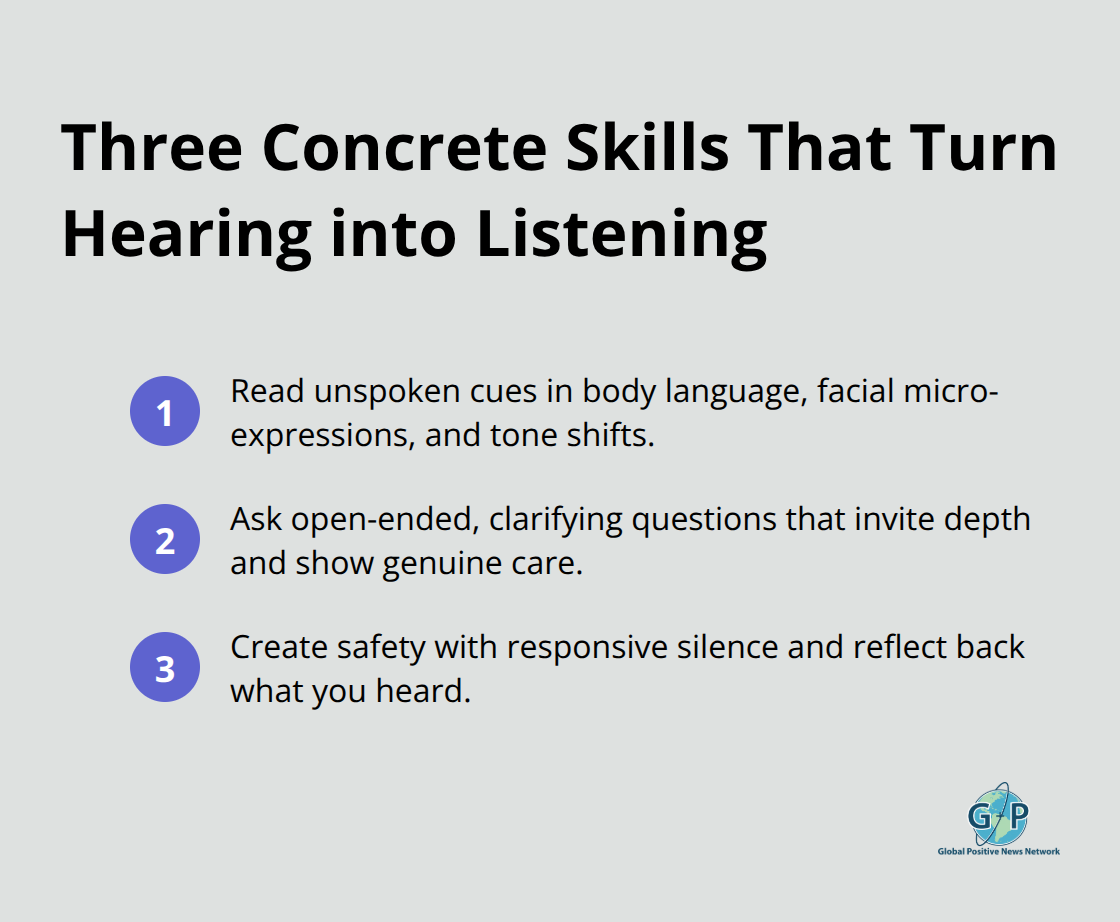
These signals appear within the first 10 seconds of a difficult topic. Most people miss them entirely because they mentally prepare counterarguments instead.
The solution is brutally simple: watch their face for the full 15 seconds before you respond to anything emotionally weighted. Neuroscience shows that the fusiform gyrus, which processes facial expressions, requires sustained attention to activate properly. When you glance at someone’s face while formulating your reply, you register only surface emotion. When you watch without planning your response, you catch micro-expressions that reveal the actual emotional content. This distinction determines whether someone feels truly seen or merely heard.
Ask Questions That Signal Genuine Care
The questions you ask reveal whether you actually care about understanding them or whether you gather ammunition for your argument. Open-ended questions that start with what or tell me more invite deeper sharing. Why questions trigger defensiveness because they feel like interrogation. A study from Harvard found that people who ask clarifying questions are perceived as more caring and trustworthy, yet the average person asks only 3.6 follow-up questions per conversation before pivoting to their own experience.
The shift from surface questions like “how was your day” to substantive questions like “what mattered most about that experience” changes everything. When you ask what mattered most, you signal that you want access to their inner world, not just their schedule. This single question opens doors that polite surface conversation keeps locked. People who receive these substantive questions feel valued in ways that small talk never achieves.
Create Safety Through Responsive Silence
Creating safety for vulnerability requires that you respond without judgment before the other person finishes speaking. Your first instinct after someone shares something painful is to fix it, minimize it, or explain why their feelings are wrong. Each of these responses teaches their nervous system that vulnerability is unsafe with you. Instead, pause for three full seconds after they finish speaking.
This silence signals that you process their words, not that you wait for your turn. Then respond with explicit acknowledgment of what you heard: “What I hear you saying is this, and that sounds genuinely difficult.” Dr. Brené Brown’s research on shame resilience shows that people recover faster from emotional pain when someone simply names what they experience without trying to change it. Your job is not to solve their problem in that moment. Your job is to signal that their experience matters and that you can hold space for it without falling apart.
Final Thoughts
Intentional listening transforms relationships because it shifts the foundation from performance to presence. When you stop waiting for your turn and absorb what someone says, they respond with more authenticity. This creates a feedback loop where vulnerability builds trust, and trust deepens connection-the Gottman Institute documented that couples who maintain this practice report sustained improvements in relationship satisfaction over months and years, not just weeks.
This transformation extends far beyond romantic relationships. Families who practice real listening experience fewer conflicts and stronger bonds across generations, while workplaces where leaders listen without interruption see increased employee engagement and retention. Friendships deepen when both people feel heard rather than performing for each other, and the common thread across all these contexts is that people stop protecting themselves when they sense authentic attention.
One concrete decision starts your journey: remove the barriers before adding techniques. Silence your phone entirely during conversations, position your body to face the speaker fully, and pause before responding so your brain shifts from response-preparation mode to genuine understanding. These structural changes create the conditions where real listening becomes possible, and we at Global Positive News Network believe this skill is foundational to building the compassionate world we need.
Having a hard day?
The 2 Minute Hope Reset is a short free guide with three small practices for the days that feel heavy. Two minutes each, nothing to keep up with.
Get the free guideExplore more positive news:
Enjoying stories like this?
Global Positive News Network is reader-supported. If you’d like to support the mission, you can visit the Official GPNN store.