

Hope feels distant when life gets heavy. At Global Positive News Network, we’ve found that curiosity-that spark of wonder and awe about the world-can quietly rebuild what despair has worn down.
The good news? You don’t need to overhaul your life to start. Small acts of genuine questioning and learning can shift how you see tomorrow.
How Curiosity Rewires Your Brain Toward Hope
The Neurochemistry of Questions
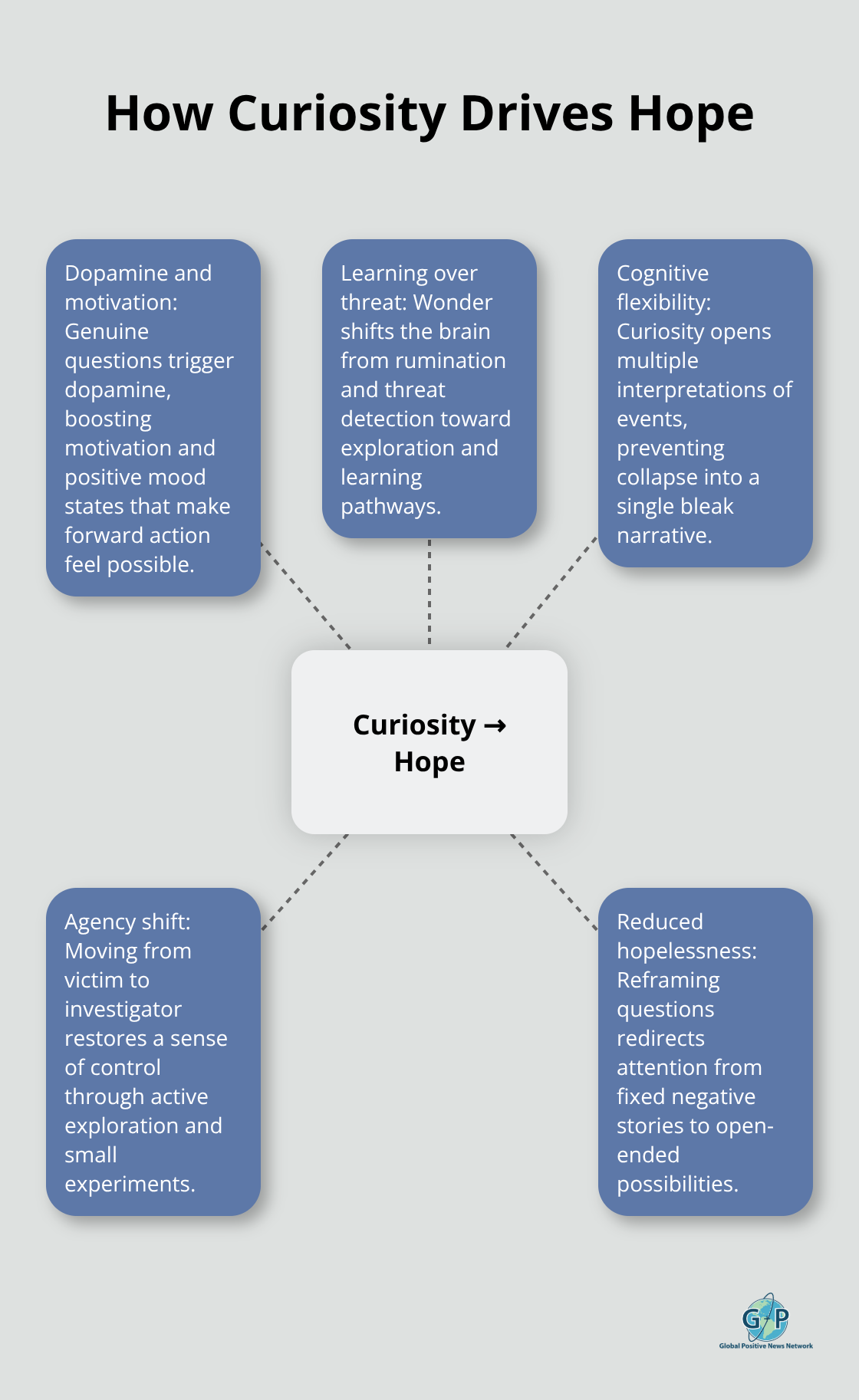
When you ask yourself a genuine question instead of spiraling in defeat, your brain shifts. Research from Todd Kashdan at George Mason University shows that curious people report significantly higher life satisfaction and lower anxiety levels than those who accept situations passively. Curiosity triggers dopamine release-the same neurotransmitter that fuels motivation and positive mood. When you wonder instead of worry, you activate your brain’s learning systems rather than its threat detection systems.
This isn’t abstract psychology. A person stuck in burnout who shifts from asking why they’re failing to asking what information they need to recover literally changes their neural pathway. Psychology Today research confirms that this reframing reduces hopelessness (by redirecting focus from fixed negative stories toward open-ended possibilities). The question itself becomes the tool.
Moving Beyond Fixed Narratives
Asking what you might learn from a setback or what a difficult experience could teach you activates cognitive flexibility-the capacity to move between different mental frameworks. Without this flexibility, hope collapses into a single bleak narrative. With it, multiple futures suddenly become visible.
This flexibility matters because it prevents your mind from locking into one interpretation of events. When you treat a setback as information rather than proof of failure, you open pathways your brain couldn’t see before. The shift happens not through forced optimism but through genuine curiosity about what else might be true. Consistent positive self-talk can rewire your brain for optimism, reinforcing these neural pathways over time.
Practical Experiments Over Catastrophe
When uncertainty feels overwhelming, pause and ask an “I wonder” question about what’s happening right now. Write it down if you can-externalizing the question reduces internal pressure and forces specificity. Instead of spiraling about whether you’ll ever feel better, ask what small experiment you could try this week to test that. Instead of accepting that nothing will change, ask what information or perspective you’re currently missing.
People who treat uncertain steps as small experiments rather than do-or-die moments report lower distress and greater resilience. This method works across life domains (health recovery, relationship repair, career transitions) because it replaces avoidance with proactive exploration. Each attempt teaches you something, whether it succeeds or fails.
From Victim to Investigator
The shift from victim narrative to curious investigator isn’t forced positivity. It’s a genuine cognitive tool that restores agency when hopelessness has stripped it away. You move from passive acceptance to active exploration, from “this is happening to me” to “what can I learn from this?” Responding with curiosity instead of judgment transforms how you process difficulty.
This reframing works because it changes your relationship to difficulty itself. Rather than something that happens to you, difficulty becomes material for investigation. That investigative stance-that “I wonder what this means”-is what opens the door to hope. The next step is learning how to build this curiosity into your daily life, not as a one-time exercise but as a sustainable practice.
How to Build a Curiosity Practice That Sticks
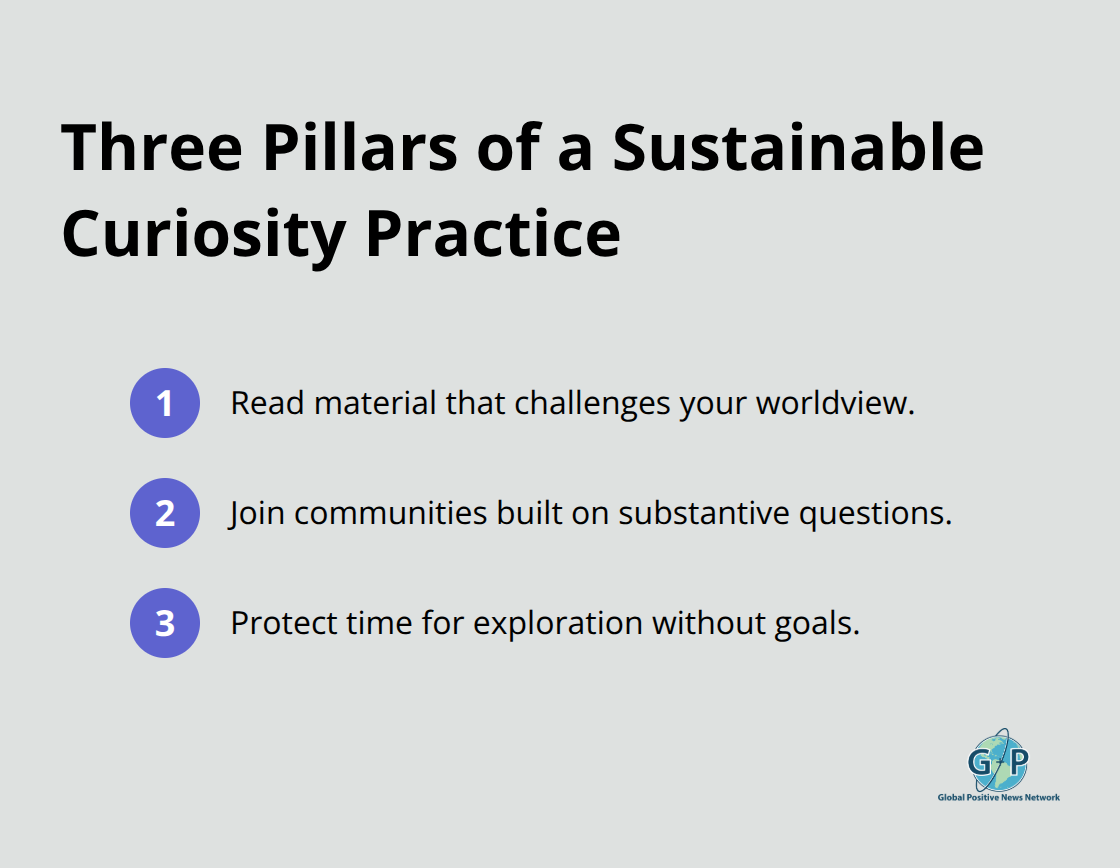
Read Material That Challenges Your Worldview
The gap between wanting to be curious and actually practicing it daily is where most people fail. Curiosity isn’t a personality trait you’re born with-it’s a skill that atrophies without deliberate use. People feel inspired by the idea of asking better questions, then return to their default patterns within a week. The fix isn’t motivation; it’s structure.
Start with material that genuinely unsettles your existing views. Choose sources that present frameworks or data you’ve never encountered, not content that confirms what you already believe. If you work in finance, read about neuroscience or urban agriculture. If you’re in healthcare, explore how artists approach problem-solving. The key is selecting material with real substance-academic papers, long-form journalism, or books by experts-not social media summaries. Try spending 20 minutes three times weekly on this practice. That’s enough to rewire your pattern recognition without overwhelming your schedule. Your brain needs time to process genuinely novel information, and consistency matters far more than duration.
Join Communities Built on Substantive Questions
The second lever is finding spaces where questioning becomes the default behavior, not the exception. Online communities built around specific curiosities-whether that’s philosophy forums, science discussion groups, or niche hobby networks-operate differently than casual social media. Members expect detailed questions and substantive responses. Spend time in communities where people ask why, challenge assumptions, and build on each other’s ideas.
These spaces train your mind to see complexity rather than accept simple answers. The conversations themselves become your teachers.
Protect Time for Exploration Without Goals
Finally, set aside 30 minutes weekly where you follow genuine curiosity wherever it leads-no productivity metrics, no learning goals, just exploration. This might be wandering through a museum, watching documentaries on subjects you know nothing about, or testing a new skill. The absence of pressure is essential because it allows your brain to move from threat-detection mode into genuine learning mode.
When exploration feels optional rather than mandatory, dopamine systems activate differently, and curiosity becomes self-reinforcing rather than effortful. This unstructured time complements your focused reading and community participation. Together, these three practices create a rhythm that sustains curiosity over months and years, not just weeks.
The real test comes when you face setback or uncertainty. That’s when your curiosity practice either holds firm or collapses back into old patterns. What determines whether your new questions stick is how you respond when answers don’t come immediately-and that’s where the science of resilience enters the picture.
How Curiosity Rewires Your Mental Health
Anxiety Loses Power When Your Mind Stays Open
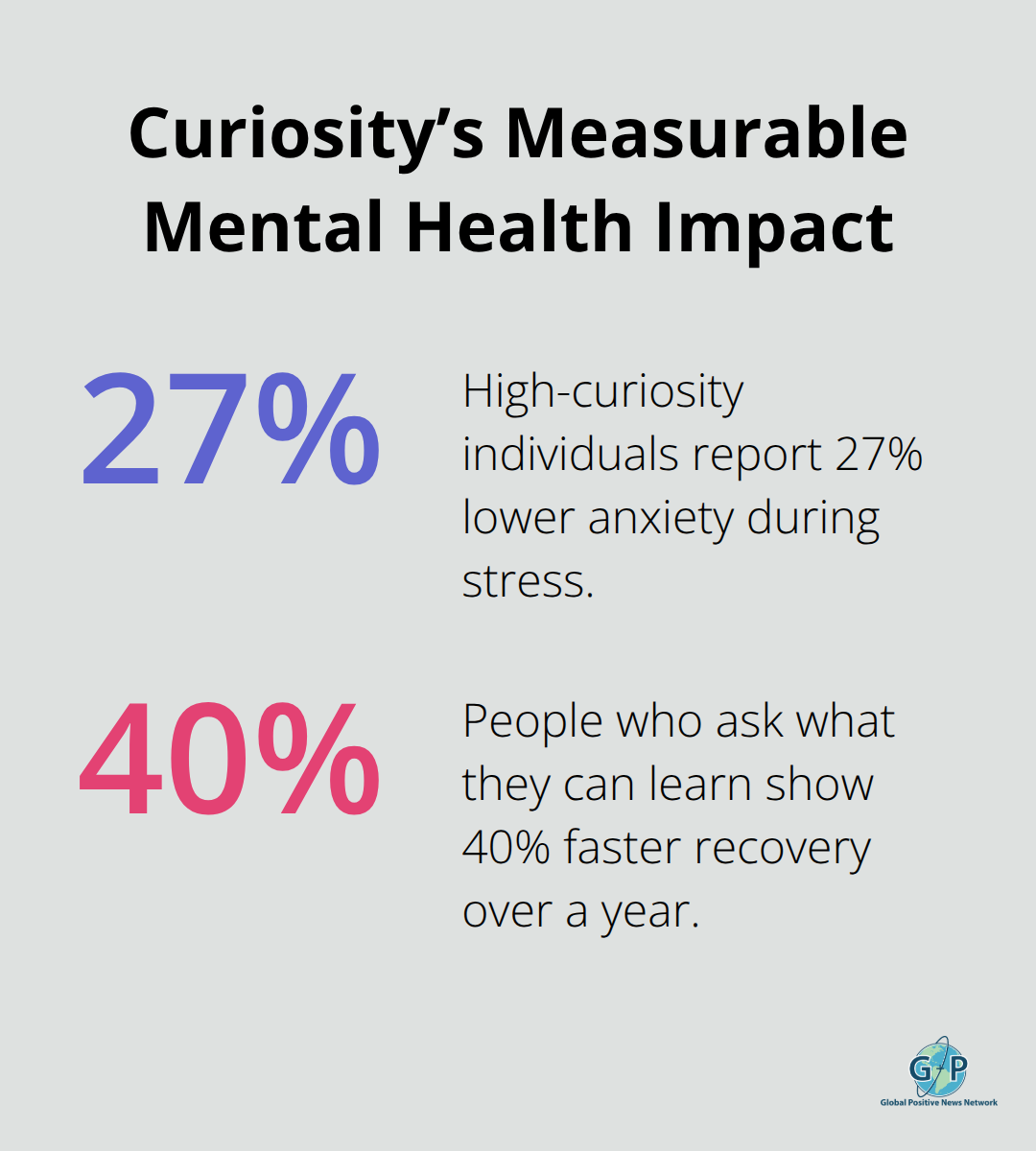
Anxiety and depression thrive in closed systems. When your mind accepts a single narrative about your situation, it locks into that story and reinforces it through repetition. Curiosity breaks this cycle by forcing your brain to consider alternatives. Research from Todd Kashdan at George Mason University found that people who score high on curiosity measures report 27% lower anxiety and significantly better psychological resilience during stress.
The mechanism is straightforward: curiosity activates your prefrontal cortex, the part of your brain responsible for flexible thinking and problem-solving. When this region is engaged, your amygdala-the threat-detection center-quiets down. This isn’t metaphorical. Brain imaging studies show measurable differences in neural activation between people who ask genuine questions and those who ruminate in fixed patterns.
Your Brain Changes Structure Through Curious Questions
Curiosity literally changes which parts of your brain take control. The dopamine released during curious exploration doesn’t just feel good; it reinforces the neural pathways associated with learning and optimism. Each time you follow a genuine question, you strengthen the same neurochemical systems that depression and anxiety suppress.
Over weeks of consistent curiosity practice, this rewiring becomes stable. People who maintain regular curiosity habits report lower relapse rates into depressive episodes compared to those using only traditional coping strategies. Research from the University of California shows that curious individuals recover faster from setbacks because their brains have practiced seeing multiple interpretations of events rather than defaulting to one catastrophic reading.
Resilience Builds When You Investigate Rather Than Suffer
Resilience isn’t about bouncing back unchanged; it’s about learning from difficulty and adapting your approach. A study in the Journal of Positive Psychology tracked 300 people through major life challenges and found that those who asked what they could learn from their struggle showed 40% faster recovery and reported higher life satisfaction one year later.
The act of investigating your own experience-asking what this setback reveals, what skills it teaches you, what new information you gain-converts passive suffering into active learning. This shift from victim to investigator is measurable. People who frame uncertainty as an experiment to run rather than a threat to endure show lower cortisol levels and better sleep quality within two weeks. Your body responds to the cognitive reframe almost immediately.
Small Daily Practice Produces Lasting Results
Consistency matters more than intensity. Fifteen minutes daily of genuine questioning about your situation produces better long-term outcomes than occasional deep reflection. Your brain needs repetition to rewire, and curiosity practice provides that repetition in a way that feels generative rather than forced. The practical takeaway: curiosity isn’t optional resilience work-it’s the foundation that prevents future breakdowns.
Final Thoughts
Curiosity transforms how you relate to uncertainty and opens doors that hopelessness locks shut. When you shift from asking why things fall apart to asking what you might learn, you move from paralysis to possibility. This isn’t forced optimism-it’s recognizing that your brain has a choice in how it processes what happens to you, and that wonder and awe remain accessible even after setback buries them.
Start this week with one topic that genuinely interests you and spend 20 minutes exploring it without any goal except learning. Join one online community where people ask substantive questions about something you care about, and set aside 30 minutes for exploration with no productivity target. These small actions create the foundation that allows curiosity to become your default mode rather than an exception.
The cycle between curiosity and hope reinforces itself as you practice asking better questions and notice more possibilities. Explore stories of resilience and renewal that show how others have walked this path, and let your next question be the one that shifts everything.
Having a hard day?
The 2 Minute Hope Reset is a short free guide with three small practices for the days that feel heavy. Two minutes each, nothing to keep up with.
Get the free guideExplore more positive news:
Enjoying stories like this?
Global Positive News Network is reader-supported. If you’d like to support the mission, you can visit the Official GPNN store.