

Most people think hope is something you’re born with or without. At Global Positive News Network, we’re here to tell you that’s wrong.
Optimism training isn’t mystical. It’s backed by neuroscience, and it works when you apply the right strategies consistently.
How Your Brain Builds Hope
Neuroplasticity Rewires Your Brain for Hope
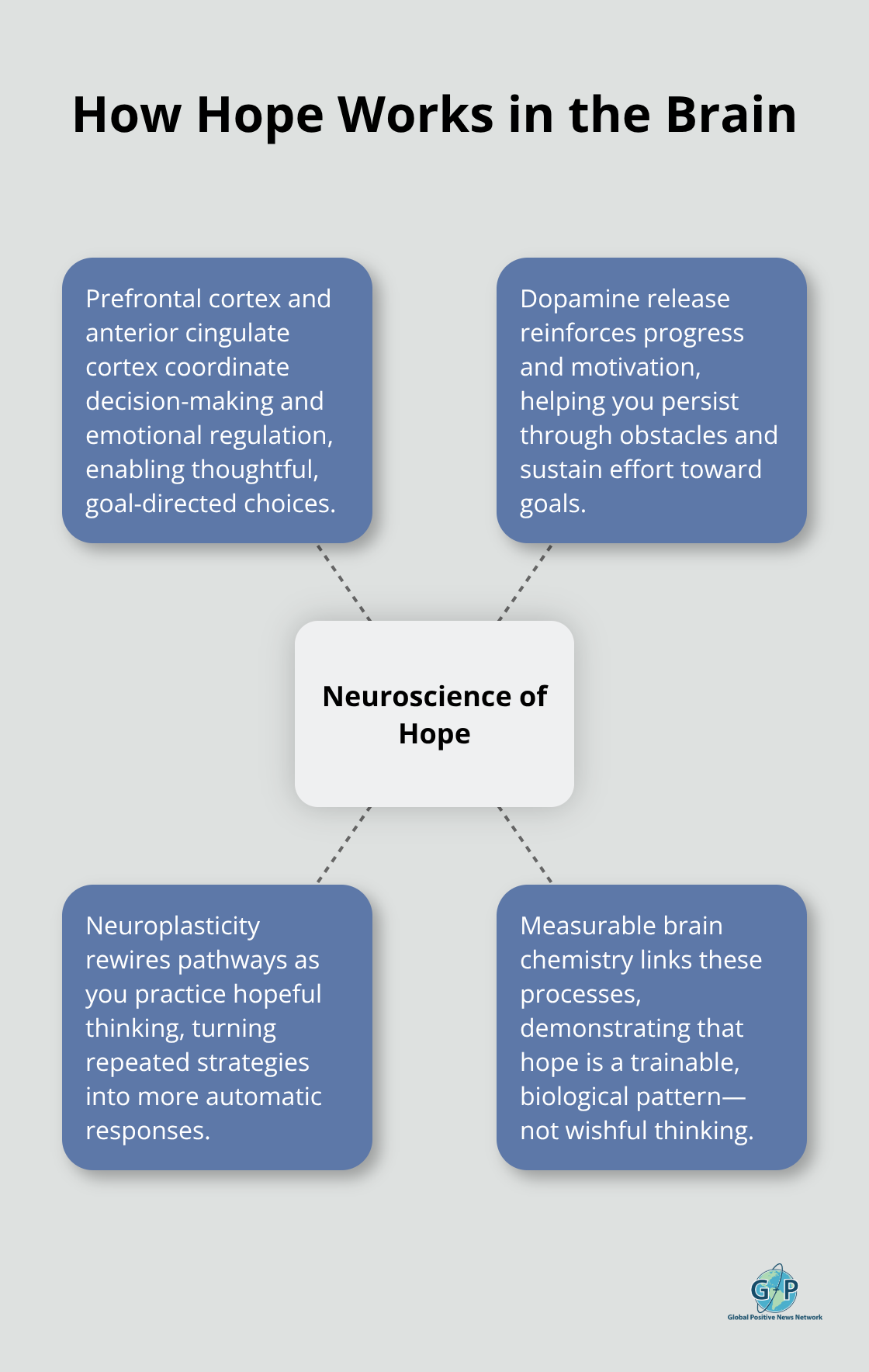
Your brain isn’t fixed. When you practice hopeful thinking, you literally rewire neural pathways through a process called neuroplasticity. Research from neuroscience shows that hope activates specific brain regions including the prefrontal cortex and anterior cingulate cortex, which handle decision-making and emotional regulation. These areas trigger dopamine release, the neurotransmitter that reinforces motivation and keeps you moving toward goals. This isn’t abstract theory-it’s measurable brain chemistry.
Real-World Performance Gains from Optimism Training
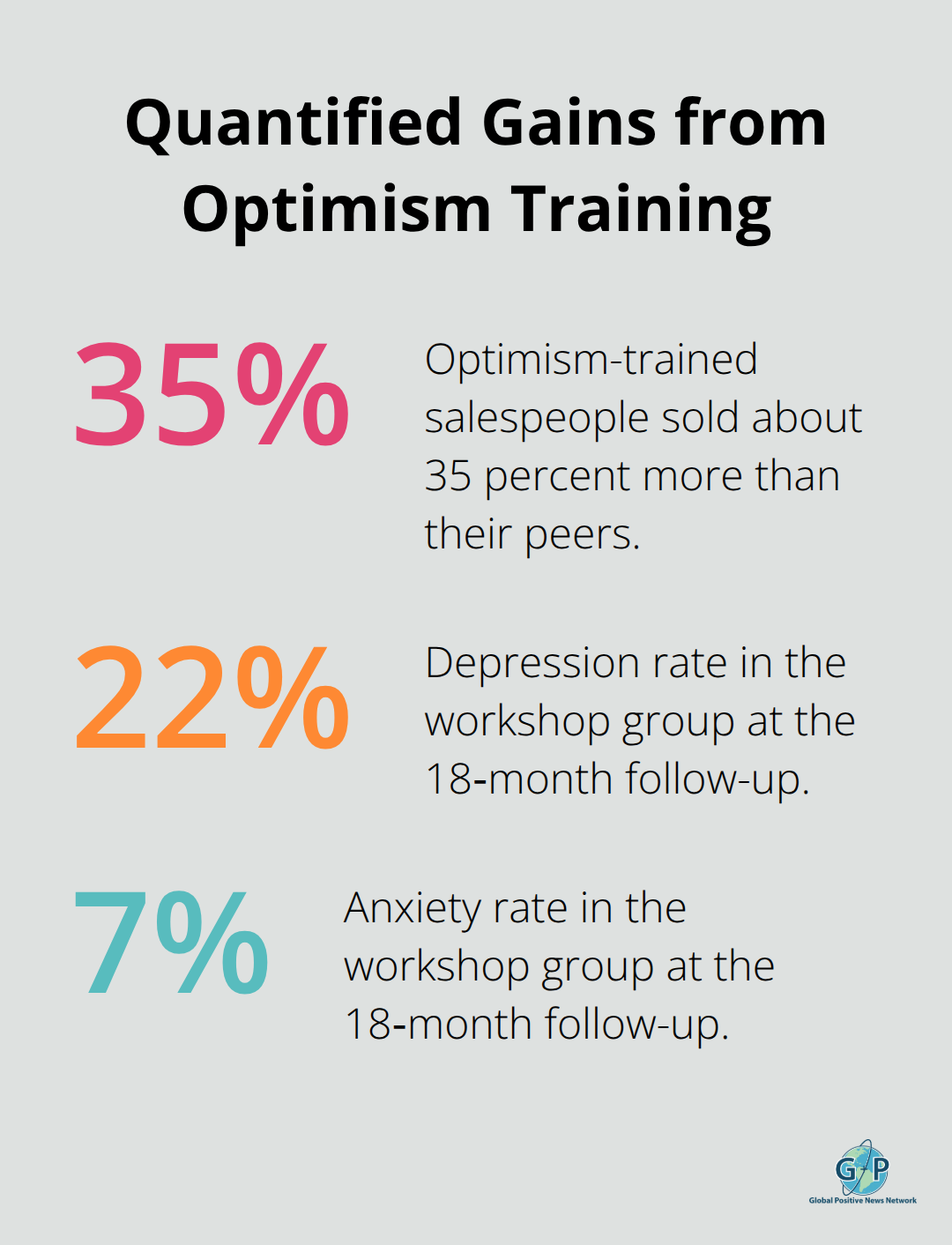
Peter Schulman at the Wharton School studied salespeople and found that those trained in optimism sold about 35 percent more than their peers. Pessimists were twice as likely to quit within their first year. The mechanism is straightforward: hopeful thinking activates your brain’s reward system, making you more persistent and creative when obstacles appear. Sales performance isn’t the only metric that shifts. A landmark study by Martin Seligman at the University of Pennsylvania tracked college freshmen who completed a 16-hour optimism workshop. At the 18-month follow-up, depression rates fell from 32 percent in the control group to 22 percent in the workshop group, and anxiety dropped from 15 percent to 7 percent.
Physical Health Protection Through Hope
The health payoff extends far beyond motivation. Hope physically protects your body by regulating cortisol, the stress hormone that damages health when chronically elevated. Hopeful individuals show reduced inflammation, improved immune response, better cardiovascular health, and superior sleep quality compared to those with pessimistic outlooks. Participants who received learned optimism training reported fewer health problems over the 18-month study period. This means cultivating hope isn’t just about feeling better emotionally-it’s a direct investment in your physical resilience.
The data proves that hope is teachable and that consistent practice produces measurable outcomes in mental health, physical wellbeing, and real-world performance. These neurological and physiological shifts open the door to practical strategies you can implement today to start building your own hopeful perspective.
How to Actually Build a Hopeful Mindset
Dispute Negative Thoughts With Written Evidence
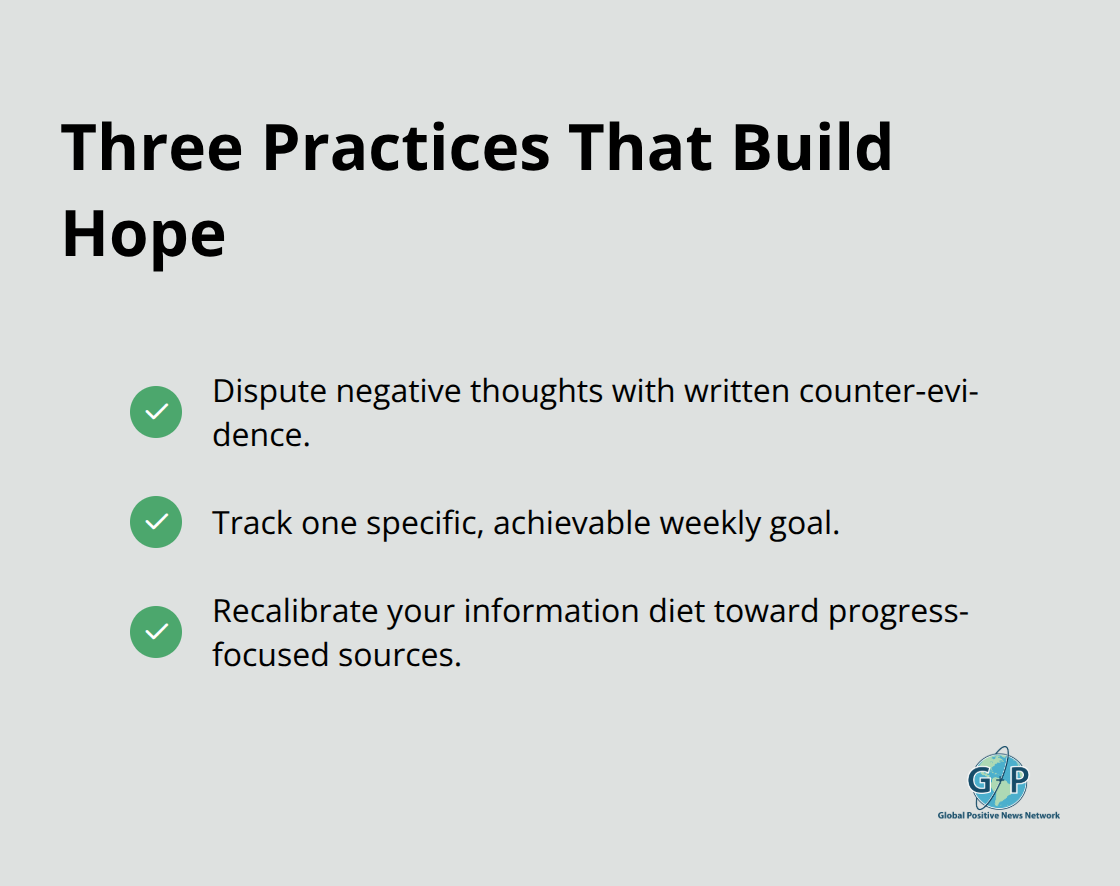
The gap between understanding hope works and actually practicing it is where most people fail. Knowing that optimism training produces measurable results means nothing if you don’t know what to act on Monday morning. Research shows that hope develops through specific, repeatable actions, not through motivation or willpower alone. Martin Seligman’s ABCDE framework provides a concrete method: when something negative happens, you identify the adversity, examine your automatic belief about it, note the consequences of that belief, dispute negative thoughts with counter-evidence, and finally energize yourself with a more realistic perspective. A study published through the American Psychological Association tracked this approach and found that participants who practiced disputation reduced their pessimistic interpretations of setbacks within weeks.
Disputation works best when you write it down. Journaling forces you to articulate exactly why your initial negative interpretation might be wrong, which engages your prefrontal cortex in active problem-solving rather than leaving you stuck in rumination. Start with one small setback per week and write three counter-arguments to your pessimistic thought. This single practice trains your brain to automatically generate alternative explanations instead of defaulting to self-blame or catastrophizing.
Track Small Wins to Build Momentum
Winning on small things compounds faster than most people realize. The mechanism is simple: achievable wins trigger dopamine release, which reinforces the neural pathways associated with agency and motivation. Set one specific, measurable goal each week that you can actually complete within seven days, then track it. Not a vague intention like “become more positive,” but something concrete like “have three conversations where I listen without planning my response” or “complete a 15-minute walk outside.” After you complete it, write down what happened and how you felt. This creates a personal evidence file that your brain references the next time pessimism creeps in.
Recalibrate Your Information Diet
Aggressively curate your information diet. The news cycle is engineered to trigger anxiety and outrage because those emotions drive engagement. If you spend 30 minutes daily consuming catastrophic headlines, your brain’s threat-detection system stays activated, making hopeful thinking neurologically harder. Replace one news source with content that curates stories of human progress and positive change without ignoring real challenges. This isn’t avoidance; it’s recalibrating your brain’s baseline toward reality instead of toward manufactured crisis.
These three practices-disputation, goal tracking, and information curation-work together to shift your neurological baseline. The next chapter explores how real people applied these exact strategies to transform their perspectives in the face of genuine adversity.
How Real People Built Hope From Nothing
Caretakers Transform Children’s Outcomes Through Shifted Perspective
Ylvisaker and Feeney’s research in Developmental Neurorehabilitation tracked caretakers of children with brain-function impairments who received learned optimism training. The striking finding: when caretakers shifted their own perspective toward possibility, the children’s functioning improved measurably. This demonstrates that hope isn’t solitary work-your mindset directly influences those around you. One caretaker stopped interpreting her child’s setbacks as permanent limitations and instead viewed them as opportunities to test new approaches. Within weeks, she noticed her child attempting tasks she’d previously avoided. The mechanism wasn’t magical thinking; it was the caretaker’s consistent reframing that created space for the child to attempt things previously labeled as impossible.
Salespeople Reverse Course With Concrete Tools
This pattern repeats across contexts. Peter Schulman’s research on salespeople revealed that pessimists quit at twice the rate of optimists, but the reverse is equally important: when pessimistic salespeople received optimism training, they stayed in their roles and performed better. One salesman in Schulman’s study had considered leaving sales entirely after a string of rejections. After learning the ABCDE disputation method, he stopped interpreting rejection as personal failure and started treating each no as data about that particular prospect, not about his capability. His sales numbers climbed 28 percent within three months, and more importantly, he stopped planning his exit. The training worked because it gave him a concrete tool to use immediately, not someday.
Clinics Mobilize Collective Hope Into Measurable Results
Community-level transformations follow the same principle: collective hope mobilizes energy toward shared goals. Organizations that implement hope-based practices see measurable shifts in engagement and outcomes. A primary-care clinic in Ohio tested hope-building interventions with patients struggling with depression. Instead of generic mental health advice, staff helped patients write down specific goals for symptom improvement and generate multiple pathways to reach them. After ten weeks, patients who completed this structured goal-setting were 40 percent more likely to seek additional treatment and reported significantly less severe depression. The intervention worked because it moved from abstract encouragement to concrete action-patients left appointments with written goals and specific next steps, not vague inspirational messages.
Small Actions Compound Faster Than Waiting
The research is unambiguous: small, specific actions compound faster than waiting for motivation or perfect conditions. Start with one disputation practice this week. Write down one small setback and three counter-arguments to your automatic negative thought. Track one achievable weekly goal. Replace one news source with content that reflects actual human progress. These aren’t massive life overhauls; they’re the exact interventions that shifted outcomes in every study cited here. Hope develops through repetition, not revelation.
Final Thoughts
Hope transforms through consistent action, not through waiting for perfect conditions. Martin Seligman’s 16-hour optimism training workshop produced lasting results at the 18-month mark, with depression rates dropping from 32 percent to 22 percent and anxiety falling from 15 percent to 7 percent. Peter Schulman’s salespeople showed performance gains within months, and primary-care patients in Ohio reported less severe depression after just ten weeks. These timelines prove you don’t need years to feel the effects of a more hopeful perspective.
Small actions compound faster than most people realize. One disputation exercise per week trains your brain to generate alternative explanations instead of defaulting to self-blame, while one tracked weekly goal builds momentum that carries forward. One curated news source replaces manufactured crisis with actual human progress, and none of these practices requires perfection or massive life changes-only repetition. Your brain rewires through neuroplasticity when you practice hopeful thinking patterns repeatedly, and that rewiring produces dopamine release that reinforces the behavior.
Start this week with one concrete action: write down one setback and three counter-arguments to your automatic negative thought, set one achievable goal and track it, or replace one news source with content that reflects genuine human progress. We at Global Positive News Network curate stories of personal triumphs, acts of kindness, and community impact to help you maintain an optimistic outlook, and you can explore these stories on our site to start consuming content that reflects what’s actually working in the world. Hope develops through action, not through waiting-that moment is now.
Having a hard day?
The 2 Minute Hope Reset is a short free guide with three small practices for the days that feel heavy. Two minutes each, nothing to keep up with.
Get the free guideExplore more positive news:
Enjoying stories like this?
Global Positive News Network is reader-supported. If you’d like to support the mission, you can visit the Official GPNN store.