
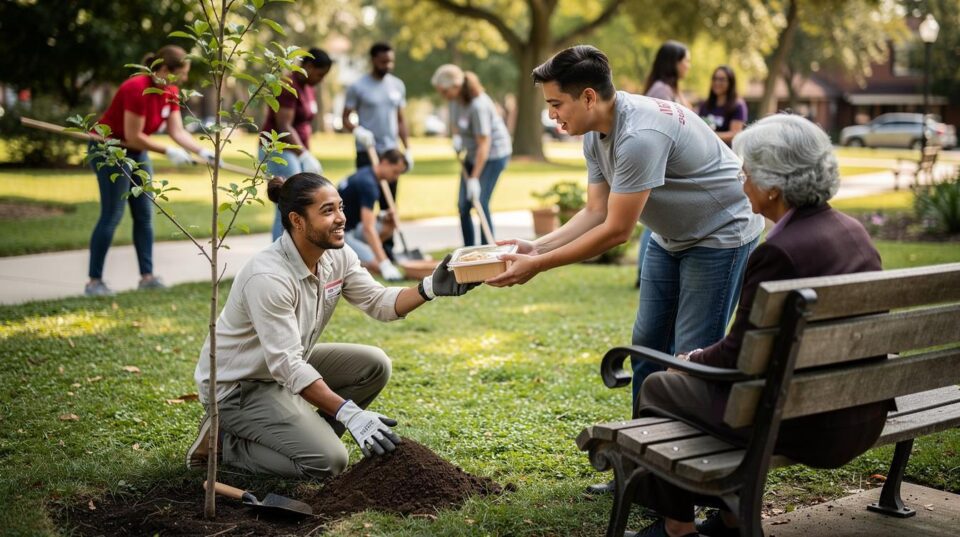
Most social change doesn’t come from politicians or celebrities. It comes from regular people who decide their communities matter more than their comfort.
At Global Positive News Network, we’ve seen courageous citizen stories transform neighborhoods, challenge injustice, and inspire thousands. This blog post shows you exactly how ordinary individuals create measurable impact and what you can learn from them.
Ordinary People, Extraordinary Actions
Volunteers Transform Numbers Into Real Change
Community volunteers logged over 5.4 billion volunteer hours in 2023, according to the Bureau of Labor Statistics. That’s not abstract goodwill-it translates to tangible action. Sarah Chen, a former accountant in Portland, Oregon, spent three years building a job training program for formerly incarcerated individuals. Her program placed 247 people into stable employment, which research from the RAND Corporation shows reduces recidivism rates by 13 percent. She didn’t wait for funding or permission. She started with her own network and a spreadsheet.
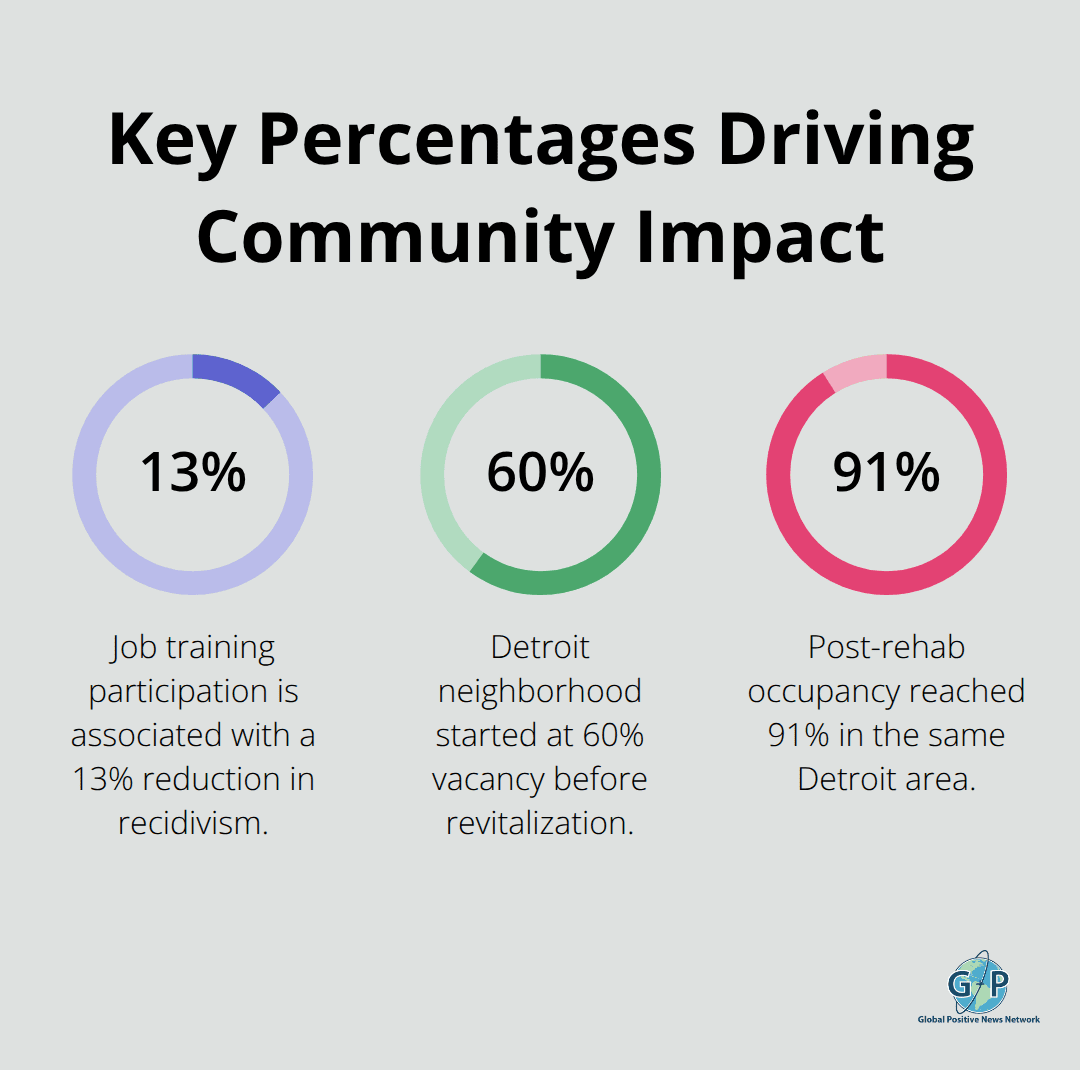
Marcus Williams in Detroit took on the city’s abandoned property crisis single-handedly. Instead of complaining about blight, he organized neighbors to rehabilitate 89 vacant homes over five years, turning a 12-block radius from 60 percent vacancy into 91 percent occupancy. The American Volunteering Survey found that volunteers who take on leadership roles like Marcus did report higher life satisfaction and stronger community bonds than those who only donate money.
Personal Sacrifice Creates Systems That Last
Individual sacrifice matters because it creates systems that outlast the person. Dr. Erin McKee, a retired teacher in rural Kentucky, noticed her county had zero domestic violence shelters. She spent her retirement savings-$47,000-to open the first one in 2019. Today it serves 340 women annually and operates on a $520,000 annual budget funded by grants and community donations she cultivated.
The key difference between people who create lasting change and those who don’t isn’t resources-it’s persistence through the uncomfortable parts. McKee spent 18 months navigating zoning laws, licensing requirements, and fundraising before opening the doors. She didn’t need permission from authorities; she needed documentation, patience, and a willingness to be uncomfortable.
Data from the Stanford Social Innovation Review shows that successful community initiatives came from people who had no prior nonprofit experience. They succeeded because they focused on solving one specific problem rather than trying to fix everything. These ordinary citizens didn’t possess special credentials or connections. They possessed clarity about what their communities needed and the willingness to act on it.
How Everyday Heroes Inspire Others
One Action Sparks Multiple Responses
When one person acts, others notice. Sarah Chen’s job training program in Portland didn’t just change 247 lives-it sparked a movement. Within two years of her success, three other community members launched similar programs in adjacent neighborhoods. The American Psychological Association found that performing acts of generosity boosts happiness and well-being. This isn’t theoretical. People see results and think, “I could do that too.”
Marcus Williams rehabilitated 89 homes in Detroit and created a measurable shift in how neighbors viewed their own power. Residents who watched his transformation moved from passive frustration about blight to active participation in community improvement projects. His actions didn’t inspire vague feelings of hope-they demonstrated a specific, replicable method that others could adopt.
Documentation Accelerates the Spread
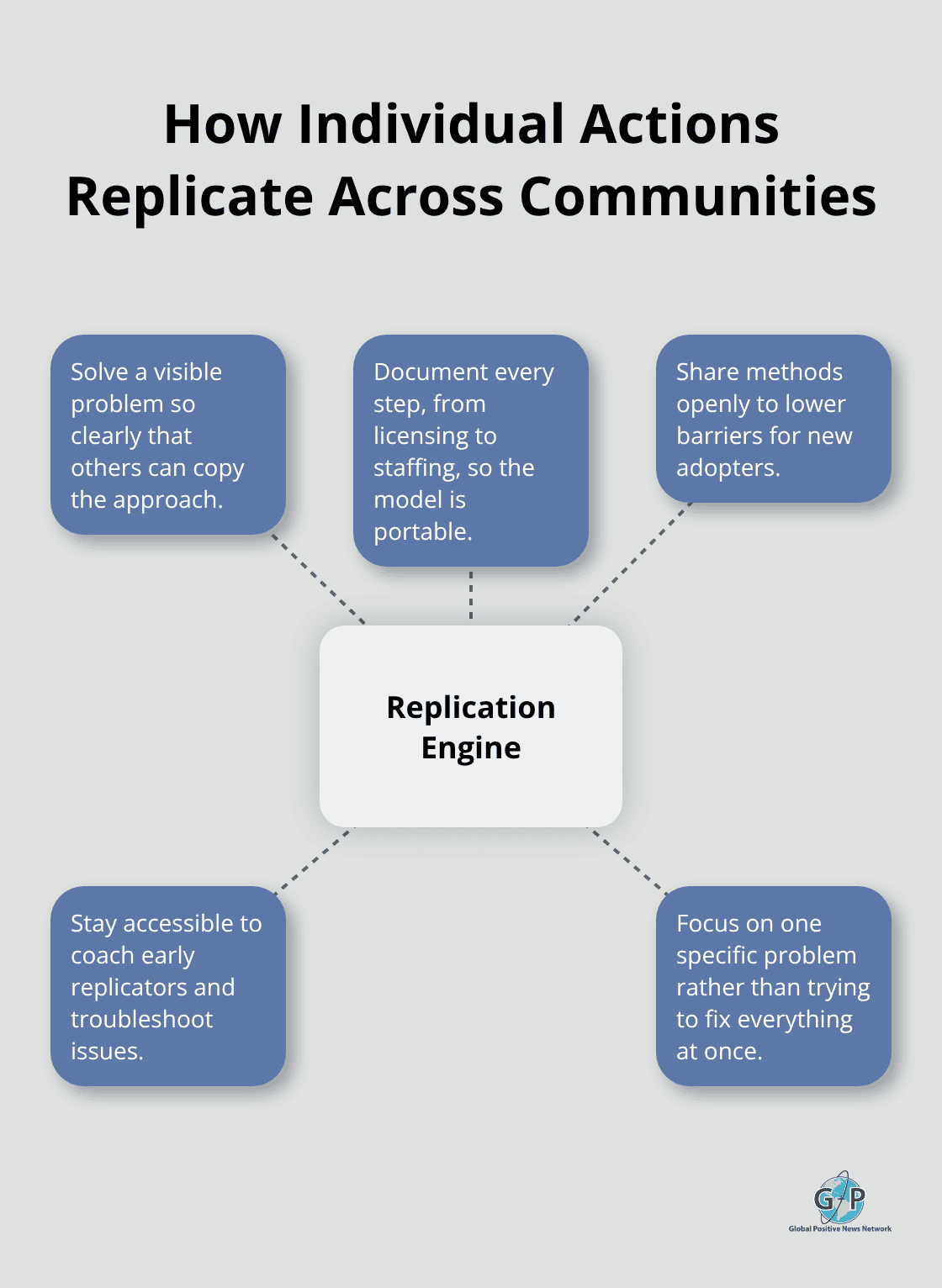
The multiplication happens fastest when the original action solves a real problem people can see. Dr. Erin McKee’s domestic violence shelter in Kentucky opened doors in 2019, and within three years, two counties nearby opened their own facilities using her operational model. She documented everything (licensing steps, fundraising strategies, staffing approaches) and shared it freely.
This matters because most people don’t start movements by announcing grand visions. They start by solving one concrete problem so visibly that others can copy the approach. Research from the Center for Social Impact Strategy shows that 73 percent of successful community initiatives spread to other areas within five years, but only when the founder actively shared their methods rather than keeping them proprietary. The ripple isn’t automatic. It requires the original person to document what worked, share it openly, and stay accessible to people trying to replicate it.
Systems Outlast Individual Founders
When volunteers take on leadership roles and create systems instead of just performing tasks, communities develop what researchers call institutional resilience-the ability to sustain positive change even when the original founder moves on. This is why individual courage transforms into movements. One person solves a problem. Others see it works. They adapt it to their context. Suddenly, what started as one person’s sacrifice becomes dozens of people’s action.
These patterns reveal something critical about what happens next: communities with strong citizen-led initiatives don’t just improve temporarily. They build the infrastructure and confidence to tackle their next challenge.
Real-World Impact and Measurable Results
Numbers That Prove Citizen Power Works
Citizen initiatives produce measurable outcomes that transform how we understand community power. Sarah Chen’s job training program in Portland placed 247 people into stable employment over three years. That’s 247 individuals who moved from incarceration to paycheck stability.
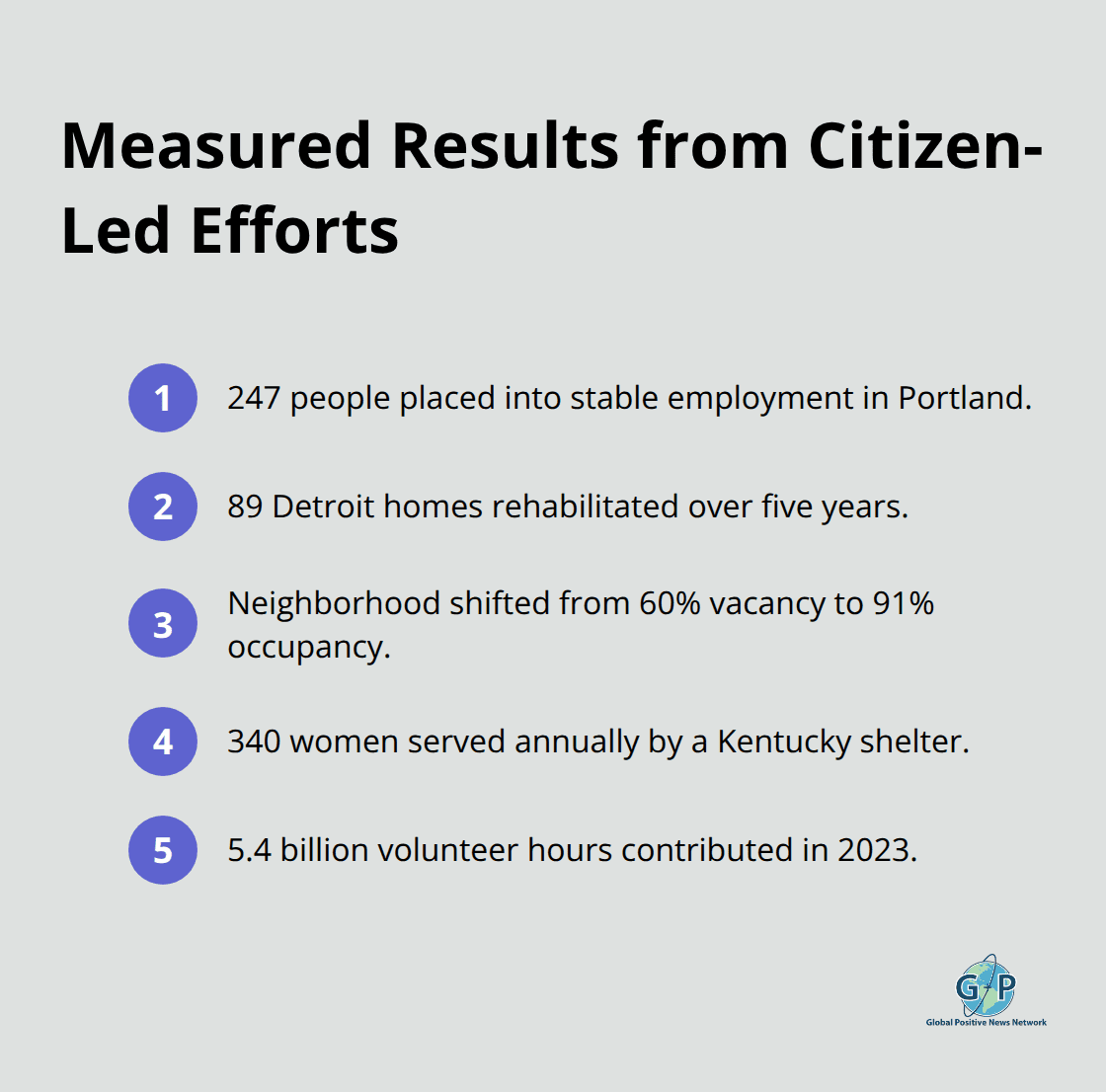
The RAND Corporation research showing a 13 percent reduction in recidivism means those 247 people represent roughly 32 fewer individuals returning to the criminal justice system. Marcus Williams rehabilitated 89 homes in Detroit, shifting his neighborhood from 60 percent vacancy to 91 percent occupancy in five years. That’s not theoretical improvement-it’s concrete real estate transformation that affected hundreds of residents and their property values.
Dr. Erin McKee’s domestic violence shelter in rural Kentucky now serves 340 women annually on a $520,000 budget she built from zero. These aren’t exceptional outliers. The Bureau of Labor Statistics reports that volunteers contributed 5.4 billion hours in 2023, which translates to economic value using standard volunteer hourly rates. This economic output came from people who weren’t professional nonprofit executives or government administrators-they were accountants, teachers, and neighbors who decided their communities needed action.
How Individual Courage Scales Into Systems
The multiplication happens because individual courage creates systems that scale. When Dr. McKee documented her shelter’s operational model and shared it freely, two adjacent counties opened facilities using her exact approach within three years. That’s replication, not inspiration. The Center for Social Impact Strategy found that 73 percent of successful community initiatives spread to other areas within five years, but only when founders actively documented and shared their methods rather than keeping them proprietary.
Communities with strong citizen-led initiatives don’t just solve one problem temporarily-they build institutional resilience that tackles their next challenge. Volunteers who take leadership roles report higher life satisfaction than those who only donate money, according to the American Volunteering Survey. This matters because sustained change requires people who stay engaged, and people stay engaged when they see tangible results and feel genuine ownership over the outcome.
Why Sustained Engagement Predicts Long-Term Success
The data point isn’t feel-good sentiment. It’s a predictor of whether a volunteer will continue their work for years or abandon it after months. Citizen-led change succeeds because ordinary people focus on solving one specific problem so visibly that others can copy the approach, adapt it to their context, and build something larger than the original effort. When one person acts with clarity and documents what works, the multiplication accelerates across multiple communities (and sometimes across entire regions).
Final Thoughts
Ordinary people throughout this blog post refused to accept their communities as they were, and that refusal changed everything. Sarah Chen trained formerly incarcerated workers without permission. Marcus Williams rehabilitated abandoned homes without city funding. Dr. Erin McKee opened a domestic violence shelter without credentials. They acted because the need was real, and their willingness to be uncomfortable mattered more than their comfort.
Social change doesn’t require wealth, political connections, or a nonprofit background-it requires clarity about one specific problem your community faces and the persistence to solve it visibly enough that others can replicate your approach. The multiplication happens when you document what works and share it freely, when you focus on solving one concrete problem rather than trying to fix everything at once, and when you stay engaged long enough to build systems that outlast your initial effort. The data proves this: 73 percent of successful community initiatives spread to other areas within five years, but only when founders actively shared their methods.
Starting your own impact doesn’t require a grand announcement or a massive budget. Identify what your neighborhood actually needs, take one concrete action that solves part of that problem, and document how you did it so others can adapt your approach. We at Global Positive News Network share courageous citizen stories because they prove that individual action in a connected world creates real change.
Having a hard day?
The 2 Minute Hope Reset is a short free guide with three small practices for the days that feel heavy. Two minutes each, nothing to keep up with.
Get the free guideExplore more positive news:
Enjoying stories like this?
Global Positive News Network is reader-supported. If you’d like to support the mission, you can visit the Official GPNN store.