

Gratitude isn’t just a feel-good emotion-it’s a measurable tool for building mental toughness. Research shows that people who practice appreciation regularly demonstrate greater stress resilience and emotional stability.
At Global Positive News Network, we’ve found that resilience through gratitude works because it shifts how your brain processes challenges. This blog post reveals the science, practical techniques, and real-world examples that prove appreciation fuels endurance.
How Gratitude Physically Rewires Your Brain for Stress
Activation of Key Brain Regions
Gratitude activates specific brain regions that directly counteract stress responses. When you practice appreciation, your medial prefrontal cortex, anterior cingulate cortex, ventral striatum, and insula light up simultaneously, according to neuroscience research from the American Brain Foundation. These areas control higher-order thinking, emotional awareness, and motivation. The limbic system and hypothalamus respond to gratitude by releasing serotonin and dopamine-neurochemicals that lift mood and drive. This isn’t abstract neurology; it’s a measurable shift in brain chemistry that occurs every time you genuinely appreciate something.
How Gratitude Reduces Stress Reactivity
The amygdala, your brain’s alarm system, becomes less reactive to stress when you build a consistent gratitude habit. Regular practice actually reduces amygdala reactivity, meaning future stressors trigger smaller emotional responses. Your parasympathetic nervous system activates during gratitude, lowering cortisol levels and supporting digestion, immune function, and sleep quality. This physiological state directly opposes the fight-or-flight response that chronic stress creates.
The Indirect Path to Resilience
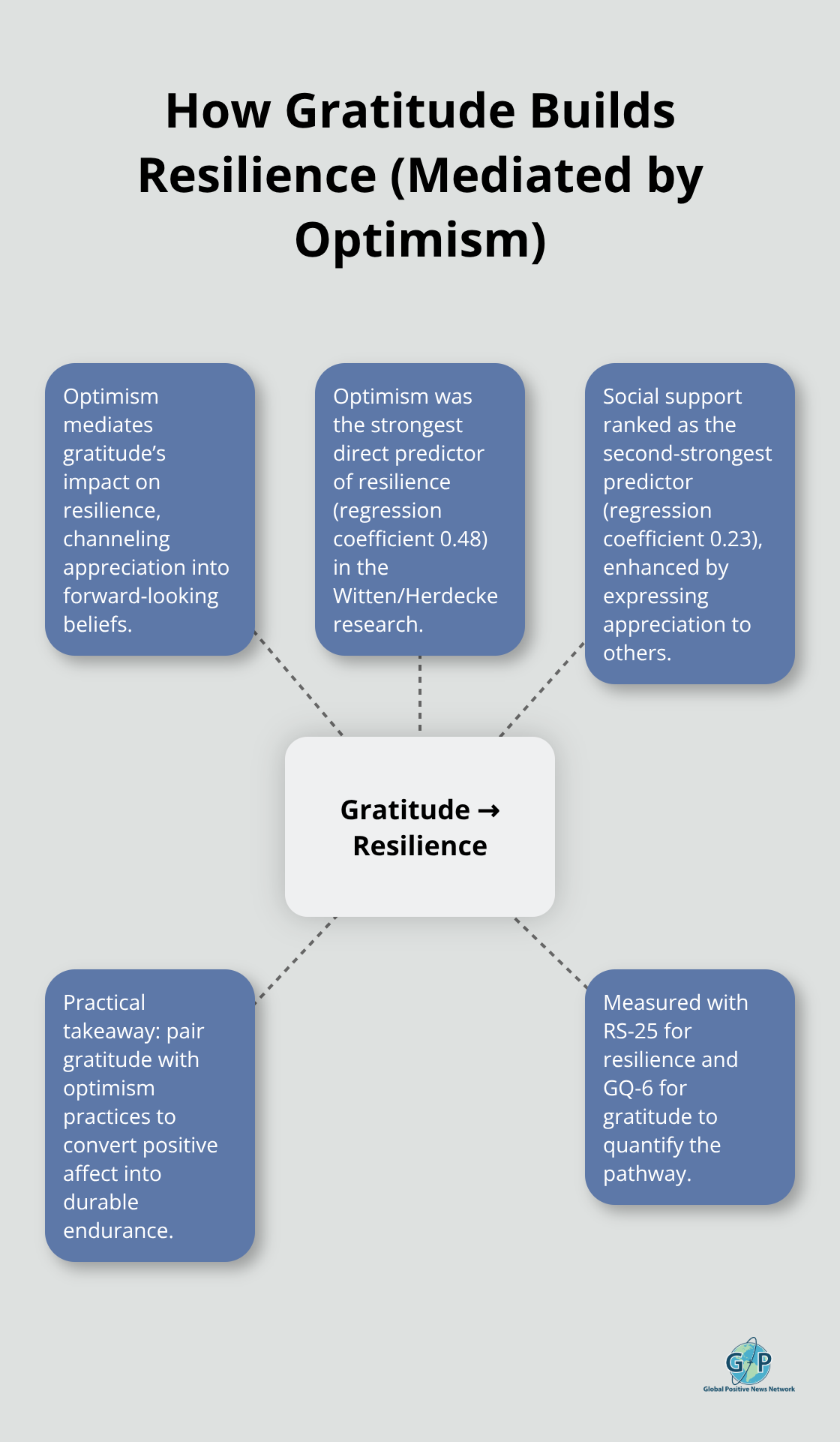
Research from Witten/Herdecke University studied 90 preclinical medical students and found that gratitude influenced resilience indirectly rather than directly. The study measured resilience using the RS-25 scale and gratitude through the GQ-6 assessment, discovering that gratitude’s main pathway to resilience operated through optimism. Optimism showed the strongest direct association with resilience among all factors studied, with a regression coefficient of 0.48. This means if you want to build genuine endurance, focusing solely on gratitude journaling misses the point-you need gratitude to fuel optimism, which then builds resilience.
Evidence Across Diverse Populations
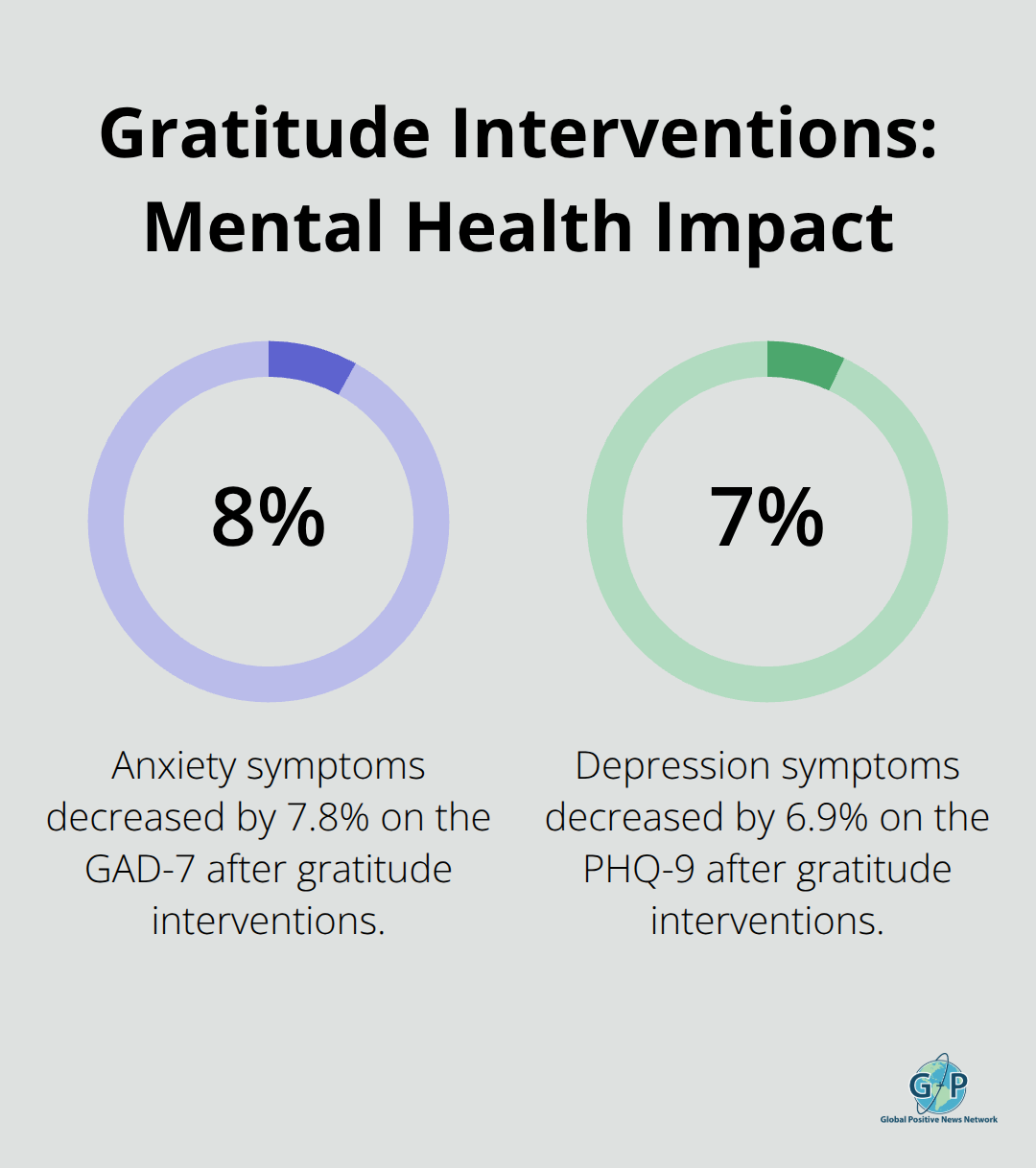
A meta-analysis examining 64 randomized trials found that gratitude interventions decreased anxiety symptoms by 7.8% and depression symptoms by 6.9%, measured on the GAD-7 and PHQ-9 scales respectively. These improvements occurred across diverse populations including children, older adults, and patients with chronic illnesses.
The interventions themselves required minimal effort: gratitude diaries, written expressions, verbal appreciation to others, or simple reflection. Medical students in the Witten/Herdecke study exhibited particularly high gratitude scores yet lower resilience than students in other disciplines, suggesting that stress exposure and sleep disturbances can overwhelm gratitude’s protective effects unless paired with optimism-building practices.
Understanding how gratitude rewires your brain sets the stage for the practical techniques that actually transform this knowledge into lasting resilience.
How to Actually Practice Gratitude for Resilience
The gap between knowing gratitude helps and actually building resilience through it comes down to execution. Research shows that gratitude interventions work, but only when you practice them consistently. The meta-analysis found that patients who underwent gratitude interventions experienced greater feelings of gratitude and better mental health. However, the Witten/Herdecke University study revealed something critical: gratitude alone doesn’t guarantee resilience. Medical students with high gratitude scores still showed lower resilience than their peers in other disciplines, suggesting that appreciation must connect to optimism to create lasting toughness. This means your gratitude practice needs structure and intention, not just good intentions.
Write for Clarity, Not Just Reflection
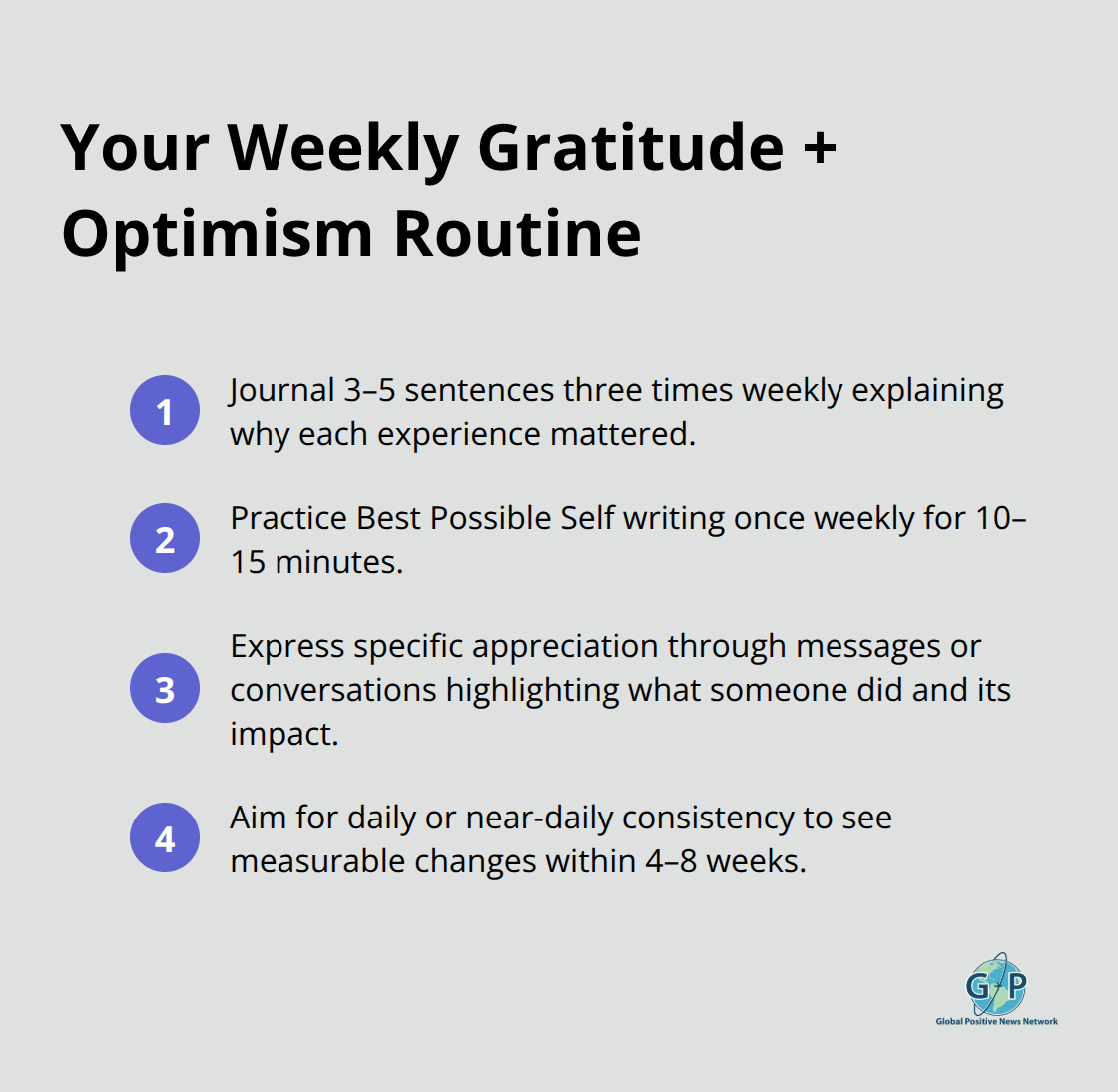
Gratitude journaling works best when you move beyond vague entries. Instead of writing what you’re grateful for, write why it matters and how it changed your perspective. The Three Good Things technique, studied by Lai and colleagues, asks you to identify three positive experiences daily and explain why each one happened. This specific approach generates measurable improvements in wellbeing because it forces your brain to construct meaning rather than simply list items. Try three to five sentences per entry, focusing on concrete details and the emotional or practical impact. Studies show consistency matters more than duration; fifteen minutes three times weekly produces better results than sporadic hour-long sessions. The American Brain Foundation recommends self-appreciation as part of your practice, which means acknowledging your own efforts and decisions, not just external circumstances. This reframes your relationship with challenges through recognition of your agency in navigating them.
Express Appreciation to Strengthen Your Network
Telling someone you appreciate them activates different neural pathways than journaling alone. Research by Williams and Bartlett found that gratitude expressions strengthen social bonds and warmth in relationships, which directly supports resilience because social support ranked as the second-strongest predictor of endurance in the Witten/Herdecke study with a regression coefficient of 0.23. Write specific thank-you notes or messages that highlight exactly what someone did and how it affected you. Include appreciation in regular conversations without waiting for special occasions. Verbal expressions during meetings or casual interactions count; you don’t need formal letters. This matters because it means you can build resilience while strengthening your community, creating a compounding effect. People who receive genuine appreciation become more likely to support you during difficult periods, establishing the social safety net that resilience research consistently identifies as essential.
Pair Gratitude With Optimism Practices
Since the Witten/Herdecke research proved that optimism mediates gratitude’s effect on resilience, you should integrate optimism-building techniques into your routine. Best Possible Self writing, studied by King and colleagues, asks you to imagine your ideal future across different life areas and write detailed descriptions of that version. Complete this exercise weekly for ten to fifteen minutes, focusing on realistic yet positive outcomes. This practice strengthens the neural pathways that gratitude activates while directing them toward forward momentum rather than just appreciation of the present. Combine it with your gratitude journal, dedicating one session weekly to reflecting on progress toward those imagined futures. The research indicates this combination amplifies resilience effects beyond either practice alone. Consistency remains non-negotiable; sporadic practice produces minimal results, but daily or near-daily engagement creates measurable changes within four to eight weeks.
The real test of these practices emerges when you face actual setbacks and obstacles. Real-world examples demonstrate how people translate gratitude and optimism into genuine resilience when circumstances demand it most.
Gratitude in Action
Athletes Transform Setbacks Into Momentum
Athletes demonstrate that gratitude functions as a performance tool, not merely an emotional practice. Tennis champion Serena Williams attributed her comeback from injury setbacks to appreciating small improvements in her physical recovery rather than fixating on lost ranking points. This shift from outcome focus to process appreciation aligns with research showing that gratitude reduces amygdala reactivity, enabling athletes to maintain emotional stability during competitive pressure. When Williams acknowledged her medical team’s efforts and her body’s capacity to heal, she constructed the optimistic narrative necessary for resilience. Elite coaches now integrate appreciation practices into training routines, asking athletes to identify three specific improvements from each session rather than dwelling on failures. This technique mirrors the Three Good Things approach studied by Lai and colleagues, which generates measurable wellbeing gains by forcing the brain to construct meaning from experience. Runners, cyclists, and weightlifters report that this practice accelerates recovery from both physical and psychological setbacks because it reorients their nervous system away from the stress response that injuries trigger.
Professionals Rebuild Careers Through Appreciation and Vision
Professionals rebuilding careers after job loss or major failure frequently credit gratitude combined with optimism for their return to stability. A marketing director laid off during economic downturn spent three months practicing Best Possible Self writing, imagining detailed scenarios of her ideal career trajectory across different companies and roles. This practice, studied by King and colleagues, strengthened her neural pathways for forward momentum while gratitude journaling kept her grounded in recognizing her existing skills and past successes. She secured a senior position within six months, attributing the shift to maintaining emotional resilience rather than desperation during interviews. Research from Witten/Herdecke University showed that optimism emerged as the strongest predictor of resilience, meaning professionals who pair gratitude with concrete future visualization outperform those using gratitude alone. Workplace cultures that encourage appreciation expressions strengthen social support networks, which ranked second in the resilience prediction model. Companies implementing team gratitude practices report lower turnover and higher employee engagement because appreciation expressions create psychological safety and strengthen the bonds necessary for supporting colleagues through difficult projects or organizational changes.
Communities Rebuild Faster Through Shared Appreciation
Communities facing collective challenges demonstrate that shared appreciation practices generate measurable resilience at scale. Neighborhoods affected by natural disasters that organized group reflection sessions focusing on mutual aid and appreciation for neighbors’ contributions rebuilt faster than those without such practices. These sessions activated the same neural pathways as individual gratitude but created shared identity and commitment to collective recovery. The anxiety reduction documented across 64 randomized trials by Diniz and colleagues, averaging 7.8% improvement on the GAD-7 scale, compounds when communities practice together because individual neurochemical shifts combine with strengthened social bonds. Local organizations that institutionalized appreciation expressions through regular community meetings or appreciation boards report sustained engagement in rebuilding efforts, suggesting that structured appreciation practices prevent the emotional burnout that typically derails long-term recovery initiatives.
Final Thoughts
Gratitude creates a foundation for long-term resilience by rewiring how your brain responds to stress while simultaneously strengthening the social connections that sustain you through difficulty. When you pair gratitude with optimism practices, you generate measurable improvements in anxiety, depression, and emotional stability across diverse populations. Medical students, athletes, professionals, and entire communities have demonstrated that consistent appreciation practices produce tangible results within weeks, not months.
Starting your practice requires minimal resources but demands consistency. Write three to five sentences in your gratitude journal three times weekly, explaining why specific experiences matter and how they shifted your perspective. Pair this with Best Possible Self writing once weekly, imagining detailed scenarios of your ideal future across different life areas, and express specific appreciation through messages or conversations that highlight exactly what someone did and how it affected you.
Resilience through gratitude strengthens when you commit to it consistently and weakens when you abandon it. The athletes, professionals, and communities featured in this post transformed their resilience through daily or near-daily engagement with appreciation and optimism practices. Your first step happens today: choose one practice and commit to it for four weeks, then explore additional resources at Global Positive News Network to deepen your practice and strengthen the communities and relationships around you.
Having a hard day?
The 2 Minute Hope Reset is a short free guide with three small practices for the days that feel heavy. Two minutes each, nothing to keep up with.
Get the free guideExplore more positive news:
Enjoying stories like this?
Global Positive News Network is reader-supported. If you’d like to support the mission, you can visit the Official GPNN store.