
How you start your morning shapes everything that follows. The first hour sets your mental tone, influences your productivity, and determines whether you approach the day with optimism or stress.
At Global Positive News Network, we’ve seen how daily positivity prompts transform morning routines into powerful mental health practices. This guide shows you exactly how to build a sustainable practice that works for your life.
Why Your Morning Sets Your Mental Health for the Entire Day
Your morning mood directly affects your productivity, decision-making, and how you treat others. Why Your Morning Sets Your Mental Health for the Entire Day research from the University of Toronto found that people who started their day with positive intentions completed tasks faster, with mental sharpness translating into a productivity boost equivalent to about 40 extra minutes of work. This isn’t coincidence. Your brain enters a neuroplastic state in the first hour after waking, meaning it’s uniquely receptive to new patterns and beliefs. When you fill that window with intentional positivity instead of checking emails or scrolling social media, you literally rewire how your nervous system responds to stress throughout the day. Morning exercise alone increases dopamine levels for up to 12 hours, but combining movement with deliberate positive reflection amplifies that effect significantly. The difference between people who thrive and those who merely survive often comes down to what they do in the first 60 minutes after waking.
Morning Positivity Directly Improves Work Performance
People who practice morning gratitude and intention-setting show measurable improvements in focus and task completion. A study by the American Psychological Association found that workers who spent 10 minutes on a morning positivity practice made fewer errors and showed higher productivity rates. This translates to real outcomes: better quality work, fewer mistakes that require rework, and faster project completion. Your morning routine determines whether you approach challenges with a growth mindset or a fixed one. When you start with affirmations and reflective prompts, you prime your brain to see obstacles as solvable problems rather than threats. This neurological shift affects everything from how you handle a difficult colleague to how you approach a project deadline.
Long-Term Health Benefits Compound Over Months
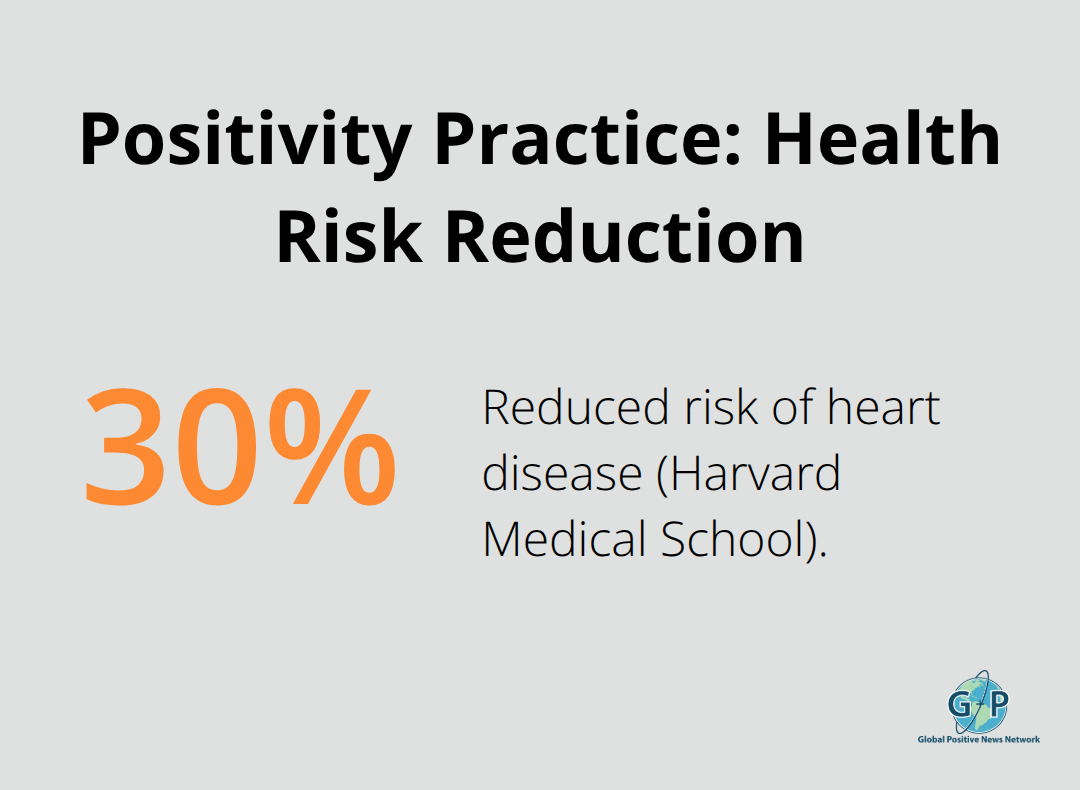
Consistent morning positivity practices reshape your health trajectory over time. People who maintain positive morning routines for three months or longer show reduced cortisol levels (the stress hormone), lower blood pressure, and better sleep quality the following night. This creates a positive feedback loop: better sleep leads to better mornings, which lead to better days, which lead to better sleep. Research from Harvard Medical School indicates that sustained positivity practices reduce the risk of heart disease by 30% and lower anxiety disorders. These aren’t small improvements. Over a year, someone practicing daily morning positivity prompts experiences measurable changes in immune function, inflammation markers, and overall resilience.
The investment in 10 minutes each morning compounds into years of better mental and physical health.
What Happens When You Skip This Practice
Most people underestimate how much their morning choices ripple through their entire day. When you skip your morning positivity practice, your nervous system defaults to reactive mode. You respond to emails, notifications, and demands rather than setting your own direction. Cortisol levels spike higher and stay elevated longer when you start your day without intention. Your brain lacks the neurological foundation it needs to handle stress effectively. The good news: you don’t need hours to reverse this pattern. Even 10 minutes of deliberate morning positivity creates measurable shifts in how you think, feel, and perform. This is where practical prompts become your most valuable tool.
The Four Prompt Categories That Actually Work
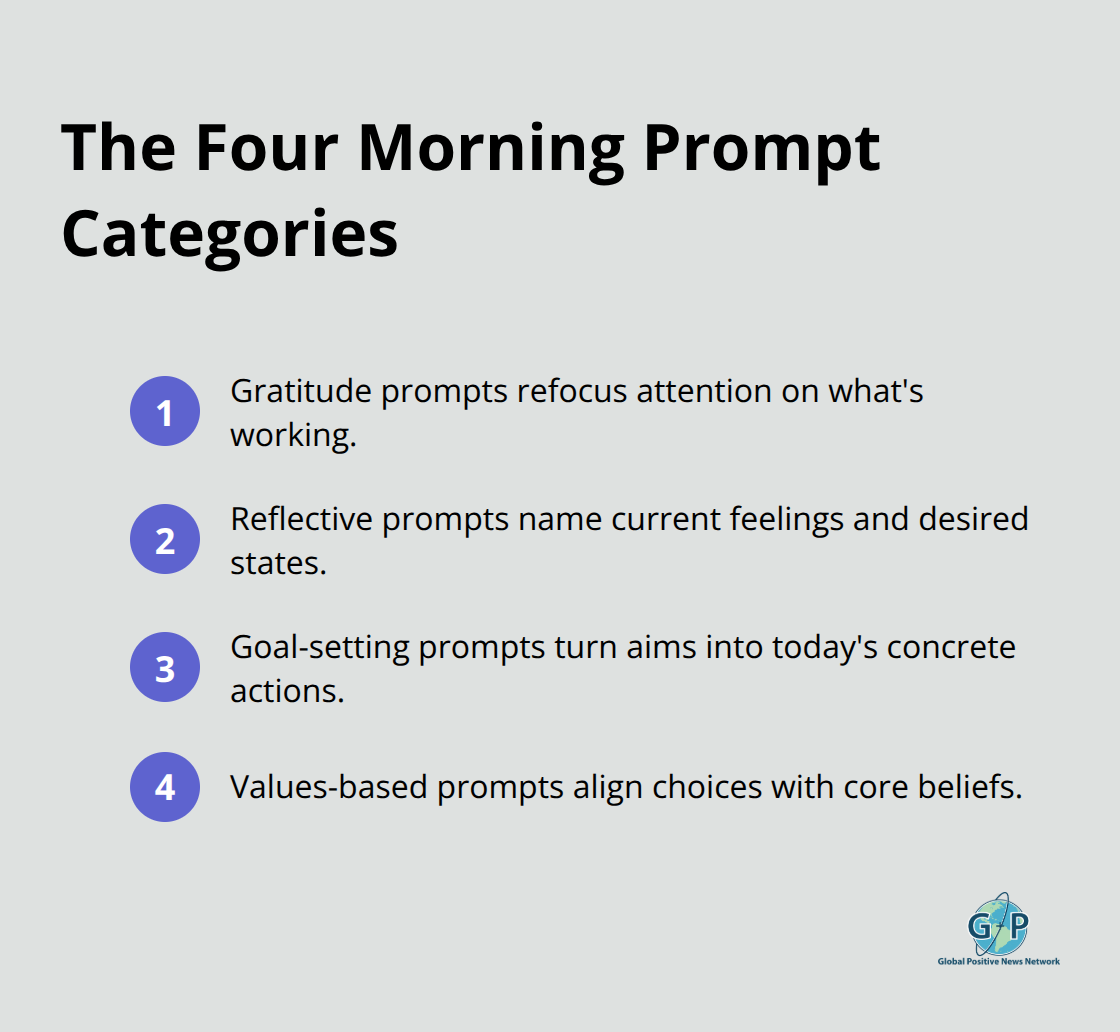
Start your morning with prompts that target specific mental outcomes rather than vague reflection. Organize your practice into four categories, each designed to activate different parts of your brain and set distinct emotional tones for your day.
Gratitude Prompts Rewire Your Attention
Gratitude prompts train your brain’s reticular activating system to notice evidence of good things, which changes what you perceive throughout the day. Ask yourself what three specific things happened yesterday that brought you genuine satisfaction, or identify ten aspects of your current life you actively enjoy rather than take for granted. This isn’t positive thinking theater-your brain literally shifts its focus toward what’s working when you practice gratitude consistently. The more you ask these questions, the more your mind searches for evidence of good things happening around you.
Reflective Prompts Build Emotional Intelligence
Reflective prompts force you to name exactly what you feel in this moment and what emotions you want to experience by day’s end. Most people operate on autopilot, never actually identifying their emotional state until a crisis forces awareness. This clarity matters because you can’t manage what you don’t acknowledge. When you reflect on your current feelings and desired emotional state, you create space between impulse and action-the foundation of emotional resilience.
Goal-Setting and Values-Based Prompts Drive Action
Goal-setting prompts transform abstract aspirations into today’s concrete actions by asking what single step moves you toward your ideal outcome and what micro-habits make progress easier. Values-based prompts anchor your daily choices to your core beliefs, asking which three qualities matter most to you and how your talents can contribute something meaningful to the world today. Together, these categories connect your deepest priorities to your immediate actions.
The Research-Backed Structure That Works
Structured prompts across these categories showed measurable improvements in mood, focus, and decision-making. The key is selecting one to three prompts from a single category for a focused five to ten minute session rather than mixing all four categories every morning, which creates cognitive overload instead of clarity. Your setup matters too-use a quiet space with minimal distractions, pair your prompts with coffee or tea, and write your answers by hand rather than type, as handwriting creates stronger neural pathways and memory retention.
Adapt Your Practice to Your Current Needs
Consistency beats perfection here. A person who answers one gratitude prompt daily for thirty days experiences more measurable mood improvement than someone who sporadically answers five prompts. Start with whichever category resonates most strongly with your current life situation, then rotate through others as your practice deepens. If you struggle with motivation, begin with goal-setting prompts that identify what excites you today. If anxiety dominates your mornings, reflective prompts help you acknowledge those feelings and plan specific responses (rather than suppress them). The framework adapts to you, not the other way around. Once you establish which prompts work best for your mornings, you’re ready to build the sustainable routine that keeps this practice alive beyond the first week.
Making Your Morning Practice Stick
The hardest part of morning positivity isn’t understanding why it works-it’s maintaining the habit when life gets chaotic. Most people start strong for three days, then drift back to their old routine. The difference between people who build a lasting practice and those who abandon it comes down to one thing: removing friction from the process.
Set Up Your Space to Eliminate Excuses
Your morning already competes with emails, notifications, and the mental fog of waking up. If your positivity practice requires you to search for prompts, find your journal, or decide what to do, you’ll skip it. Instead, set up your space the night before so everything sits waiting for you. Place your journal and pen on your nightstand or kitchen table alongside your coffee setup. Write your chosen prompts directly into your journal so you’re not hunting for them at 6 a.m. when your brain isn’t fully awake.
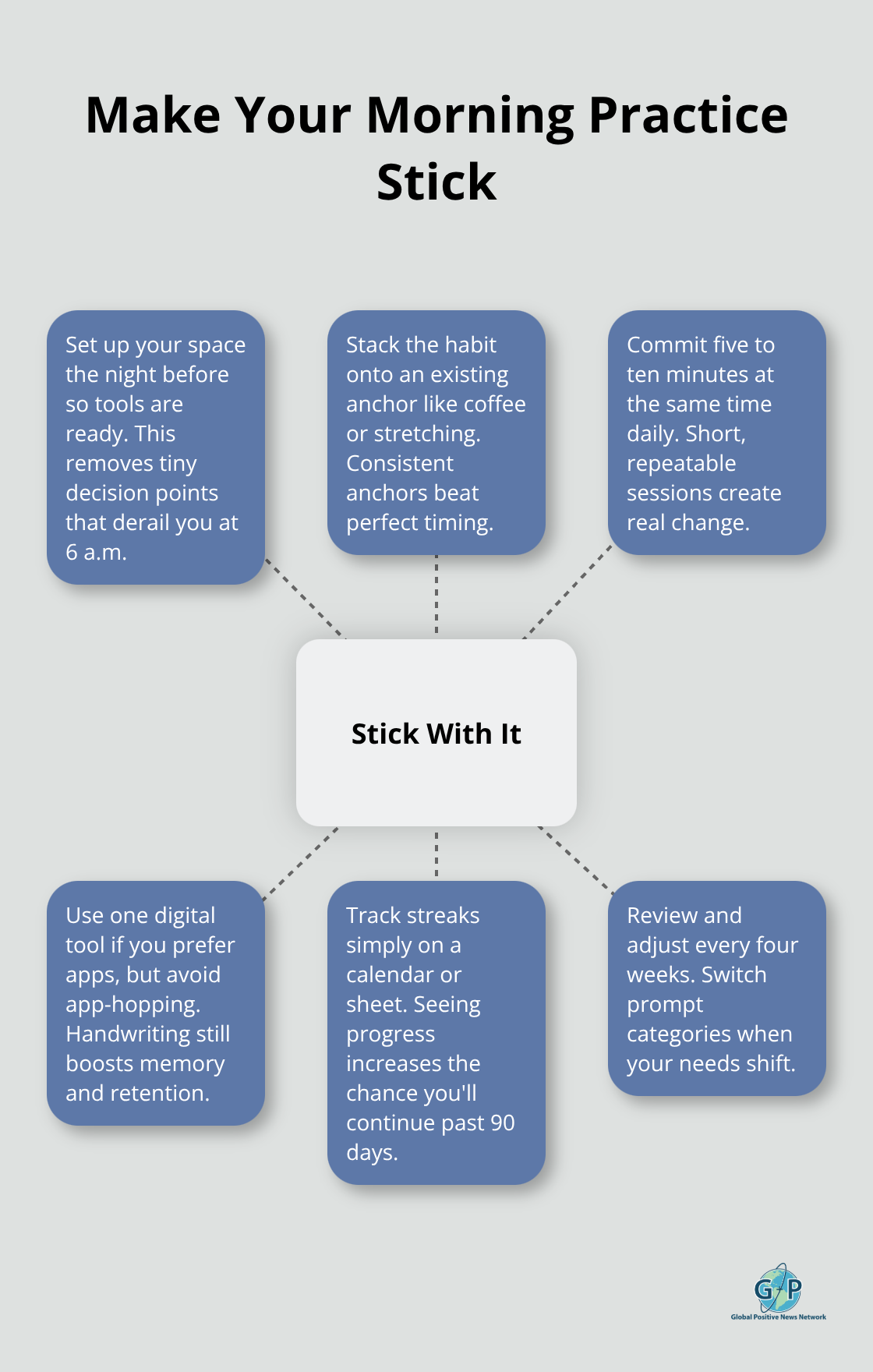
Habit stacking-attaching your new behavior to an existing routine-is a simple and effective way to build new routines. Pair your prompts with something you already do every morning: after your first coffee, after you stretch, or immediately after you sit down at your desk. The timing matters less than the consistency of the anchor.
Commit to a Realistic Time Frame
Most people succeed when they commit to five to ten minutes at the same time each day, which is short enough to feel manageable even on rushed mornings and long enough to create genuine mental shifts. Start with one category of prompts for a full month before rotating to another. This removes decision fatigue and builds momentum through repetition.
Digital tools can support your practice, though handwriting remains superior for memory formation and neural engagement. If you prefer digital journaling, apps like Day One or Journey offer prompt libraries and streak tracking that gamify consistency without becoming overwhelming. The key is choosing one tool and sticking with it rather than constantly switching between apps, which creates the illusion of progress without actual habit formation.
Track Progress Without Perfectionism
Tracking your practice matters for accountability, but keep it simple. A physical calendar where you mark each completed morning with a checkmark or a simple spreadsheet that counts consecutive days both work effectively. People who tracked streaks showed likelihood of continuing the practice beyond 90 days.
However, the moment you miss a day, don’t restart your count from zero-that perfectionism kills more practices than anything else. Simply mark that day as a miss and continue the next morning. Most sustainable practices involve missing two to three days per month and still maintain significant benefits.
Evolve Your Practice as Your Life Changes
Adjust your approach every four weeks by noting which prompts generated the deepest responses, which times felt most natural, and whether your morning needs have shifted. If goal-setting prompts that worked in January feel stale in May, switch to reflective or gratitude prompts. Your practice should evolve with your life rather than remain rigid.
Final Thoughts
Your morning sets the trajectory for everything that follows, and daily positivity prompts give you direct control over that trajectory. Ten minutes of intentional reflection reshapes your mood, productivity, and resilience in measurable ways. People who practice gratitude, reflective, goal-setting, and values-based prompts experience better focus, fewer errors, and stronger emotional clarity throughout their day, with these benefits compounding into lower stress hormones and improved sleep over months.
The real power of this practice lies in consistency, not perfection. You don’t need elaborate rituals or hours of your morning-a quiet space, your journal, and one category of prompts answered by hand creates genuine neurological shifts. Missing days happens, and that’s fine; what matters is returning the next morning without judgment and letting your practice evolve as your life changes.
Daily positivity prompts work because they interrupt the default pattern of reactive living. Instead of letting your day happen to you, you shape your mindset, emotions, and priorities before the world makes its demands. Visit Global Positive News Network to explore resources that support your journey toward sustained wellbeing and discover how positivity can reshape your entire perspective on life.
Having a hard day?
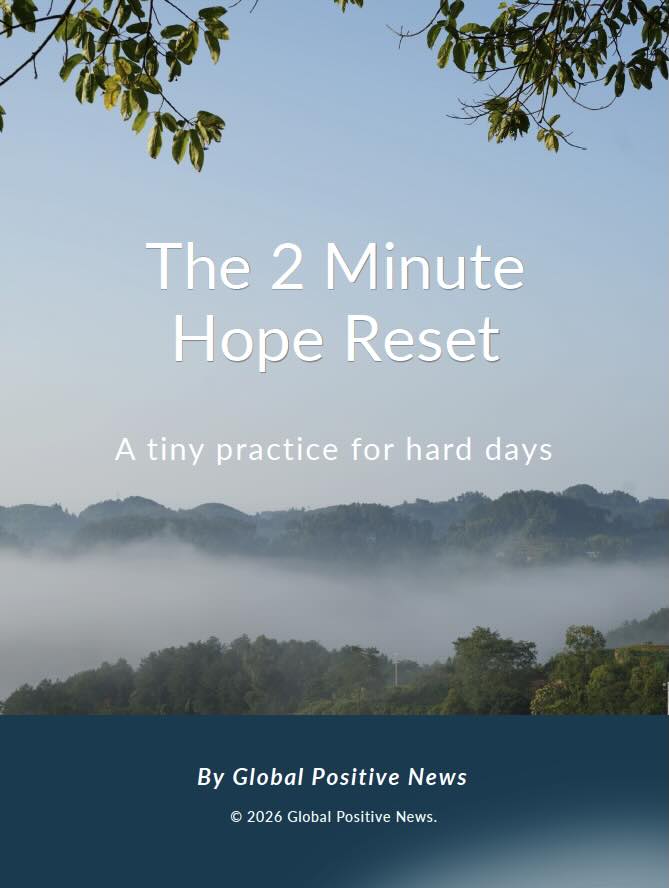
The 2 Minute Hope Reset is a short free guide with three small practices for the days that feel heavy. Two minutes each, nothing to keep up with.
Get the free guideExplore more positive news:
Enjoying stories like this?
Global Positive News Network is reader-supported. If you’d like to support the mission, you can visit the Official GPNN store.