

Gratitude journaling transforms how you experience daily life by shifting your focus toward what matters most. At Global Positive News Network, we’ve found that simple gratitude journaling ideas help people build stronger mental resilience and deeper connections with others.
This guide walks you through practical prompts, creative techniques, and sustainable habits that fit your real life. Whether you’re starting fresh or deepening an existing practice, you’ll find actionable approaches that work.
Simple Daily Gratitude Prompts
Start With What’s Right in Front of You
The most effective gratitude prompts work because they’re specific to your actual life, not abstract ideals. Research from the University of California, Davis found that people who wrote about gratitude once per week showed greater life satisfaction than those who wrote multiple times weekly. This matters because it reveals that consistency beats frequency. Your first prompt should identify three things you’re grateful for today, but here’s the critical part: they need to be concrete and immediate. Instead of writing gratitude for health in general, name the specific moment when your body felt strong. Instead of appreciating your job, write about the exact conversation with a colleague that made you feel valued. This specificity activates your brain’s reward system differently than vague thankfulness.
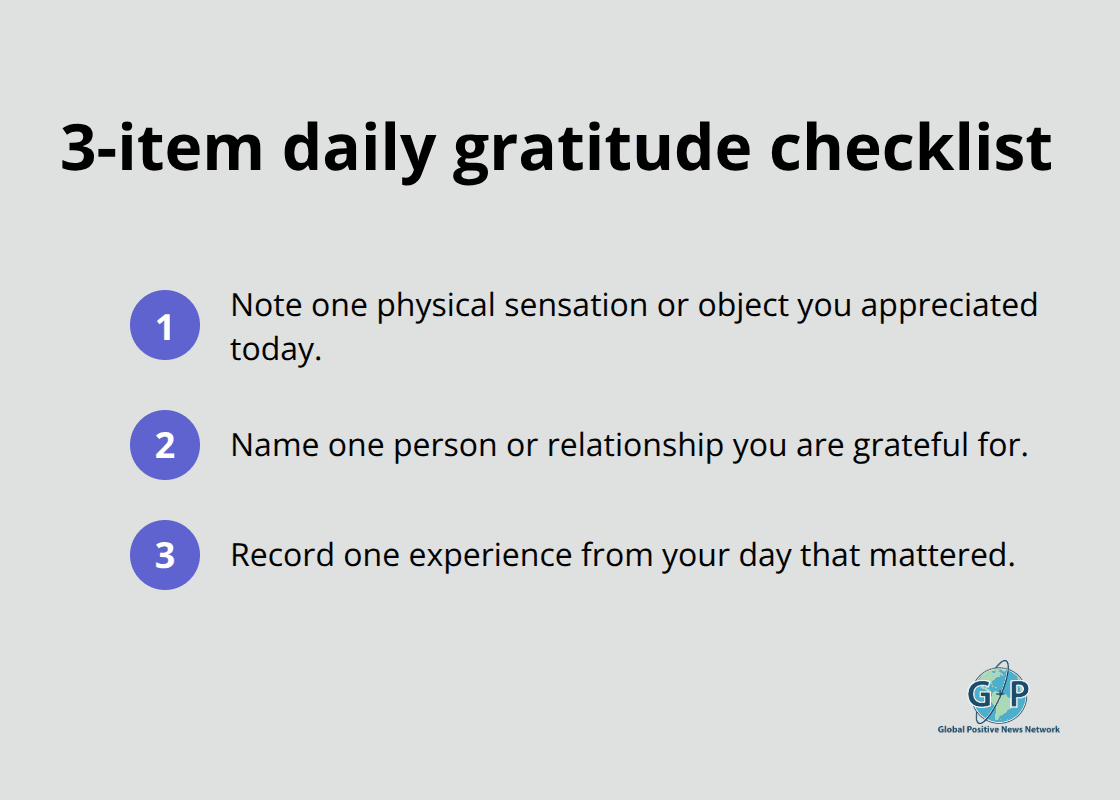
Start your journal entry by writing the date, then list exactly three items. Make them from different categories: one physical sensation or object, one person or relationship, one experience from your day. This variety prevents your brain from defaulting to autopilot responses.
Naming People Who Changed Your Day
The people you interact with deserve specific recognition in your journal. Write about someone who made a positive impact on you today, but go beyond their action. Describe how their words or behavior shifted something in you. Did a family member’s joke ease your stress? Explain what made it funny and how you felt afterward. Did a stranger hold a door? Write about the small moment of human consideration. This transforms gratitude from passive observation into active relationship building.
Strong relationships are connected to longevity and happiness, according to research from Harvard Medical School’s Study of Adult Development. Your journal becomes a tool for recognizing these connections. Try to name at least one person weekly in this way. If you struggle to find someone, that’s a signal to reach out and create positive interactions deliberately.
Capturing Joy in Small Details
Most people miss daily joy because they scan for major events. A promotion, a vacation, a big celebration. But neuroscience shows your brain registers small moments intensely when you pause to acknowledge them. The warmth of your first coffee. A song you heard twice in one day. A text that made you laugh. Your final prompt each day should identify small moments of joy you noticed. Write about the sensory details. What did it look like, sound like, feel like?
This practice rewires your attention over time. You’ll naturally start noticing more small joys because your brain learns they matter. Start tracking these moments for two weeks. You’ll likely find you capture between five and fifteen small joys daily once you begin paying attention. This shift in awareness compounds quickly and changes how you experience ordinary days. As your ability to spot these moments strengthens, you’ll be ready to explore more creative ways to express your gratitude.
How to Express Gratitude Beyond Writing
Write Letters That People Actually Read
Written gratitude prompts work well, but they’re incomplete. Moving beyond simple list-making into actual expression deepens your practice significantly. Letters to people in your life force you to articulate exactly why they matter. Start with someone who influenced you recently, not necessarily someone you’ve known longest. Write directly to them as if they’ll read it, because the best version of this practice means they actually do. Address specific moments when they showed up for you. Instead of saying someone is kind, describe the Tuesday afternoon when they listened without interrupting, or the way they remembered something you mentioned weeks earlier. Try to keep the letter between 300 and 500 words. This length is long enough to go deep but short enough to finish without overwhelming yourself. Mail it, email it, or read it aloud to them. Research shows that expressing gratitude to someone increases relationship satisfaction, and the effect lasts weeks beyond the initial expression. This beats silent journaling every time because vulnerability creates connection.
Create Visual Gratitude Through Collages and Timelines
Visual gratitude practices activate different neural pathways than writing. Create a gratitude collage monthly using magazine cutouts, photos, or drawings that represent what you’re thankful for. You don’t need artistic skill. Paste images onto poster board or cardboard, add words or phrases, include colors that feel meaningful.
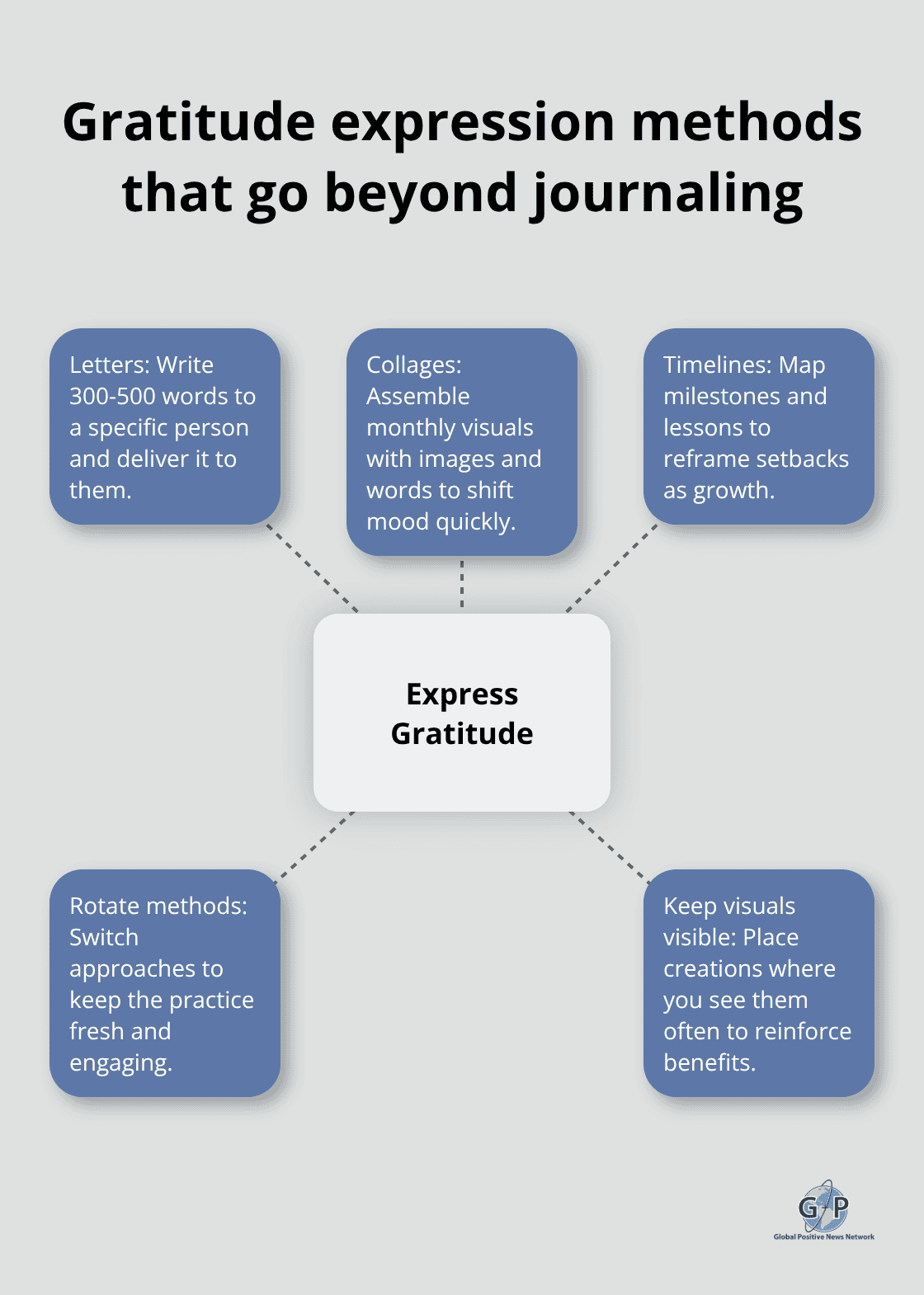
Spend 45 minutes on this once monthly. The tactile process of cutting and arranging shifts your thinking away from perfectionism into creation. Keep these collages visible for at least two weeks so your brain registers them regularly.
Gratitude timelines work differently. On a large sheet of paper, draw a horizontal line representing your life from birth to today. Mark major milestones and growth moments along it, then add annotations about what each taught you or how you’ve changed because of it. Include setbacks alongside victories. This visual representation shows you how challenges contributed to who you are now. This transforms regret into recognition. Spend two to three hours on your timeline. Update it annually. Visual gratitude practices improve mood and mental health, according to research on positive psychology interventions.
Combine Multiple Expressions for Lasting Impact
The combination of written letters, visual creation, and timeline reflection gives your gratitude practice texture and prevents it from becoming stale. Each method activates your brain differently, which means you retain the benefits longer and stay engaged with your practice. Letters build relationships. Collages shift your mood quickly. Timelines reveal patterns in your personal growth. When you rotate between these approaches, your gratitude work stays fresh and meaningful. This variety also prepares you to sustain your practice over months and years, which is where real transformation happens.
Making Your Gratitude Practice Stick
Attach Your Practice to Existing Routines
The biggest mistake people make is treating gratitude journaling like a New Year’s resolution instead of a sustainable habit. You need a schedule that fits your actual life, not an idealized version of yourself. Research shows that habits form faster when you attach them to existing routines rather than trying to create new time blocks from scratch. If you drink coffee every morning, journal right after that first cup. If you brush your teeth before bed, spend five minutes writing then. This attachment method works because you leverage an already-automatic behavior. The specific time matters less than the consistency.
Most people fail because they set unrealistic expectations, like journaling for thirty minutes daily. Start with five minutes, three times weekly. This sounds minimal, but it’s sustainable. After consistent practice, you’ll naturally want to extend your time because the benefits become obvious. Track your actual journaling sessions for two weeks before you commit to a schedule. Write down when you have genuine free time and which times you actually follow through. Your schedule should match your real behavior, not your aspirations.
Rotate Your Prompts to Combat Repetition
Repetition kills motivation faster than anything else, and most people quit around week three when their entries start feeling redundant. The solution isn’t to push harder, it’s to rotate your prompts deliberately. Spend one week on the three-item gratitude list, then switch to letters the following week, then move to visual timelines. This rotation keeps your brain engaged because each method feels different. When motivation dips, acknowledge it directly instead of fighting it. A dip in motivation doesn’t mean your practice failed, it means you need to shift methods.
Track Progress With Visible Markers
Keep a simple tracking system: mark an X on a calendar for each session you complete. After two months of consistent practice, you’ll have visual proof that your habit stuck. This matters psychologically because seeing your progress prevents the motivation collapse that derails most people.
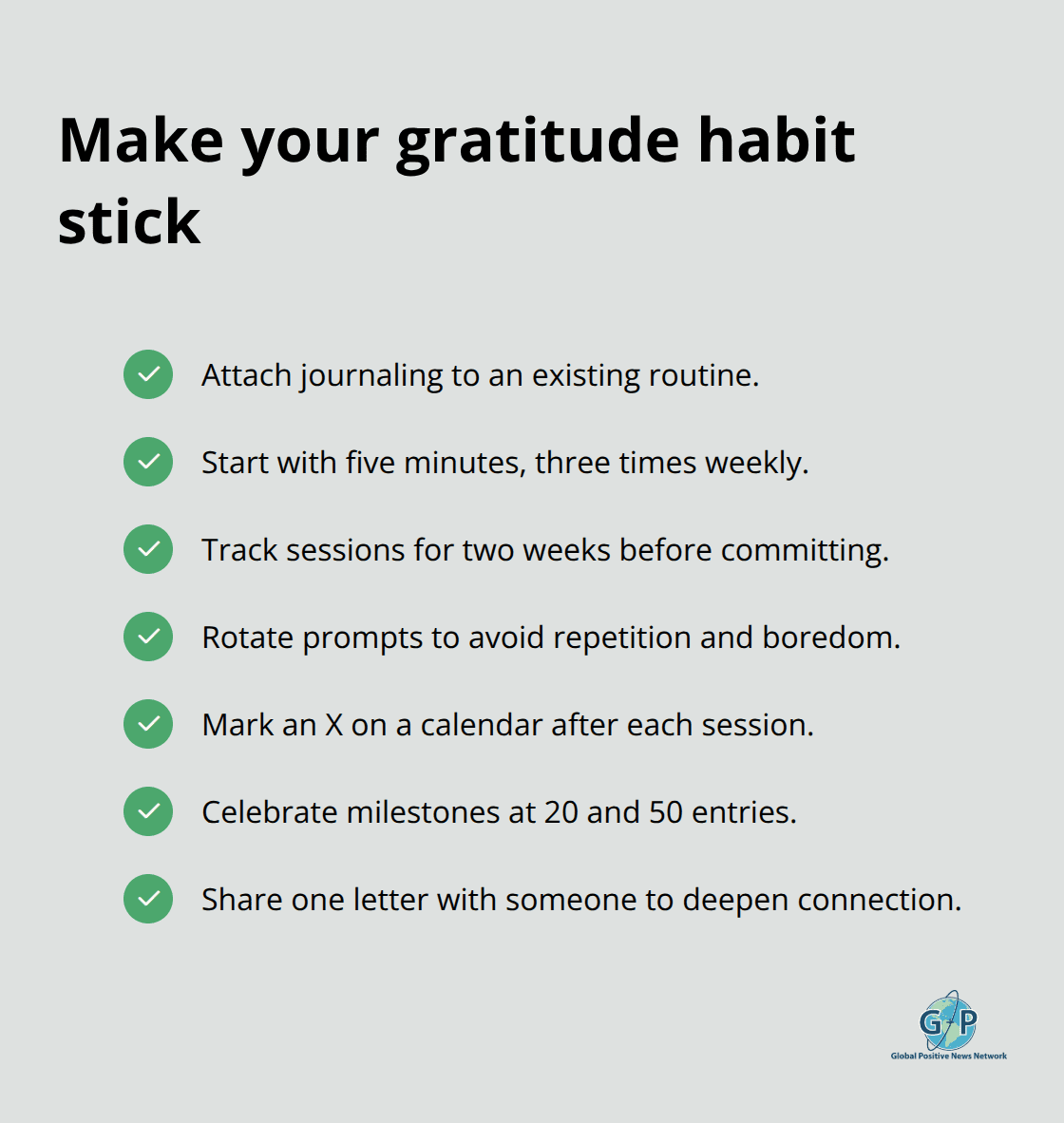
Celebrate specific milestones, not vague achievements. After twenty journal entries, read back through them and note patterns in what you’re grateful for. After fifty entries, share one letter with someone you wrote about (the vulnerability deepens your relationships and reinforces your practice). These concrete milestones give your practice purpose beyond the act of writing itself. The real measure of success isn’t perfect consistency, it’s showing up more often than you don’t.
Final Thoughts
Your gratitude journaling practice transforms your perspective gradually, not overnight, as you notice patterns in what you’re grateful for and recognize how often people show up for you. After weeks of consistent practice, you’ll catch yourself pausing during ordinary moments to appreciate them before they pass. This awareness becomes automatic, and your brain stops scanning for problems and starts registering abundance instead.
Starting your gratitude journaling ideas practice requires one decision: pick your attachment point and choose the existing routine where you’ll journal, whether that’s after morning coffee or before bed. Commit to five minutes, three times weekly, write your first three concrete things you’re grateful for today, name one person who made a positive impact, and capture one small moment of joy. The practice builds from there once you complete this single session and repeat it three days later.
Research consistently shows that gratitude practices improve sleep quality, reduce anxiety, and strengthen relationships (people who maintain gratitude journals report better emotional regulation and increased resilience during difficult periods). We at Global Positive News Network believe gratitude forms the foundation for maintaining an optimistic outlook, and your journal becomes both a record of what’s working in your life and evidence that good things happen regularly.
Having a hard day?
The 2 Minute Hope Reset is a short free guide with three small practices for the days that feel heavy. Two minutes each, nothing to keep up with.
Get the free guideExplore more positive news:
Enjoying stories like this?
Global Positive News Network is reader-supported. If you’d like to support the mission, you can visit the Official GPNN store.