

You don’t need grand gestures to feel happier. At Global Positive News Network, we’ve found that daily joy makers-those small, intentional moments-reshape how you experience life.
A morning gratitude practice, a kind word to a stranger, or five minutes of mindfulness can shift your entire day. This blog post shows you exactly how to weave these tiny moments into your routine and watch them transform your mental health and resilience.
How to Start Your Day With Intention
Your morning sets the trajectory for everything that follows. The first hour after waking determines whether your nervous system stays calm or kicks into stress mode. Start with a specific practice rather than vague positivity: name three concrete things that are already working in your life before you check your phone. Not someday goals or hopes, but things happening right now. Your coffee tastes good. Your bed was comfortable. Your lungs are working. Research from the Greater Good Science Center tracked over 22,000 participants across 22 countries and found a 26 percent increase in emotional wellbeing after just seven micro-acts of joy over seven days. That means your morning doesn’t need to be perfect or lengthy. Five minutes of deliberate attention to what’s present shifts your baseline mood for hours.
The Three-Minute Gratitude Reset
Gratitude doesn’t rewire your brain through passive thinking. It requires active notice and often, speaking or writing. Your brain is wired to notice problems, not solutions. Psychologist Rick Hanson describes this as Velcro for bad experiences and Teflon for good ones. Counter this by pausing during one meal each day and naming exactly what you taste, smell, or feel. Savor a cherry slowly. Feel the texture of toast. This sensory anchor makes gratitude stick in your nervous system, not just your thoughts.
Amplify Joy Through Connection
When you share this appreciation with someone else, the effect multiplies. Tell a family member what you noticed. The act of verbalizing appreciation reinforces the positive experience and strengthens your connection simultaneously. Small acts of kindness throughout your day work the same way. A genuine compliment to a colleague, holding a door, or sending a message of support costs nothing but creates measurable shifts in both your mood and theirs. The key is intention. Random politeness fades quickly. Deliberate kindness, noticed and named, compounds over time into a habit that transforms how you move through the world.
Building Momentum Into Your Afternoon
These morning practices don’t end when breakfast finishes. The attention you train in those first minutes carries forward, making you more likely to spot joy throughout your day. Your nervous system, once calm, stays more responsive to small positives rather than defaulting to threat detection. This foundation matters because what happens next-how you handle stress, setbacks, and ordinary frustrations-depends entirely on whether your baseline mood started high or low. The practices above aren’t optional add-ons; they’re the scaffolding that supports everything else you’ll attempt today.
How Micro-Moments Transform Your Stress Response
Your nervous system doesn’t distinguish between a major crisis and your email inbox exploding. Both trigger the same fight-or-flight response unless you actively interrupt the pattern. This is where micro-moments of joy become essential. When you pause to notice something positive, your vagal tone improves, which directly regulates your heart rate, digestion, and breathing. This isn’t theoretical-it’s measurable physiology. Research shows that consistent attention to small positives reduces rumination, the mental loop where you replay problems endlessly. Instead of catastrophizing or over-generalizing, your brain learns to spot exceptions, moments when the problem temporarily disappears or feels manageable.
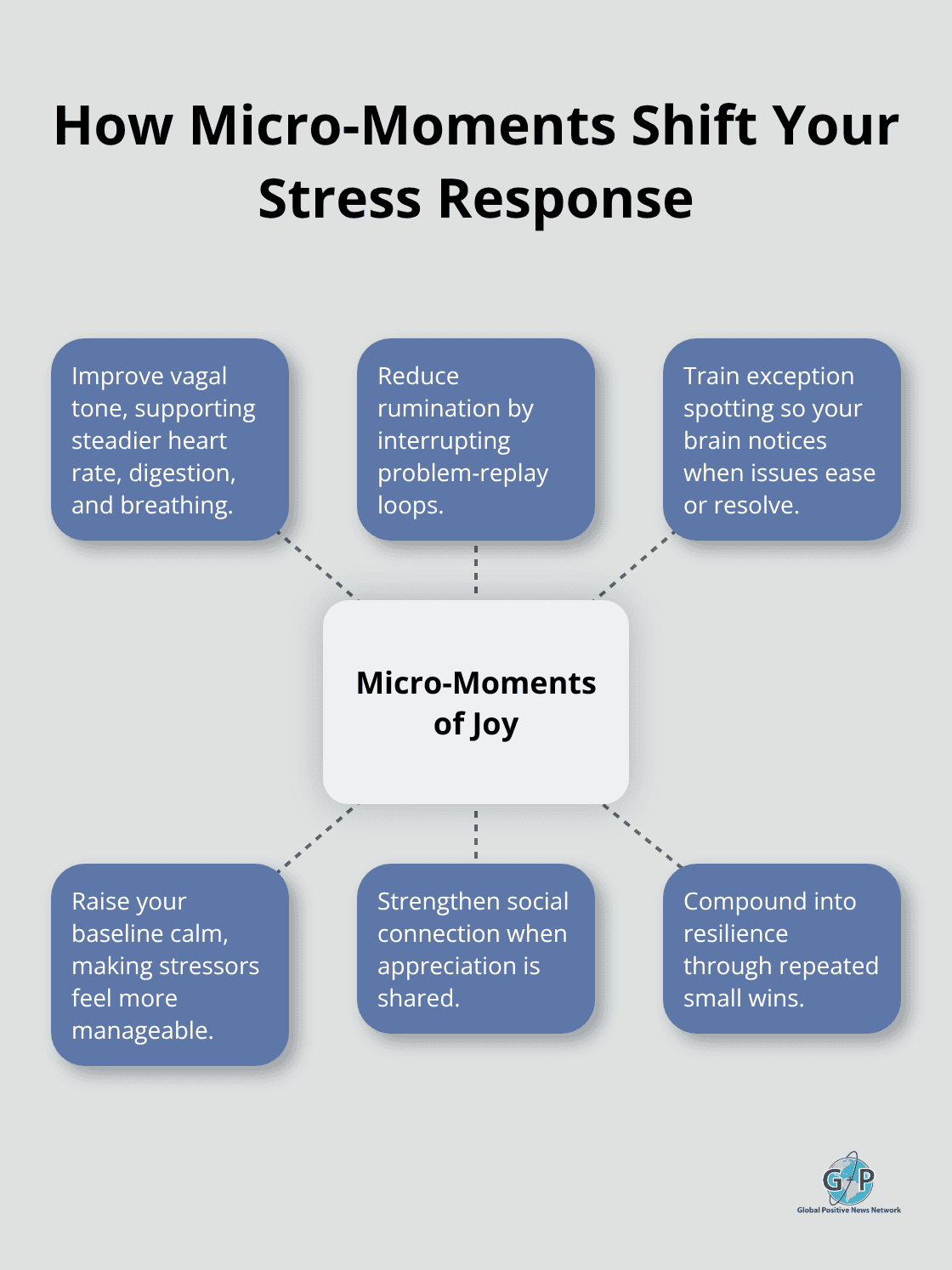
The Greater Good Science Center’s research across 22,000 participants found that seven intentional micro-acts of joy over seven days produced a 26 percent increase in emotional wellbeing. That’s not marginal. That’s a significant neurological shift from a week of deliberate practice.
Where Resilience Actually Builds
Resilience isn’t built through surviving one massive challenge. It’s built through repeated small wins that prove to your nervous system that you can handle difficulty. Each time you notice something working-your phone battery lasted all day, your colleague responded kindly to feedback, the bus arrived on time-you train your brain to recognize stability. These aren’t trivial. They’re data points that counter the brain’s default negativity bias. When stress arrives, and it will, your nervous system has a different baseline. Instead of spiraling, you default to a calmer state because you’ve spent weeks practicing the opposite. This compounds into long-term wellbeing.
The Foundation That Holds
The connection between daily joy and lasting mental health isn’t about feeling happy constantly. It’s about building a psychological foundation so solid that temporary difficulties don’t demolish your entire mood architecture. When you practice micro-joy deliberately, you don’t avoid hard things. You strengthen your capacity to face them without falling apart. Your nervous system, once trained to spot small positives, maintains this skill even when challenges mount. This shift happens gradually, almost invisibly, until one day you notice that setbacks no longer trigger the same spiral. You’ve built something durable.
Moving From Personal Practice to Shared Impact
The real transformation happens when you extend these micro-moments beyond yourself. Your own resilience matters, but it matters even more when it influences how others around you respond to difficulty. The practices you’ve developed-noticing what works, pausing to feel gratitude, recognizing small wins-these become contagious when people witness them in action. What you model in your daily life shapes how others approach their own stress and joy. This is where individual practice becomes community strength, and where your personal wellbeing starts to ripple outward in ways you might not immediately see.
Finding Joy in Ordinary Moments
Mindfulness does not require sitting in silence for an hour. Real joy practice happens in thirty-second pauses throughout your day. The most effective technique is the sensory anchor: stop whatever you’re doing and name one thing you can see, one you can hear, one you can touch, and one you can taste. This forces your attention away from mental loops and into present reality. Try this while waiting for your coffee to brew, standing in line, or sitting in traffic. Even brief sensory awareness interrupts rumination patterns and activates parasympathetic nervous system, the part that calms you down. The specificity matters more than the duration. Noticing the exact shade of a leaf or the particular texture of a handrail creates a stronger neurological imprint than vague thoughts about being mindful. Start with one anchor moment per day and add another when it becomes automatic. Within two weeks, your brain will begin to default to this noticing mode without prompting.
How Sensory Anchors Rewire Your Attention
Your five senses offer the fastest route out of stress. When you name what you perceive-the temperature of air on your skin, the sound of traffic, the taste of salt-your nervous system shifts from threat detection to present-moment awareness. This shift happens instantly, not gradually. The brain cannot simultaneously spin in worry and register sensory detail. One activity dominates. Choose sensory awareness, and worry recedes. The specificity matters because vague mindfulness produces weak results. “I notice something nice” creates less neurological change than “I notice the rough grain of this wooden table and the cool metal of the door handle.” Concrete sensory data anchors your attention in ways abstract thoughts cannot. This practice works anywhere-in a waiting room, on a crowded train, or at your desk between tasks. No special equipment or quiet space required.
Community Amplifies Joy in Measurable Ways
When you share your micro-moments with others, the emotional impact strengthens for everyone involved. Join or create a small group, even just two or three people, that meets weekly to discuss what worked that week. This is not a therapy session or a complaint circle. It is a structured fifteen-minute conversation where each person names one small win, one moment of beauty, or one kind interaction they witnessed. Sharing positive experiences increases their lasting impact on mood. If a group feels too formal, text one person daily with something you noticed. The act of articulating joy to someone else embeds it deeper into your nervous system than keeping it private.
Digital and Physical Tools for Recording Joy
Digital platforms create space for sharing without requiring in-person commitment. Community forums or local social media groups allow you to post micro-moments and connect with others pursuing the same practice. A simple journal or even your phone’s notes app becomes a micro-joy library when you record moments as they happen. Photos of small beautiful things, written descriptions of sensations, or voice recordings of sounds you want to remember create a personal database you can revisit on difficult days. This is not about creating perfect documentation. It is about building evidence that joy exists reliably in your ordinary life, not just on special occasions. When you return to these records during stress, your nervous system recognizes that positive moments are real and recurring, not rare exceptions.
Final Thoughts
Tiny moments matter because they’re the only moments you actually live. You experience your life right now, in this breath, this conversation, this meal-not in grand achievements or distant goals. The research is clear: a 26 percent increase in emotional wellbeing comes not from waiting for something big to happen, but from deliberately noticing what’s already working. Daily joy makers train your attention toward what’s present rather than what’s missing.
Starting your practice requires no preparation or perfect conditions. Pick one sensory anchor tomorrow morning and name three things already working in your life before checking your phone. Savor one meal slowly, and that foundation shifts how your nervous system responds to stress. Each micro-moment of deliberate attention builds on the last, creating resilience so solid that setbacks no longer demolish your mood.
Your own wellbeing influences how others approach theirs. When you model the ability to notice small wins and feel genuine gratitude, people around you absorb this approach without instruction. Children learn what’s normal at home by watching how adults respond to difficulty, and colleagues notice when someone maintains steadiness amid chaos. Explore our platform for stories that remind you daily joy is real and accessible.
Having a hard day?
The 2 Minute Hope Reset is a short free guide with three small practices for the days that feel heavy. Two minutes each, nothing to keep up with.
Get the free guideExplore more positive news:
Enjoying stories like this?
Global Positive News Network is reader-supported. If you’d like to support the mission, you can visit the Official GPNN store.