

Your inner voice shapes how you show up every day. When that voice doubts you, confidence crumbles. When it supports you, you become unstoppable.
At Global Positive News Network, we’ve seen how affirmations for confidence transform the way people think and act. This guide shows you exactly how to use them.
How Affirmations Rewire Your Brain for Confidence
Positive self-talk isn’t just feel-good psychology. Your brain physically rewires itself when you repeat affirmations consistently. Research from Carnegie Mellon University found that people who used self-affirmation exercises showed increased activity in the ventromedial prefrontal cortex, the part of your brain responsible for self-evaluation and processing personal values. This isn’t metaphorical-the neural pathways strengthen through repetition. A study published in Social Cognitive and Affective Neuroscience demonstrated that affirmations activate the same reward centers in your brain as winning money, which explains why they feel genuinely motivating rather than forced. The more you repeat an affirmation, the more your brain treats it as established fact rather than wishful thinking. This neurological shift happens gradually but measurably. Most people notice tangible changes within two to three weeks of daily practice, though brain imaging shows structural changes taking place even sooner.
Your Thought Patterns Shift First
Your automatic thoughts shift before your confidence does. When you repeat affirmations like “I handle challenges with skill” or “My abilities grow every day,” you train your brain to notice evidence that supports these statements. This is called confirmation bias, and affirmations weaponize it in your favor. Instead of your mind automatically scanning for threats and failures, it starts hunting for proof that you’re capable. The shift happens in your attention first-you literally start seeing different things. Opportunities that seemed invisible before suddenly appear. Setbacks that once felt catastrophic become learning moments.
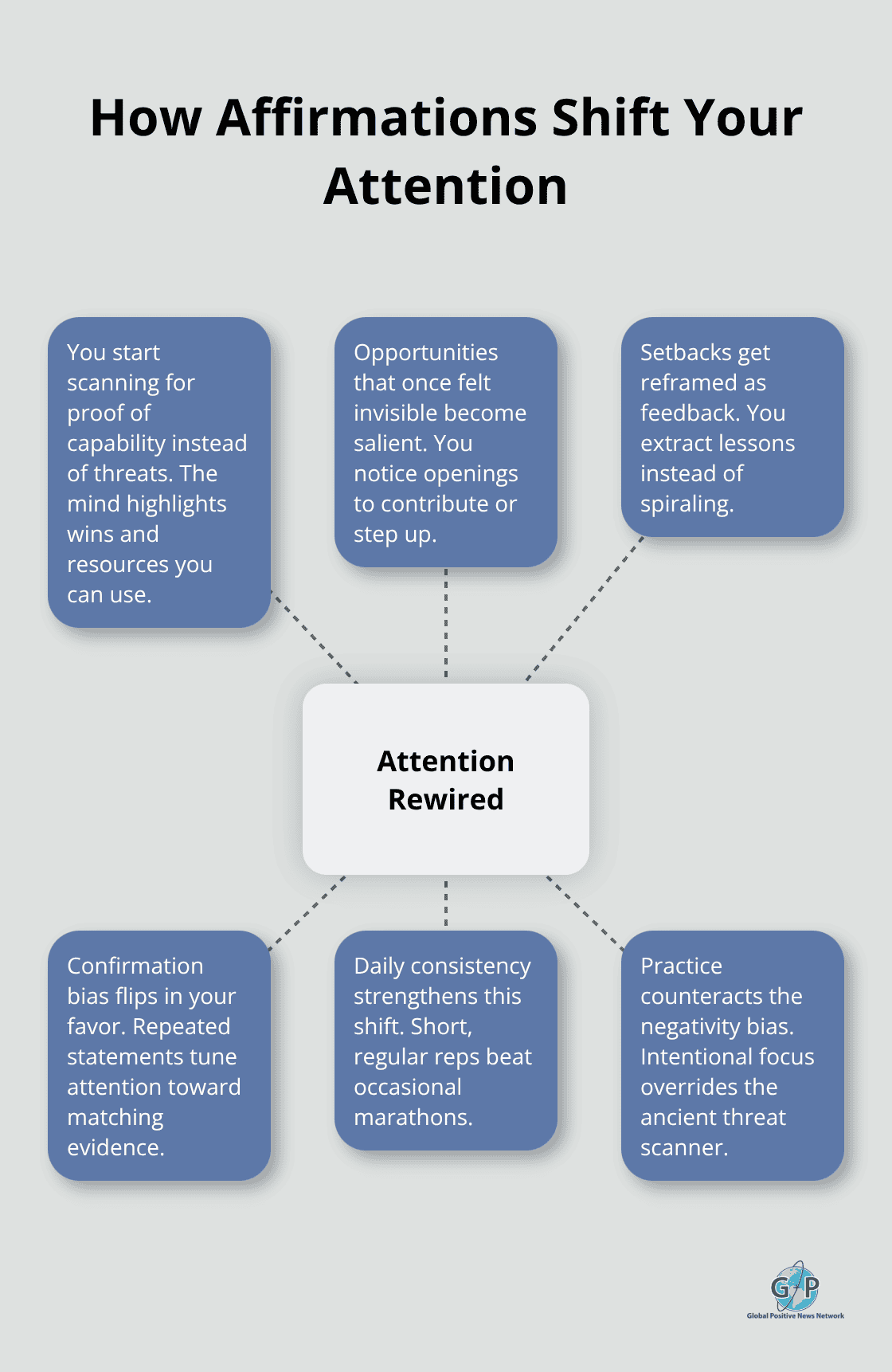
This rewiring takes effort though. Your brain defaults to negativity bias because that kept your ancestors alive, so you’re fighting against millions of years of evolution. Consistency matters more than intensity. Five minutes daily beats one hour once a week.
Repetition Builds New Neural Pathways
Repetition is the only mechanism that actually works. Your brain strengthens neural connections through the principle of Hebbian learning: neurons that fire together wire together. When you speak an affirmation aloud, you engage multiple brain regions simultaneously-the auditory cortex processes the words, the motor cortex controls your speech, and the prefrontal cortex evaluates the meaning. This multi-sensory activation creates stronger neural pathways than silent affirmations alone. The physical act of writing engages your motor memory, which your brain treats as behavioral evidence. Try speaking your affirmation at the same time each day-morning works best because your brain is most receptive after sleep. Anchor it to an existing habit like your coffee routine or morning shower (this removes the need for willpower and makes the practice automatic). After 66 days of consistent repetition, your brain treats the affirmation as default neural firing.
When Confidence Becomes Automatic
At this point, confidence stops feeling performative and becomes genuinely embedded in how you think. Your brain no longer questions whether the affirmation is true-it accepts it as part of your identity. This is when you’re ready to move beyond generic affirmations and craft statements that target your specific confidence gaps. The next chapter shows you how to identify exactly where your confidence falters and build affirmations that address those weak points directly.
Affirmations That Actually Work in Real Life
Generic affirmations fail because they don’t address where your confidence actually breaks down. Saying “I am confident” means nothing if you freeze during presentations or second-guess yourself in conversations. The affirmations that stick target your specific situations. Work confidence crumbles differently than relationship confidence, which differs from how self-doubt hits when you’re alone. Your brain needs affirmations matched to the exact moment your doubt appears. A software engineer needs different language than a manager, who needs different language than someone rebuilding self-worth after a setback.
The practical approach starts with identifying which environment drains your confidence most, then building affirmations for that specific context. Research shows that affirmations work best when they address values relevant to the threat you face. If you fear looking incompetent at work, an affirmation about personal relationships won’t help. You need statements like “I bring valuable perspective to meetings” or “I ask questions that move projects forward.” If relationship anxiety hits you hardest, affirmations must target that: “I communicate my needs clearly” or “I listen without planning my response.”
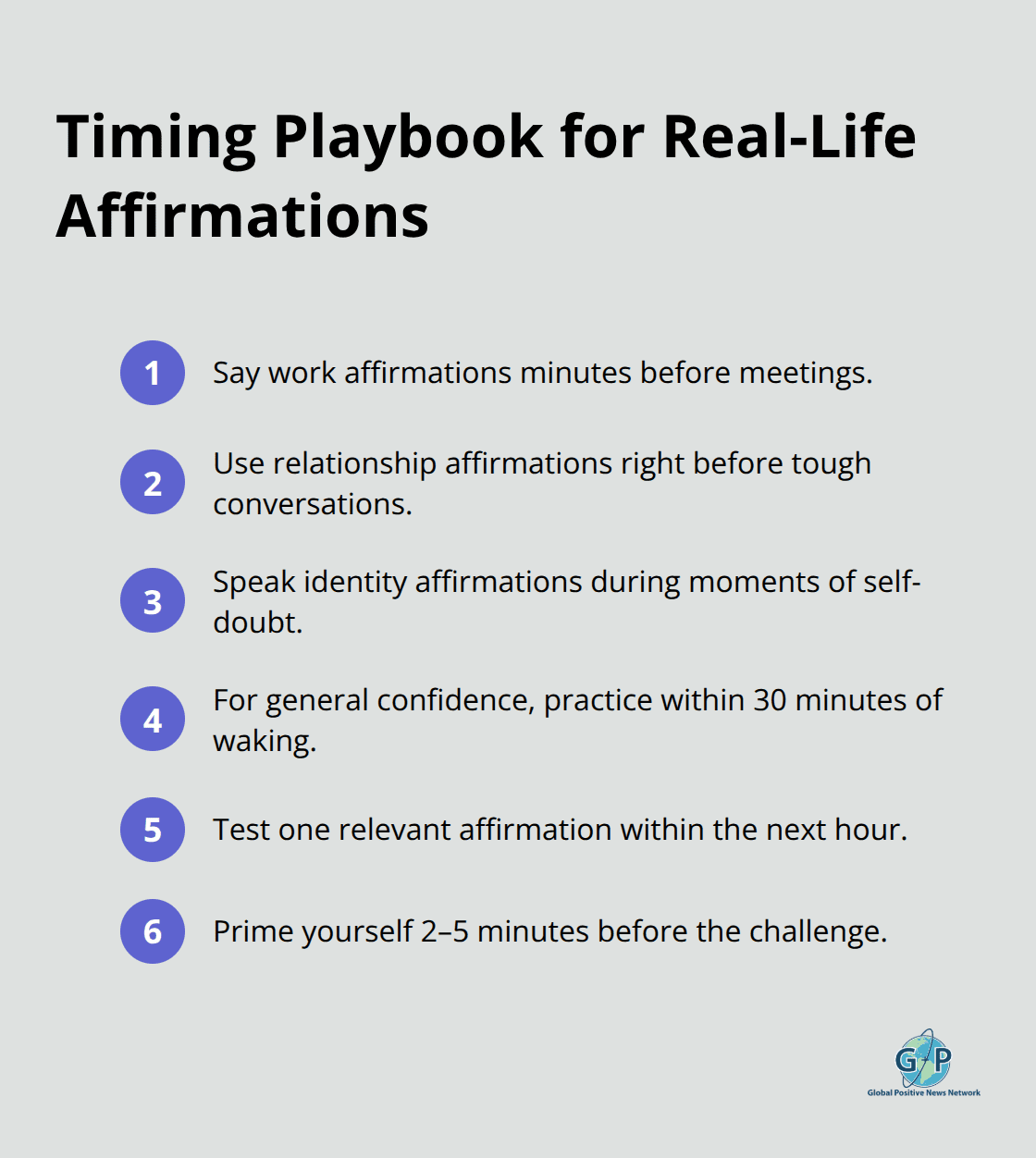
Timing matters significantly. Speak work affirmations before meetings, relationship affirmations before difficult conversations, and identity affirmations during moments of self-doubt. Morning works for general confidence building, but situational affirmations work best minutes before the actual situation happens. Your brain responds to proximity. An affirmation spoken five minutes before a presentation activates different neural patterns than one spoken eight hours earlier. Test this yourself: speak an affirmation relevant to something happening today within the next hour and notice the difference in how your body responds.
Affirmations for Professional Confidence
Work environments demand specific language that addresses performance anxiety, imposter syndrome, and authority concerns. Instead of vague statements, use affirmations that acknowledge your actual skills and past wins. Say “I’ve solved problems like this before” rather than “I’m smart,” because your brain has evidence for the first statement. One is provable; the other is abstract.
Other effective work affirmations include “My contributions matter in this team,” “I handle pressure by focusing on what I control,” and “I learn from mistakes faster than most people.” The last one works because it’s humble enough to feel true while still building confidence. Arrogant affirmations backfire because your brain rejects them as lies.
Pair these with concrete reminders of past successes. Before a high-stakes meeting, review three specific times you handled similar situations well. Your brain treats memory as evidence. If you’ve closed deals before, your brain knows you can do it again. If you’ve led successful projects, that’s neural evidence you’re capable. The combination of affirmation plus memory activates your confidence system more powerfully than either alone.
Affirmations for Relationship Confidence
Relationships require affirmations addressing vulnerability, communication, and acceptance. The confidence gap here isn’t about competence-it’s about being valued. Affirmations that work include “I express my thoughts without needing approval,” “People appreciate my honesty,” and “I set boundaries that protect my peace.” These target the actual fears: rejection, judgment, and abandonment.
Test which one resonates by noticing which fear appears most in your relationships. If you struggle speaking up, focus on the first. If you worry people judge you, focus on the second. If you let people cross your limits, focus on the third. Speak these affirmations before difficult conversations, not during them. Your brain needs the confidence primed before the interaction starts. One minute of affirmation before a conversation changes how you show up. You’ll notice you listen better, speak more clearly, and feel less defensive.
Relationship confidence also improves when you remind yourself of times people valued you exactly as you are. That’s not arrogance-it’s factual memory that counters the lie your anxiety tells you. This evidence-based approach works because your brain accepts what it can verify. The next chapter shows you how to identify your specific confidence gaps across all areas of life and craft affirmations that address them directly.
Creating Your Own Personalized Affirmations
Generic affirmations fail because they ignore where your confidence actually collapses. You need to identify the exact situations that trigger your self-doubt, then build statements addressing those moments specifically.
Track Your Confidence Gaps
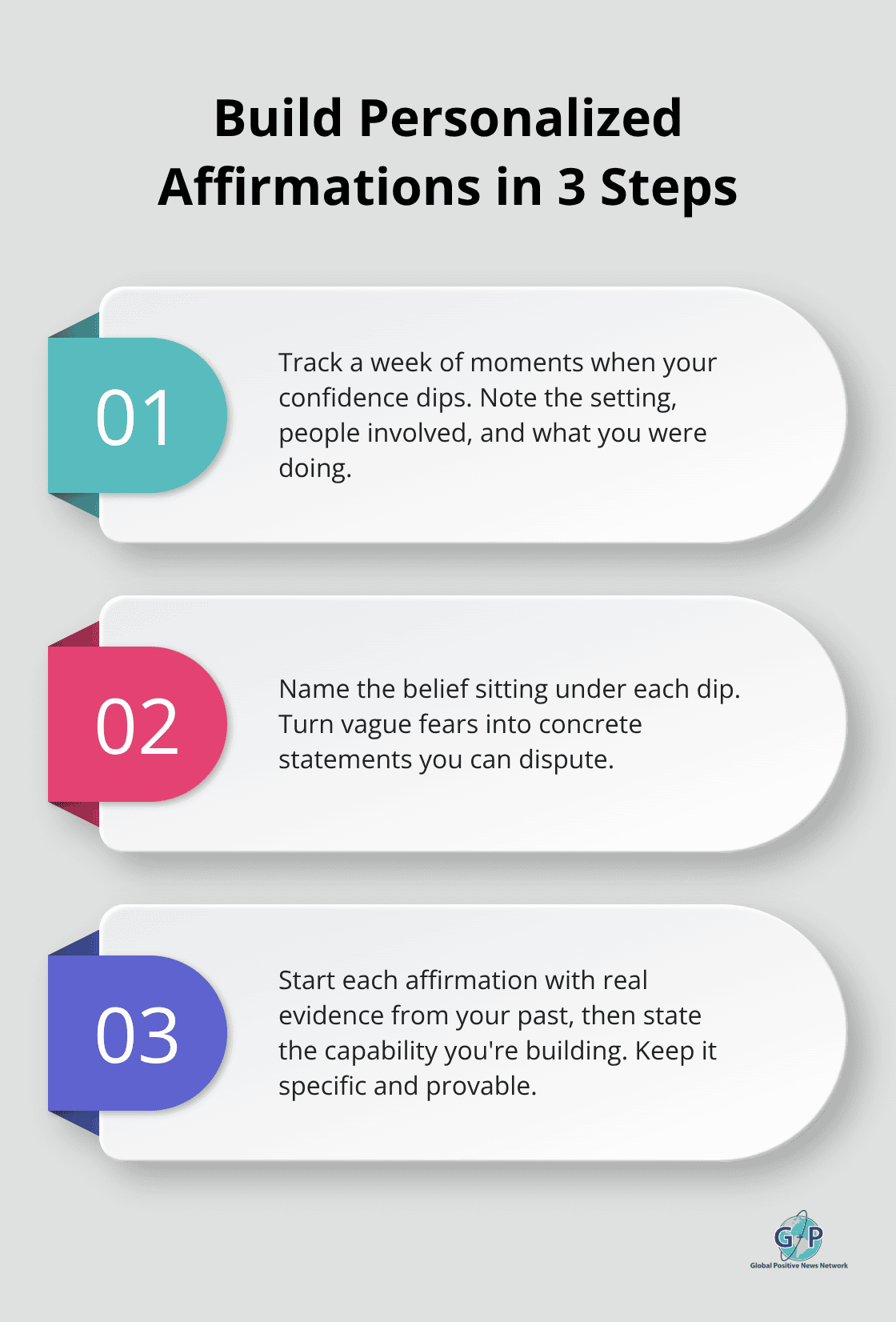
Start by tracking when your confidence drops over the next week. Write down three situations where doubt appeared strongest. Was it during a conversation with your boss? Speaking in group settings? Making decisions alone? Asking for help? The pattern matters more than the frequency. Most people discover their confidence gaps cluster in two or three specific areas. One person freezes when presenting ideas, another when receiving criticism, another when starting new projects. Your brain needs affirmations matched to your actual trigger, not someone else’s.
Identify the Beliefs Underneath
The next step involves examining what belief sits underneath each gap. If presentations terrify you, the underlying belief might be “I’ll embarrass myself” or “People will judge my competence.” If asking for help drains your confidence, the belief might be “I should handle everything alone” or “I’m burdening others.” These underlying beliefs are what affirmations actually target. Surface-level statements like “I am confident” won’t work because they ignore the real fear. You need to build affirmations that directly contradict the false belief your brain keeps repeating. If the belief is “I always mess up under pressure,” your affirmation becomes “I’ve handled pressure successfully before,” which is provable and specific. If the belief is “Nobody takes me seriously,” your affirmation becomes “People listen when I speak with conviction,” which addresses the actual problem.
Craft Affirmations From Evidence
Now craft affirmations using this formula: start with evidence from your past, then state the confidence you’re building. For example, “I’ve completed five projects on deadline” becomes “I complete projects on deadline even when stakes are high.” Your brain accepts this because it’s rooted in fact. Speak these affirmations out loud in the exact environment where your doubt appears, if possible. If your confidence crumbles during meetings, speak your affirmation in the conference room before people arrive. If self-doubt hits when you’re alone, speak it during quiet moments at home. This environmental pairing makes your brain link the affirmation directly to the situation.
Timing and Frequency for Results
Timing matters intensely here. Speak affirmations two to five minutes before the actual situation happens, not hours earlier. Research shows that self-affirmations work best when they’re temporally close to the threatening situation. Your nervous system needs the confidence primed right before you face the challenge. For daily affirmations building general confidence, morning works best within thirty minutes of waking. Your brain is most neuroplastic after sleep, so the affirmation sticks more readily. Speak the same affirmation for at least fourteen consecutive days before expecting shifts in how you feel. Two weeks is the minimum threshold your brain needs to start treating the statement as credible. Most people benefit from three to four affirmations targeting different confidence gaps simultaneously rather than one broad statement. Rotate which affirmation you lead with each day to prevent your brain from tuning it out. If you speak the same words in the same order every day, your brain eventually stops processing them as meaningful. Varying the sequence keeps your attention sharp and your brain engaged.
Final Thoughts
Affirmations for confidence work because they target your brain’s actual wiring, not just your emotions. Repetition strengthens neural pathways, and proximity to your confidence gaps determines whether the affirmation sticks. You’ve learned that generic statements fail, but affirmations rooted in your past evidence succeed.
Timing matters intensely-speak an affirmation five minutes before a challenging situation to activate your confidence system far more effectively than speaking it hours earlier. Consistency beats intensity, and your brain needs at least two weeks to treat an affirmation as credible. Test this yourself by speaking an affirmation minutes before something challenging happens today and notice how your body responds differently.
Confidence isn’t something you’re born with or without-it’s a skill your brain builds through deliberate practice. Identify your specific confidence gaps this week, track the exact moments when doubt appears strongest, and build three to four affirmations targeting those moments. At Global Positive News Network, we believe your inner voice deserves to support you rather than sabotage you.

Having a hard day?
The 2 Minute Hope Reset is a short free guide with three small practices for the days that feel heavy. Two minutes each, nothing to keep up with.
Get the free guideExplore more positive news:
Enjoying stories like this?
Global Positive News Network is reader-supported. If you’d like to support the mission, you can visit the Official GPNN store.