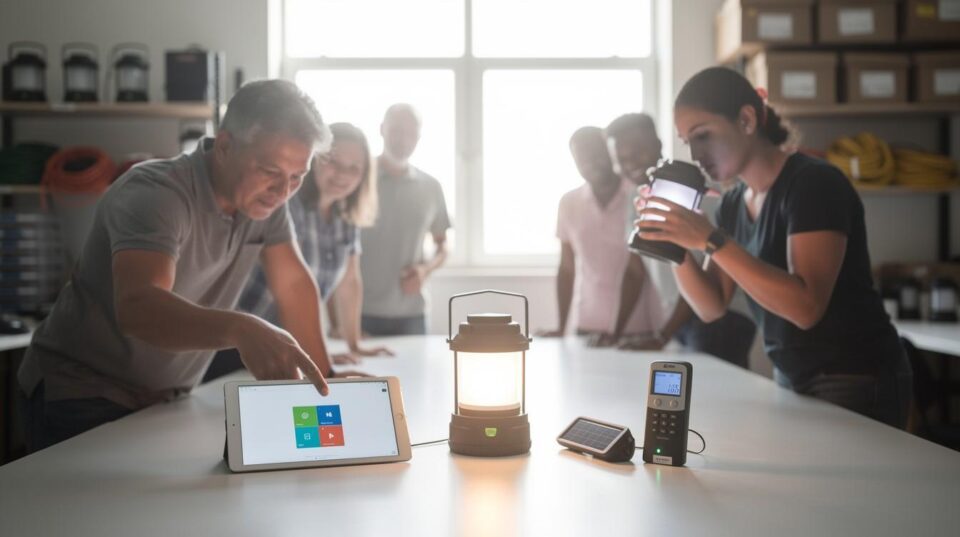
Technology is reshaping how communities access energy, healthcare, and information. We at Global Positive News Network believe these innovations represent genuine hope for millions of people facing real barriers.
From solar panels cutting energy bills to telemedicine reaching remote villages, technologies for hope are already working. This post shows you concrete examples of how communities are adopting these solutions today.
Renewable Energy Solutions Transform Local Economies
Solar Technology Cuts Energy Costs Dramatically
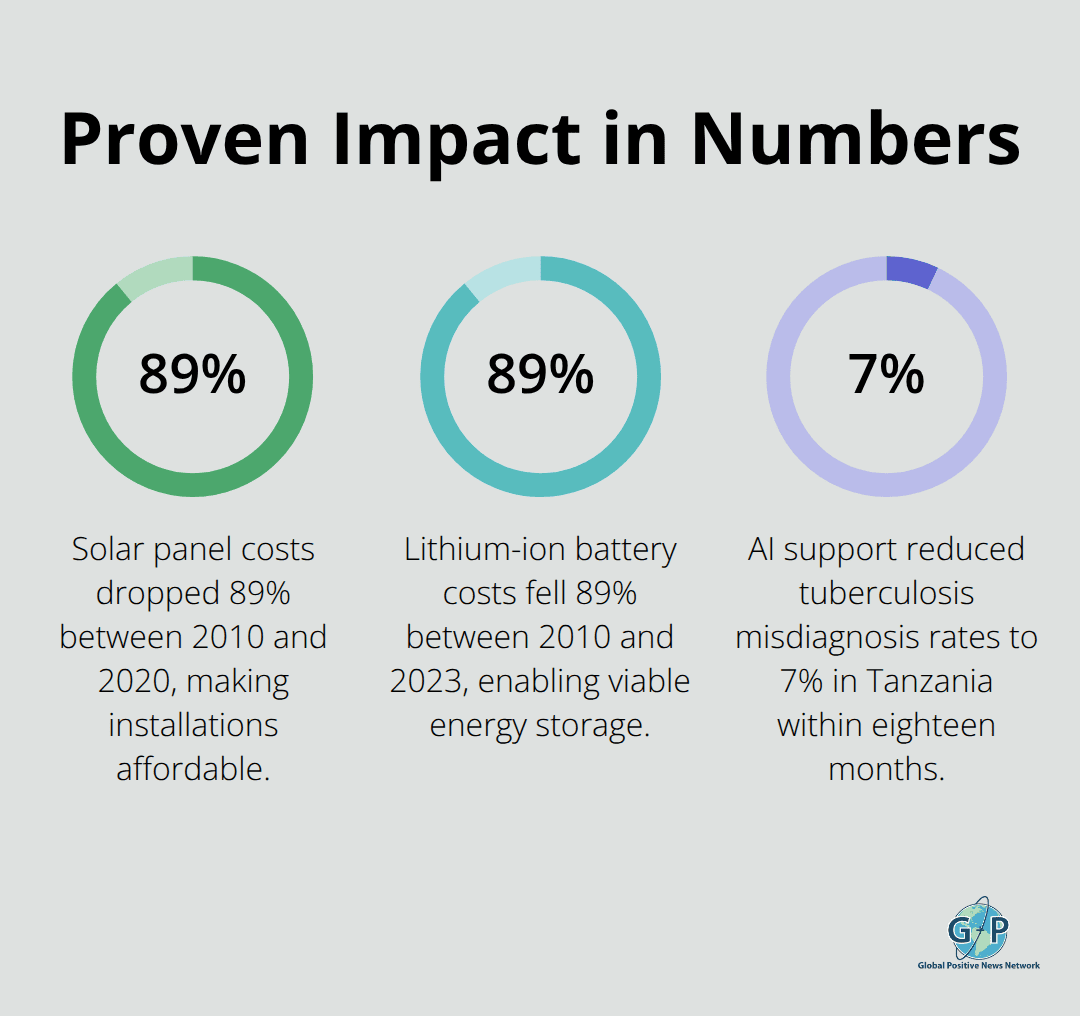
Solar panel costs dropped 89% between 2010 and 2020, according to the International Renewable Energy Agency, making residential and municipal installations genuinely affordable for the first time. A household installing rooftop solar in favorable conditions reduces electricity bills by 50-90%, with systems paying for themselves within 6-10 years. Communities across sub-Saharan Africa, India, and Southeast Asia bypass expensive grid infrastructure entirely by deploying solar microgrids. Kenya’s M-KOPA Solar installed over 750,000 solar home systems since 2012, allowing rural families to access reliable electricity without connection to centralized power networks. Families spend less on kerosene lanterns and diesel generators, freeing up income for education and healthcare.
Wind Power Creates Sustained Employment
Wind energy projects generate sustained employment in ways solar installations cannot match at scale. The Global Wind Energy Council reported that the wind sector employed 1.4 million people globally in 2023, with the majority in manufacturing, installation, and maintenance roles requiring technical training but not university degrees. A single utility-scale wind turbine requires ongoing maintenance from trained technicians earning competitive wages in rural regions where job opportunities remain scarce. These positions provide stable income and professional development pathways for workers in communities that historically lacked such opportunities.
Battery Storage Enables True Energy Independence
Battery storage systems transform both solar and wind from intermittent sources into reliable power supplies. Lithium-ion battery costs fell 89% between 2010 and 2023, making energy storage economically viable for communities and businesses. India’s Mahagenco utility paired 100 MW of solar capacity with 40 MWh of battery storage to maintain stable grid power during monsoon seasons when solar output drops. Communities implementing this combination gain genuine energy independence: they reduce reliance on fuel imports, stabilize local electricity prices against global oil fluctuations, and retain energy spending within their own economies rather than sending money to distant energy corporations.
Healthcare innovations now address the access barriers that renewable energy solutions have begun to solve.
Healthcare Technologies Reaching Where Doctors Cannot
Telemedicine Connects Remote Patients to Specialists
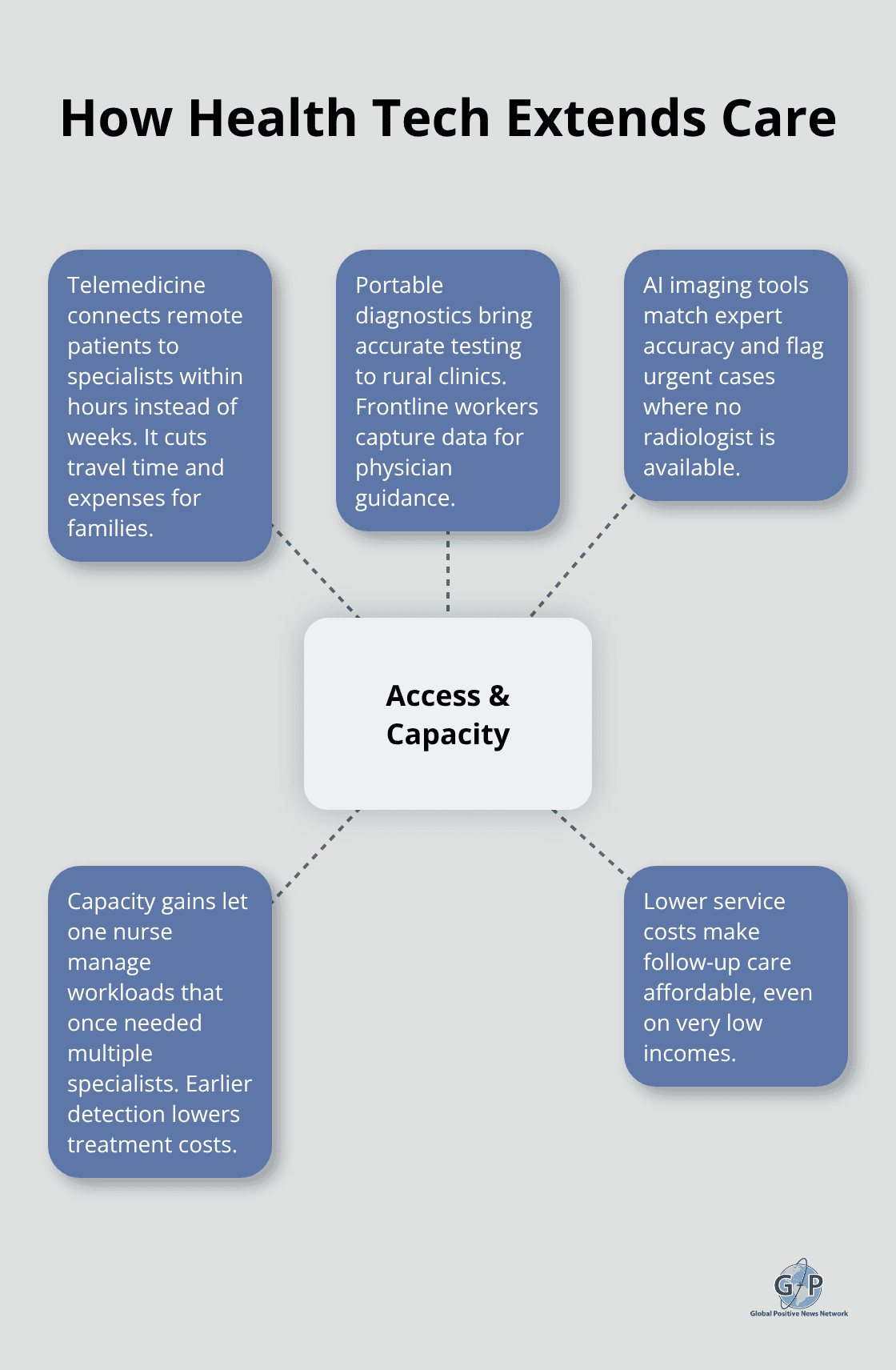
Telemedicine has moved beyond video consultations into genuine medical infrastructure for regions abandoned by traditional healthcare systems. The World Health Organization estimates 4.3 billion people lack access to essential surgical care, yet telemedicine platforms now connect remote patients to specialists within hours rather than weeks of travel. Rwanda deployed remote diagnostic services across 500 health centers, allowing nurses in rural clinics to transmit patient data to physicians in Kigali for real-time guidance on treatment decisions. Patients receive care without leaving their communities, reducing the financial burden of transportation and lost work days that often prevents poor families from seeking medical attention.
India’s Apollo Telehealth conducted over 3 million consultations in 2023, predominantly serving populations in districts lacking cardiologists, oncologists, and other specialists. These services operate at costs 60-70% lower than in-person visits, making regular follow-up care financially viable for families earning less than $5 daily.
Portable Diagnostics Bring Accuracy to Remote Clinics
Portable diagnostic devices have eliminated the false choice between accuracy and accessibility that plagued rural healthcare for decades. GE Healthcare’s Vscan portable ultrasound devices now operate in 120 countries, allowing frontline health workers to diagnose conditions previously requiring expensive imaging centers. Community health workers in Uganda using portable spirometers identify asthma and chronic obstructive pulmonary disease in children before permanent lung damage occurs, then connect patients to telemedicine physicians for medication management.
AI-Assisted Analysis Multiplies Healthcare Worker Capacity
AI-assisted analysis of medical imaging has reached practical deployment beyond research settings. Zebra Medical Vision’s algorithms detect breast cancer in mammograms with 94.5% accuracy matching radiologists trained for decades, while operating in clinics where no human radiologist exists. Tanzania’s Ministry of Health integrated AI diagnostic support into district hospitals, reducing misdiagnosis rates for tuberculosis from 23% to 7% within eighteen months.
These technologies function as force multipliers for existing health workers rather than replacements, allowing a single nurse to manage patient loads that previously required three specialists. Earlier detection means earlier treatment, which costs less money and saves more lives than managing advanced disease stages. Digital connectivity now extends these healthcare gains by addressing the information barriers that limit treatment access.
Digital Connectivity Bridges the Information Gap
Mobile Networks Reach Underserved Populations
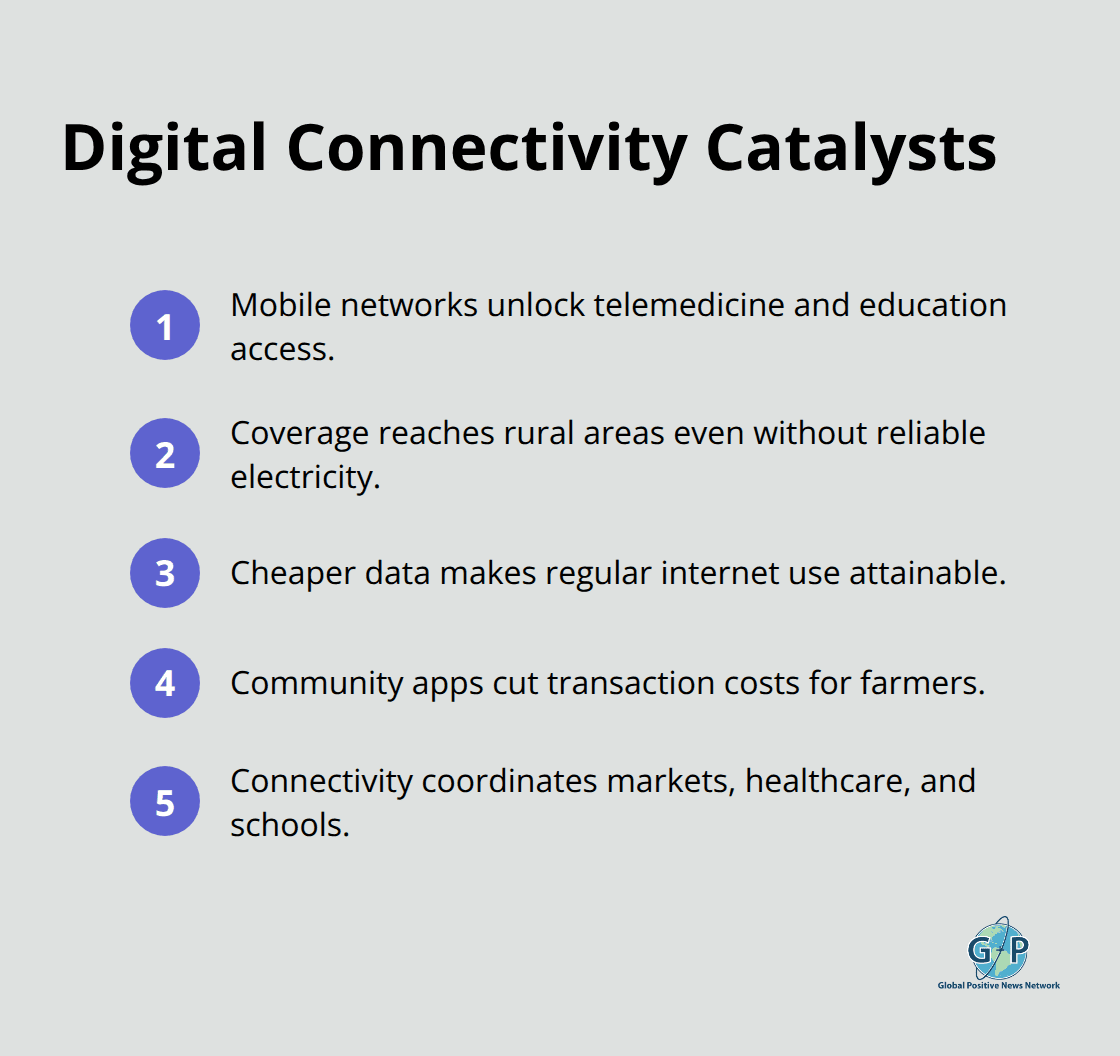
Mobile networks form the foundation for healthcare and education access in regions where traditional infrastructure never existed. Africa added 190 million new mobile subscribers between 2019 and 2024, expanding connectivity to populations previously isolated from digital services. This expansion matters because mobile connectivity directly enables telemedicine adoption, educational access, and community coordination that renewable energy and healthcare innovations require to function. In Bangladesh, Grameenphone’s network reaches 84 million subscribers across rural areas where 40% of the population lacks reliable electricity, yet these same communities now access health information and educational content through basic mobile phones. The cost of mobile data in sub-Saharan Africa dropped from $8.50 per gigabyte in 2015 to $2.30 in 2023, making regular internet access financially viable for families earning under $3 daily.
Solar Microgrids Paired with Mobile Networks Create Independence
Communities that implement solar microgrids paired with mobile networks gain genuine independence from centralized infrastructure controlled by distant corporations. They power their devices, access remote medical consultations, and coordinate local economic activity without reliance on external systems. This combination transforms how rural populations interact with markets, healthcare providers, and educational institutions. Families retain control over their energy spending and information access rather than sending money to distant energy corporations or telecommunications monopolies.
Educational Platforms Democratize Learning Access
Educational platforms operating on mobile networks have eliminated the gatekeeping that prevented poor communities from accessing quality learning. Khan Academy reaches 180 million learners monthly, with content accessible on 2G networks through their lightweight mobile app designed specifically for low-bandwidth environments. India’s DIKSHA platform delivers educational content to 3.7 million teachers and 450 million students, predominantly in rural schools where qualified instructors remain scarce. Students in villages access lessons from expert educators without waiting years for trained teachers to arrive in their regions.
Community Apps Strengthen Local Economic Coordination
Community-based apps strengthen local coordination in concrete ways that generate measurable economic gains. Farmers in Kenya use Tigo Pesa mobile money integrated with agricultural advisory services to receive weather forecasts and crop pricing information, then execute transactions without traveling to distant markets. Information access directly reduces transaction costs and middleman markups that previously captured 30-50% of agricultural revenues. Mobile networks function as the connective tissue that enables every other innovation to reach communities that traditional systems abandoned decades ago.
Final Thoughts
Technologies for hope work because they address real barriers that communities face today. Solar panels cut energy costs by 50-90%, telemedicine connects patients to specialists within hours instead of weeks, and mobile networks enable access to education and market information that previously required expensive travel. These innovations function together, not separately-a community with solar power and battery storage can reliably charge mobile devices that connect patients to remote doctors and students to educational platforms.
The examples throughout this post show that these solutions already operate at scale. Kenya’s M-KOPA Solar installed 750,000 systems, India’s Apollo Telehealth conducted 3 million consultations in 2023, and Khan Academy reaches 180 million learners monthly. Communities are adopting these technologies right now and experiencing measurable improvements in income, health outcomes, and educational opportunity.
Local governments, NGOs, and community organizations can access funding through organizations focused on sustainable development and technology adoption, while technical training programs exist for installation, maintenance, and operation of these systems. The barrier is no longer whether these technologies work-the barrier is connecting communities with the resources and expertise to deploy them. We at Global Positive News Network believe these innovations represent genuine hope because they solve real problems with proven solutions.
Having a hard day?
The 2 Minute Hope Reset is a short free guide with three small practices for the days that feel heavy. Two minutes each, nothing to keep up with.
Get the free guideExplore more positive news:
Enjoying stories like this?
Global Positive News Network is reader-supported. If you’d like to support the mission, you can visit the Official GPNN store.