

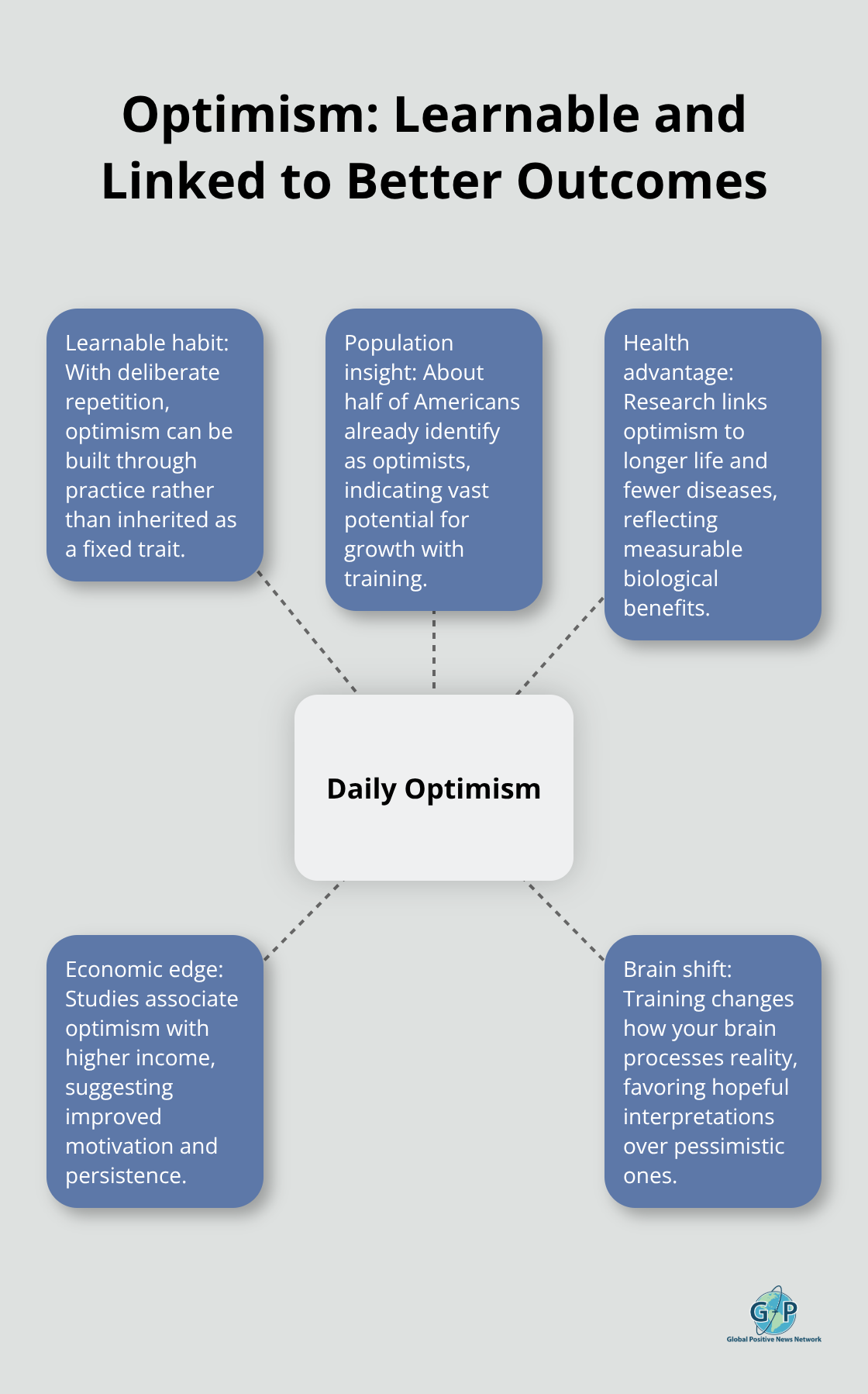
Optimism isn’t something you’re born with or without. It’s a skill you build through deliberate daily choices, and the science proves it works.
At Global Positive News Network, we’ve found that cultivating daily optimism starts with understanding how your brain actually changes. Small habit shifts compound into lasting hope, and this guide shows you exactly how.
How Your Brain Rewires Itself Into Optimism
The Neuroscience of Neuroplasticity
Your brain isn’t fixed. Neuroscientist Carla Shatz proved this when she discovered that neurons that fire together wire together, meaning repeated thoughts and actions physically reshape your neural pathways. When you practice optimistic responses consistently, your brain strengthens the neural connections supporting hopeful thinking and weakens those tied to pessimism. Research from Scheier and Carver shows that dispositional optimism-your tendency to expect positive outcomes-isn’t a personality trait you inherit; it’s a learnable habit built through deliberate repetition.
About half of all Americans identify as optimists, which suggests the other half can develop this capacity with focused practice. The Italian research review linking optimism with longer life, fewer diseases, and higher income confirms that this isn’t wishful thinking; it’s a measurable shift in how your brain processes reality.
How Thoughts Trigger Emotional Responses
Your thoughts directly trigger emotional responses, and your emotions drive behavior. When you habitually reframe setbacks as temporary and specific rather than permanent and global, your amygdala-the brain’s threat detector-activates less intensely. This means less stress hormones flood your system and more cognitive resources become available for problem-solving.
Consistent practice changes your default mindset because repetition moves optimistic thinking from conscious effort into automatic response. Viktor Frankl argued that maintaining present belief in hope determines future happiness, and neuroscience confirms his insight: the more you practice hopeful thinking, the more your brain defaults to it under pressure.
From Thought to Action: Practical Rewiring Techniques
Challenge negative thoughts immediately when they arise. Write them down, test the evidence against them, and list specific counterarguments. This simple act interrupts the automatic loop where one pessimistic thought triggers another.
Optimists tend to use problem-focused coping-they ask what they can actually control and act on it-while pessimists dwell on what they cannot change. Set realistic daily goals rather than vague aspirations; one concrete, meaningful objective creates steady momentum and gives your brain evidence that effort produces results.
Track small wins deliberately in a progress log and celebrate them, because your brain needs this feedback loop to strengthen optimistic neural pathways. Physical activity elevates mood and reshapes your neurochemistry within minutes; try at least 15 minutes daily if you’re serious about rewiring toward optimism.
Sleep, Social Environments, and Neural Development
Sleep quality matters enormously for resilience-poor sleep impairs your prefrontal cortex, the part responsible for rational thinking and emotional regulation, leaving you vulnerable to pessimism. Surround yourself with people who reinforce optimistic thinking because social environments shape neural development; pessimism spreads as easily as optimism does.
The research is clear: small daily habit shifts compound into lasting neurological change, and your brain rewards consistency with faster, stronger automatic responses toward hope. These rewired neural pathways form the foundation for the daily habits that sustain optimism over time.
Daily Habits That Build Lasting Optimism
Your First Hour Sets the Tone for Everything
The first hour after you wake up determines whether your brain defaults to optimism or pessimism for the entire day. Sleep deprivation impairs your prefrontal cortex, the region responsible for rational thinking and emotional regulation, which means you wake vulnerable to negative thought spirals. Counter this vulnerability with a deliberate morning structure that activates your optimistic neural pathways before external demands hijack your attention.
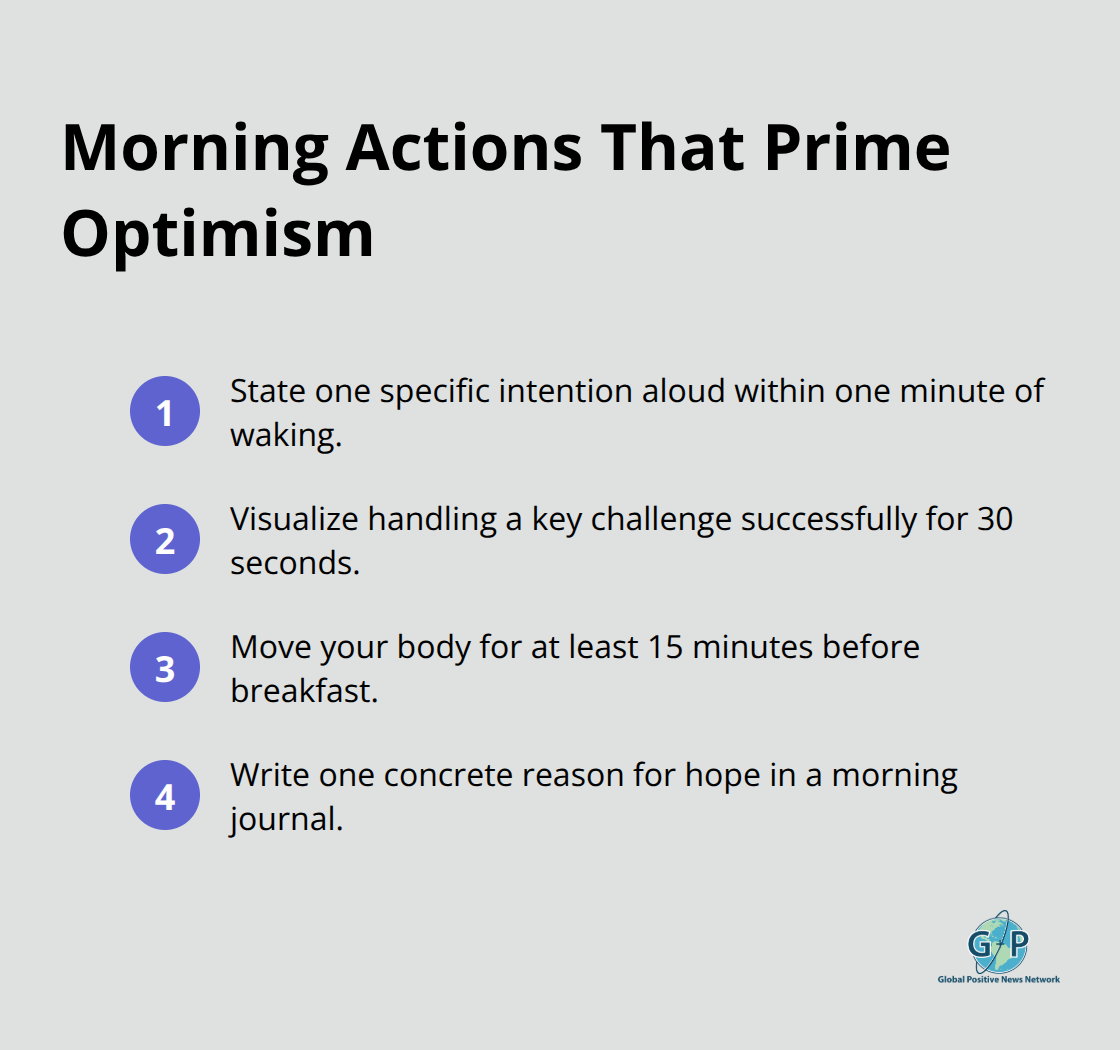
Start with a single optimistic intention spoken aloud within one minute of waking-not vague positivity but a concrete statement about what you’ll handle well today. Research from Scheier and Carver shows optimists use problem-focused coping, so your intention should address a specific challenge you’ll face. Spend 30 seconds visualizing yourself handling that challenge successfully; this primes your brain’s motivation centers and increases follow-through.
Move Your Body Before Breakfast
Physical activity within the first two hours of waking elevates mood through dopamine and serotonin release, so a 15-minute walk, brief strength work, or even stretching shifts your neurochemistry before breakfast. Many people skip this and wonder why they feel reactive by 10 a.m. Daily habits that build lasting optimism work faster than any other single intervention for mood stabilization.
Write Specificity Into Your Gratitude Practice
Gratitude isn’t motivational speaking-it’s a neurobiological reset that redirects attention away from threat detection toward resource recognition. Write one concrete reason for hope every morning in what some call a hope journal; specificity matters because vague gratitude produces vague results. Instead of writing you’re grateful for family, write exactly what your partner or friend did yesterday that mattered. This specificity activates your anterior cingulate cortex, the brain region that processes meaningful reward.
End each evening by listing three tangible highlights from your day, not to feel artificially happy but because your brain literally consolidates these memories during sleep, making them more accessible tomorrow when stress hits. If nothing good happened, congratulate yourself for surviving the day and commit to one small action tomorrow-this prevents the downward spiral where a difficult day becomes evidence that life is hopeless.
Interrupt Spirals With Your Breath
Mindfulness interrupts negative thought loops before they amplify. When anxiety or worry spikes, use three to five minutes of focused breathing rather than trying to think your way out of the spiral; your prefrontal cortex is already offline when stress hormones flood your system, so reasoning won’t work. Box breathing works best for most people: inhale for four counts, hold for four, exhale for four, hold for four, repeat five times. This activates your parasympathetic nervous system and restores rational thinking capacity within minutes.
Practice these three techniques consistently for two weeks before expecting automatic responses; neuroplasticity requires repetition, and your brain needs roughly 14 days to begin defaulting toward these patterns under pressure. Once these morning and evening anchors become automatic, you’ll notice obstacles arise-moments when stress, setbacks, or external pressure test whether your new habits hold. The next section shows you exactly how to recognize what derails optimism and how to rebuild it when life pushes back.
Overcoming Obstacles to Maintaining Optimism
Recognize Cognitive Distortions Before They Spiral
Your optimistic habits will collide with reality, and your brain will sabotage you. This isn’t weakness; it’s neurological defense. Your brain evolved to detect threats, and when stress spikes, it defaults to catastrophic thinking patterns that feel absolutely true. Cognitive distortions aren’t character flaws-they’re automatic mental shortcuts your brain uses under pressure, and they’re predictable enough to interrupt before they derail your progress.
The most common distortion is catastrophizing, where one setback becomes evidence of total failure. A single rejection becomes proof you’re fundamentally unlovable. A mistake at work becomes confirmation you’re incompetent. Your brain amplifies the threat signal and suppresses evidence to the contrary.
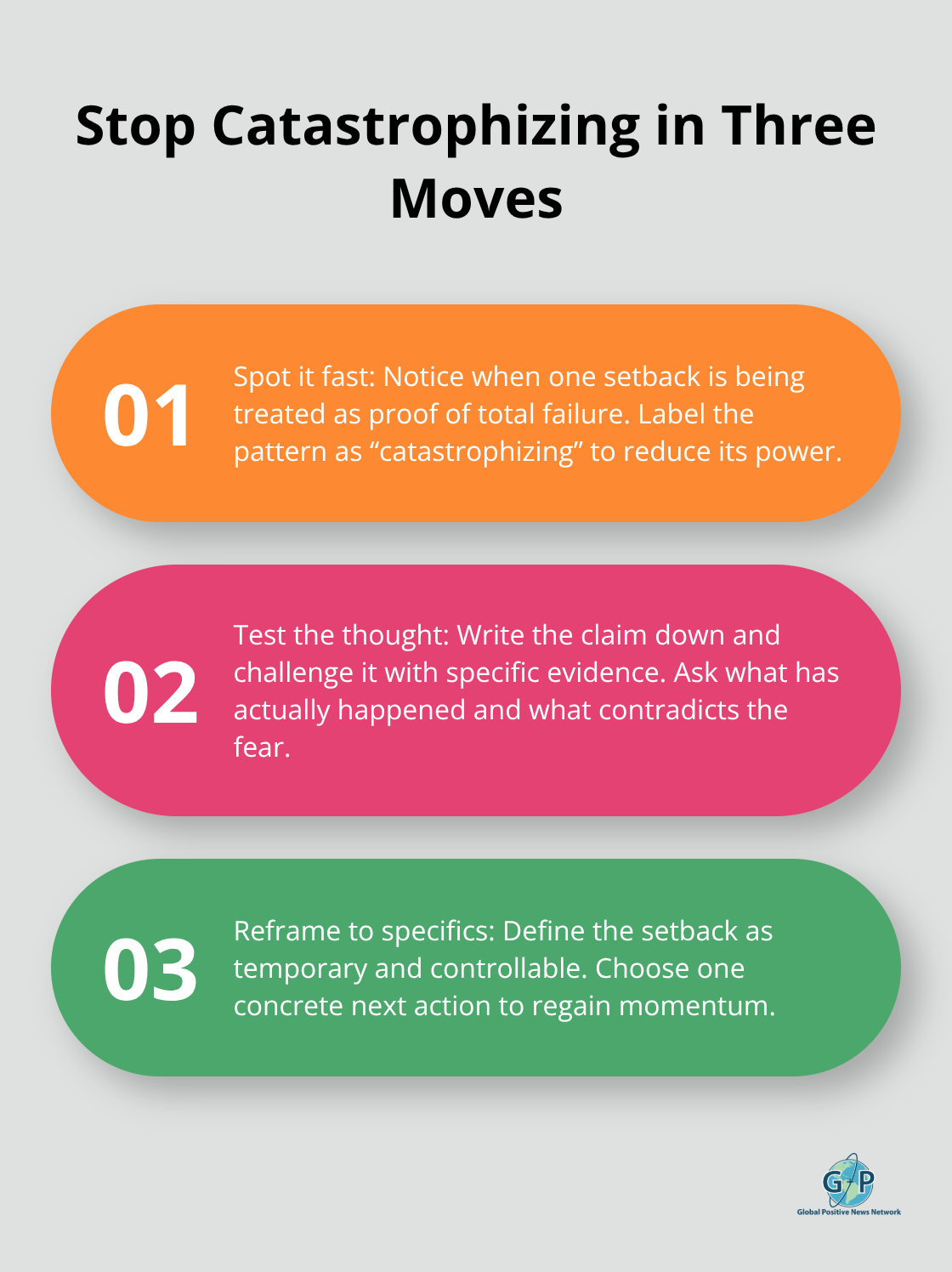
Combat this by identifying and challenging negative thoughts immediately, then testing them against specific facts. Ask yourself: Has this catastrophe actually happened before, or am I predicting it? What evidence contradicts this thought? What would I tell a friend in this exact situation?
This written exercise forces your prefrontal cortex back online when your amygdala has hijacked your thinking. Research shows that people who write down negative thoughts and challenge them with evidence recover from setbacks faster than those who ruminate silently.
Address Overgeneralization With Pre-Planned Responses
The second distortion is overgeneralization, where one difficult day means your entire life is broken. Counter this by setting if-then plans before stress hits. If I have a terrible morning, then I will remember that one bad hour doesn’t determine the day. If I fail at something important, then I will identify one specific thing I learned and write it down. These pre-planned responses bypass the emotional reaction and activate problem-focused coping instead of catastrophic spiraling.
Transform Setbacks Into Data for Improvement
Resilience doesn’t mean bouncing back unchanged; it means learning from setbacks and adjusting your approach. Optimists reframe failures as temporary and specific, not permanent and global. You failed this particular task, not at life itself. The failure happened because of controllable factors you can address, not because the universe is against you.
This explanatory style-how you interpret why things happen-directly predicts how quickly you recover and whether you try again. When you face a real setback, write a two-sentence takeaway: what went wrong, and what will you do differently next time? This transforms the failure from evidence of hopelessness into data for improvement.
Build Your Support System Before Crisis Hits
Identify three specific people who reinforce optimistic thinking and reach out to at least one every week-not when you’re desperate but regularly. Share a small win, ask for perspective on a challenge, or simply connect over something positive. People who maintain optimistic explanatory style recover from depression faster than isolated individuals.
Your support system should include at least one person who challenges your catastrophic thoughts directly. This is not a cheerleader who dismisses your concerns; it’s someone who asks tough questions like, Is that actually true? or What evidence contradicts that thought? Surround yourself with people who model problem-focused coping rather than complaint spiraling. If your current social circle defaults to pessimism, this is your signal to gradually shift toward people who practice the habits described in this guide.
Final Thoughts
The habits you’ve learned in this guide work because they’re grounded in how your brain actually functions. Neuroplasticity means your brain responds to repetition, and small daily shifts compound into measurable changes within weeks. You don’t need perfection; you need consistency.
One optimistic intention each morning, three gratitude highlights each evening, and 15 minutes of movement daily create the foundation for lasting hope when obstacles arise. Cultivating daily optimism isn’t about ignoring real problems or pretending setbacks don’t hurt; it’s about training your brain to recognize what you can control and act on it rather than spiraling into catastrophic thinking. When stress tests your new habits, you now have specific tools to interrupt negative thought patterns, challenge cognitive distortions, and rebuild momentum.
Start with one habit this week and pick whichever feels most doable, because a habit you actually do beats a perfect plan you abandon. After two weeks, add a second habit, and after a month, you’ll notice your default responses shifting toward hope. Visit Global Positive News Network for stories of people who’ve rebuilt their lives through deliberate habit shifts and for tools that support your journey toward sustained optimism.
Having a hard day?
The 2 Minute Hope Reset is a short free guide with three small practices for the days that feel heavy. Two minutes each, nothing to keep up with.
Get the free guideExplore more positive news:
Enjoying stories like this?
Global Positive News Network is reader-supported. If you’d like to support the mission, you can visit the Official GPNN store.