

Your mindset for optimism isn’t something you’re born with-it’s something you build. Most people assume their thoughts are fixed, but neuroscience shows they’re remarkably flexible.
At Global Positive News Network, we’ve seen how small, deliberate shifts in thinking create lasting changes in how people experience their lives. This post walks you through the exact techniques that work.
Why Your Mindset Shapes Your Reality
Your Brain’s Default Setting Works Against Optimism
Your brain is wired to notice threats before opportunities. This negativity bias kept your ancestors alive when predators lurked nearby, but in modern life it sabotages your optimism at every turn. Research from Harvard Health Publishing shows that negative experiences stick in memory far more strongly than positive ones-a single critical comment can overshadow ten compliments. Your brain treats bad news like an emergency signal, flooding your system with cortisol and adrenaline even when the threat is trivial. This bias isn’t a personal flaw; it’s neurological. The amygdala, your brain’s threat-detection center, processes negative information faster than positive information. Studies from the American Psychological Association confirm that people naturally interpret ambiguous situations pessimistically unless they actively train themselves otherwise.
The problem compounds because pessimistic thoughts trigger pessimistic behaviors. If you believe a project will fail, you invest less effort, gather less information, and give up faster when obstacles appear. This creates a self-fulfilling prophecy where your brain’s negativity bias becomes your reality.
How Neuroplasticity Rewires Your Thinking Patterns
Neuroplasticity proves that repeated thoughts physically reshape your neural pathways. Each time you interrupt a negative thought and reframe it, you strengthen new neural connections while weakening old pessimistic patterns. Harvard Health Publishing and the American Psychological Association both document that this rewiring happens faster than most people expect-consistent practice over weeks, not years, produces measurable shifts.
The catch is that your brain won’t rewire itself automatically. You must interrupt the negative spiral deliberately. When you notice yourself thinking “I always fail at this,” your brain has already activated the same neural pathway thousands of times. The reframe-“I’ve handled similar challenges before”-activates a different pathway. Practice this enough times and the optimistic pathway becomes your default. Research shows that people who practice cognitive reframing experience measurable improvements in mood, sleep quality, and stress management within three to four weeks of daily practice.
The Difference Between Wishful Thinking and Strategic Thinking
The transformation isn’t positive thinking or wishful thinking-it’s strategic thinking based on evidence and past experience. Your reframes must anchor to real situations you’ve navigated successfully. This grounded approach (rooted in actual capability rather than fantasy) separates effective optimism from denial. When you reframe a setback as a learning opportunity, you’re not ignoring the problem; you’re shifting how your brain processes it. This shift changes what actions you take next.
Now that you understand how your brain creates pessimism and how you can interrupt that pattern, the real work begins. The techniques that follow show you exactly how to rewire these pathways through daily practice.
Three Daily Practices That Rewire Your Brain Faster Than You Think
Gratitude Shifts Your Brain’s Focus Toward What Works
Gratitude redirects your brain’s focus away from threat-detection and toward what’s working. Harvard Health Publishing documents that people who maintain a daily gratitude journal experience measurable improvements in mood and sleep quality. The practice works because it forces your brain to scan for positive information instead of defaulting to problems. Write three specific things each morning that went well the previous day, but here’s the critical part: include why each thing mattered to you. This addition activates deeper neural pathways than generic gratitude. A study from Stanford University on growth mindset shows that people who link their gratitude to personal meaning report stronger motivation and resilience. Spend no more than five minutes on this. Research confirms that consistency matters far more than duration, so a quick daily practice beats occasional lengthy reflection. Start this tomorrow morning, not next Monday. Your brain rewires through immediate, repeated action, not future promises.
Catch, Check, and Change Your Negative Thoughts
Reframing negative thoughts requires you to catch them in real time, which is why the NHS developed the catch-it, check-it, change-it technique specifically for this purpose. Step one: notice when you think in absolutes like always or never. Step two: ask yourself what evidence actually supports this thought versus what contradicts it. Step three: replace the thought with a more accurate statement rooted in your actual experience. If you catch yourself thinking “I always fail at presentations,” check whether that’s true. You’ve given presentations before that went well. Change it to “I’ve handled similar presentations before and I’m more prepared this time.” This isn’t positive thinking; it’s accurate thinking based on evidence. Keep a thought record on your phone or notebook to track which thoughts appear most frequently. Most people identify they cycle through three to five recurring negative patterns. Once you identify them, reframing becomes automatic. The goal is flexible thinking, not forced optimism.
Choose Your Social Circle With Intention
Who you spend time with directly shapes your optimistic outlook. Research from Christakis and Fowler published in the Proceedings of the National Academy of Sciences found that happiness spreads through social networks, meaning your mood influences those around you and theirs influences you. Deliberately choose at least one weekly interaction with someone who demonstrates realistic optimism-someone who acknowledges problems but focuses on solutions. Avoid chronic complainers, not because they’re bad people but because their negativity bias is contagious. Your mirror neurons activate others’ emotional states in your brain. Seek communities aligned with your values through local groups, online forums, or volunteer organizations. The quality of one weekly conversation with an optimistic person outweighs dozens of passive scrolling moments on social media. Identify one person in your life who embodies grounded optimism and schedule a specific time to connect this week.
These three practices work because they interrupt your brain’s default patterns and replace them with new neural pathways. But practices alone don’t stick without structure. The next chapter shows you how to build habits that maintain your optimistic outlook over months and years, transforming these daily techniques into automatic responses.
How to Lock In Your Optimistic Shifts
Daily practices work only when they become automatic, which means you need a system that tracks what’s working and removes friction from what matters. Most people abandon new habits within two weeks because they rely on motivation instead of structure. Your environment, measurement systems, and social accountability determine whether your optimistic mindset becomes permanent or fades like a New Year’s resolution.
The Positivity Journal Tracks Real Progress, Not Just Feelings
A positivity journal differs fundamentally from a gratitude journal. While gratitude focuses on what went well, a positivity journal documents your actual behavioral shifts and their measurable outcomes. Write down each time you catch and reframe a negative thought, noting the original thought, your reframe, and what action you took differently as a result. After two weeks, you’ll see patterns. Most people discover they reframe the same three to five recurring thoughts.
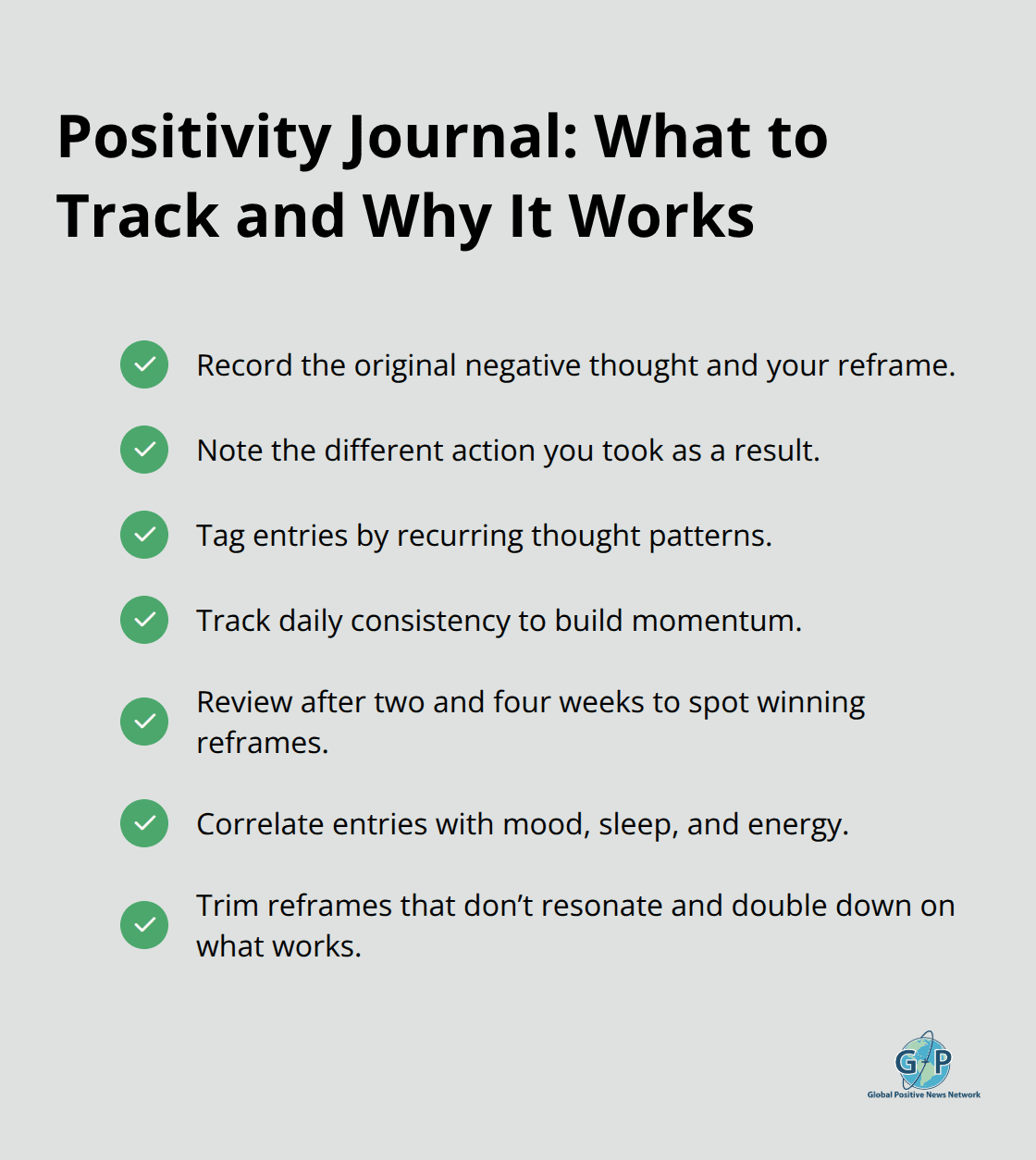
Research shows that tracking progress increases consistency because you gain concrete evidence that the work produces results. Use a simple spreadsheet or app like Mood Meter or Daylio that requires only thirty seconds per entry. The goal isn’t perfection; it’s visibility. When you see that you’ve successfully reframed negative thinking on nineteen out of twenty-one days, your brain registers progress and creates momentum. After four weeks of tracking, review your entries and identify which reframes work best for your specific thought patterns. Delete the ones that don’t resonate. Your journal becomes personalized rather than generic. Date each entry and mark whether you felt more motivated or energized that day. Over time you’ll spot which reframes correlate with better mood and sleep. This data-driven approach beats vague positive thinking because it shows you exactly which techniques work for your brain.
Environmental Design Makes Optimistic Thinking Effortless
Your physical space either supports or undermines your optimistic mindset. Place visible reminders of past successes where you’ll see them during moments of doubt-a photo of you completing a challenging project, a handwritten note from someone thanking you, or a certificate of accomplishment posted near your workspace. These triggers recall your actual capabilities when pessimism creeps in. Research from the American Psychological Association confirms that environmental cues activate neural pathways associated with those memories, making reframing faster and more automatic. Remove or minimize exposure to doomscrolling triggers. If social media feeds drain your optimism, delete the apps from your phone and access them only through a browser on your computer. This friction works in your favor because most people won’t bother with the extra step when triggered. Set your phone background to an image that represents a goal you’re working toward or a value you hold. Every time you check your phone, that visual cue reinforces your direction. Subscribe to uplifting news sources and mute accounts that consistently trigger negativity. Your feed shapes your default thinking patterns. Spend ninety seconds each morning reviewing one story that demonstrates human resilience or kindness. This primes your brain to notice similar patterns throughout your day instead of defaulting to threats. Small environmental shifts compound because they work automatically, without relying on willpower.
Communities Sustain What Solitary Practice Cannot
The people you interact with weekly determine whether your optimistic shifts stick or erode. A 2008 study by Christakis and Fowler in the Proceedings of the National Academy of Sciences found that happiness spreads through networks with measurable precision. When you spend time with optimistic people, their explanatory style becomes contagious. Conversely, chronic complainers pull your thinking toward negativity through emotional mirroring. Identify one community aligned with your values, whether that’s a volunteer organization, fitness group, book club, or online forum focused on skill development or personal growth. Commit to attending or participating weekly at a set time. Consistency matters more than the activity itself. The social accountability creates external structure that supports your internal work. Look for communities where people focus on solutions rather than problems. A running group discusses training strategies and race goals. A knitting circle celebrates completed projects. A volunteer organization sees tangible community impact. These environments naturally reinforce optimistic thinking because the group culture emphasizes progress and capability. Avoid groups centered on complaint or commiseration, even if they feel supportive initially. After four weeks in a solution-focused community, you’ll notice your default thinking patterns shift toward problem-solving rather than rumination. Identify one community you’ve considered joining and attend once this week. Notice how the group’s language and focus shape your thinking during and after the interaction. This single experience will show you whether that community supports your optimistic mindset or drains it.
Final Thoughts
Your mindset for optimism transforms through consistent small actions, not occasional intense effort. People who practice reframing for ten minutes daily outperform those who spend two hours once monthly because your brain rewires through repeated practice, not heroic bursts. Showing up for your gratitude practice on days when you lack motivation matters far more than the days when enthusiasm flows naturally, since those difficult days are when your old neural pathways attempt to reassert themselves.
Setbacks will interrupt your progress, and you will miss journal entries or scroll through feeds that drain your optimism. This is not failure; it is part of the process that separates people whose optimistic mindset sticks from those who revert to pessimism. Treat a missed day as data rather than proof that you cannot change, then identify what made that day different and adjust your environment or practice accordingly.
After eight weeks of consistent practice, compare your mood, sleep quality, and recovery speed against your baseline to measure what matters. We at Global Positive News Network see this transformation repeatedly in the stories we share, with people reporting measurable improvements in relationships, work performance, and life satisfaction through rewiring their thinking patterns.
Having a hard day?
The 2 Minute Hope Reset is a short free guide with three small practices for the days that feel heavy. Two minutes each, nothing to keep up with.
Get the free guideExplore more positive news:
Enjoying stories like this?
Global Positive News Network is reader-supported. If you’d like to support the mission, you can visit the Official GPNN store.