
Internet connectivity for communities remains one of the most pressing challenges of our time. Billions of people still lack reliable access to broadband, which limits their economic opportunities, educational prospects, and health outcomes.
At Global Positive News Network, we’re examining how infrastructure solutions and real-world projects are closing this gap. This blog post explores the digital divide, proven connectivity strategies, and the measurable impact of better internet access on communities worldwide.
Who Really Lacks Internet Access and Why It Matters
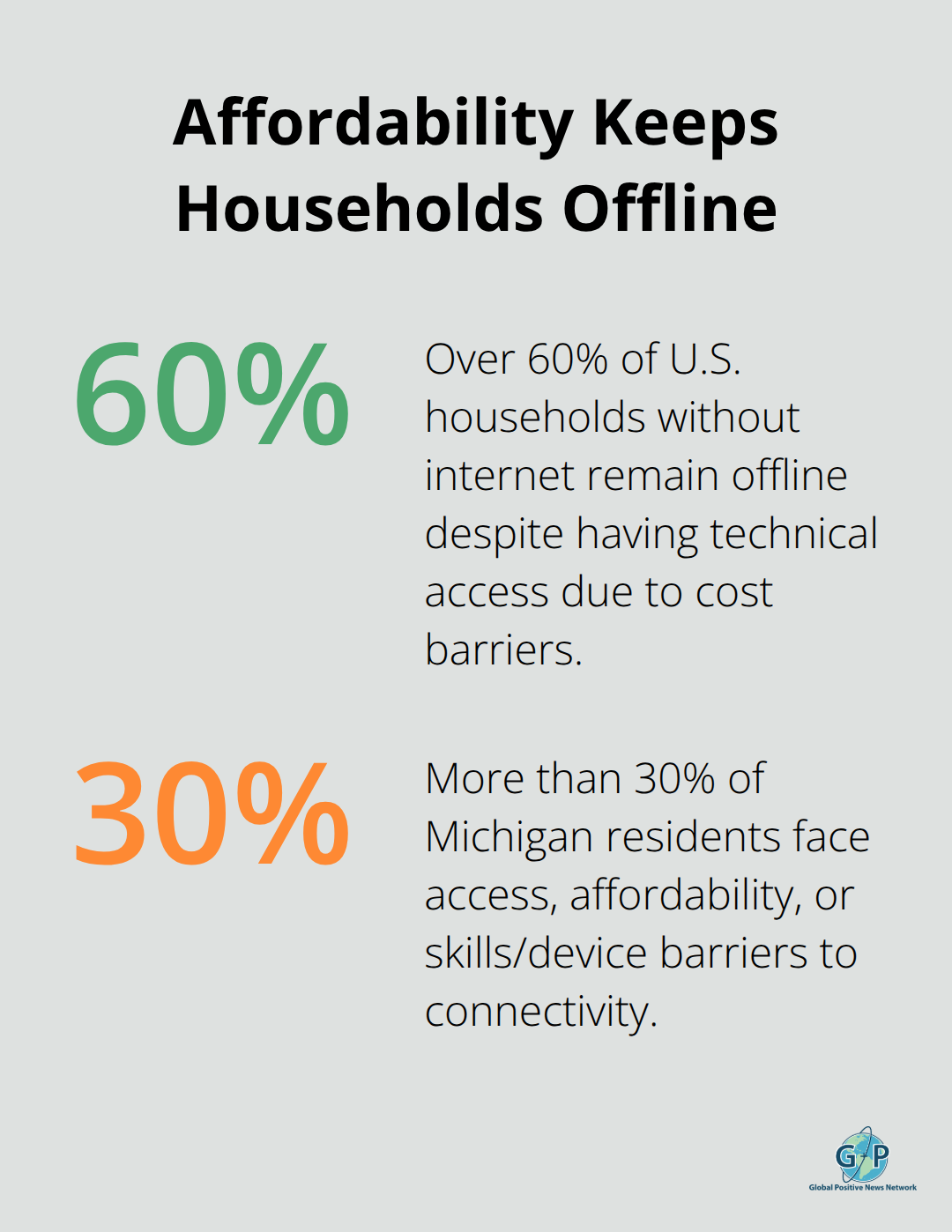
The digital divide isn’t evenly distributed. Rural areas in the United States face the harshest connectivity gaps, with approximately 26 million Americans lacking fixed broadband, mostly in rural communities located in every region of the country. In Michigan, more than 30% of residents either lack access entirely, cannot afford service, or lack the skills and devices needed for connectivity. The problem intensifies in persistent poverty counties across the South and rural regions, where the economics of broadband deployment make private investment unattractive. Communities Unlimited documented this reality across Arkansas, Louisiana, Mississippi, Oklahoma, Tennessee, Texas, and Alabama through over 80 broadband assessments since 2022. Affordability remains a massive barrier even where infrastructure exists. The typical base broadband cost hovers around 70 dollars monthly, higher than regional and global averages, which explains why more than 60% of households without internet remain offline despite having technical access. Rural communities face a compounding problem: they lack both infrastructure and the income to support expensive connections.
Education Takes the Hardest Hit
The educational consequences of poor connectivity hit immediately and measurably. In 2020, approximately 16 million K-12 students lacked sufficient home broadband, with 6 million missing devices entirely and 9 million lacking both. Students without reliable home internet complete homework more slowly, earn lower grade point averages, and face weaker prospects for postsecondary education. Fixed broadband proved dramatically more effective than mobile-only options for maintaining learning continuity, yet millions of families cannot afford either. The digital divide directly translates into academic disadvantage that compounds over years of schooling.
Employment and Health Suffer Without Connection
Broadband access fundamentally shapes employment prospects and health outcomes. Communities without reliable connectivity struggle to participate in job searches, remote work opportunities, and professional upskilling programs. Telehealth services require stable internet connections that low-income, elderly, disabled, and non-English-speaking populations often cannot access. The pandemic exposed these gaps starkly, with entire populations unable to participate in virtual healthcare and work environments. These aren’t theoretical problems-they’re documented barriers that prevent people from earning income and receiving timely medical care.
Structural Barriers Persist Across Demographics
Demographic disparities persist stubbornly, with Black, Latine, and Native American families remaining less connected even after controlling for income, education, and age due to structural barriers and digital redlining practices. These systemic inequities require more than infrastructure alone. Solutions must address affordability, device access, and digital literacy simultaneously to create genuine opportunity equity. The next section examines how communities and governments are building infrastructure solutions that tackle these interconnected challenges.
Building Connectivity Where Markets Won’t
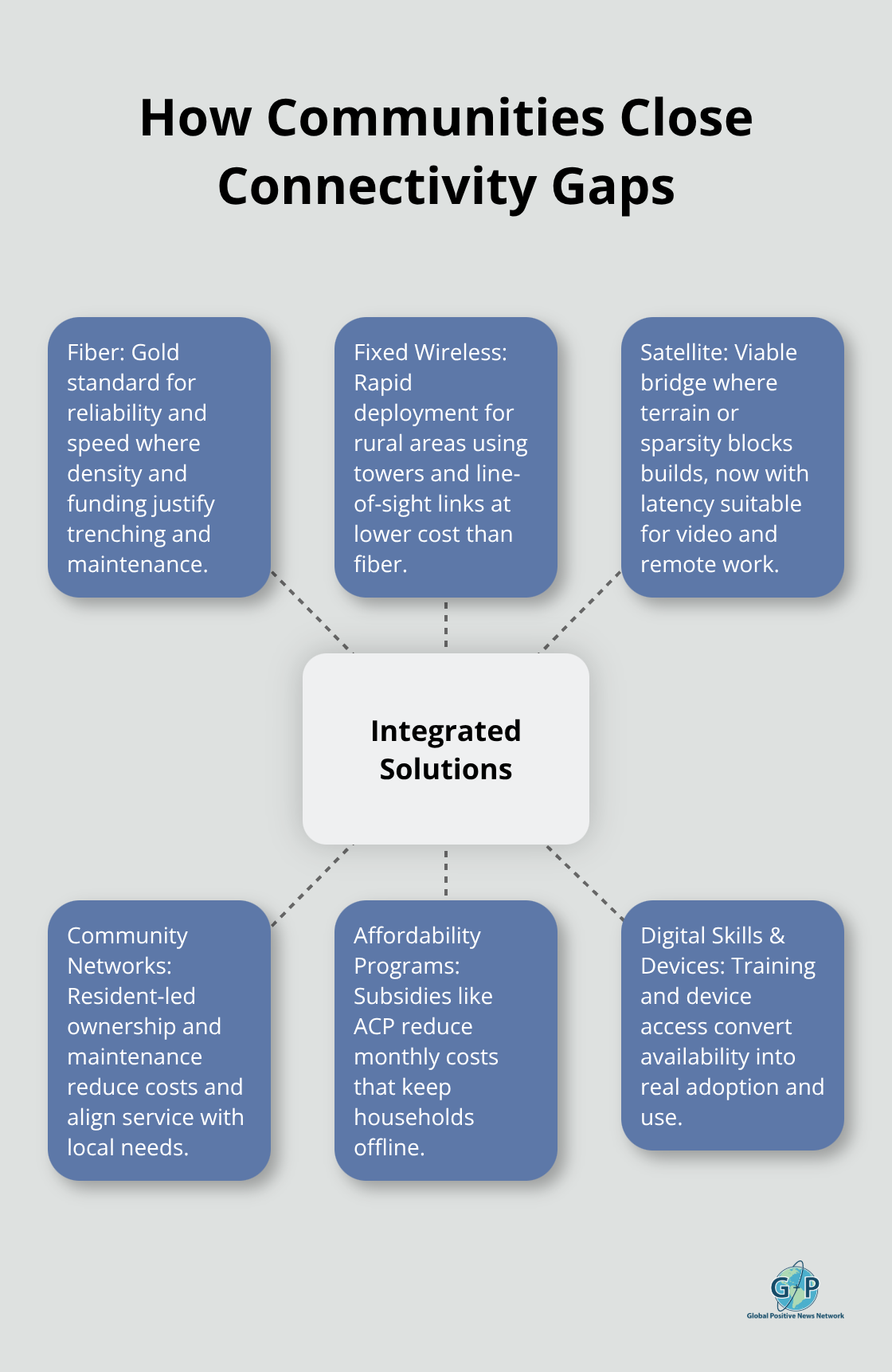
Fiber optic networks remain the gold standard for broadband speed and reliability, but deployment costs exceed $20,000 per mile in rural areas, making private investment economically unviable in low-density regions. Federal funding through the Broadband Equity Access and Deployment program has become essential. Michigan received $1.55 billion from BEAD to expand high-speed internet, and the state used community listening tours across ten prosperity regions to identify exactly where infrastructure gaps existed. The MI Connected Future initiative gathered feedback from 949 participants across 43 in-person meetings, then incorporated this data directly into deployment plans. Infrastructure decisions based on actual community needs outperform top-down planning.
Mapping Gaps Through Community Assessment
Communities Unlimited’s work across Arkansas, Louisiana, Mississippi, Oklahoma, Tennessee, Texas, and Alabama demonstrates how targeted assessment identifies real connectivity barriers. Since 2022, the organization completed over 80 broadband assessments that mapped local connectivity gaps and created digital opportunity plans tailored to each region’s specific barriers. These assessments identified which communities needed fiber expansion, which could benefit from wireless infrastructure, and which required satellite solutions as a temporary bridge. Satellite internet has improved dramatically, with newer systems offering latency low enough for remote work and videoconferencing, though ground-based wireless and fiber remain superior where deployment is feasible. No single technology solves the digital divide uniformly-rural communities with sparse populations benefit from wireless towers and satellite, while suburban and denser rural areas justify fiber investment.
Community-Owned Networks Transform Urban Connectivity
Urban areas increasingly deploy community-owned networks that shift control away from large providers. NYC Mesh is a volunteer-run, open-source community broadband network that has grown since installing its first node in 2014. These networks prove that cities can build affordable connectivity when residents participate directly in deployment and operations. The model works because grassroots tech initiatives maintain ownership and control over infrastructure decisions and ongoing maintenance.
Federal Programs and Funding Mechanisms
Federal and state programs now provide concrete funding mechanisms beyond BEAD. The Affordable Connectivity Program subsidizes broadband costs for low-income households, directly addressing the $70 monthly affordability barrier that keeps over 60 percent of unconnected households offline. States operate additional programs like Kansas Broadband Partnership Adoption Grants and Indiana Next Level Connections, targeting specific regional needs. Public-private partnerships work when structured carefully around shared accountability. Michigan’s approach involved monthly roundtables with residents, tribal nations, community organizations, local governments, and internet service providers to align infrastructure investments with actual demand. This coordination prevents the common mistake of building infrastructure nobody can afford or nobody needs.
Cooperative Models Deliver Affordability and Community Benefits
Successful models like Guifi.net in Spain and Broadband for the Rural North in the UK demonstrate that volunteer-built or cooperatively-owned networks achieve high speeds while charging significantly less than commercial providers. B4RN in the UK covers 9,000 properties at roughly 33 pounds monthly, reinvesting profits into community benefits like computer clubs and local employment. These examples prove that connectivity infrastructure succeeds when communities maintain ownership and control. Communities Unlimited’s Rural Broadband Institute, launched in 2022, now offers memberships for rural broadband advocates accessing technical assistance, training, and policy support. The institute translates national broadband policy into actionable local solutions by convening industry experts and identifying practical gaps. As communities build stronger infrastructure foundations, the question shifts from whether connectivity is possible to how communities can maximize its benefits through digital literacy and skills training.
What Real Communities Built When Markets Failed Them
Community Networks That Outperform Commercial Providers
Guifi.net in Spain operates the world’s largest community-owned wireless network with over 37,000 active nodes, charging users significantly less than commercial providers while maintaining network speeds comparable to traditional ISPs. The network uses unlicensed spectrum and open optical fiber that volunteers deployed across the region, governed through a compensation system linking user contributions directly to infrastructure costs. This model proves that community ownership produces affordability without sacrificing performance. In the United Kingdom, Broadband for the Rural North covers approximately 9,000 properties with fiber-to-the-home connections delivering 1 Gbps speeds at roughly 33 pounds monthly, reinvesting profits back into community programs including weekly computer clubs and local employment in network maintenance. Volunteers dug trenches and installed fiber across rural Lancashire, demonstrating that labor contribution replaces expensive contractor costs.
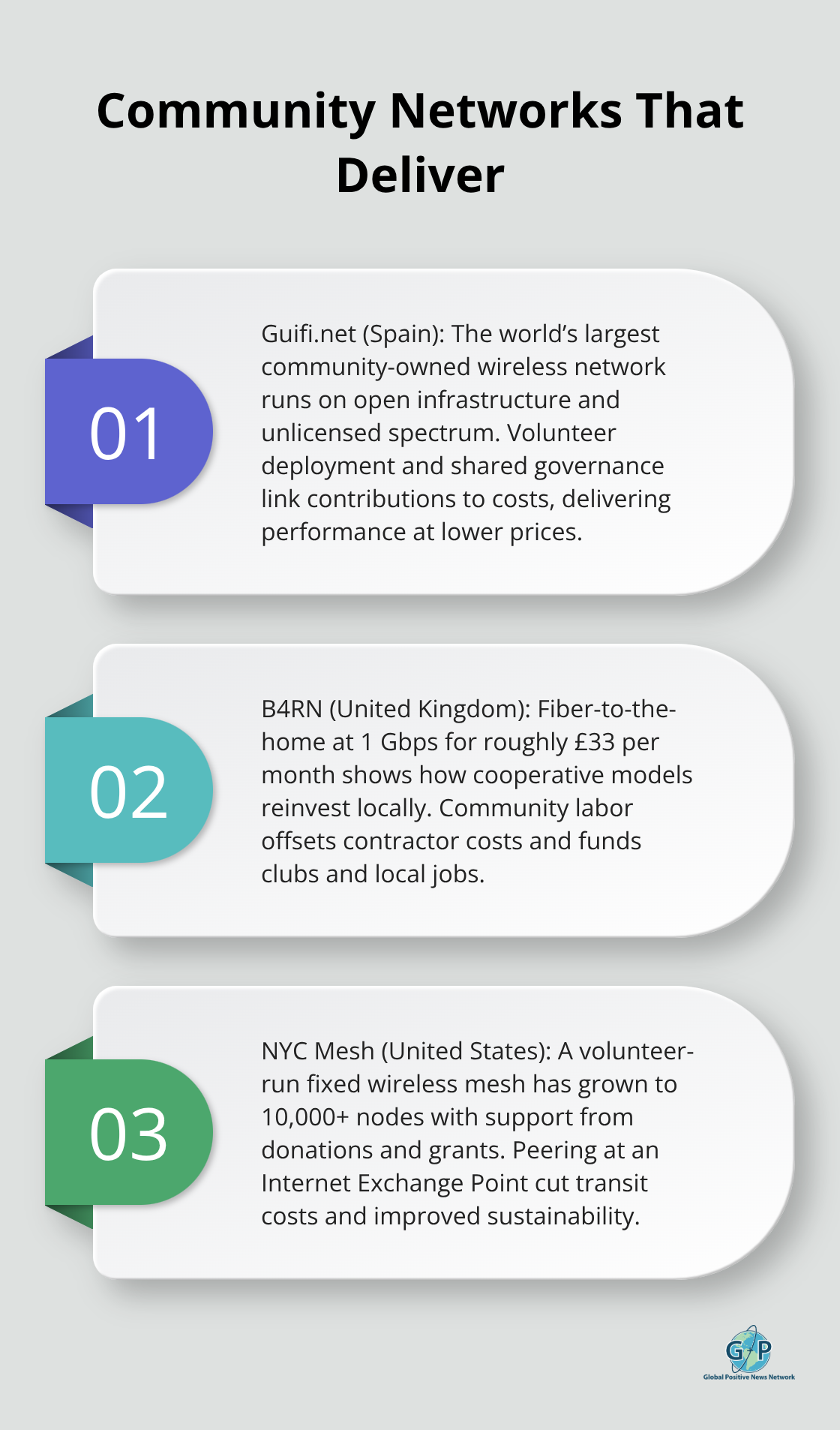
NYC Mesh in the United States has grown to over 10,000 nodes since 2012 by installing rooftop fixed wireless equipment across Manhattan and surrounding boroughs, providing free or low-cost internet funded largely through donor support and grants. The network connected to an Internet Exchange Point in 2015 with assistance from the Internet Society, reducing transit costs substantially and enabling sustainable long-term operation.
Cooperative Models Serve Excluded Populations
South Africa’s Zenzelini network illustrates how community cooperatives manage connectivity infrastructure at scale, with over 13,000 users accessing the network by 2021 at approximately 25 South African Rand monthly for unlimited data. The network operates solar-powered charging stations to address unreliable electricity, placing hotspot locations through local cooperative decisions rather than top-down infrastructure planning. Rhino Camp Refugee Settlement in Uganda demonstrates how community-owned connectivity combined with digital skills training expanded access for populations completely excluded from commercial broadband markets, with residents gaining capacity to participate in remote work and education previously impossible without internet access. When communities control their own networks, they prioritize affordability and local content creation in native languages, addressing utilization gaps that plague infrastructure projects designed without community input.
Local Action Translates National Policy Into Results
Communities Unlimited’s broadband assessments across Arkansas, Louisiana, Mississippi, Oklahoma, Tennessee, Texas, and Alabama directly shaped digital opportunity plans that communities now implement, moving infrastructure decisions from abstract federal planning into locally-responsive action. The Rural Broadband Institute membership model, launched through Communities Unlimited in 2022, formalizes technical assistance and policy support for rural advocates across underserved regions, translating national broadband thinking into actionable local solutions through monthly convenings of industry experts and community leaders. This approach directly challenges the assumption that connectivity requires massive corporate infrastructure investments. The evidence from Guifi.net, B4RN, NYC Mesh, Zenzelini, and AlterMundi in Argentina shows that communities willing to invest volunteer labor and maintain cooperative governance achieve sustainable, affordable connectivity that commercial markets simply will not provide.
Final Thoughts
Internet connectivity for communities remains a prerequisite for economic participation, educational advancement, and health equity. The evidence throughout this blog post demonstrates that the digital divide persists not because solutions don’t exist, but because markets alone won’t serve low-income and rural populations. Communities that took control of their own infrastructure-from Guifi.net’s 37,000 nodes in Spain to NYC Mesh’s rooftop networks across Manhattan-proved that affordability and performance aren’t mutually exclusive when communities maintain ownership and governance.
The path forward requires sustained federal investment through programs like BEAD and the Digital Equity Act, combined with local leadership that prioritizes actual community needs over top-down planning. Michigan’s listening tour approach gathered input from 949 participants before deploying $1.55 billion in federal funding, showing how infrastructure decisions improve dramatically when communities shape them. States and regions must continue funding digital literacy programs, device access initiatives, and affordable connectivity subsidies that address the full spectrum of barriers keeping 2.2 billion people offline globally.
The most promising opportunities emerge when governments, nonprofits, and communities work together rather than separately. Communities Unlimited’s Rural Broadband Institute membership model demonstrates how technical assistance and policy advocacy translate national broadband initiatives into local action across underserved regions. Cooperative ownership models like Broadband for the Rural North and Zenzelini prove that communities willing to invest labor and maintain democratic governance achieve sustainable results that commercial providers cannot match, and we invite you to explore more stories of community resilience and positive change at Global Positive News Network.

Having a hard day?
The 2 Minute Hope Reset is a short free guide with three small practices for the days that feel heavy. Two minutes each, nothing to keep up with.
Get the free guideExplore more positive news:
Enjoying stories like this?
Global Positive News Network is reader-supported. If you’d like to support the mission, you can visit the Official GPNN store.