
Your mindset shapes your output. When you approach work with positivity, you work faster, think clearer, and produce better results.
At Global Positive News Network, we’ve seen how positivity-focused productivity transforms workflows. This isn’t wishful thinking-research backs it up. The question isn’t whether positivity matters, but how to build it into your daily systems.
How Positivity Actually Changes Your Work Output
Your brain works differently when you’re positive. A positive mindset reduces cognitive load, meaning your brain uses less energy on stress and worry, leaving more resources for complex problem-solving and creative thinking. When stress drops, your prefrontal cortex-the part responsible for decision-making and focus-operates at peak efficiency. Lower stress levels directly correlate with faster task completion, fewer errors, and higher-quality output. Research from workplace psychology shows that employees with positive outlooks demonstrate measurably better performance on tasks requiring attention and innovation. The mechanism is straightforward: negativity consumes mental bandwidth. When you’re worried or frustrated, your brain allocates processing power to threat-detection, leaving less capacity for the work itself.
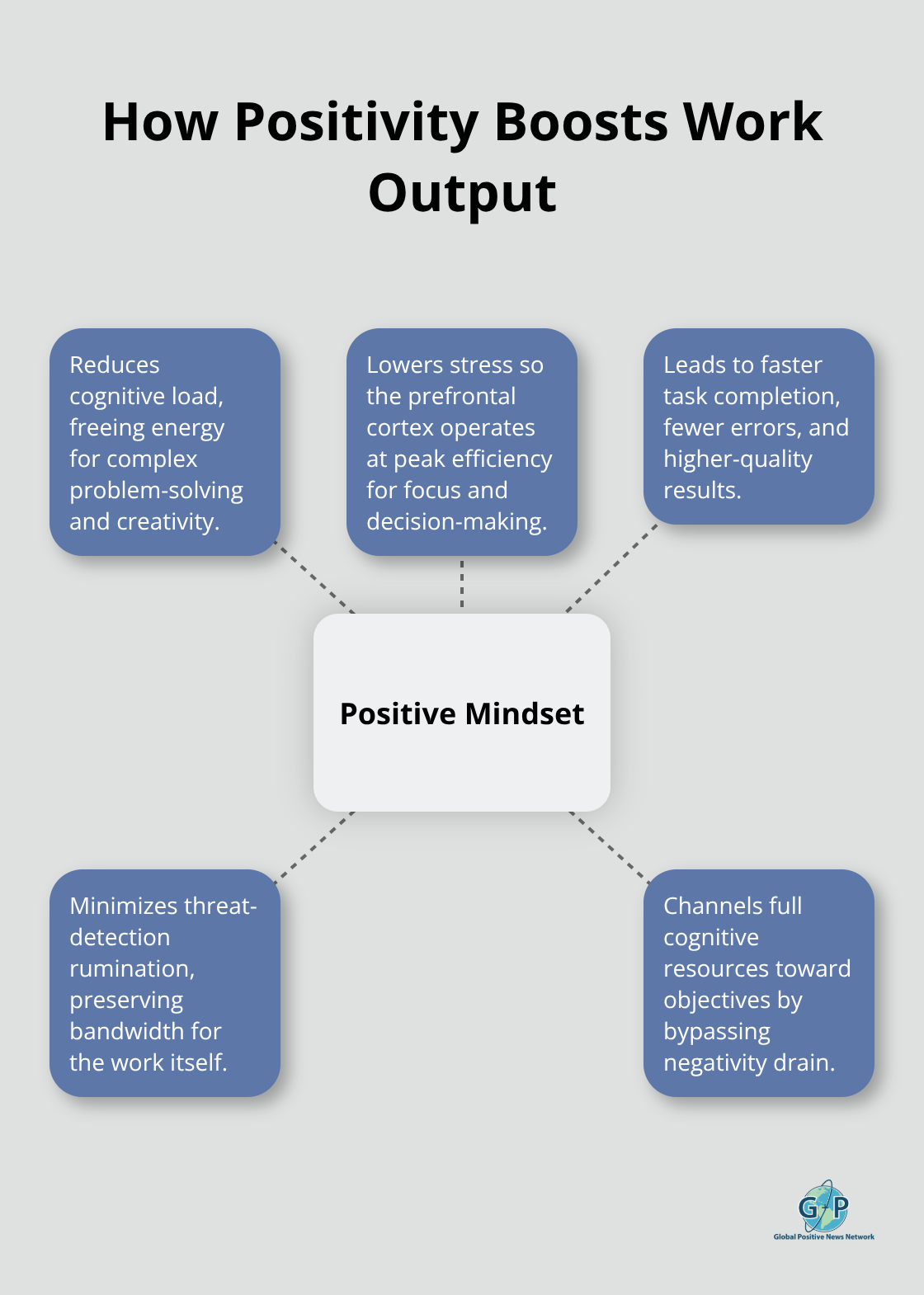
Positive employees bypass this drain entirely, channeling full cognitive resources toward their objectives.
The Negativity Bias That Slows You Down
Your brain is wired to notice problems first. Negativity bias-the tendency to give more weight to negative information than positive-evolved as a survival mechanism but now works against workplace productivity. This bias makes you ruminate on mistakes longer than you celebrate wins, replay difficult conversations, and anticipate worst-case scenarios. The result is wasted mental cycles. One study on workplace cognition found that employees who experienced negative feedback spent significantly longer processing and recovering from it than employees who received positive feedback spent on processing praise. Negativity creates stickiness in your mind, whereas positivity fades faster unless deliberately reinforced. You must consciously shift attention toward progress, no matter how small. Tracking completed tasks, marking wins on a visible dashboard, and explicitly naming what went right forces your brain to register positive information with the same weight it naturally gives to problems. Without this effort, negativity bias will always pull your focus backward.
Systems That Counter Your Brain’s Default
Positive employees aren’t naturally immune to negativity bias-they’ve structured their work differently. They use systems that make positivity visible and repetitive. Progress tracking works because it makes wins undeniable. When you log completed tasks into a dashboard or checklist, you create a running record that contradicts the brain’s tendency to dismiss small victories. This visibility matters more than the wins themselves. A task completed is a win; a task completed and recorded is a pattern of success your brain cannot ignore. Celebration practices serve the same function. Scheduling time to acknowledge completed goals-even brief acknowledgments-forces your brain to register achievement before moving to the next problem. Without this pause, you skip from one task to the next without ever consolidating the win. Your brain learns through repetition and visibility. When positivity becomes part of your workflow structure rather than an occasional feeling, it shapes how you approach challenges. You stop viewing setbacks as proof of failure and start viewing them as data points requiring adjustment. This reframe happens faster when you’ve built systems that reinforce it daily. The next step is translating this understanding into concrete daily practices that anchor positivity into your actual workflow.
How to Start Your Day and Sustain Positivity Through Work
Your morning sets the tone for everything that follows. The first hour of your workday determines whether you’ll approach challenges as solvable problems or threats. Start by setting a specific intention before you open your email or attend your first meeting. This isn’t vague optimism-it’s a concrete statement about what you want to accomplish and how you want to feel while doing it. Write down one primary objective and one mindset anchor. The objective might be finishing a project proposal; the mindset anchor might be staying curious about feedback rather than defensive. This pairing forces your brain to link your task to an emotional strategy. Research on implementation intentions shows that people who pair goals with specific mental states complete tasks faster and with fewer emotional detours. Spend three minutes on this practice, not thirty. The specificity matters more than duration. Once you’ve set your intention, protect it by batching your first deep work block before meetings begin.
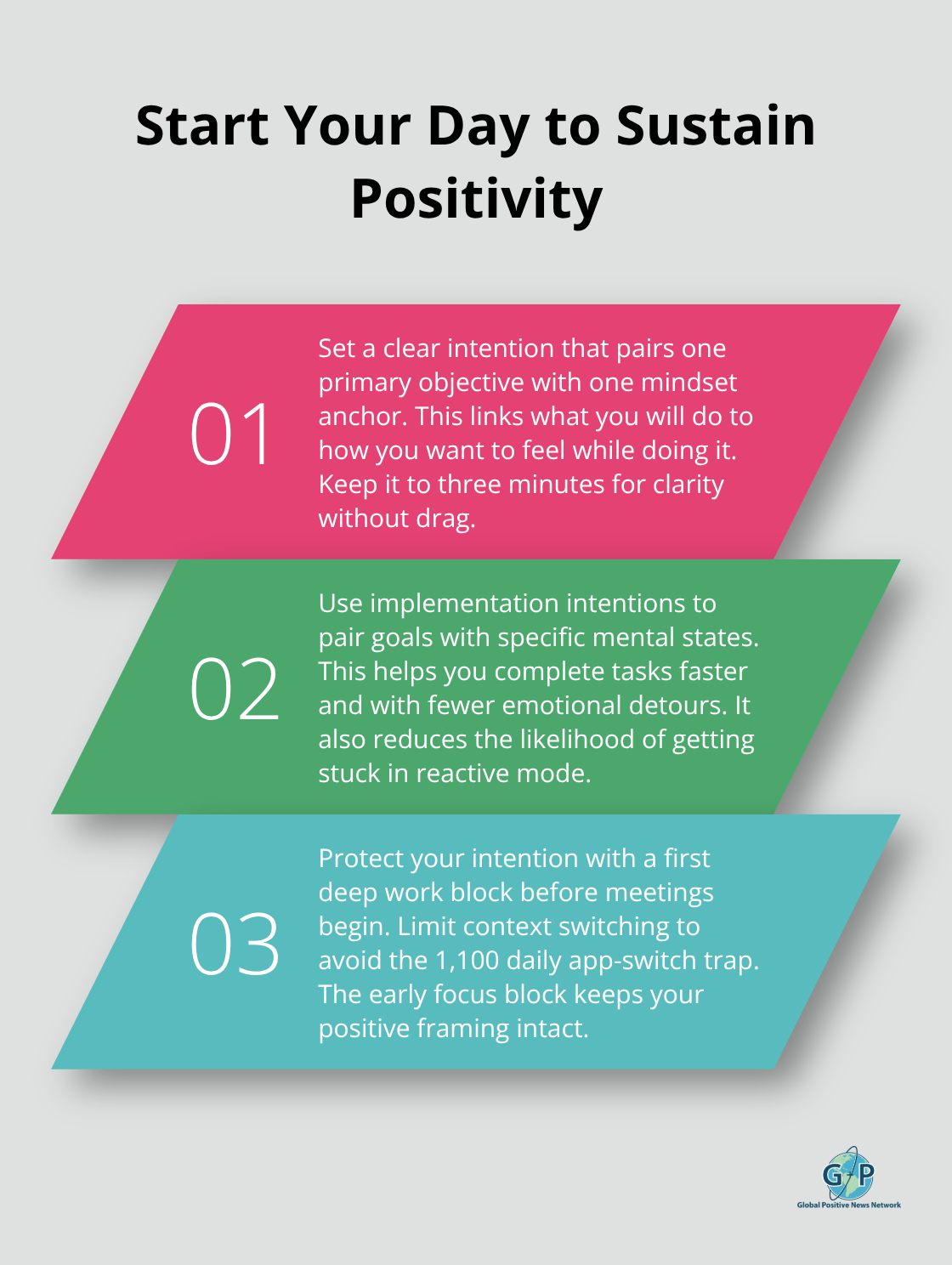
Most knowledge workers face 1,100 app switches daily, which fragments focus and resets your mental state repeatedly. Your first 90 minutes of undistracted work, anchored to your morning intention, will produce more output than six fragmented hours later. This is when your brain’s positive framing remains strongest before negativity bias pulls your attention toward problems.
Reset Breaks That Restore Your Focus
Micro-breaks between tasks aren’t luxuries-they’re maintenance for your cognitive system. Instead of scrolling social media, which extends mental fatigue, take a five-minute break that genuinely resets your state. Step outside for two minutes if possible; outdoor exposure restores attention capacity better than indoor breaks. If you can’t leave your desk, use a focused breathing exercise: inhale for four counts, hold for four, exhale for six. This pattern shifts your nervous system from alert to calm in minutes. Pair your reset break with one concrete win you just completed. Name it explicitly: finished the client email, completed the design draft, solved the formula error. This forces your brain to register the achievement before you move to the next task, directly counteracting the tendency to skip from problem to problem. Many workers report that adding this 30-second acknowledgment practice changes how they perceive their productivity. They feel progress accumulating rather than perpetually behind.
Gratitude That Anchors Your Progress
Gratitude during breaks doesn’t mean listing things you’re thankful for in abstract terms. Instead, thank the specific tool, person, or process that made your last task easier. Thank the template that saved you 15 minutes, thank the colleague who clarified the requirement, thank the focus time you blocked. This specificity creates a mental pattern that links positive outcomes to concrete systems, not luck or talent. When you repeat this practice four to six times daily across your reset breaks, your brain begins seeking systems and solutions rather than dwelling on obstacles.
Language That Shapes Your Mental Response
Language shapes how you process work throughout the day. Instead of describing a task as something you have to do, rephrase it as something you’re choosing to do and why it matters. The difference between “have to finish the report” and “choosing to finish the report because it unblocks the team’s decision” is neurologically significant. One activates obligation and resistance; the other activates agency and purpose. Apply this reframe to obstacles too. Rather than “the client changed the scope again,” try “the client’s new input reveals what actually matters to them.” This isn’t pretending problems don’t exist-it’s directing your mental resources toward actionable response instead of frustration. Communicate this language shift to your team explicitly. When colleagues hear you name problems as opportunities to adjust, they adjust their own internal dialogue. Workplace culture that normalizes this language creates collective momentum that individual practices alone cannot achieve. The systems you’ve now established-intention-setting, reset breaks, gratitude anchors, and reframed language-form the foundation of your daily positivity practice. What remains is making these practices visible and measurable so your brain registers the pattern of success they create.
Make Your Wins Visible and Impossible to Ignore
Progress tracking transforms invisible effort into undeniable evidence. Most workers complete tasks throughout the day but never consolidate them into a pattern their brain recognizes as success. You finish the email and move to the next task. You solve the spreadsheet error and immediately face another problem. Without a system that captures and displays these wins, your brain defaults to negativity bias and assumes you’re falling behind.
Create a Daily Wins Dashboard
The solution is straightforward: create a daily wins dashboard. This can be a spreadsheet, a note in your task manager, or even a physical checklist on your desk. At the end of each day, write down three to five concrete tasks you completed. Not vague accomplishments like “worked on the project”-specific completions like “wrote the project proposal introduction,” “reviewed client feedback,” “debugged the form validation.” Make your wins visible by logging completed tasks. The visibility matters more than the complexity of your system. A simple daily list in a note app beats an elaborate spreadsheet you update sporadically.
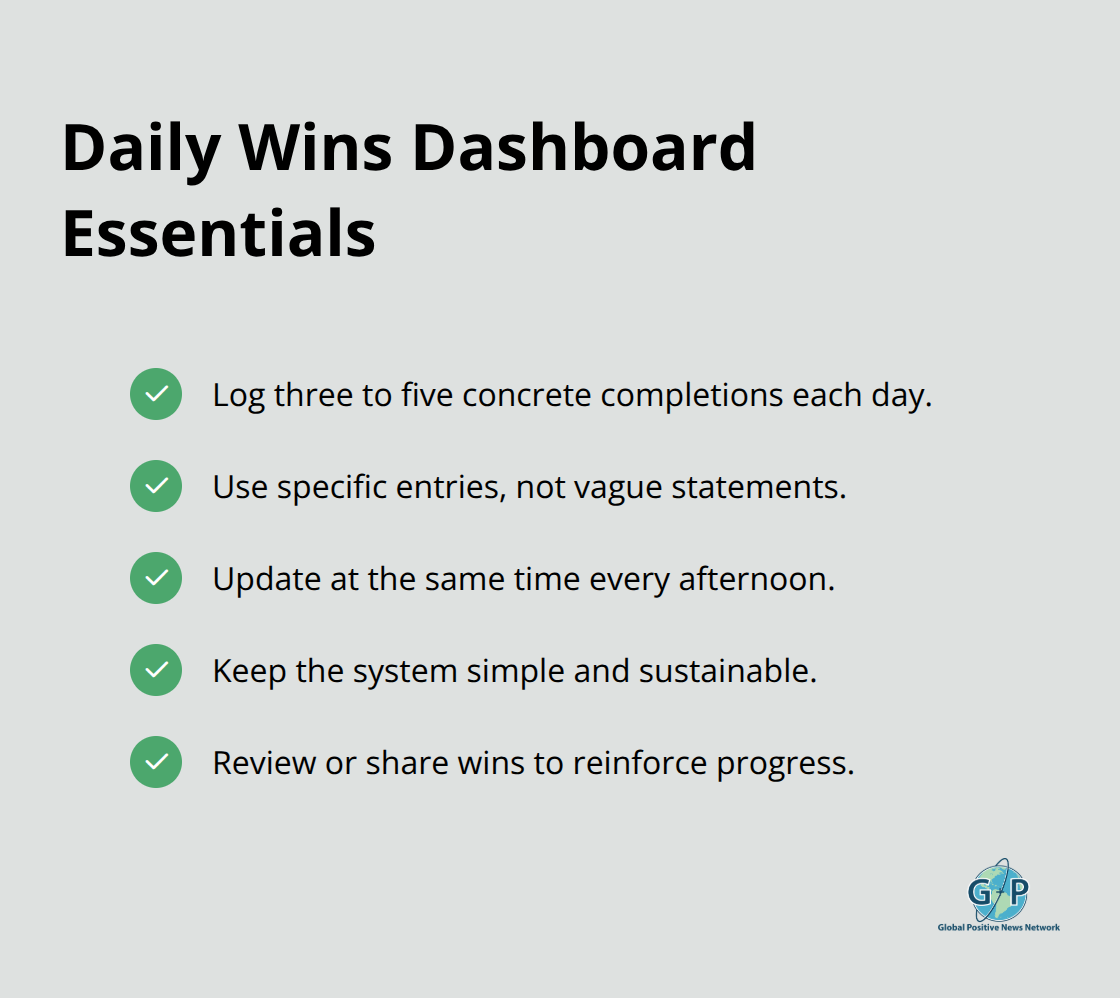
Update your dashboard at the same time each day, ideally late afternoon before you leave work. This creates a transition moment where your brain shifts from task mode to reflection mode, allowing you to consolidate the day’s work before moving on. Many workers report that this 5-minute practice changes how they perceive their productivity. They stop feeling perpetually behind and start noticing actual forward progress.
Schedule Weekly Wins Reviews
Celebrating completed goals does not require grand gestures-it requires deliberate pauses. Schedule weekly wins reviews by blocking 10 minutes on your calendar each Friday afternoon labeled explicitly as “wins review.” During this time, open your progress dashboard and review the week’s completed work. Read through the list slowly. Your brain needs this repetition to override negativity bias. Acknowledge one win out loud or in writing: “I completed the client proposal, which unblocks their decision-making process.” This specificity links your action to its impact, reinforcing that your work matters.
Share one win with a teammate or manager. Public acknowledgment is not about seeking praise-it is about creating accountability and visibility that strengthens your internal narrative. Beyond weekly reviews, create a running archive of completed projects. Save a copy of finished work, screenshots of shipped features, or client feedback in a dedicated folder. When you face a difficult project or moment of doubt, reviewing past completions reminds your brain that you have solved hard problems before. This archive becomes your evidence against impostor syndrome and self-doubt.
Curate Your Information Diet
Your information environment directly influences your positivity throughout the day. If your email inbox, Slack channels, and news feeds flood you with problems, complaints, and worst-case scenarios, your brain activates threat-detection mode. This is not a character flaw-it is how human attention works. The solution is curating your information diet with the same intentionality you would apply to food.
Unsubscribe from email newsletters that primarily report problems or create urgency without actionable solutions. Mute Slack channels that function as complaint forums rather than collaboration spaces. Most workers never audit their information sources; they passively receive whatever reaches them. This passive approach means negativity has more access to your attention than positivity does.
Spending time each morning reading stories of community impact, personal achievement, and human progress creates a different mental foundation than scrolling crisis headlines. This is not avoidance-it is strategic attention allocation.
Replace one daily news source with content that documents human progress. Follow accounts or publications that share solutions alongside problems. Create a dedicated reading folder for positive stories you encounter throughout the week. Many workers use these stories as mental anchors during difficult projects: when facing a frustrating problem, they spend two minutes reading about someone who overcame a similar challenge. This resets their mental state from stuck to resourceful.
Final Thoughts
Positivity-focused productivity compounds over time through the systems you’ve built-intention-setting, reset breaks, progress tracking, and curated information work together to reshape how your brain processes challenges. Each practice reinforces the others, and your brain responds to what you repeatedly expose it to and what you deliberately make visible. When you log wins daily, celebrate weekly, and surround yourself with stories of human progress, your brain learns to expect success rather than failure.
The most important insight is this: positivity emerges through systems, not feelings. You don’t wait to feel positive before building productive workflows; you construct the workflows, and positivity follows naturally. When a project fails or feedback stings, your progress dashboard reminds you that you’ve completed hard work before, and when doubt creeps in, your wins archive proves you’re capable. These systems protect you during difficult periods when motivation drops and negativity bias pulls your attention toward problems.
Start with one practice this week-choose the system that feels most natural to you, whether that’s a morning intention, a daily wins dashboard, or replacing one news source with uplifting stories. Build consistency before adding more, and over weeks and months these practices become automatic as your productivity transforms alongside your mindset. For stories that reinforce this positive momentum, explore Global Positive News Network, where curated stories of personal triumphs and community impact sustain your optimistic outlook.
Having a hard day?
The 2 Minute Hope Reset is a short free guide with three small practices for the days that feel heavy. Two minutes each, nothing to keep up with.
Get the free guideExplore more positive news:
Enjoying stories like this?
Global Positive News Network is reader-supported. If you’d like to support the mission, you can visit the Official GPNN store.