
Most people chase happiness as if it’s somewhere far away. But at Global Positive News Network, we believe joy lives in the small moments you can access right now.
Daily joy reminders are simple tools that interrupt your routine with reasons to feel good. When you practice them consistently, they rewire how you experience each day.
Why Daily Joy Reminders Rewire Your Brain
The science behind positive psychology
Positive psychology isn’t wishful thinking-the science is clear. Research from the University of California, Riverside found that people who practiced gratitude for just two weeks showed measurable improvements in life satisfaction that lasted months. This isn’t about ignoring problems. It’s about training your brain to notice what’s working alongside what isn’t.
When you interrupt your day with a joy reminder, you activate your brain’s reward system and shift your attention away from the default negativity bias that kept our ancestors alive but now keeps us stuck in anxiety. Studies show that this practice reduces cortisol levels and improves sleep quality within days, not months.
Small moments compound into strength
The real power doesn’t live in one big happiness event. It lives in the accumulation of small positive experiences. Research published in the Journal of Happiness Studies demonstrated that people who noticed three small good things daily reported 25% higher life satisfaction than those who didn’t.
These moments don’t need to be profound. A warm coffee, a text from a friend, sunlight through a window-these register in your nervous system and build what psychologists call emotional resilience buffer against stress. When life throws difficulties at you, people with consistent joy practices recover faster and cope better. They’re not happier because life is easier. They’re happier because they’ve trained themselves to access positive experiences that were always there.
Gratitude restructures your brain
Gratitude isn’t just a feeling. Brain imaging studies show that regular gratitude practice actually increases gray matter in areas responsible for social bonding, decision-making, and perspective-taking. A study from Indiana University found that people who wrote about gratitude showed increased activity in the brain regions associated with dopamine and serotonin production.
This means daily joy reminders aren’t a temporary mood boost. They’re rebuilding your brain’s architecture. When you practice gratitude consistently, you rewire neural pathways. This explains why some people naturally notice good things while others miss them. The difference isn’t luck. It’s practice. Your brain becomes what you repeatedly focus on.
Moving from understanding to action
Now that you know how joy reminders transform your brain, the question shifts: how do you actually implement them into your daily life?
How to Start Your Daily Joy Practice
The gap between understanding how joy reminders work and actually using them daily is where most people stumble. Theory means nothing without execution. Start with your morning, the moment your mind is most receptive. Before checking your phone or email, spend three minutes writing down one specific thing that went well yesterday and why it mattered.
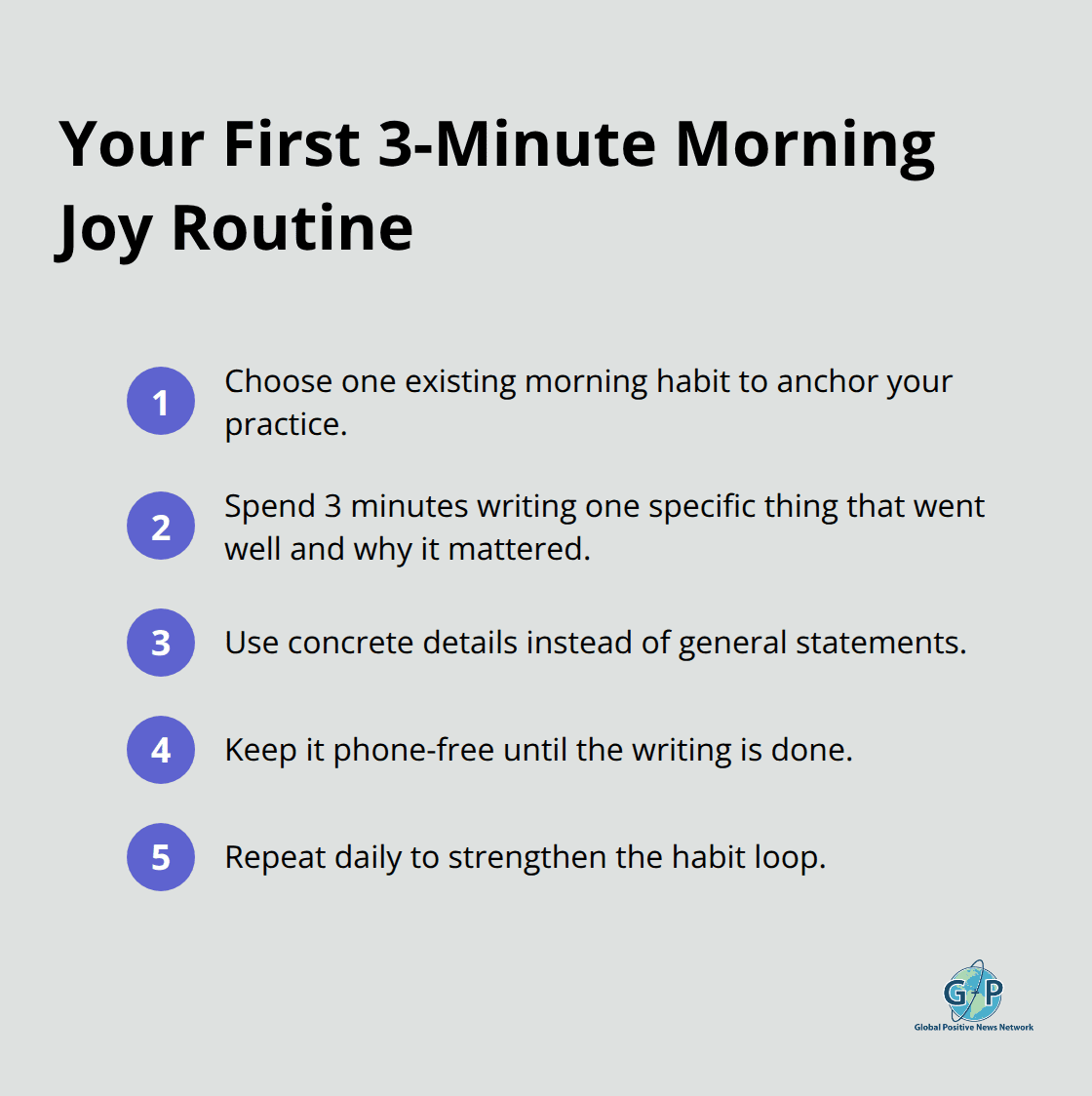
Research shows that morning gratitude practice produces stronger neural activation in reward centers than evening practice. The specificity matters more than the volume. Writing that your partner made you laugh because they mimicked the dog is more powerful than writing that you had a good day. Your brain needs concrete details to anchor the positive experience.
Anchor reminders to existing habits
Don’t create a new routine from scratch. Instead, attach joy reminders to habits you already perform. If you drink coffee every morning, pause for 30 seconds after your first sip and name one thing you’re looking forward to today. If you shower daily, use that time to mentally list three things you’re grateful for. A study in the European Journal of Social Psychology found that habit-stacking, where new behaviors attach to established routines, has a success rate compared to isolated new habits. The tracking itself triggers your brain to stay consistent. After two weeks of anchored practice, your nervous system begins expecting that moment of positive focus, making it feel natural rather than forced.
Use friction strategically
Most people fail with joy reminders because they require too much effort. Remove friction through phone notifications that appear at the same time daily, but make them specific. A notification saying “smile” works better than one saying “practice gratitude” because your brain responds faster to action words. However, the most effective approach involves placing physical reminders in high-traffic spaces: a sticky note on your coffee maker, a stone on your desk, or a specific object on your nightstand. When you see it, you pause. That pause is where the rewiring happens. A study published in Consciousness and Cognition found that visual cues interrupt automatic thinking patterns more effectively than digital notifications because they surprise your conscious mind.
Make specificity your competitive advantage
Generic reminders fade into background noise. Your brain ignores what it expects. Instead, craft reminders that connect to your actual life and values. If you value connection, your reminder might be “text someone who matters.” If you value growth, try “name one thing I learned today.” The more personal the prompt, the stronger your neural response. This personalization transforms a reminder from something you tolerate into something you anticipate. Your joy practice becomes less like a chore and more like a conversation with yourself about what actually matters.
Prepare for the next level of your practice
Once you’ve anchored joy reminders to your daily habits and removed friction from the process, you’re ready to deepen your practice. The real transformation happens when you move beyond solo practice and build community around your joy work.
Building a Sustainable Joy Practice
Systems beat willpower every time
The difference between trying joy reminders and actually maintaining them comes down to one thing: systems, not willpower. Willpower depletes. Systems persist. Most people abandon their joy practice within three weeks because they treat it like motivation instead of mechanics. You need friction reduction, not inspiration.
Start by identifying the exact moment in your day when you already pause naturally. For many people, this happens right after they pour their morning coffee or tea. For others, it occurs when they sit at their desk or walk through their front door. The timing matters less than the consistency.
Anchor your practice to physical triggers
Once you’ve identified that moment, place a physical object there that serves as your trigger. The object could be a specific mug, a small stone, a photo, or anything that catches your eye. Your brain needs that interruption to shift attention.
After you’ve anchored the trigger, write down exactly what you’ll do at that moment in three words or fewer. Instead of telling yourself you’ll practice gratitude, write down the specific action: name three things, write one win, or list what’s working. Specificity transforms vague intentions into executable behaviors.
Track progress to maintain momentum
Track your completion with a simple check mark on a calendar or a tally on your phone. You’re not tracking perfection. Missing one day doesn’t break the chain permanently. Missing two days does. That’s the threshold where habits collapse, according to research from University College London. If you miss a day, resume the next day without shame or explanation.
Share joy to amplify its power
The real power emerges when you stop treating your joy practice as something purely personal and start building it into your relationships. This doesn’t mean forcing others to practice. It means creating space where joy reminders become part of how you connect.
Ask one person close to you what they’re grateful for each day and share one thing you noticed going well. The sharing amplifies the neural benefit for both people. Your brain doesn’t just register your own joy. It registers joy reflected back to you through another person’s response.
If you have a partner or close friend, suggest a weekly five-minute check-in where you each share three specific things that went well during the week. The specificity requirement prevents this from becoming generic small talk. You’re looking for concrete details: the conversation that made you laugh, the project you solved, the way someone showed up for you. This practice costs nothing and takes minimal time, yet it strengthens both people’s resilience simultaneously.
Create environmental design for joy
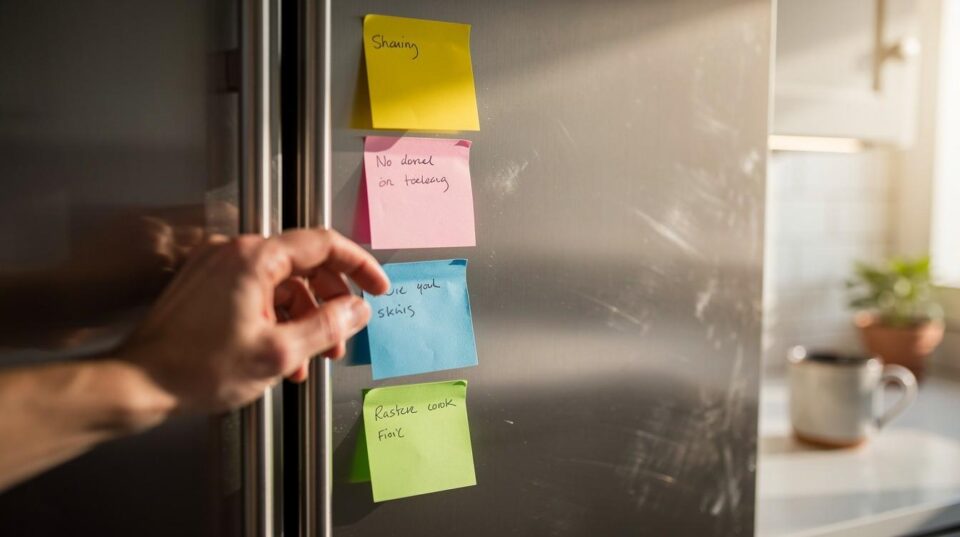
If you live with others, create a shared joy board where anyone can add a sticky note about something good that happened. No pressure. No requirements. Just availability. Families that implement this simple system report that younger members begin noticing positive moments independently, suggesting that environmental design shapes how people’s brains scan for good things. The goal isn’t to become relentlessly positive or to pretend difficulties don’t exist. The goal is to balance your brain’s natural negativity bias by deliberately training it to notice what’s actually working. When your sustainable joy practice becomes woven into your daily transitions and your relationships, it stops feeling like something you do and starts feeling like how you live.
Final Thoughts
The transformation that happens when you commit to daily joy reminders isn’t dramatic or sudden. It’s quiet and cumulative. After weeks of pausing to notice what’s working, your brain stops defaulting to problems and starts scanning for possibilities. You catch yourself smiling at small things.
Research shows that people who maintain joy reminder practices report higher life satisfaction, better sleep, and lower stress levels. The numbers matter only if you actually start, though. Most people stay stuck in the gap between knowing joy reminders work and implementing them into their lives.
Your first step is simple: choose one existing daily habit and attach a joy reminder to it. After two weeks, your brain will expect that pause, and after a month, it will feel natural. We at Global Positive News Network believe this practice matters because it shifts how you experience every single day.
Having a hard day?
The 2 Minute Hope Reset is a short free guide with three small practices for the days that feel heavy. Two minutes each, nothing to keep up with.
Get the free guideExplore more positive news:
Enjoying stories like this?
Global Positive News Network is reader-supported. If you’d like to support the mission, you can visit the Official GPNN store.