

Stress doesn’t have to be your constant companion. We at Global Positive News Network believe that joyful routines for stress are one of the most practical ways to reclaim your peace and energy.
This guide walks you through simple, actionable practices you can weave into your day-from morning to evening-that actually work to lighten your mental load.
How to Start Your Day With Purpose
Gratitude Rewires Your Stress Response
How you begin your morning shapes everything that follows. The first hour sets your stress baseline for the entire day, which is why morning routines matter far more than most people realize. Research from the University of British Columbia found that people who practiced gratitude for just three minutes showed measurable decreases in cortisol levels, the primary stress hormone.
This isn’t about forcing positivity or pretending problems don’t exist. Instead, you deliberately redirect your attention toward what’s working before stress takes over. Spend three minutes each morning writing down three specific things you’re grateful for-not abstract ideas like family or health, but concrete details. Write that your legs carried you up the stairs without pain rather than writing health. Write that sunlight came through your kitchen window this morning rather than writing gratitude for your home. This specificity activates different neural pathways than generic gratitude and produces stronger stress-reduction effects.
Movement Shifts Your Nervous System
Movement matters just as much as gratitude. A recent study showed that ten minutes of morning movement can improve mood and reduce anxiety symptoms throughout the day. You don’t need intense exercise-five to ten minutes of gentle stretching, walking, or simple yoga poses activate your parasympathetic nervous system, which counteracts your fight-or-flight stress response.
Follow this with intentional hydration and eating within thirty minutes of waking. Dehydration impairs cognitive function and increases perceived stress by up to 30 percent according to research from the Journal of the American College of Nutrition. Drink at least 16 ounces of water before consuming anything else.
Nutrition Stabilizes Your Stress Hormones
For breakfast, prioritize protein and complex carbohydrates over sugar-heavy options. Eggs with whole grain toast or Greek yogurt with berries stabilize blood sugar and prevent the mid-morning cortisol spike that refined carbohydrates trigger. These three practices-gratitude, movement, and intentional eating (taking roughly twenty minutes combined)-create a biochemical foundation that makes stress management possible throughout your day.
With your morning foundation solid, the real test comes when midday stress hits hardest.
Midday Stress Doesn’t Have to Win
The 90-Minute Break Rule Changes Everything
The hours between noon and evening are when stress typically peaks. Your morning foundation crumbles under meetings, interruptions, and decision fatigue. The solution isn’t pushing through-it’s strategic intervention. Breaks from work can improve task performance through beneficial resource-strain, cognitive, affective, and motivational mechanisms. This isn’t optional self-care; it’s how your brain actually functions.
A five-minute break every 90 minutes works better than a single 30-minute break at the end of your workday because your stress hormones spike throughout the day rather than accumulating in one lump. Set a timer on your phone for 90 minutes. When it goes off, step away completely. Walk to a different room, look out a window, or stretch for three minutes. This interrupts the stress cycle before cortisol levels climb dangerously high.
Social Connection Reduces Stress Hormones
During these breaks, spend two minutes on social interaction. Text a friend something genuine, call a colleague about something non-work related, or chat with someone nearby. Research from Harvard Medical School found that positive social interactions reduce stress hormones more effectively than solitary relaxation. The key is genuine connection, not forced small talk.
Nature Exposure Amplifies Your Reset
Nature exposure during your midday break amplifies these benefits dramatically. Nature exposure reduces cortisol levels when lasting between 21 and 30 minutes, with cortisol dropping at a rate of 18.5% per hour. If you work indoors, eating lunch outside makes a measurable difference. If outdoor access is limited, opening a window and sitting near it for five minutes still activates your parasympathetic nervous system.
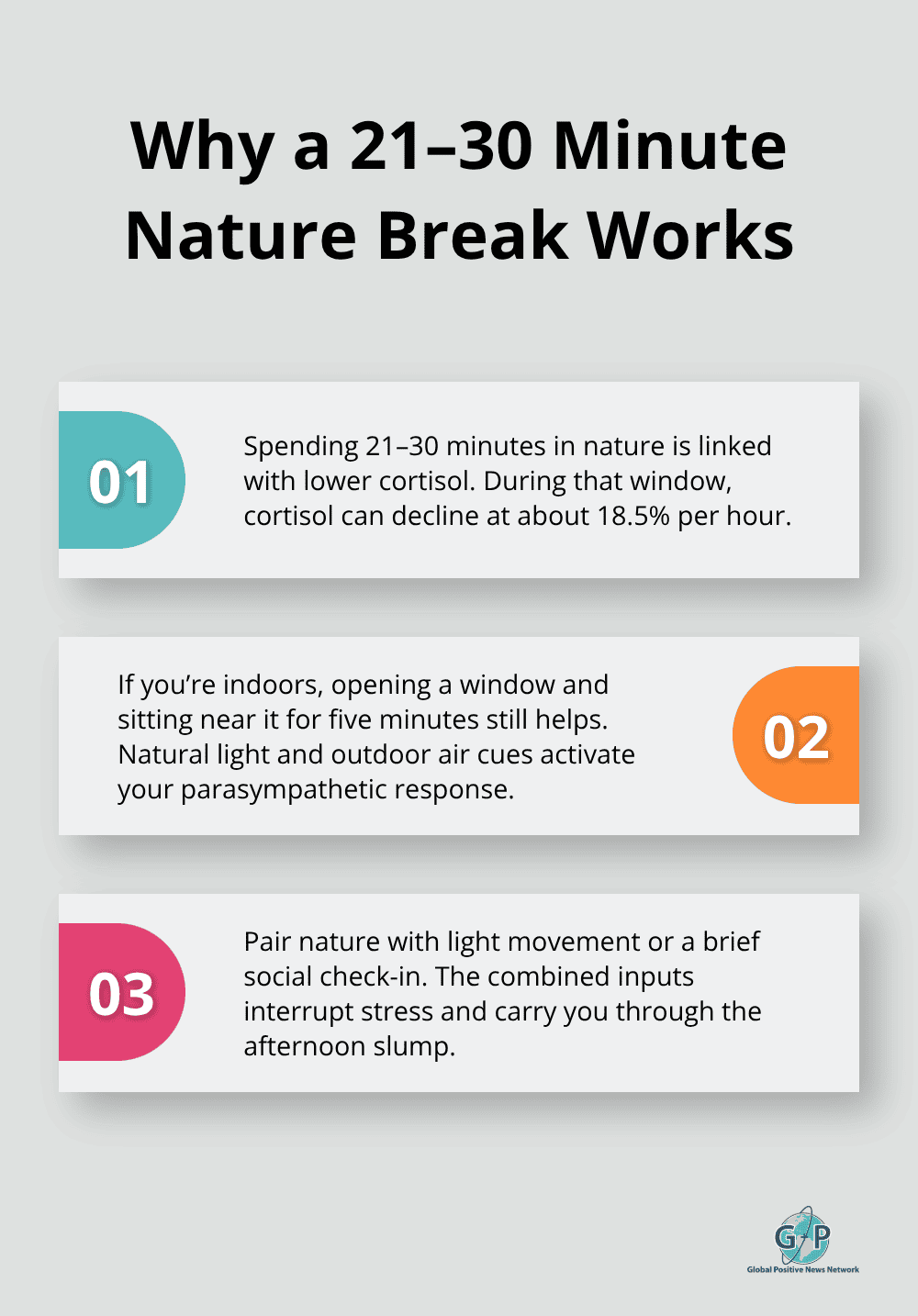
The combination of movement, social connection, and natural light creates a biochemical reset that carries you through the afternoon slump. When evening arrives, your stress management strategy shifts entirely-and this is where your day truly stabilizes.
How to Shut Down Your Day Without Stealing Sleep
Blue Light Sabotages Your Sleep Architecture
Evening routines determine whether your day’s stress dissolves or lingers into your sleep. The transition from daytime activity to nighttime rest takes deliberate action, not passive hope. Most people scroll through phones until they collapse, then wake at 3 a.m. with racing thoughts. Your evening strategy needs to reverse this pattern completely.
Start by eliminating screens at least 60 minutes before bed. Research from Harvard Medical School shows that blue light suppresses melatonin production and shifts circadian rhythms significantly, making it nearly impossible to fall asleep naturally. This isn’t a suggestion-it’s biochemistry. Set a specific time each evening when all devices power down. Place your phone in another room, not just face-down on your nightstand where you’ll reach for it during moments of restlessness. The physical distance matters because willpower weakens in the evening when your prefrontal cortex is depleted from decision-making throughout the day.
Journaling Processes Your Stress Before Sleep
Replace screen time with reflective journaling or meditation for 15 to 20 minutes. Journaling works better than meditation for most people because it gives your anxious brain something concrete to do. Write three specific stressors from your day, then write one small action you took or could take to address each one. This signals to your nervous system that today’s problems have been processed and filed away, not left dangling.
Follow this with five minutes of body scan meditation where you mentally move through each muscle group, consciously relaxing as you progress. This combination of written reflection and somatic awareness prepares your body for genuine rest rather than restless tossing.
Sleep Consistency Matters More Than Sleep Duration
Sleep quality depends on sleep consistency more than anything else. Go to bed and wake at the same time seven days a week, even weekends. Irregular sleep schedules can disrupt your body’s natural rhythm and impact your overall health, even when total sleep hours remain identical.
Keep your bedroom temperature between 60 and 67 degrees Fahrenheit and completely dark (invest in blackout curtains if needed). Avoid alcohol as a sleep aid despite its sedating effects because it fragments sleep architecture and leaves you waking exhausted. These practices create conditions where your body actually recovers from stress rather than compounding it.
Final Thoughts
The practices throughout this guide aren’t one-time fixes-they’re building blocks that compound over weeks and months, creating genuine resilience against stress. When you practice gratitude each morning, take strategic breaks at midday, and protect your sleep at night, your nervous system gradually recalibrates and your baseline stress level drops measurably. You stop fighting your biology and start working with it instead.
Consistency matters far more than perfection, and research shows that people who maintain joyful routines for stress see the biggest improvements after three to four weeks of daily practice. Start with just one practice from this guide-the one that feels most doable for your life right now. Small, consistent actions reshape your stress response more effectively than dramatic changes you can’t maintain.
Your joyful routines for stress become the foundation that lets you show up fully in your work, relationships, and life. We at Global Positive News Network believe that stress management starts with practical routines, not motivation or willpower. Start today with one practice.
Having a hard day?
The 2 Minute Hope Reset is a short free guide with three small practices for the days that feel heavy. Two minutes each, nothing to keep up with.
Get the free guideExplore more positive news:
Enjoying stories like this?
Global Positive News Network is reader-supported. If you’d like to support the mission, you can visit the Official GPNN store.