

Communities across the world are transforming through innovations improving communities-from tech platforms to social enterprises to grassroots movements. We at Global Positive News Network have identified the most effective approaches that deliver real results.
This article breaks down three categories of change-makers and shows you exactly how they work.
How Technology Bridges the Gap Between Communities and Resources
The Speed Advantage of Data-Driven Solutions
Technology solves one critical problem that communities face: disconnection. When residents don’t know what resources exist nearby, or when local organizations can’t reach the people who need them most, potential impact gets wasted. Cities using AI-enabled governance tools identify problems faster than those relying on traditional research methods. This speed matters because solutions get implemented sooner, and communities see tangible results faster.
Real-World Applications in Air Quality and Coastal Safety
The NSF Civic Innovation Challenge demonstrates exactly how this works in practice. In Utah, the University of Utah paired affordable high-tech sensors with AI modeling to create real-time air quality monitoring that includes three-day forecasts.
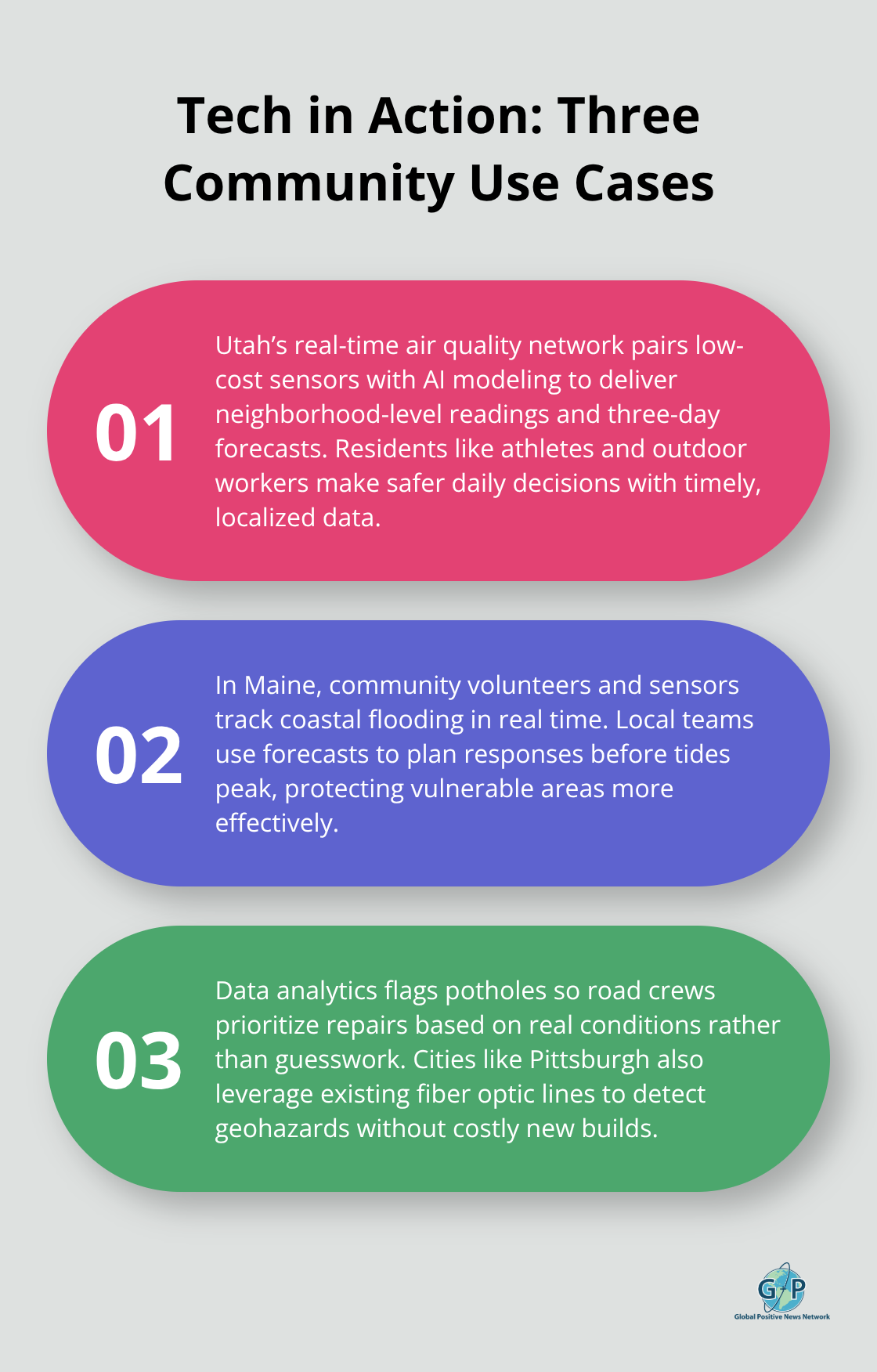
Athletes, students, and outdoor workers now receive specific, localized predictions instead of generic regional data. This approach works because it answers a concrete question that affects daily decisions. Similarly, in Maine, sensors combined with community volunteers monitor coastal flooding in real time, allowing vulnerable coastal communities to forecast events and plan responses accordingly.
Housing and Infrastructure Innovation
In West Philadelphia, Drexel University implemented arts-centered housing pilots that address gentrification head-on by keeping housing affordable through direct intervention. These aren’t theoretical exercises-they’re systems that work because they connect technology to actual community needs. Pothole identification powered by data analytics allows governments to prioritize road repairs based on real information rather than guesswork. Pittsburgh uses existing fiber optic cables to sense geohazards with minimal new infrastructure investment, proving that communities don’t always need expensive new technology (they need smarter ways to use what already exists).
Infrastructure Inspection and Water Management
Civil infrastructure inspection has shifted dramatically. Autonomous rooftop inspection robots now detect water leaks quickly and at lower cost than traditional methods. Acoustic sensing attached to buried fiber optic lines, combined with machine learning, enables earlier and more accurate detection of underground water leaks. These technologies eliminate the slow, expensive process of finding problems after they cause damage. When technology connects directly to community problems, it transforms how quickly and efficiently solutions take hold-setting the stage for how social enterprises amplify these innovations with sustainable business models.
Social Enterprises Transforming Local Economies
Social enterprises operate as engines of sustainable community change, moving well beyond nonprofit dependency on grants. These organizations generate revenue that funds their own operations and reinvests profits directly into community programs. The Social Enterprise World Forum supports social enterprises, many of which address climate, employment, and local resilience simultaneously.
Climate-Focused Business Models Creating Impact
Climate-focused enterprises demonstrate how business models aligned with community needs create income while solving environmental problems. Bamboovement produces eco-friendly personal care products, while Entojutu advances earth-friendly farming practices. Growin’ Money plants mangroves to prevent erosion and tsunamis while creating jobs and generating income from carbon credits and agricultural products. These aren’t charity models-they’re self-sustaining systems where profitability enables expansion rather than limiting it.
Revenue Generation Unlocks Continuous Growth
The practical advantage lies in scalability. A social enterprise that generates revenue can replicate its model across neighborhoods without waiting for external funding cycles. When a model works financially in one location, managers launch it in the next neighborhood with confidence that operations will sustain themselves. This matters because traditional community programs often plateau when grant money runs out, but revenue-generating enterprises grow continuously.
Measurable Results Through Community Investment
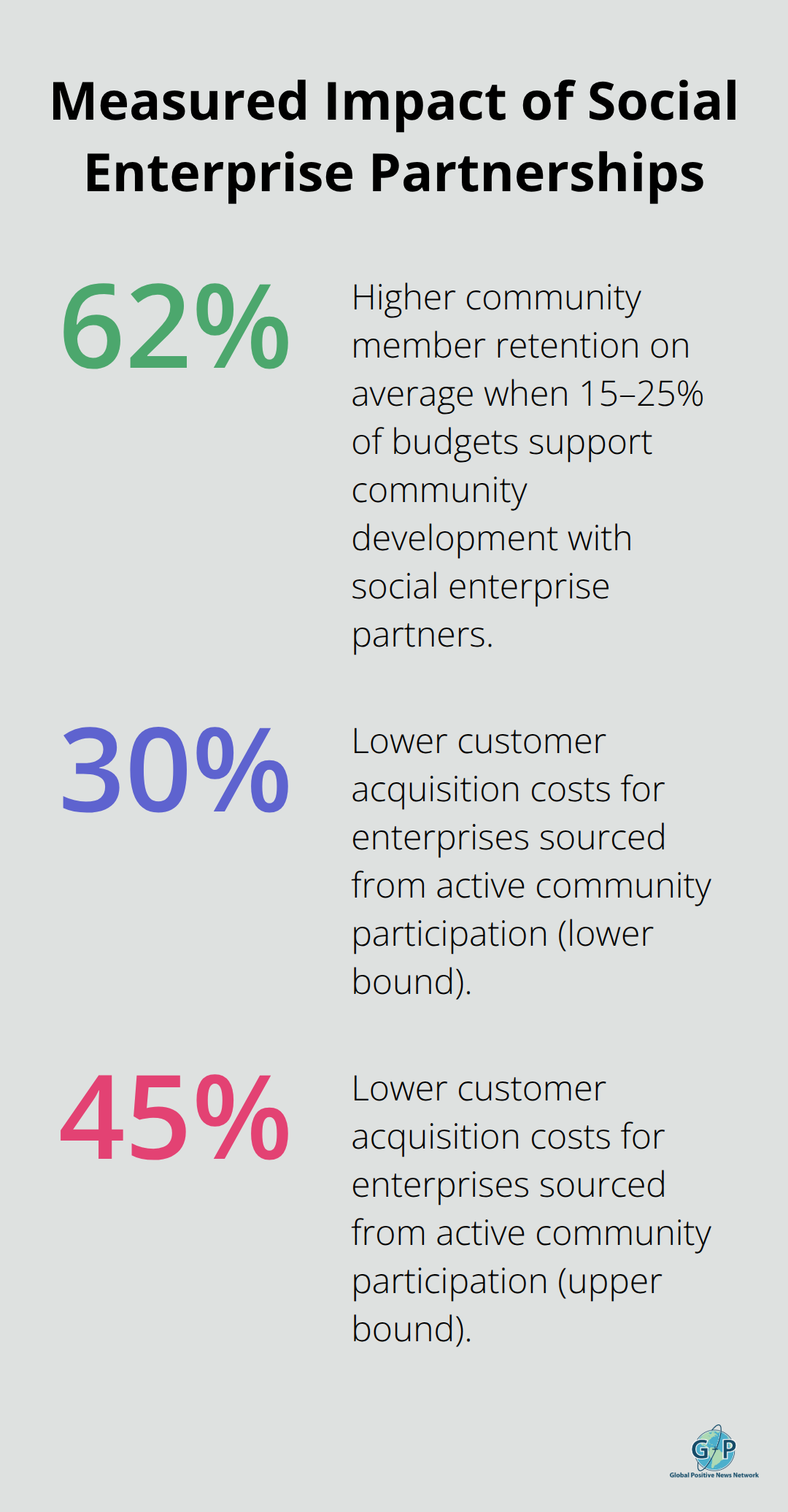
Organizations allocating 15 to 25 percent of their budgets to community development alongside social enterprise partnerships see measurable results. Community members show 62 percent higher retention rates on average, and enterprises sourced from active community participation achieve 30 to 45 percent lower customer acquisition costs compared to traditional channels. These numbers reveal that communities shouldn’t choose between impact and sustainability-they should build business models that make impact financially inevitable.
Scaling Solutions Beyond Single Neighborhoods
Revenue-generating enterprises expand impact across multiple locations simultaneously. Social enterprises that establish profitable operations in one area replicate their success in adjacent neighborhoods without depleting resources or waiting for new funding approvals. This expansion model contrasts sharply with grant-dependent programs that stall when external support ends. Communities that embrace social enterprise frameworks experience continuous growth rather than cyclical funding constraints. The shift toward these business models signals that sustainable community change requires financial viability as much as social purpose. With social enterprises establishing the financial foundation for community programs, grassroots movements and citizen-led initiatives amplify this impact through volunteer networks and peer-to-peer knowledge systems.
How Citizen Power Transforms Community Problems Into Solutions
Trust Built From Within Communities
Grassroots movements succeed where top-down initiatives fail because residents understand their own communities better than external experts ever will. The Alaska Community Justice Worker project proves this principle works in practice. Alaska’s court system trained trusted community members to provide civil legal advocacy instead of waiting for lawyers to travel to rural areas. This approach standardized services across remote regions while keeping costs manageable and building genuine trust with residents who already knew their advocates. The model works because it starts with who communities already trust, not with imported solutions.
Local Solutions That Strengthen Economic Resilience
When Chicago implemented good-food procurement policies, the success came from small local producers gaining direct access to supply chains they previously couldn’t reach. Residents organized around a specific problem, identified concrete barriers, and pushed for policy changes that removed those barriers. The result strengthened local food resilience while keeping money circulating within the community instead of flowing to distant distributors. Volunteer networks generate momentum that paid staff alone cannot match. The NSF Civic Innovation Challenge shows volunteers monitoring coastal flooding in Maine alongside professional sensors, creating redundancy that catches problems traditional systems miss.
Youth Engagement Shifts Community Belief
Youth engagement amplifies grassroots impact dramatically. The Youth Climate Action Fund expanded to 300 city halls and activated 100,000 young people. When residents see their peers solving problems, they believe change is possible. Local fundraising campaigns work because they tap into existing community networks rather than competing for attention in crowded grant databases. Communities that build peer-to-peer knowledge systems create sustainable solutions because residents learn directly from neighbors who succeeded first, not from distant case studies. This knowledge transfers faster and adapts immediately to local conditions.
Ideas Spread Faster Than Institutions Approve
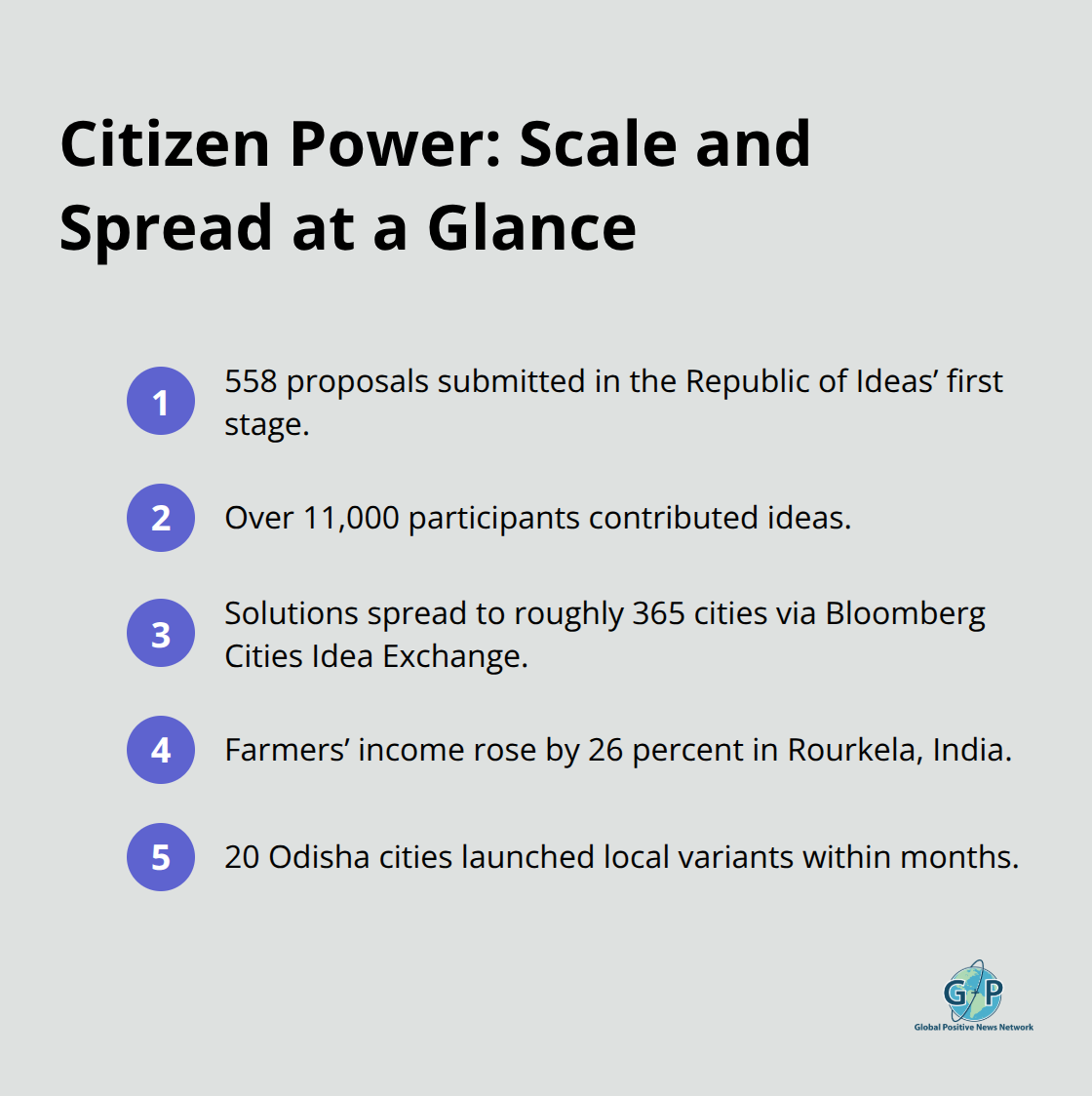
The Dominican Republic’s Republic of Ideas open-innovation contest generated 558 proposals from over 11,000 participants in its first stage, demonstrating that communities overflow with practical ideas when given platforms to share them. The Bloomberg Cities Idea Exchange helped spread solutions to roughly 365 cities, including replicating a cold-storage approach that raised farmers’ income by 26 percent in Rourkela, India, with 20 Odisha cities launching their own variants within months.
Citizen-led initiatives move faster because residents implement solutions immediately rather than waiting for institutional approval processes to conclude.
Final Thoughts
Three distinct pathways for innovations improving communities have emerged across this article: technology that connects residents to resources faster, social enterprises that generate revenue while solving problems, and grassroots movements where citizens lead their own solutions. Each approach works because it addresses a specific failure point in traditional community development-technology eliminates disconnection, social enterprises eliminate funding dependency, and grassroots movements eliminate the delays that come from waiting for external approval. What makes community change actually stick comes down to one principle: solutions must serve the people implementing them, not just the people funding them.
Communities that engage residents in problem-solving show 62 percent higher retention rates, cities that replicate proven solutions across neighborhoods see results spread to 365 cities within months, and youth-led initiatives activate 100,000 young people because peers believe change is possible when they see it happening around them. When residents trust their advocates, when enterprises profit from solving local problems, and when volunteers see immediate results from their efforts, momentum builds naturally. Start with what already exists in your community-inventory your local assets, whether that means existing fiber optic cables, trusted community members, or residents with practical ideas.
Form partnerships across sectors so technology teams work alongside social entrepreneurs and grassroots organizers, then implement solutions in stages and measure what works before scaling. Communities that combine these three approaches simultaneously see compound results because each reinforces the others. Global Positive News Network documents these innovations because they prove that communities don’t need permission to transform themselves-they need platforms, partnerships, and the confidence that their ideas matter.
Having a hard day?
The 2 Minute Hope Reset is a short free guide with three small practices for the days that feel heavy. Two minutes each, nothing to keep up with.
Get the free guideExplore more positive news:
Enjoying stories like this?
Global Positive News Network is reader-supported. If you’d like to support the mission, you can visit the Official GPNN store.