

Poetry has a quiet power to reshape how we think and feel. A few carefully chosen words can shift our perspective when doubt creeps in or stress builds up.
At Global Positive News Network, we believe positivity poems offer a practical tool for mental wellbeing. Whether you’re facing a tough day or simply want to strengthen your mindset, the verses ahead will show you how poetry works as a daily anchor for positivity.
How Poetry Rewires Your Brain for Positivity
Poetry works differently than prose because it compresses meaning into fewer words, forcing your brain to engage more actively with language. Research shows that reading activates multiple brain regions simultaneously, including areas responsible for motor cortex, sensory cortex, and frontal cortex involvement. When you encounter a vivid image or metaphor in a poem, your brain doesn’t just process the words-it simulates the experience described. This neurological engagement creates stronger emotional imprints than longer passages do.
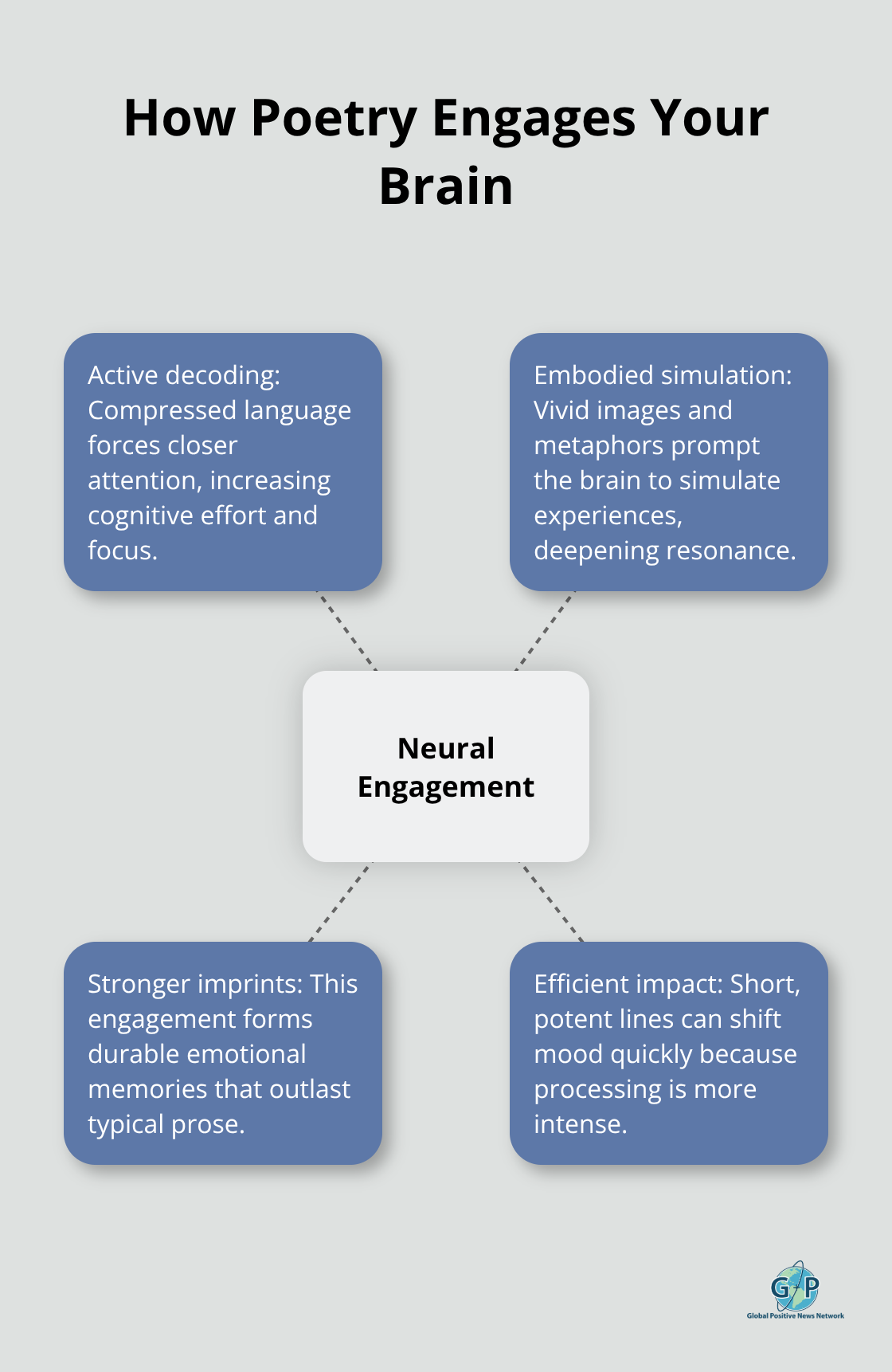
The Power of Single Lines
A single line from Maya Angelou’s Still I Rise or Emily Dickinson’s Hope is the Thing with Feathers can anchor your mood for hours because your brain has worked harder to extract its meaning. Short verses demand your full attention in ways that scrolling through longer articles never will. This intensity is precisely why busy people benefit most from poetry. You don’t need thirty minutes; five minutes with the right poem produces measurable shifts in perspective.
Words as Emotional Anchors
The connection between specific words and emotional states runs deeper than motivation or inspiration. When you read a poem that resonates, you’re not just consuming content-you’re creating a neural pathway you can return to during difficult moments. Memorizing short verses gives you a portable coping tool. People who use them report relying on them as grounding techniques during stress, similar to how therapists recommend repeating affirmations.
The difference is that poetry phrases carry literary weight and precision that generic affirmations lack. A line like See It Through from Edgar Guest’s poem stays with you because it combines simplicity with emotional authenticity. This is why Reader’s Digest compiled thirty inspirational poems spanning classical to early-twentieth-century voices-they recognized that certain combinations of words carry disproportionate emotional power. Your brain learns to associate those specific phrases with resilience, hope, or courage, creating automatic mood shifts when you recall them.
Why Length Matters for Daily Practice
Longer poems demand sustained mental energy, which works against your ability to integrate them into daily routines. A poem you can read in two minutes fits into morning coffee, bathroom breaks, or evening wind-down rituals without requiring dedicated time blocks. This accessibility matters because consistency builds the real benefit. Reading one short poem daily for thirty days creates stronger mental habit patterns than reading one long poem once.
Short verses also work better for sharing with friends and family because they don’t require explanation or lengthy discussion. You can text a line to someone struggling without overwhelming them. The practical advantage is undeniable: shorter poems get read, remembered, and repeated far more often than lengthy pieces. This is why contemporary poetry collections increasingly favor concise formats. Your brain retains short, powerful lines more effectively than it processes lengthy narratives, making brevity a feature, not a limitation.
With your brain now primed to understand how poetry shifts perspective, the next section introduces specific poems that address the challenges you face every day.
Positivity Poems for Everyday Challenges
Poems That Counter Doubt Before It Takes Hold
When doubt whispers that you can’t handle what’s ahead, Rudyard Kipling’s If- cuts through with practical instructions for staying steady. The poem prescribes specific mental moves: keep calm when others panic, trust yourself when success feels impossible, dream without letting dreams control you, and maintain balance between winning and staying humble. This isn’t motivational fluff-it’s a cognitive framework you can apply to actual situations. Read it before a difficult conversation or decision, and your internal dialogue shifts. You stop catastrophizing and start assessing what you can actually control.
Robert Frost’s The Road Not Taken operates differently but equally practical. It doesn’t tell you which path to take; instead, it reframes choice itself as the point. The poem argues that your life hinges on decisions you make, not on regret about roads not taken. For people paralyzed by perfectionism or fear of choosing wrong, this distinction matters enormously. It grants permission to move forward without needing certainty.
Maya Angelou’s Still I Rise directly addresses external pressure and internal doubt simultaneously. The poem declares resilience against prejudice and dismissal, celebrating identity as non-negotiable. People facing discrimination, self-doubt rooted in shame, or pressure to conform find this verse acts as a psychological shield. The repetition of I rise throughout the poem creates a mantra effect-each return to that phrase reinforces the statement. When you memorize this poem and repeat key lines during moments of doubt, you deploy language that carries the weight of Angelou’s own lived experience and artistic authority.
Building Strength Through Verses About Endurance
Edgar Guest’s See It Through appears in Reader’s Digest’s thirty inspirational poems specifically because it addresses resilience without sentimentality. The poem treats persistence as unsexy but necessary, advising you to hold on when things feel hard and meaningless. This matters because most positivity content sells inspiration as feeling good. See It Through acknowledges that sometimes you simply endure until circumstances shift.
William Ernest Henley’s Invictus takes endurance further by positioning you as the master of your fate despite circumstances beyond your control. The distinction is vital: the poem doesn’t claim you control external events, only that you control your response. People recovering from setbacks, illness, or loss report that this poem grounds them in agency when everything else feels random.
Henry Wadsworth Longfellow’s A Psalm of Life demands action in the present moment rather than waiting for the right time. It urges you to live earnestly and leave a lasting mark, treating daily choices as consequential. For people stuck in procrastination or waiting for perfect conditions, this poem functions as practical permission to start now with what you have. The underlying argument-that the present moment is where actual life happens-shifts behavior more effectively than abstract advice about seizing the day.
Jericho Brown’s Foreday in the Morning argues that small truths like saying I love you carry larger social weight than we typically acknowledge. The poem suggests that intimate honesty in morning moments creates ripples of empathy throughout your day. This reframes resilience as relational rather than individual. You build strength not just through personal perseverance but through vulnerability and connection with others.
Where Joy Lives in Ordinary Details
Terrance Hayes’s What I Am affirms the reality and dignity of diverse identities against stereotypes, but it accomplishes something more practical: it teaches you to recognize your own validity without external permission. For people doubting whether they belong or fit, this poem provides language for self-recognition.
Li-Young Lee’s Early in the Morning is a four-stanza, free-verse poem written from the point of view of an adult looking back on his adolescence or late childhood, revealing that profound connection hides in mundane moments. This shifts where you look for joy. Instead of waiting for extraordinary experiences, you start noticing affection in small gestures. The practical effect is measurable: people who practice this kind of attention report higher daily satisfaction because they actually see what’s already present.
Pat A. Fleming’s What Life Should Be emphasizes simple living and acts of kindness. It strips away complexity and returns to basics. When your day feels overwhelming, this poem reminds you that meaning doesn’t require achievement or accumulation. It arrives through how you treat people and what you choose to notice.
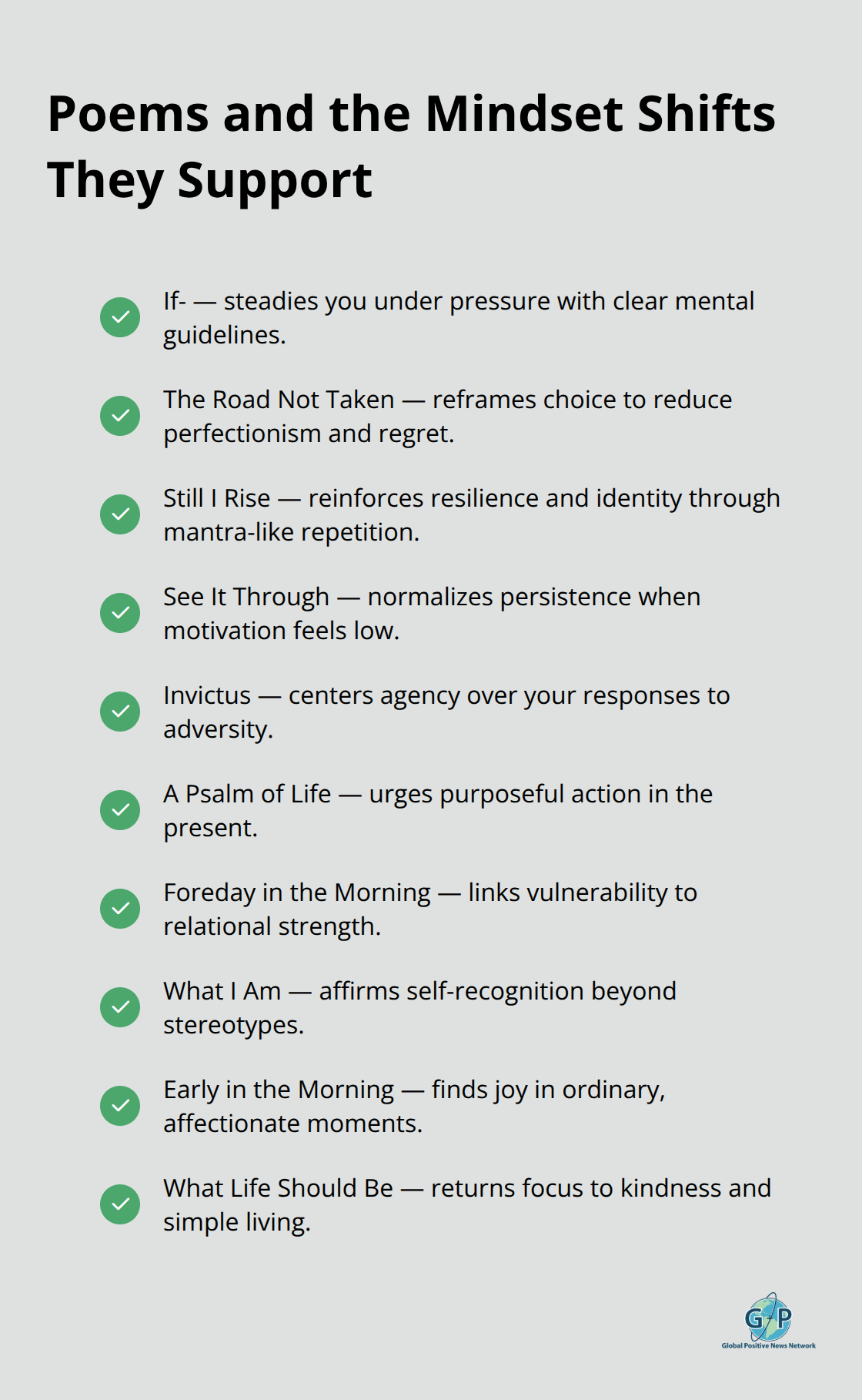
Reading this verse during stress recalibrates your priorities instantly because it names what actually matters.
These poems work best when you move them from passive reading into active practice. Integrating poetry into your daily life so these verses transform from words on a page into tools that reshape your mindset creates lasting change.
Making Poetry Part of Your Daily Life
Anchor Poetry to Your Existing Routines
Poetry only works when you actually read it, which means building a system that fits your existing schedule rather than creating new time commitments. Morning routines are ideal because they’re already established habits you can modify without friction. Nadia Colburn, a mindfulness teacher and poet, recommends spending ten minutes in meditation before reading poetry to open your perception and increase receptivity. This pairing works because meditation quiets mental noise that usually blocks emotional resonance.
Start with five minutes of meditation, then spend two to three minutes with a single short poem. This takes less time than scrolling social media but produces measurable shifts in how you approach your day. The practical advantage is consistency: a three-minute morning ritual compounds over thirty days into genuine mental rewiring. If mornings don’t work, integrate poetry into existing transitions like coffee breaks, lunch pauses, or evening wind-down.
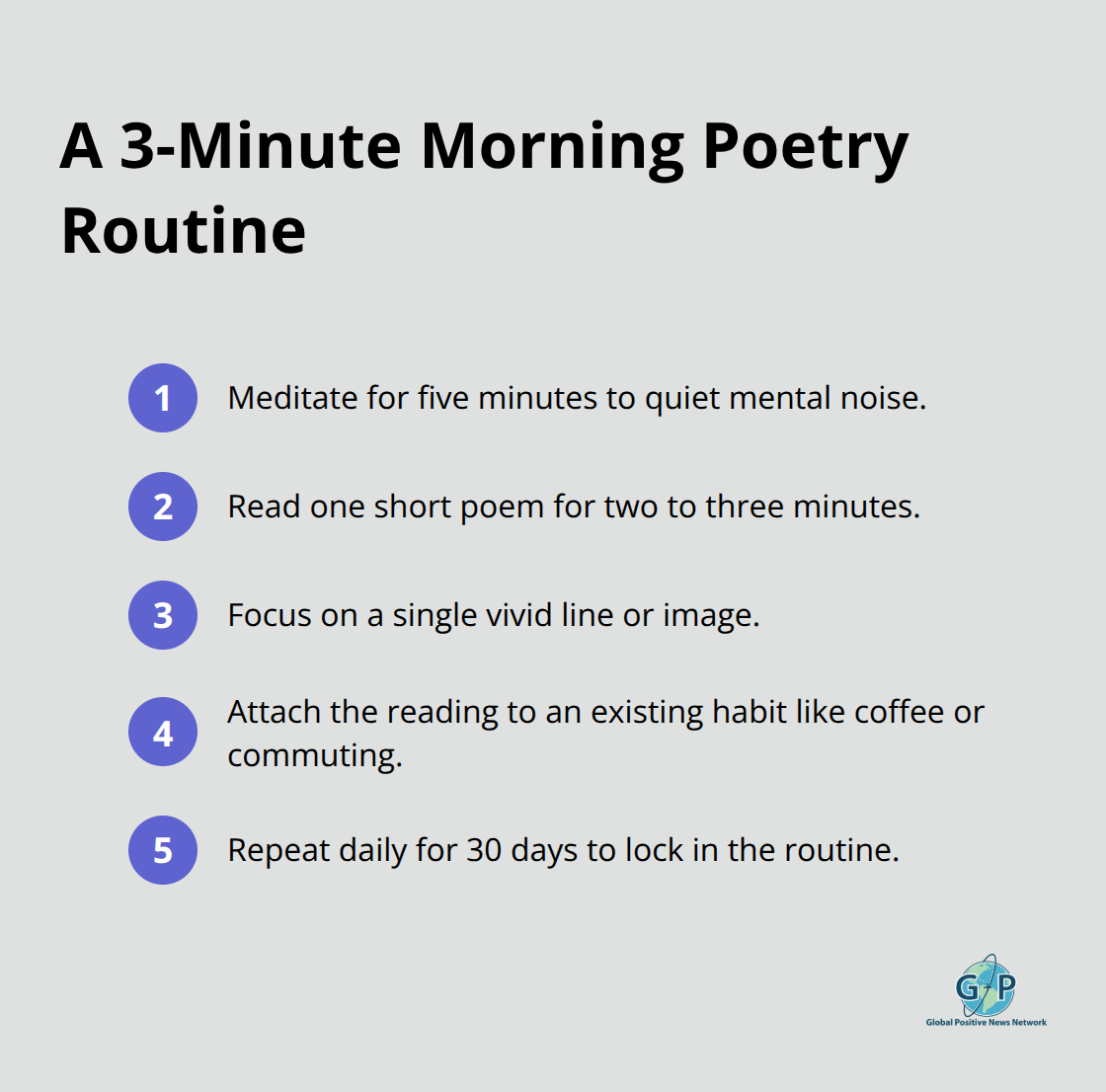
The specific time matters less than attaching poetry to an anchor activity you already do daily.
Some people read one poem while their coffee brews. Others read before bed as a way to process the day’s stress. Research on habit formation from BJ Fogg at Stanford University shows that attaching new behaviors to existing routines creates stronger neural pathways than isolated practices. Your brain learns to associate that transition moment with the emotional shift poetry provides, making the practice automatic after three weeks.
Share Verses to Strengthen Connections
Sharing specific lines with friends and family amplifies the benefit because vulnerability around emotions strengthens relationships while spreading positivity outward. Text a single line from Emily Dickinson or Maya Angelou to someone you know is struggling rather than sending generic encouragement. The specificity signals that you’ve thought about their situation and selected something meaningful rather than offering platitudes. This practice transforms poetry from a solitary activity into a relational one.
Write Your Own Verses to Clarify What Matters
Writing your own poems accelerates this entire process because the act of composing forces you to articulate what matters to you, which clarifies your values and priorities faster than passive reading. Start with simple observations from your morning: how light hits a window, a conversation that moved you, a moment of unexpected kindness. Write three to five sentences without worrying about structure or rhyme. The goal isn’t literary quality but translation of internal experience into language.
After two weeks of this practice, you’ll notice that your attention sharpens naturally because you’re hunting for details worth capturing in words. Heightened awareness itself becomes the mood-lifting tool. You stop sleepwalking through days and start noticing what’s actually present, which research on attention shows directly increases daily satisfaction and resilience against stress.
Final Thoughts
Poetry reshapes mental health through consistent, small encounters with language that speaks directly to your experience. The verses throughout this article work because they acknowledge real struggle while offering practical frameworks for moving through it. When you read Still I Rise during moments of self-doubt or See It Through when persistence feels pointless, you access distilled wisdom from people who faced similar challenges. This matters because positivity poems ground hope in something concrete rather than leaving you with empty reassurance.
The real transformation happens when you stop treating poetry as occasional inspiration and start building it into your daily structure. Three minutes with a single verse each morning creates neural pathways that reshape how you respond to stress, disappointment, and uncertainty. Your brain learns to associate specific phrases with resilience, making those lines available during difficult moments when you need them most. Consistency matters more than intensity-reading one poem daily for thirty days produces measurable shifts in perspective that a single lengthy reading session never achieves.
Making poetry part of your routine also strengthens your relationships because sharing verses with others creates moments of genuine connection. When you text a meaningful line to someone struggling or discuss a poem that moved you, you invite vulnerability and understanding into your interactions. Explore more uplifting content at Global Positive News Network to discover additional resources that inspire peace and positivity in your life.