

Motivation doesn’t come from nowhere. It builds when you have the right words at the right moment, reminding you of your strength when doubt creeps in.
At Global Positive News Network, we’ve gathered positivity and strength quotes that speak to real struggles-overcoming challenges, believing in yourself, and connecting with others. These aren’t empty platitudes. They’re anchors for your mindset when you need them most.
Overcoming Challenges Rewires How You Respond
Challenges don’t break you because of what they are-they break you because of how you respond to them. Eleanor Roosevelt understood this when she said you gain strength, courage, and confidence by every experience where you stop to look fear in the face. This isn’t motivational fluff. Neuroscience backs it up: when you deliberately face difficulty instead of avoiding it, your brain rewires itself to handle stress better. The practical takeaway is simple but demanding-when something hard appears, your first instinct should be to turn toward it, not away. Write down what specifically scares you about the challenge. Name it. Then ask yourself what one small action you can take today.
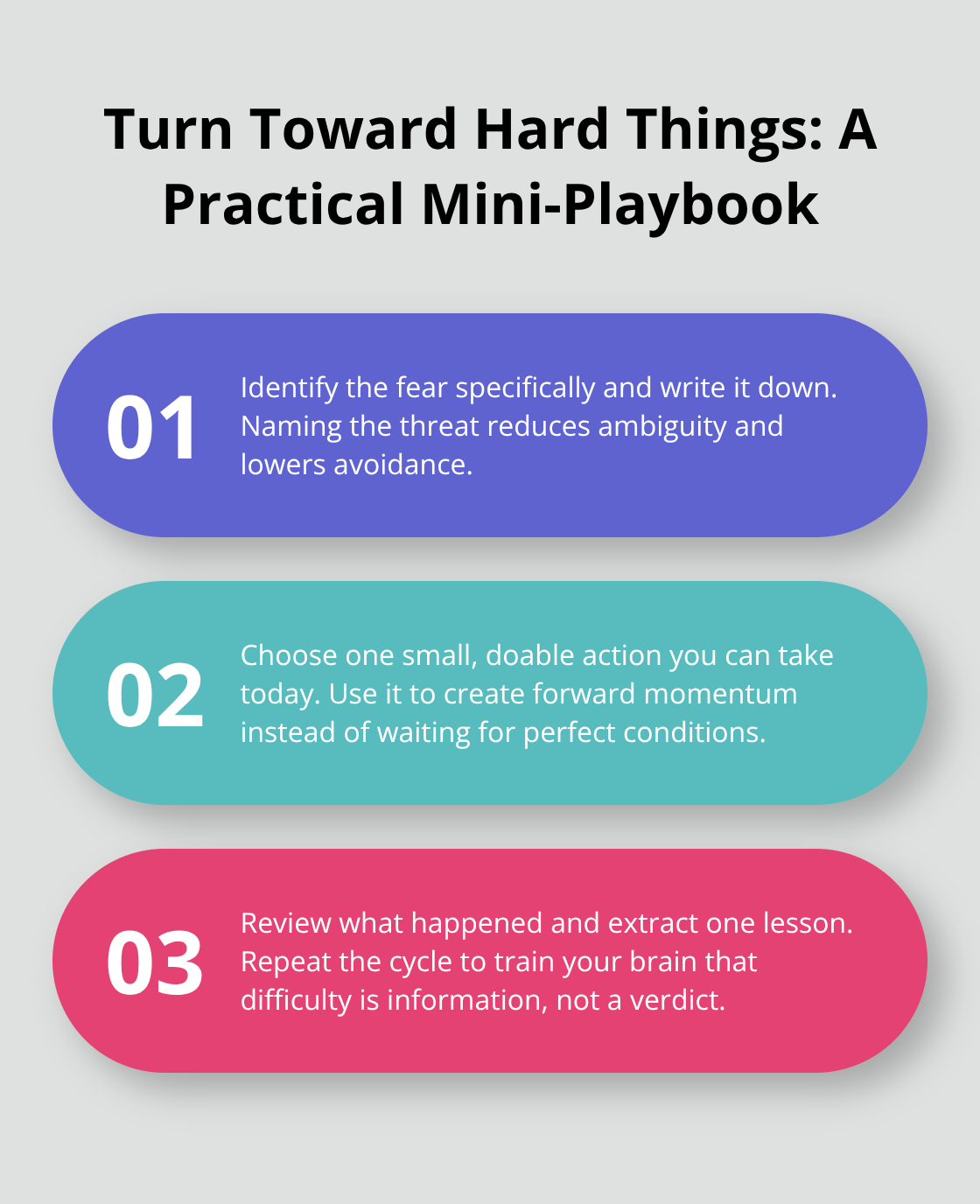
That’s how resilience actually builds. Winston Churchill captured this urgency perfectly: “This is no time for ease and comfort. It is time to dare and endure.” He wasn’t speaking in abstracts. During World War II, he made concrete decisions daily, knowing failure meant devastation. You face the same principle at smaller scale-your challenges demand your active choice to persist, not passive hope that things improve.
Setbacks Contain Information, Not Verdicts
Most people treat failure as proof they should quit. That’s backward. Nelson Mandela spent 27 years in prison and emerged to lead a nation because he reframed captivity as a forge for his character. He said it plainly: don’t judge me by success, judge me by how many times I fell down and got back up again. This mindset shift transforms what happens next. When you fail at something, reframe negative thoughts into lessons by extracting the specific information. Did your approach lack detail? Did you rush? Did you need different skills? Each failure contains actionable information if you look for it instead of just feeling defeated. Maya Angelou reinforced this when she noted that some of your greatest pains become your greatest strengths. The strength doesn’t come from the pain itself-it comes from what you do with it afterward. Start a failure log. Write down what went wrong and what you learned. Over weeks, patterns emerge. You’ll spot recurring mistakes and fix them. That’s how people who seem unstoppable actually operate.
Forward Motion Matters More Than Perfect Conditions
Martin Luther King Jr. gave guidance that cuts through hesitation: if you can’t fly then run, if you can’t run then walk, if you can’t walk then crawl, but whatever you do you have to keep moving forward. He wasn’t encouraging blind action. He was saying momentum matters more than perfection. When you’re facing something difficult, paralysis feels safe because at least you’re not failing. Moving forward, even badly, feels riskier. Research from Stanford shows that incremental achievements are good early motivators. Start where you are. Use what you have. Act on what you can. That’s not a motivational poster phrase-it’s the actual mechanism of progress. If you’re scared of public speaking, give a talk to five people in your living room first. If you’re afraid of starting a project, work on it for fifteen minutes. These aren’t stepping stones to real action. They are real action. Each one moves you forward and proves to your brain that you’re capable.
Self-Belief Emerges From Action, Not Thought
Confidence doesn’t arrive before you act-it arrives after. Carrie Fisher understood this when she said to stay afraid but do it anyway, because eventually the confidence will follow. Most people wait for confidence to show up before they try something hard. That’s the trap. You build confidence through repeated small wins, not through thinking positively. Take one action today that scares you slightly (not terrifyingly, slightly). Notice that you survived it. Your nervous system registers this. Tomorrow, you try something slightly harder. Over weeks, your brain recalibrates what feels possible. This is why people who seem naturally confident aren’t actually different from you-they’ve simply accumulated more evidence that they can handle difficulty. They’ve moved forward more times. That’s the entire secret. Your next chapter will explore how self-belief actually forms and how you can accelerate that process through deliberate choices.
How Self-Belief Actually Builds
The gap between people who accomplish difficult things and those who don’t isn’t talent or circumstance. It’s whether they trust themselves enough to start. That trust doesn’t materialize from positive thinking or affirmations repeated in the mirror. It emerges from evidence. Every time you attempt something hard and survive it, your nervous system collects data that contradicts your doubt. Marcus Aurelius said you have power over your mind, not outside events, and this is precisely what he meant. Your mind generates the story that you can’t do something, and only your mind can change that story through accumulated proof.
Start With Tasks Where Success Is Almost Guaranteed
The practical mechanism is simple: start with tasks where success is almost guaranteed. If you want to build confidence in public speaking, don’t aim for a TED talk. Speak up once in a meeting you’re already attending. Your voice will shake. Now you know what that feels like and you survived it. Next time it will shake slightly less because your nervous system has already processed the experience.
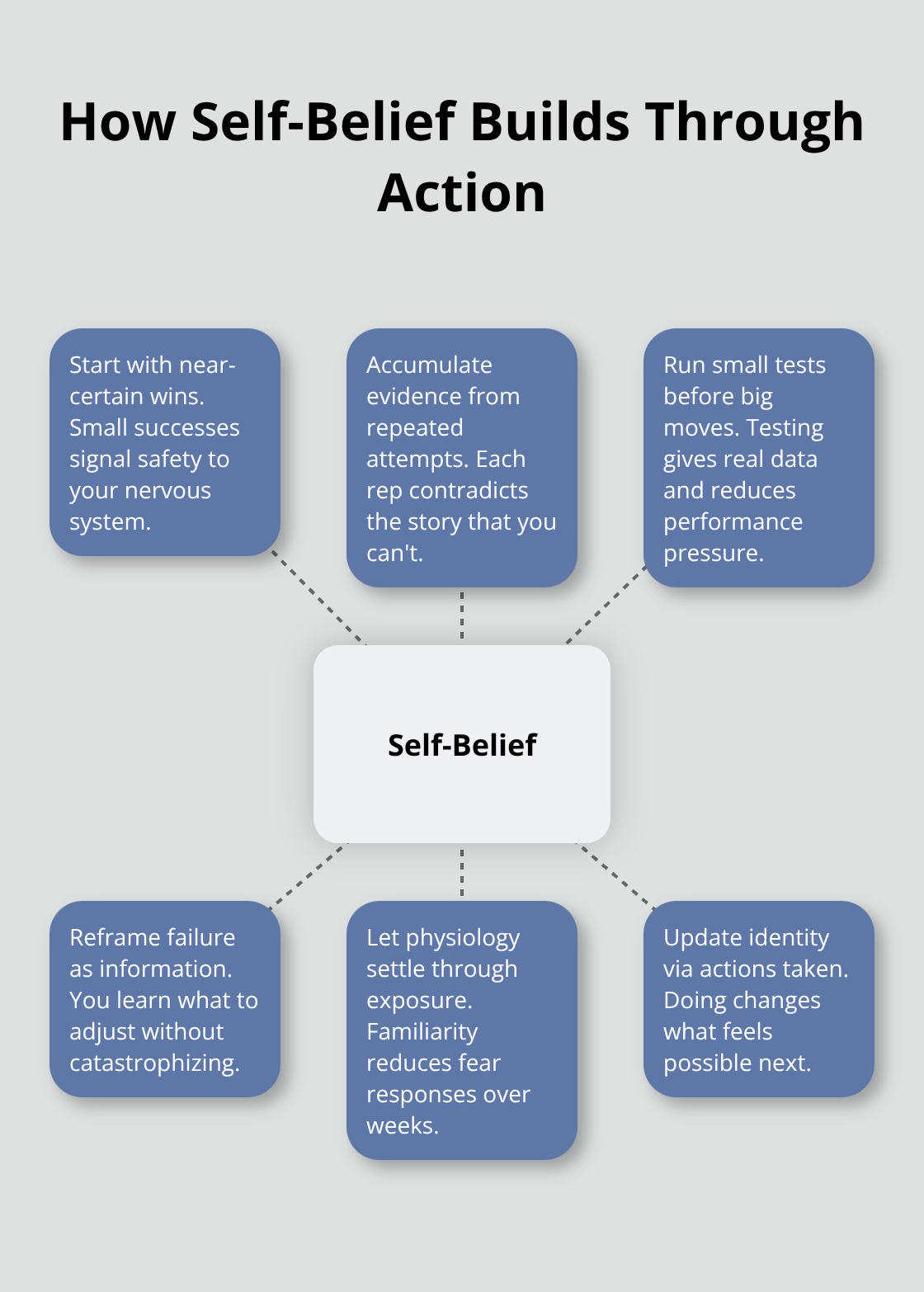
Robert F. Kennedy noted that only those who dare to fail greatly can achieve greatly, and he was describing this exact process. Failure at small scale teaches your brain that failure isn’t catastrophic. This rewiring takes weeks, not days. Most people quit before the rewiring happens because they expect confidence to feel different than it actually does. Confidence isn’t a warm glow of certainty. It’s a calm willingness to try despite uncertainty because you’ve tried before and you’re still here.
Test Yourself Before Major Attempts
You cannot think your way into self-trust. You must act your way there. The most effective strategy is deliberate small-scale testing before major attempts. If you’re considering a career change, don’t quit your job immediately. Take a course. Do freelance work in that field on weekends. Talk to five people doing that work. Each conversation and experience gives you real information instead of fear-based assumptions. When you approach something with genuine curiosity about what you’ll learn rather than terror about what will happen, your physiology shifts. Ambrose Redmoon said courage is not the absence of fear but the judgment that something else is more important than fear. That something else is usually information. You move forward to gather facts, not to prove yourself. This reframe removes the performance pressure that makes confidence impossible. You’re not trying to be perfect. You’re trying to know more than you knew yesterday. That love of the process, that genuine interest in what you’re building or learning, sustains action when doubt shows up. Identify one area where you want more confidence and commit to three small tests this week. Not three big achievements. Three small tests that generate information.
Your Potential Expands With Each Action You Take
Abraham Maslow observed that growth must be chosen again and again, not once. This means your potential isn’t a fixed ceiling you either reach or don’t. It’s a frontier that moves forward every time you expand your comfort zone. The person you could become exists only if you repeatedly choose slightly harder versions of what you’ve already done. Oprah Winfrey stated that we cannot become what we need to be while remaining what we are, and this describes the mechanism perfectly. You cannot think differently while acting identically. Your actions shape your identity, which then shapes what feels possible to you. Someone who has given five presentations thinks differently about public speaking than someone who has given none. Someone who has started a small project thinks differently about their competence than someone who has only consumed content about projects. The data from your own experience rewrites your self-concept faster than any external motivation can. Take stock of what you’ve actually done in the past year, not what you intended to do. That track record is your real evidence of capability. Now ask what one category of action you haven’t tried yet. Not something massive. Something one step beyond your current experience. That single action, completed this month, expands what you believe is possible for you next month. As your confidence grows through these small victories, you’ll find yourself ready to explore how this self-belief translates into meaningful connections with others.
Connection Transforms How You Show Up
Strength doesn’t build alone in your head. It emerges when you connect with others and recognize that your actions ripple outward. Mister Rogers understood this when he said that in tough times, you should look for the helpers because you will always find people who are helping. This isn’t sentiment-it’s observation. When you struggle, other people actively choosing to show up for you changes your neurochemistry. Your cortisol levels drop. Your sense of isolation evaporates. You realize you’re not broken; you’re just temporarily stuck and someone else has been stuck too.
Isolation amplifies doubt while connection amplifies capability. The practical implication is direct: stop waiting until you’re completely stable to reach out. Reach out while you’re struggling. Tell one person what you’re actually facing this week-not the sanitized version, but the real version. Then listen when they tell you what they’re facing.
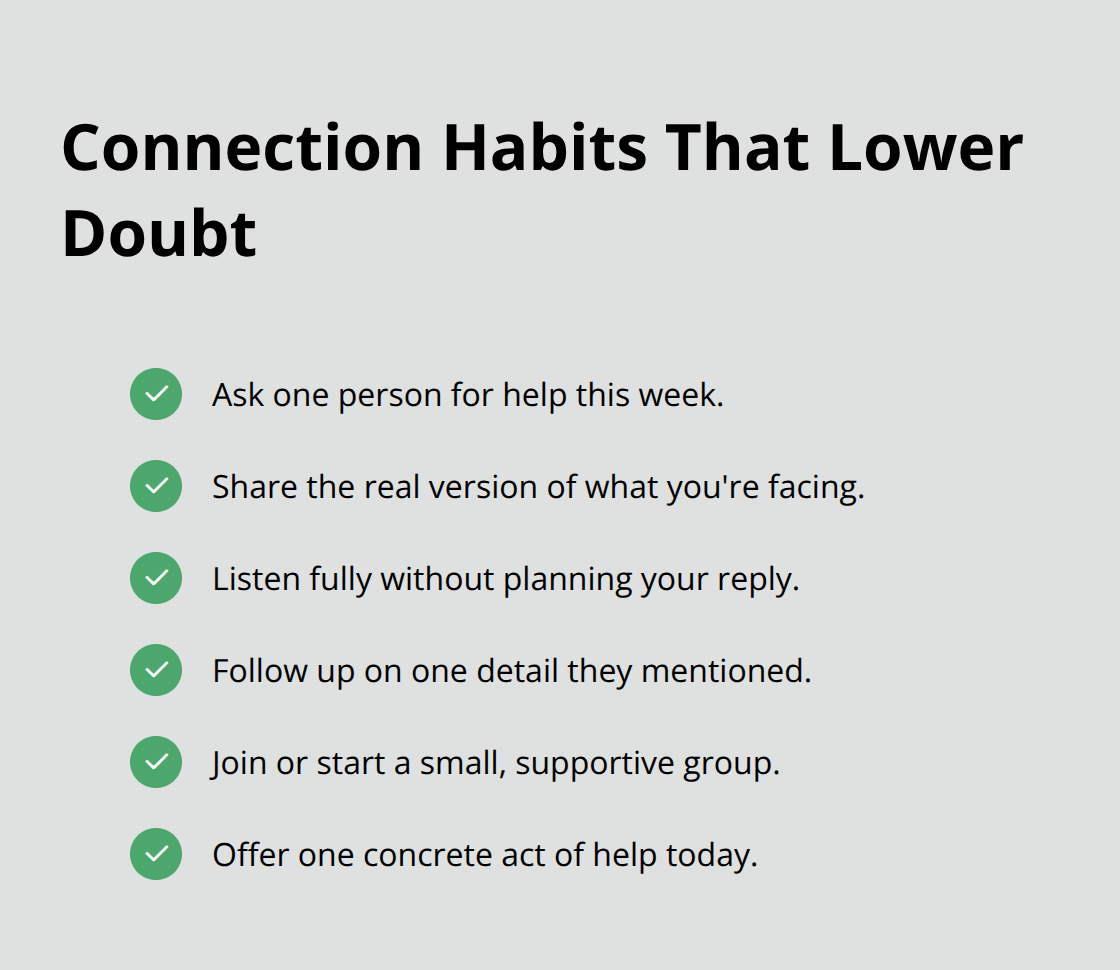
This exchange does something that no amount of solo motivation can do. It proves that difficulty is a human experience, not a personal failure.
Lao Tzu said that being deeply loved by someone gives you strength while loving someone deeply gives you courage. He described this exact mechanism. When you feel seen by another person, your nervous system settles. When you show up for another person, your sense of purpose sharpens. Neither feeling requires perfection or complete certainty. Both emerge from showing up as you actually are.
Compassion Means Seeing People Clearly
Compassion gets misunderstood as niceness or agreement with everyone. That’s weak. Real compassion means seeing someone clearly, understanding what they’re actually struggling with, and responding to that reality rather than what you wish were true. When you practice this with others, you develop the same clarity about yourself. You stop pretending you’re fine when you’re not. You stop accepting excuses from yourself that you’d never accept from a friend.
Jane Goodall noted that what you do makes a difference and you decide what kind of difference. This applies to how you treat people in your actual life. The difference you make starts with one conversation where you ask someone what’s actually going on instead of assuming. It continues when you remember details they mentioned and follow up.
Research shows that people with strong social connections have lower rates of anxiety and depression and higher overall life satisfaction. That’s not because they have fewer problems. It’s because they process problems with others instead of alone. Start this week with one conversation where you ask someone a real question and then actually listen to the answer instead of planning what you’ll say next. Your presence matters more than your words.
Community Action Reveals What You Actually Care About
Contributing to your community isn’t about charity or obligation. It reveals what you actually care about and then organizes your time around it. When you volunteer, mentor someone, or help solve a problem in your neighborhood, you discover what energizes you versus what drains you. This self-knowledge is invaluable. It shows you where your strengths genuinely lie and where you’re pretending.
Elizabeth Edwards understood this when she said that resilience emerges from adapting to new realities and choosing to build something good out of change. Community work forces you to adapt. You encounter people different from you. You face problems more complex than your personal struggles. You discover capabilities you didn’t know you had. This is where confidence becomes real instead of theoretical. You’re not just thinking about what you could contribute. You’re actually contributing and seeing the results.
Pick one specific community problem you notice regularly-not global hunger or world peace, but something you see in your actual neighborhood or workplace. Maybe people in your building don’t know each other. Maybe someone at work always eats lunch alone. Maybe a local park needs attention. Start with one small action that addresses it. Not a massive campaign, just one action. That single action connects you to people facing similar problems and shows you that you’re capable of creating change, which then changes how you approach everything else in your life.
Final Thoughts
The positivity and strength quotes you’ve encountered throughout this article function as tools for reshaping how you respond when difficulty arrives. Daily motivation works because it interrupts the automatic patterns your brain defaults to under stress, and repeated exposure to these quotes literally changes your neural pathways over time. When doubt whispers that you can’t, a well-timed reminder of Eleanor Roosevelt’s words about facing fear directly gives you permission to act anyway-this isn’t magical thinking, it’s neuroscience.
The real work happens when you apply these ideas to your actual life, not to some imagined future version of yourself. Start with one quote that resonates with your current struggle and write it somewhere you’ll see it daily. When you face that specific challenge this week, recall what the quote actually means in concrete terms, then take the action it points toward-your nervous system will register that you survived, and that single action matters more than reading a hundred motivational posts.
Positivity in the long term isn’t about feeling happy constantly; it’s about maintaining the belief that your actions matter and that difficulty contains information rather than verdicts. Visit Global Positive News Network to explore stories of personal triumphs and community impact that reinforce this truth daily. Your mindset shapes your choices, and your choices shape your life.
Explore more positive news:
Enjoying stories like this?
Global Positive News Network is reader-supported. If you’d like to support the mission, you can visit the Official GPNN store.