

Negative thoughts drain your energy and hold you back from what matters most. At Global Positive News Network, we believe positive thinking techniques for daily life aren’t just feel-good ideas-they’re practical tools that reshape how you handle stress, build relationships, and perform at work.
This guide shows you exactly how to rewire your thinking patterns and apply these strategies where they count most.
Three Techniques That Actually Work
Reframe Negative Thoughts Into Constructive Ones
Negative thoughts drain your energy before you even act. Catch yourself mid-thought by spending a day tracking your self-talk without judgment. Notice when you say things like “I can’t do this” or “I always make mistakes.” Then replace them with specific alternatives that shift your attention to what you can control and learn from.
Instead of “I can’t do this,” say “I can do anything I focus on and commit to.” Instead of “I always make mistakes,” say “Every mistake is a learning opportunity.” This isn’t positive fantasy-it’s training your brain to find the constructive angle rather than dwelling on failure. The Penn Resilience Program, used by schools and the U.S. Army, teaches this exact technique to prevent stress-related problems.
Interrupt negative patterns by saying “Cancel that” out loud. This physical act breaks the loop and resets your thinking. When something annoys you (like traffic), reframe negative thoughts rather than ignoring it. Traffic becomes time to enjoy music or a podcast. A meal that didn’t go well becomes “Every day, I get better at cooking.” These small rewrites train your brain to find what works instead of fixating on what went wrong.
Use Affirmations That Match Your Real Life
Affirmations work best when they’re specific and tied to situations you actually face. Generic statements like “I am enough” matter less than ones you use when stress hits. Say “I have what I need to handle today” when anxiety rises. Say “I choose to focus on what I can control and let go of what I can’t” when worry spirals.
The key is saying them aloud or writing them down, not just thinking them. This creates stronger neural pathways and makes the affirmations stick. Repeat them daily to reinforce belief and counter self-doubt. Your brain responds to what you consistently feed it, so make these statements part of your routine rather than occasional thoughts.
Practice Gratitude as Your Most Powerful Tool
Gratitude shifts your brain’s baseline toward noticing what’s working. Write down three specific things you’re grateful for each day, but make them concrete. Not just “my family,” but “my daughter’s laugh this morning” or “my partner helping with dinner.” Gratitude is related to greater satisfaction with life and improves overall wellbeing.
The difference between people who stay stuck in negativity and those who move forward isn’t talent or circumstance-it’s daily practice. These three techniques combined create a synergistic effect far stronger than any single approach. The real power emerges when you weave all three into your daily routine, building consistent positive habits that reshape how you respond to challenges.
How Positive Thinking Reshapes Your Mental Health
The Direct Link Between Your Thoughts and Your Stress Response
Positive thinking doesn’t just feel better in the moment-it actively rewires how your brain handles stress and anxiety. When you consistently practice the techniques from the previous section, your nervous system learns to calm down faster. A Harvard study found that optimistic women had a lower risk of death from cancer, heart disease, stroke, and infection over extended periods, demonstrating that mental outlook connects directly to physical outcomes. Short-term stress can actually boost your immune system, but long-term stress weakens it significantly, according to research synthesizing over 300 studies.
The difference lies in how you interpret and respond to pressure. When you reframe a work deadline as an opportunity to prove your capability rather than a threat, your body produces less cortisol. This isn’t wishful thinking-it’s a documented shift in your stress response. The Penn Resilience Program, used by schools and the U.S. Army to prevent PTSD and stress-related problems, teaches soldiers and students to challenge catastrophic thinking patterns before they take root. People who practice daily affirmations and gratitude show measurably lower anxiety levels within weeks, not months.
How Resilience Emerges From Your Daily Choices
Resilience during difficulty emerges from one specific habit: you look for lessons in every experience rather than dwell on what went wrong. When you face a setback, your brain has two paths forward. One leads to rumination and self-blame; the other leads to extraction of useful information. People with higher positive psychological capital-hope, efficacy, resilience, and optimism combined-report greater job satisfaction, commitment, and overall wellbeing, according to research on workplace performance.
This means your mental health improves not just from feeling good, but from actually functioning better under pressure. Start tracking how you respond to one small frustration each day. Did you blame yourself completely, or did you identify one controllable factor you could improve next time? That single shift in perspective, repeated daily, trains your brain to handle larger challenges with the same solution-focused approach. Your confidence grows because you build evidence of your own resilience through consistent small wins.
Visualization Prepares Your Nervous System for Real Challenges
Visualization intensifies anxiety reduction when you practice positive outcome visualization. Your mind doesn’t distinguish between vivid mental rehearsal and actual experience, so you can spend five minutes visualizing yourself handling a difficult conversation successfully. This mental preparation readies your nervous system for the real event, making your actual performance sharper and your anxiety lower when the moment arrives.
These mental shifts don’t happen in isolation-they compound when you apply them across your work life and personal relationships, where the stakes feel highest and your old patterns run deepest.
Where Positive Thinking Creates Real Results
How Your Thoughts Shape Professional Success
Your thoughts shape how colleagues respond to you, how much effort you invest in difficult tasks, and whether you build genuine connections or surface-level transactions. At work, people with higher positive psychological capital-hope, efficacy, resilience, and optimism combined-report greater job satisfaction and commitment, according to research on workplace performance. Happier employees tend to be more productive and more creative, which supervisors notice and reward. This means positive thinking directly affects your paycheck and career trajectory, not just your mood.
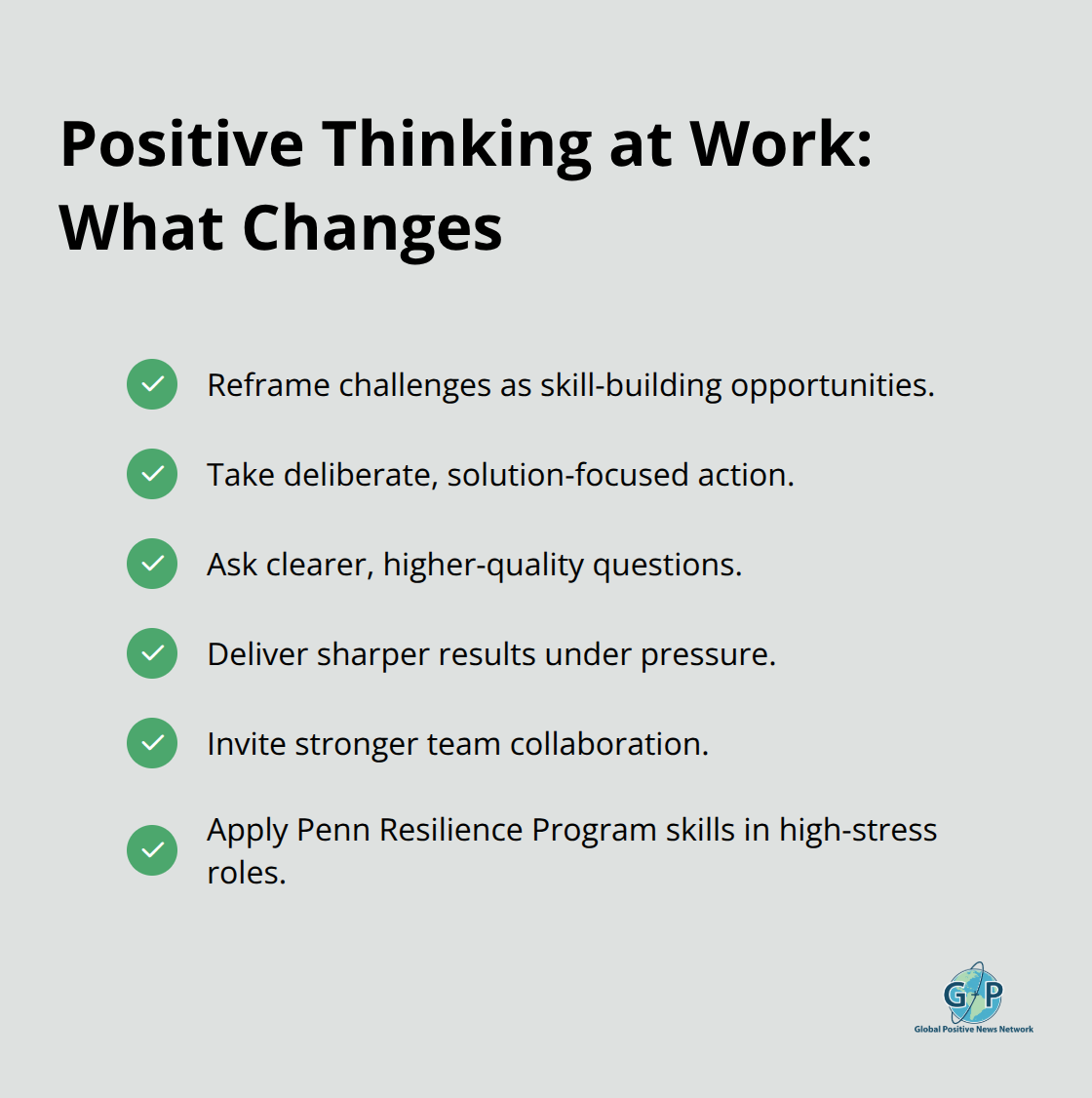
When you face a challenging project, your internal narrative determines whether you see it as a threat or an opportunity to develop skills. Reframe challenges as opportunities to shift how you approach the work itself. You take more deliberate action, ask better questions, and produce sharper results. Your team notices this shift in your energy and responds with greater collaboration. The Penn Resilience Program teaches this exact mechanism to professionals in high-stress roles, and participants show measurable improvements in performance within weeks.
How Positive Thinking Transforms Relationships
In personal relationships, positive thinking prevents you from catastrophizing minor conflicts into relationship-ending disasters. When your partner forgets something you mentioned, your brain can either spiral into “they don’t care about me” or land on “they’re stressed about work right now.” The second response keeps you calm enough to communicate clearly instead of reacting defensively.
Research on optimistic individuals shows they maintain stronger social connections because they interpret ambiguous situations generously rather than with suspicion. Track one interaction per day where you caught yourself interpreting someone’s actions negatively, then ask yourself what other explanation might fit the facts. This single practice rewires your relationship patterns faster than any amount of general advice about communication. People who practice this consistently report fewer conflicts and deeper trust, because their partners feel genuinely understood rather than judged.
Preparation That Serves Both People
The visualization technique from the previous section applies directly to difficult conversations. Before a challenging discussion, spend five minutes mentally rehearsing a positive outcome where you both feel heard. Your nervous system arrives at the conversation calmer, your tone softer, and your listening sharper. This isn’t manipulation; it’s preparation that serves both people. You both benefit when you show up mentally ready instead of defensive or anxious.
Final Thoughts
The positive thinking techniques for daily life you’ve learned throughout this guide work because they reshape how your brain responds to stress and challenge. Reframing, affirmations, and gratitude rewire your nervous system, strengthen your relationships, and sharpen your performance at work. Research confirms that people who practice these techniques consistently report lower anxiety, greater resilience, and measurably better outcomes across their lives.
Start with one technique this week. Track your self-talk, repeat a single affirmation that matches your real situation, or write down three specific things you’re grateful for. The compound effect emerges from daily practice, not perfection, so your automatic responses will shift within weeks as you catch negative spirals faster and interpret setbacks as learning opportunities instead of personal failures.
Your brain responds to what you repeatedly feed it, so make these practices part of your routine rather than occasional efforts. When stress hits, you’ll have trained your nervous system to respond with calm clarity instead of panic. Visit Global Positive News Network for uplifting stories and resources designed to help you maintain an optimistic outlook.