

Most people wake up to a flood of bad news. Anxiety spikes, mood dips, and that sense of connection to something good feels distant.
At Global Positive News Network, we believe positive news daily inspiration isn’t just feel-good fluff-it’s a practical tool that rewires how you experience the world. This post shows you exactly why uplifting stories matter for your mental health and how to weave them into your everyday life.
How Positive News Rewires Your Mental Health
Negative news doesn’t just make you feel bad for a moment-it changes your physiology. When you consume crisis-focused content, your cortisol levels spike, your nervous system stays activated, and anxiety becomes your baseline. The solution isn’t ignoring reality; it’s balancing your information diet with stories that show progress and human capability.
Research from Stanford Medicine demonstrates that what you consume shapes your mental state. A study published in Nature found that participants on a well-formulated ketogenic diet showed substantial improvements in depression symptoms and overall wellbeing within 10 to 12 weeks. While diet and news consumption differ, the principle is identical: intentional choices compound over time. Positive news works the same way.
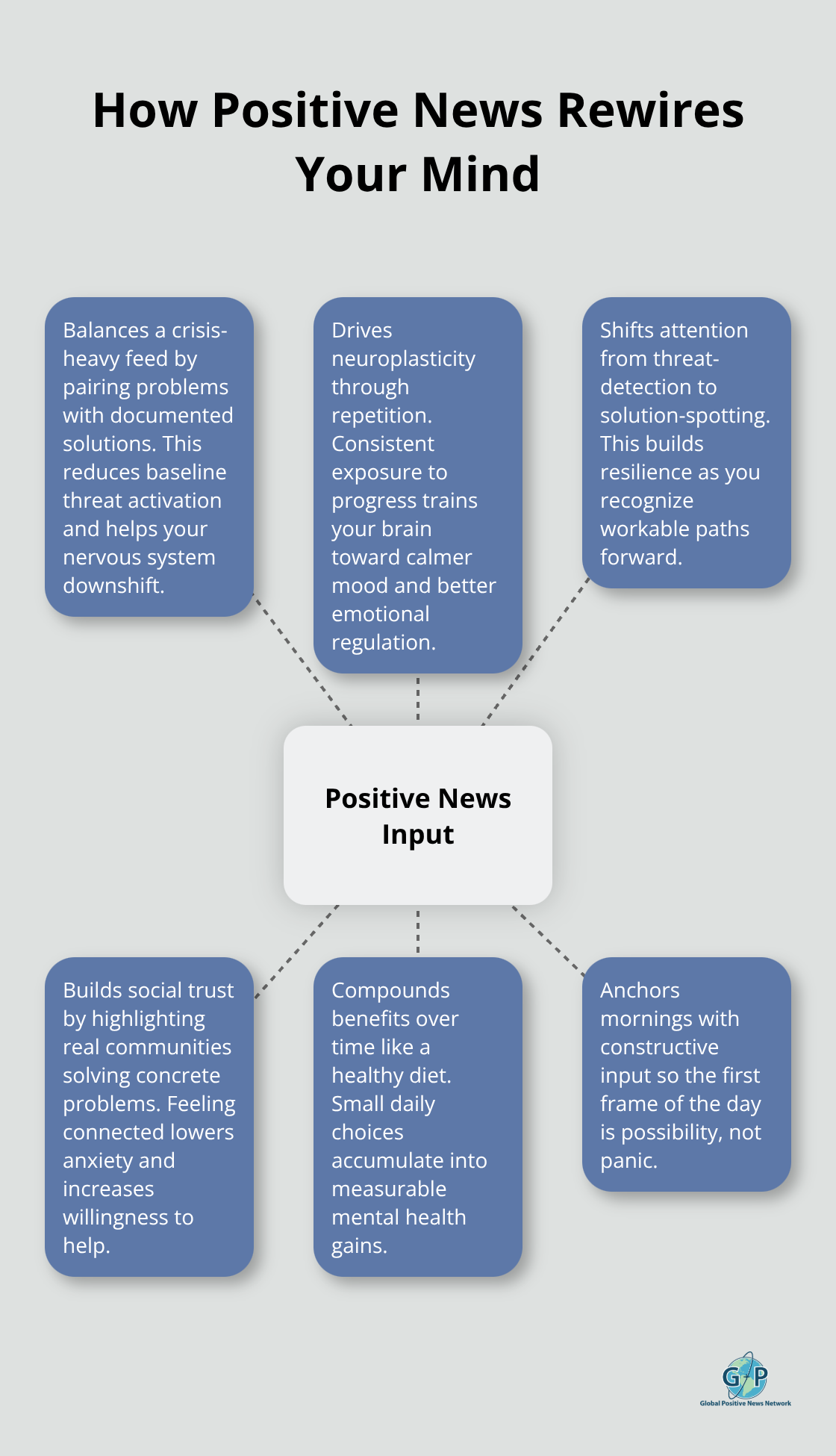
When you read about the University of Pennsylvania’s study showing that smartphone bans in Indian classrooms improved grades for nearly 17,000 students-especially struggling learners-your brain registers that problems have solutions. When you learn that global solar installations rose 64% in the first half of 2025 compared to the same period in 2024, you see evidence that clean energy isn’t a distant dream. These aren’t feel-good fantasies; they’re documented breakthroughs. Each story you absorb trains your mind to recognize what’s working, not just what’s broken. This shift from threat-detection to solution-spotting reduces your anxiety and builds emotional resilience.
The Stress-Reduction Effect Happens Fast
You don’t need months of positive news consumption to feel the difference. A 2025 study in the Netherlands found that 75% of high school staff reported improved student concentration after smartphone bans, with roughly one-third noting better academic performance. Benefits appear within weeks, not years. When you start your morning with a story about how Indonesia revoked mining licenses in orangutan habitats or how Austria’s top court strengthened non-binary rights, your mind enters the day primed to notice progress.
This isn’t optimism bias; it’s neuroplasticity. Your brain literally rewires based on input. Readers who engage with positive news consistently report lower morning anxiety and better emotional regulation throughout the day. The key is consistency, not intensity-five minutes of genuine uplifting content beats occasional deep dives into feel-good stories.
Community Connection Follows Naturally
When you read about real people solving real problems-like an Indian village saving Kerala’s largest lake through community-led water management or Philadelphia schools now guaranteeing water breaks and daily recess-you recognize yourself in those stories. You see that change happens through ordinary people taking action, not distant authorities making proclamations. This recognition builds what researchers call social trust.
You feel less isolated because you witness humanity at its most capable. That sense of connection is measurable. People who regularly consume positive news report stronger feelings of belonging and greater willingness to contribute to their own communities. The Philly-based mobile laundromat helps wash homeless residents’ clothes on-site, the elephant ambulance marked its first rescue, and scientists created super-honey from cocoa bean waste-these stories prove that compassion and innovation coexist in the real world.
When you see what’s possible, you become more likely to act. This momentum carries into the next part of your day: how you actually integrate these stories into your routine so the benefits stick.
Stories That Show What’s Actually Possible
The stories that stick with you aren’t the ones that make vague promises about humanity’s potential. They’re the concrete ones where a specific person or community solved a real problem and documented the result. An Indian village saved Kerala’s largest lake through water management. Scientists at the University of Pennsylvania tracked 17,000 students and found that smartphone bans improved grades, especially for struggling learners. Austria’s top court strengthened non-binary rights through legal action. These aren’t inspirational abstractions; they’re evidence that change happens when people act. When you read about the Ocean Cleanup removing 45 million kilograms of plastic from the oceans or Indonesia revoking mining licenses in orangutan habitats, you’re not reading marketing copy. You’re reading the measurable output of deliberate effort. This distinction matters because your brain responds differently to documented progress than to motivational speeches. You absorb these stories and your mind automatically asks: what’s the mechanism? How did they do it? What could I learn from this approach? That’s the moment positive news becomes actionable.
Why Personal Stories Outperform Generalities
A person overcoming a specific obstacle creates something generic inspiration cannot match. When you learn that an elephant ambulance marked its first rescue, transporting a 27-year-old elephant with a leg injury to medical care, you’re seeing innovation applied to a real crisis. When Philadelphia schools now guarantee water breaks and daily recess, eliminating silent lunches to foster inclusive environments, you’re watching policy shift based on student wellbeing research. The Philly-based mobile laundromat solves homelessness barriers by bringing laundry services directly to people who need them most. These aren’t hypothetical scenarios; they’re people identifying friction points and removing them. The pattern across every story that actually changes how you think is specificity. Endangered Persian leopards mount a comeback in Central Asia, Thailand’s café chains cut sugar in popular drinks by half to support public health, and a New Zealand designer created solar-powered skylights that desalinate water for drinking. Each one tells you exactly who did what and why it mattered. That’s what separates positive news from cheerleading.
Community Action Stories Show Momentum Building
The most powerful stories aren’t about lone heroes. They’re about ordinary people recognizing a shared problem and solving it together. Women in India protect biodiversity as nesting boxes became required in new buildings to support the rarest stork. Seagrass restoration in Malaysia demonstrated effective coastal ecosystem recovery. An Indian village led water conservation for Kerala’s largest lake. These stories reveal that progress scales when communities align around a goal. You read about global solar installations rising 64% in the first half of 2025 compared to the same period in 2024, and you understand that renewable energy isn’t advancing because governments mandated it. It’s advancing because the cost dropped and communities chose it. China now produces 60% of the world’s wind turbines and 80% of solar panels, with 91% of newly commissioned wind and solar projects cheaper than fossil options. That’s not a feel-good statistic; that’s the economic foundation for real transition.

Stories of community impact work because they show you the mechanism. They don’t tell you change is possible; they show you how it’s already happening around you.
How Specificity Transforms Your Perspective
Concrete details activate your mind differently than abstract statements. When you encounter a story about Austria’s top court strengthening non-binary rights or the Netherlands enhancing climate protection for Bonaire, you’re not just reading news-you’re absorbing a blueprint for how change actually occurs. The specificity matters because it moves you from passive observation to active understanding. You see the problem, the solution, and the measurable result. This clarity is what separates stories that inspire temporary feelings from stories that reshape how you think about what’s possible in your own life and community.
What happens next is where these stories transform from inspiration into action. The question isn’t whether positive news matters-the evidence shows it does. The question is how you weave these stories into your daily life so the benefits compound over time.
Building Your Daily Positive News Habit
The moment you decide to integrate positive news into your routine, you face a practical question: when and how do you actually do it without it becoming another obligation competing for your attention? The answer is treating positive news like a strategic counterweight rather than an addition to your day. Your morning sets the tone for how you interpret everything that follows. Instead of opening your email or social media feeds first, open a platform dedicated to documented progress. Spend five to seven minutes reading one concrete story before you check anything else. This timing matters because your brain hasn’t yet encountered the day’s stressors, so positive input registers as foundational rather than reactive.
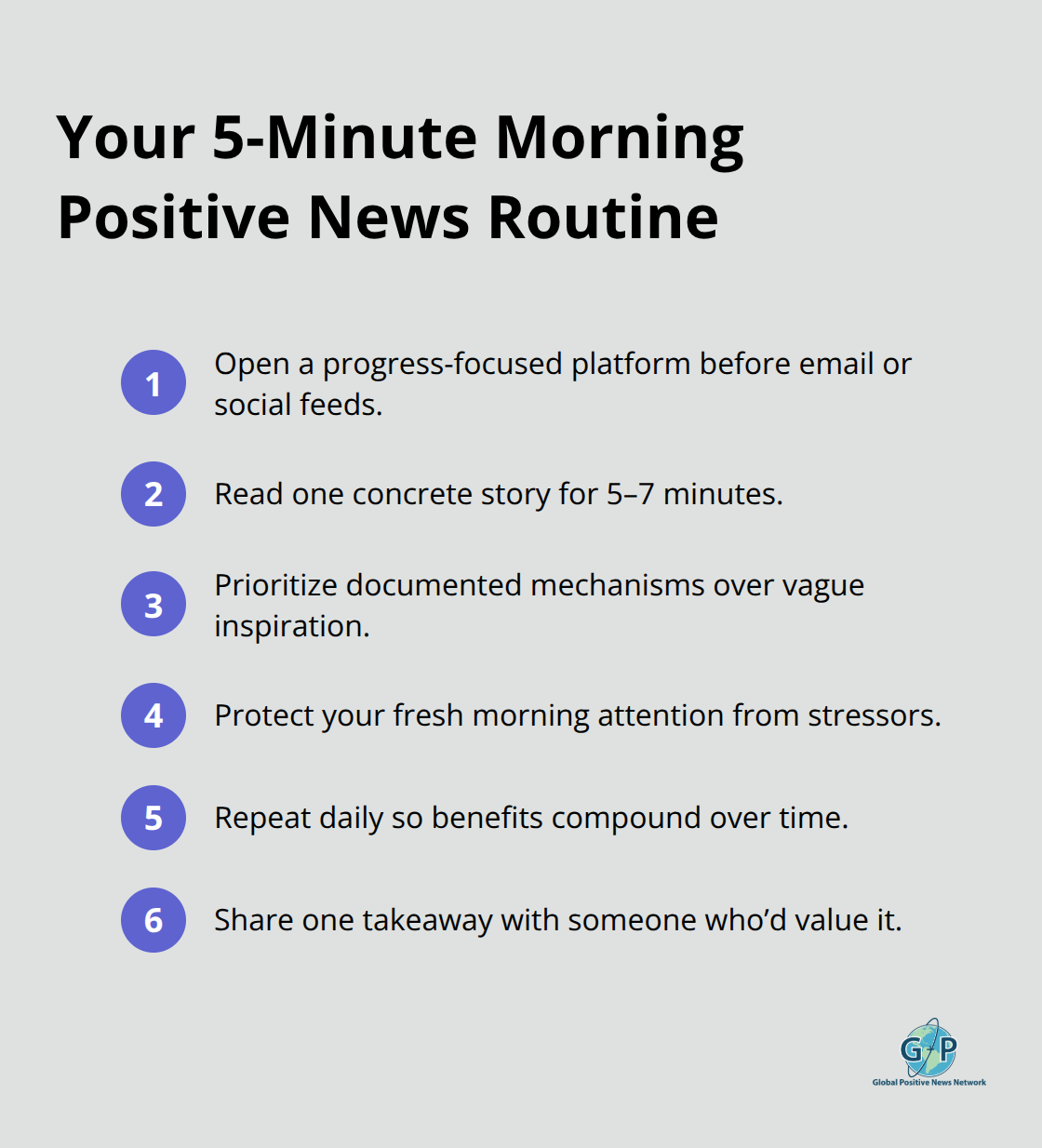
Protect your morning attention as your most valuable cognitive asset.
Choose Stories With Specific Mechanisms
Stories that show exactly how change happened stick with you far longer than vague inspiration. An article about Indonesia revoking mining licenses in orangutan habitats teaches you something about conservation policy. A story about Philadelphia schools guaranteeing water breaks and daily recess shows you how advocacy translates into institutional change. These specifics remain with you throughout your day because they’re not feel-good abstractions; they’re blueprints for how the world actually works. When you read about concrete examples of progress-women in India protecting biodiversity through required nesting boxes in new buildings, or renewable energy installations expanding globally-you absorb evidence of tangible change. The mechanism matters more than the sentiment.
Share Stories to Amplify Impact
Sharing stories with others amplifies the benefit beyond yourself and creates a feedback loop that strengthens your habit. When you encounter a story about renewable energy growth, send it to one person who would find it meaningful. Not as cheerleading, but as evidence. Text a colleague about relevant data because it shows how energy markets are shifting. Share a story about endangered species mounting comebacks with someone interested in conservation. This approach transforms positive news from a personal consumption habit into a communication pattern. You become someone who notices progress and passes it along, which changes how others perceive you and your worldview.
Balance Progress With Reality
The final piece is deliberate positioning: when you encounter negative news through your regular feeds, immediately follow it with a story that addresses the same domain. Read about climate concerns, then read about renewable energy expansion and solar panel production growth. See a story about health challenges, then read about medical breakthroughs offering new diagnostic options. This isn’t denial; it’s intellectual honesty. Both the problem and the progress are real. Your brain needs both to form accurate models of how the world works. The habit sticks when you treat positive news as essential information that mainstream outlets systematically under-report. Stories about innovative solutions in water technology, sustainable design, and public health show that responses to challenges exist alongside the challenges themselves. Your information diet should reflect this reality.
Final Thoughts
Making positive news a daily habit creates measurable shifts in how you experience your life. Research confirms that consistent exposure to documented progress reduces anxiety, strengthens emotional resilience, and builds genuine connection to your community. When you start your morning with stories about renewable energy expansion, medical breakthroughs, or conservation wins, you train your brain to recognize solutions alongside problems rather than indulging in escapism.
This practice compounds over weeks and months. After reading about concrete achievements-from smartphone bans improving student grades to communities solving water crises-your default mindset shifts fundamentally. You stop waiting for permission to feel hopeful and start recognizing that progress happens through ordinary people taking action. Positive news daily inspiration becomes the lens through which you interpret your world.
Visit Global Positive News Network and spend five minutes with one story tomorrow morning before you check anything else. Notice how that single decision shapes your day, then share what you find with someone who needs to see it. The world’s problems are real, and the solutions are real too-you deserve an information diet that reflects both.