

At Global Positive News Network, we’re excited to share classroom positive reinforcement ideas that can transform your teaching experience.
Positive reinforcement is a powerful tool that can shape student behavior, boost academic performance, and create a more harmonious learning environment.
In this post, we’ll explore effective strategies and practical techniques to implement positive reinforcement in your classroom.
What Is Positive Reinforcement?
The Power of Positive Reinforcement
Positive reinforcement is a teaching tool that rewards desired behaviors to encourage their repetition. This approach can transform classrooms into vibrant learning environments.
The Scientific Foundation
B.F. Skinner’s operant conditioning theory forms the basis of positive reinforcement. This psychological principle suggests that behaviors followed by pleasant consequences are more likely to be repeated. In a classroom setting, this translates to students’ inclination to repeat actions that earn them praise or rewards.
Measurable Benefits for Students
Research suggests that positive reinforcement can be effective in addressing severe problem behaviors in classroom settings. A study by Hanley et al. (2005) describes an assessment sequence that may be used to identify individualized, effective, and preferred interventions for severe problem behaviors.
Effective Implementation Strategies
To make positive reinforcement work, teachers should be specific and immediate with their praise. Instead of a generic “good job,” they can say, “I’m impressed by how you used evidence to support your argument in that essay.” This specificity helps students understand exactly what they did well and encourages them to repeat that behavior.
Comparison with Other Management Techniques
While punishment-based techniques might seem effective in the short term, they often lead to resentment and decreased motivation. Research by Polirstok (2006) demonstrates that increasing on-task behavior in classrooms and reducing misbehavior results in increased student achievement.
Fostering a Positive Classroom Culture
Consistent implementation of positive reinforcement can create a supportive classroom culture. Students become more willing to take risks, participate actively, and support their peers. This positive atmosphere can lead to improved learning outcomes and better social-emotional development.

Positive reinforcement isn’t about bribing students or lowering standards (it’s about recognizing and encouraging behaviors that lead to success). Teachers who incorporate these techniques into their practice can create a more engaging, effective, and enjoyable learning environment for all their students.
Now that we understand what positive reinforcement is and its benefits, let’s explore specific strategies to implement it effectively in the classroom.
Practical Strategies for Classroom Positive Reinforcement
Specific Verbal Praise
Verbal praise transforms classrooms when teachers use it effectively. Teachers should focus on specific behaviors instead of generic compliments. For example, “I appreciate how you helped your classmate understand that math problem” proves more effective than a simple “Good job.” This specificity helps students understand exactly what they did well and encourages them to repeat that behavior.
Specific Verbal Praise has been found to be effective in changing behavior in elementary school students. Teachers who focused on increasing praise with individual students’ performance feedback led to an increase in their use of behavior-specific praise.
Token Economy Systems
Token economies motivate students powerfully. Teachers can create a system where students earn tokens for positive behaviors, which they can later exchange for rewards. These rewards don’t have to be expensive – extra computer time, choosing a class game, or being the teacher’s assistant for a day can be powerful motivators.
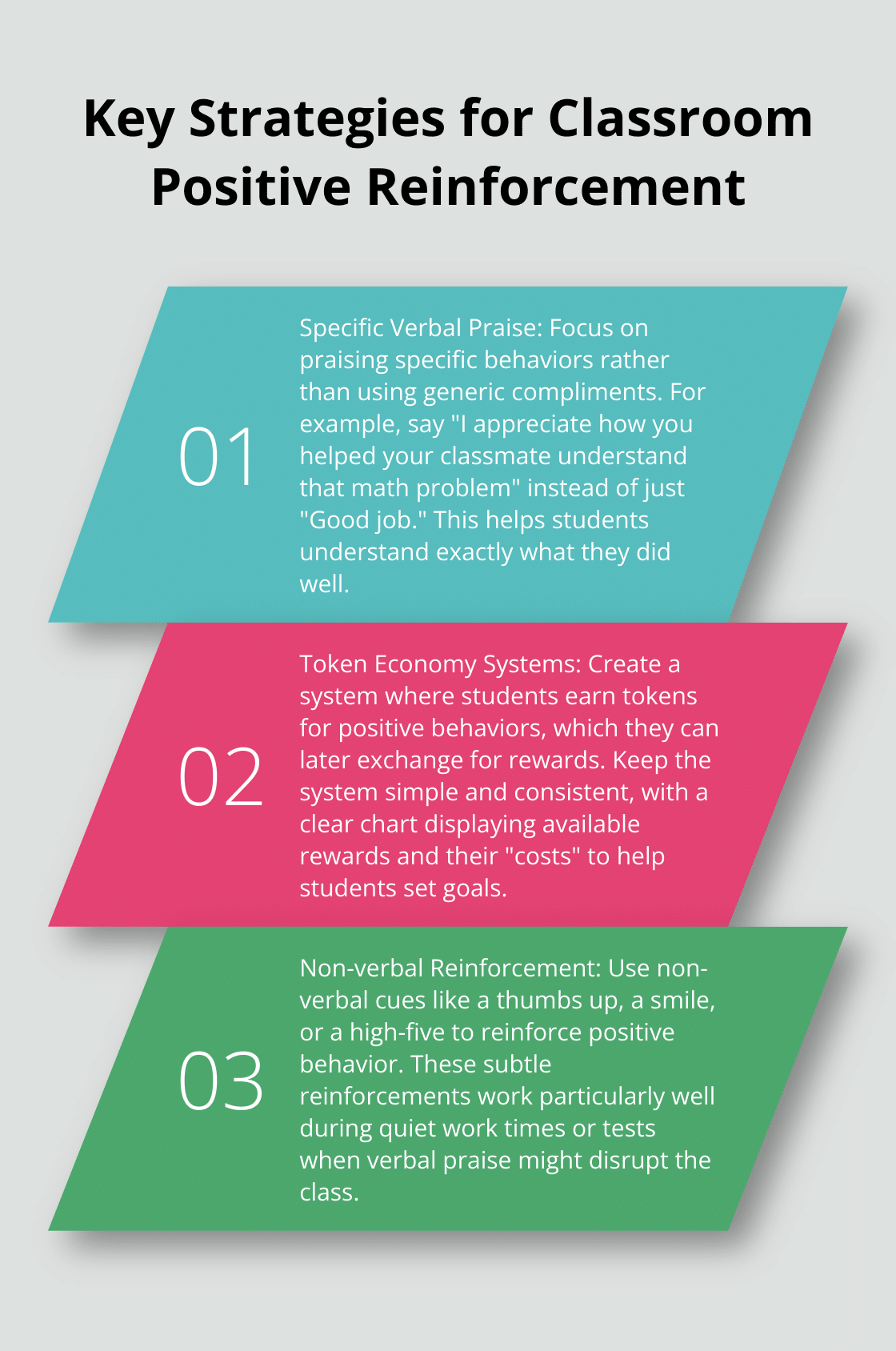
Teachers should keep the system simple and consistent. A clear chart displaying available rewards and their “costs” helps students set goals and work towards them.
Token economy systems have shown overall improvements in student behaviors, offering initial support for their effectiveness in classrooms.
Non-verbal Reinforcement
Non-verbal cues pack a powerful punch. A thumbs up, a smile, or a high-five can be just as effective as verbal praise, especially for students who are shy or easily embarrassed by public recognition.
These subtle reinforcements work particularly well during quiet work times or tests when verbal praise might disrupt the class.
Special Responsibilities
Special responsibilities or privileges reinforce positive behavior powerfully. This could include being the class messenger, leading the line to lunch, or choosing the next class read-aloud book.
These responsibilities not only reinforce positive behavior but also help build students’ self-esteem and sense of belonging in the classroom community.
Tailoring Approaches
Teachers must tailor these approaches to their specific classroom and students. What works for one group might need adjustment for another. The key lies in consistency and adaptability.
Now that we’ve explored these practical strategies, let’s examine how to implement positive reinforcement in different classroom scenarios.
Positive Reinforcement in Action
Tackling Disruptive Behavior
When teachers face disruptive behavior, positive reinforcement can transform the classroom dynamic. Instead of punitive measures, teachers should actively seek and reward positive actions, no matter how small.
For example, if a student who often interrupts others raises their hand and waits their turn, the teacher should immediately acknowledge this: “I really appreciate how you raised your hand and waited patiently to speak. That shows great respect for your classmates.”
This approach reinforces the desired behavior and shifts the student’s focus from seeking attention through disruption to gaining recognition through positive actions.
Boosting Academic Performance
Positive reinforcement can significantly impact academic achievement. Teachers should celebrate the process and effort students put into their work, rather than solely focusing on grades.
When a student shows improvement in a challenging subject, teachers should acknowledge their progress specifically: “I noticed you practice your multiplication tables every day. Your hard work really pays off in your quiz scores!” (This type of recognition motivates students to continue putting in effort, even when faced with difficult subjects.)
A study by Mueller and Dweck (1998) found that praising effort over innate ability fosters a growth mindset, which can have consequences for children’s motivation and achievement.
Fostering Social Skills and Teamwork
Positive reinforcement plays a key role in developing social skills and promoting cooperation among students. Teachers should highlight behaviors that demonstrate good teamwork or kindness.
For instance, if a teacher observes a student helping a classmate understand a difficult concept, they might say: “Sarah, I saw you explain the science experiment to John. Your patience and clear explanations really show what it means to be a good teammate.”
This reinforces Sarah’s helpful behavior and sets an example for the entire class about the value of cooperation and kindness.
Addressing Individual Needs
Every student has unique strengths, challenges, and motivations. Teachers should tailor their positive reinforcement approach to individual needs for remarkable results.
For a student struggling with anxiety, teachers can create a private signal to acknowledge their progress in participating more in class discussions (This could be as simple as a subtle thumbs up or a quick note on their desk).
For students with ADHD, immediate and frequent positive feedback can be particularly effective. Teachers can use a point system or sticker chart to provide visual reinforcement for staying on task or completing assignments.
The key to successful implementation of positive reinforcement lies in consistency, specificity, and genuine enthusiasm. Teachers who adapt these strategies to various classroom scenarios create a positive learning environment where every student can thrive.

Final Thoughts
Positive reinforcement transforms classrooms into nurturing environments that foster academic growth and social-emotional development. Teachers who implement classroom positive reinforcement ideas create a culture of positivity and growth. Students in these environments feel valued, motivated, and empowered to reach their full potential.
Educators shape the future through their interactions with students. Small, consistent actions yield significant results when teachers focus on desired behaviors and provide immediate, specific feedback. Teachers who explore and implement these strategies adapt them to fit their unique classroom dynamics.
We at Global Positive News Network believe in the power of positivity to transform lives. We encourage educators to cultivate positivity in their classrooms (just as we curate uplifting news stories to inspire hope and optimism). Together, we can create a more positive, supportive, and successful learning environment for all students.
Enjoying stories like this?
Global Positive News Network is reader-supported. If you’d like to support the mission, you can visit the Official GPNN store.