

Starting a positivity project doesn’t require a massive budget or years of experience. It requires clarity, the right people, and a willingness to take action.
At Global Positive News Network, we’ve seen firsthand how ordinary people create extraordinary change in their communities. This guide walks you through every step-from defining your vision to scaling your impact.
Define Your Positivity Project Vision
Your positivity project fails the moment it tries to help everyone. Vague missions like making the world happier produce nothing but frustration and wasted effort. Instead, pick a specific community or problem that matters to you personally. This could be supporting mental health in your local high school, reducing loneliness among elderly residents in your neighborhood, or building confidence in girls interested in STEM. The specificity matters because it shapes every decision you make next, from who you recruit to how you measure success. Research from positive psychology interventions shows that targeted wellbeing programs outperform generic ones. When you narrow your focus, you also narrow the resources needed to launch, which means you can start immediately rather than waiting for perfect conditions.
Set Measurable Goals
Measurable goals separate real projects from wishful thinking. Instead of aiming to make your community happier, commit to concrete targets like delivering kindness activities to 50 families in your area within three months, or creating a weekly strength-spotting routine in a specific classroom where students can identify and share each other’s character strengths. The VIA Character Strengths assessment from the VIA Institute on Character helps quantify progress by showing how students’ top strengths shift over time. Try timelines that feel ambitious but achievable. A three-month pilot teaches you what works before you scale up. Track progress weekly using simple metrics: number of participants, attendance rates, feedback scores, or observable changes in group dynamics.
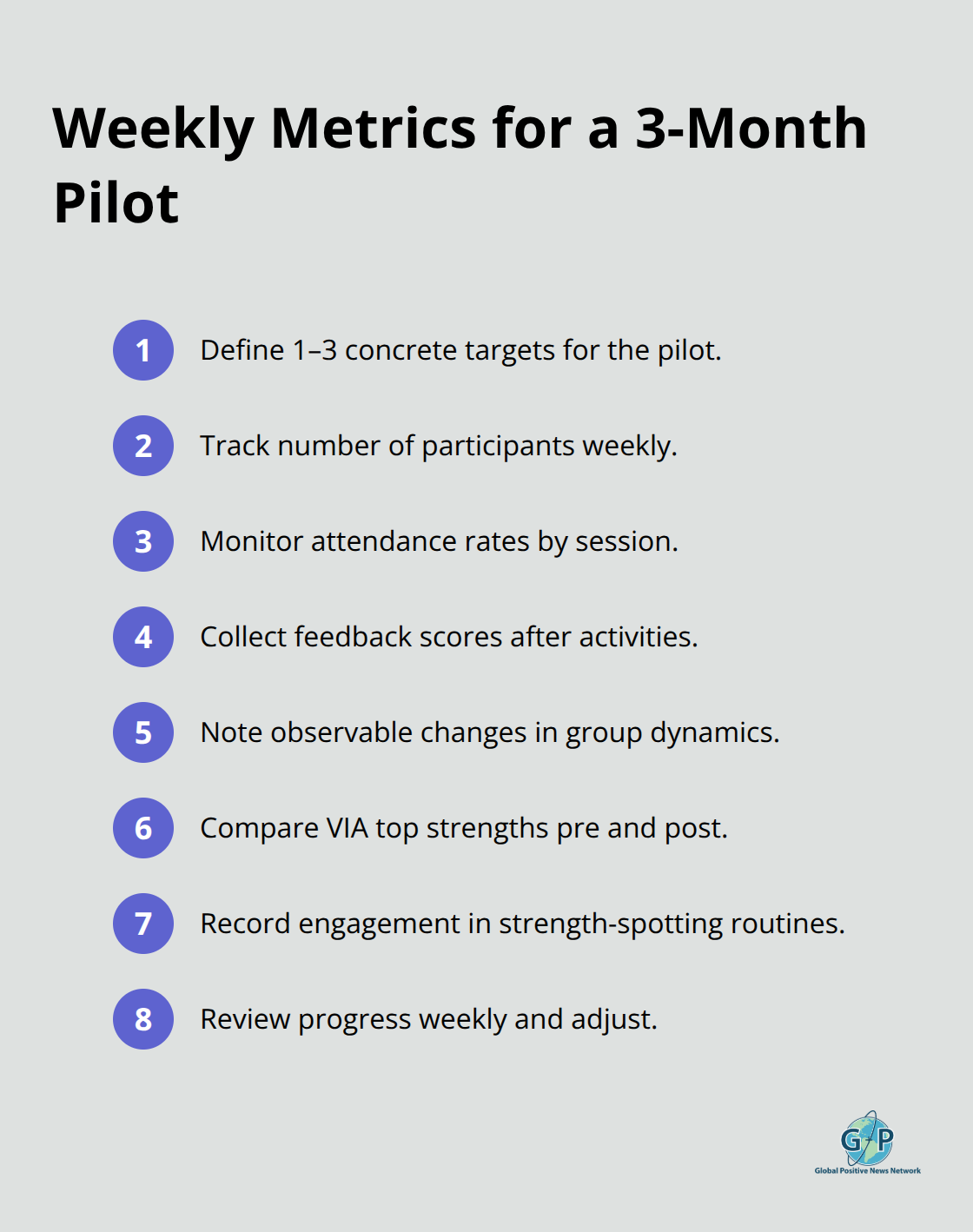
Setting measurable goals in community projects ensures clarity and accountability.
Determine Your Scope and Starting Point
Decide how big your project starts, not how big it eventually becomes. A positivity project in a single classroom with ten students is a legitimate starting point. A neighborhood kindness challenge involving five blocks is another. Your scope should match your available time, energy, and resources right now. If you launch solo, start smaller than you think necessary. Document what you can realistically maintain for the first ninety days, then expand. Many successful projects begin with morning meetings in one school or a weekly service activity in one community group before they spread further. Once you’ve locked in your vision and scope, the next step involves assembling the right people to turn your idea into action.
Build Your Team and Gather Resources
Your volunteers matter far more than your budget. A single passionate person outperforms a dozen lukewarm helpers every time. Start by identifying people who already care about your specific cause. If you launch a kindness project in a school, recruit teachers who mention student wellbeing unprompted, counselors frustrated with surface-level interventions, and parents who express concern about classroom climate. Post your need in hyper-local spaces: neighborhood Facebook groups, school parent channels, community centers, and local business networks. State exactly what you need and how much time it requires. Vague calls for helpers attract uncommitted participants. Instead, say: We need three people to help organize weekly strength-spotting activities in the 6th-grade hallway for ten weeks, meeting for one hour every Tuesday after school.
Research on volunteer retention shows that people stay engaged when they understand exactly what they sign up for and see tangible results within the first month. Start with a small core team of two to four people who share genuine enthusiasm for your mission, then expand once your project proves it works.
Secure Funding Without Major Complexity
Most positivity projects launch for under $500 during a three-month pilot when you use free tools and donated supplies. Calculate your actual expenses: printed materials, snacks for meetings, small incentives for participants, or platform subscriptions. Many schools have discretionary budgets for social-emotional learning initiatives, and teachers can often access $200 to $500 annually through their department.
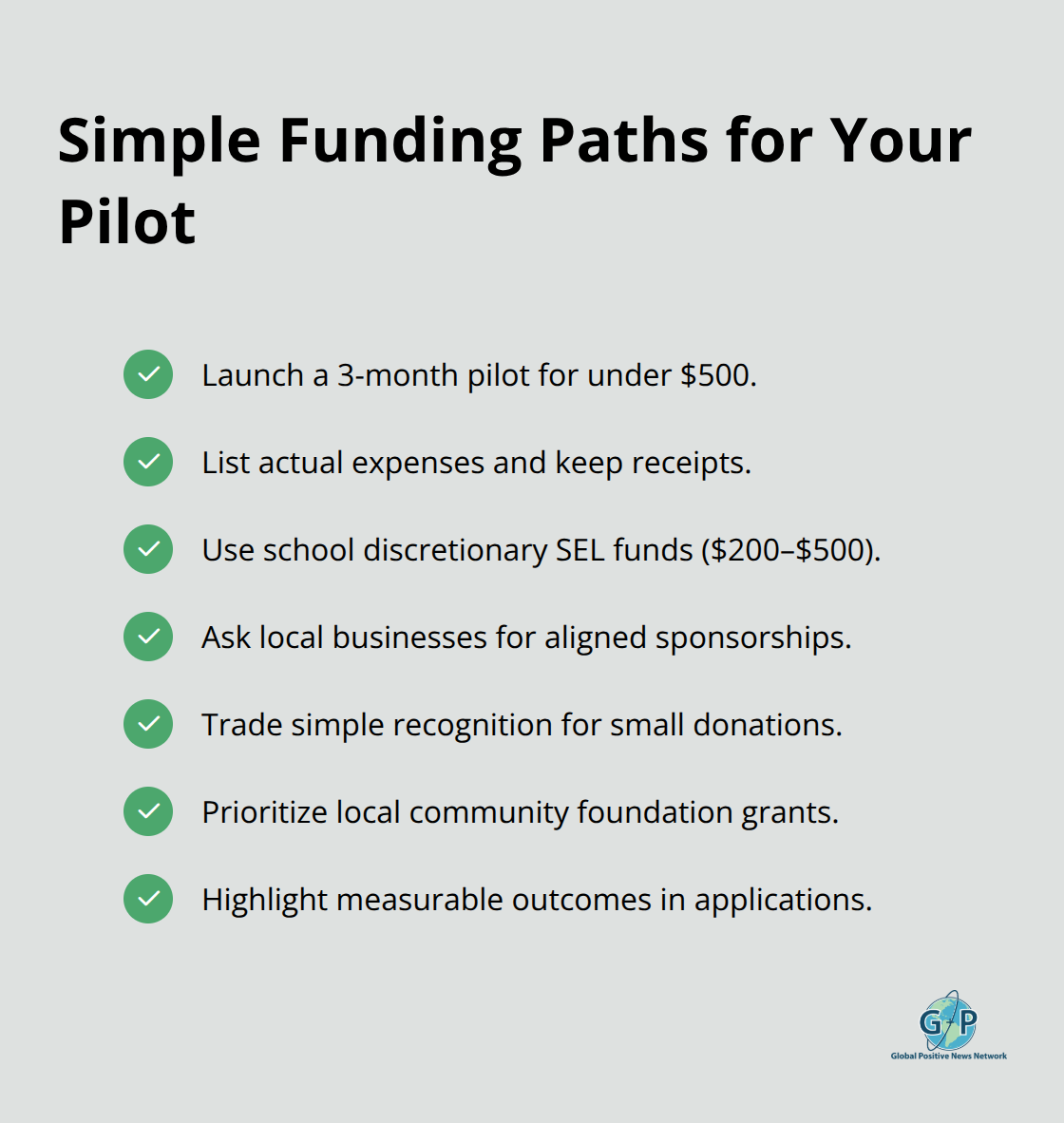
Local businesses sponsor projects tied to their values at no cost if you ask directly and frame the benefit clearly. A coffee shop might fund your neighborhood kindness challenge in exchange for social media mentions. A mental health clinic could support a school wellbeing project to build community goodwill.
If you pursue grants, start with local community foundations rather than national ones. Community foundations award smaller grants with simpler applications, and they prioritize local impact. The Foundation Center and Grants.gov list opportunities, but your county nonprofit resource center often has curated local options. When you apply, emphasize measurable outcomes: how many people you reach, what specific change you track, and how you report results. Avoid vague language like making communities happier. Say instead: We will implement weekly character strength activities in three classrooms with 75 students, and we will measure engagement through attendance rates and pre-post surveys on peer recognition.
Select Tools That Reduce Administrative Work
Free and low-cost platforms handle the operational work so you focus on impact. Google Forms collects feedback and tracks attendance with zero learning curve. Airtable or Monday.com organize volunteer schedules, participant data, and progress tracking in one place without costing money during your pilot phase. Slack or WhatsApp groups keep your core team aligned without endless email threads. Canva creates simple graphics for social media and flyers in minutes, even if you have never designed anything.
For documenting progress and sharing wins, Google Slides works better than written reports because people actually read visual summaries. Take photos of activities, clip quotes from participant feedback, and build a simple slide deck each month showing what happened and what changed. This becomes your communication tool when you pitch the project for expansion or additional funding. Start with two tools maximum during your first ninety days. Adding too many platforms creates confusion and abandonment. Pick one for team coordination and one for participant management, then add others only when you hit genuine bottlenecks. With your team assembled and your operational foundation in place, you now move into the phase where your project becomes visible and starts generating momentum.
Launch and Grow Your Initiative
Make Your Project Visible Where It Matters
Visibility without strategy wastes energy. Start by identifying where your target audience already spends time. If you launch a school-based strength project, your audience is teachers, students, and parents who check school emails and attend morning meetings. Post updates in those channels first: staff emails, parent newsletters, classroom announcements.
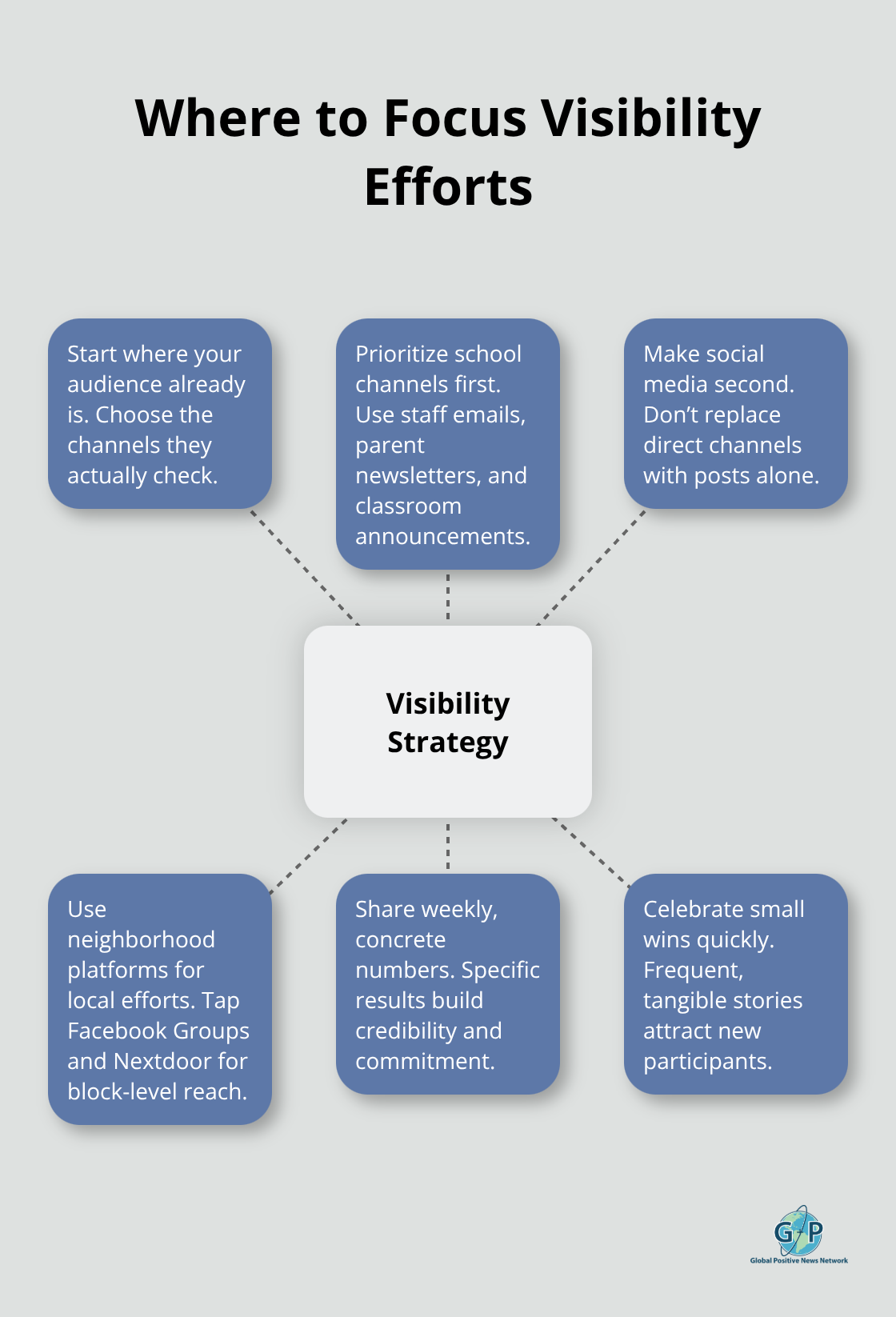
Social media comes second, not first. Schools that post only on Instagram while missing staff emails reach nobody who matters. For neighborhood kindness initiatives, neighborhood Facebook groups and Nextdoor reach people who care about local change.
Post weekly progress updates in these spaces, but keep them specific. Instead of saying the project is going well, report concrete numbers: We completed 47 acts of kindness this week, and five neighbors joined our effort. This specificity builds credibility and attracts more participants than vague enthusiasm. Research on volunteer motivation shows that people commit when they see tangible progress within the first four weeks. Share wins immediately and often, even small ones. A classroom where students identify one peer strength daily seems minor, but after two weeks you have 40 instances of peer recognition happening. That becomes your story.
Document Progress With Raw Materials
Documentation matters more than perfection. Take photos during activities, collect one-sentence quotes from participants explaining what changed, and record attendance numbers weekly. These raw materials become your proof that the project works. Create a simple monthly update using Google Slides with three sections: what you did, what changed, and what comes next. This format works for grant reports, team meetings, and social media content without requiring separate writing for each audience.
Adapt Based on Real Feedback
Adaptation separates projects that survive from those that fade. After two weeks, ask your core team and participants directly: What is working? What feels forced? What would make this better? Act on feedback within one week. If your weekly strength activity consistently draws ten people but your monthly community gathering draws three, shift your energy toward the weekly format instead of abandoning both.
If certain character strengths generate more conversation than others, feature those more often. Positivity projects that ignore feedback stay stuck at their launch size. Those that adjust based on what people actually respond to grow steadily. Track attendance rates, collect simple feedback through Google Forms, and measure observable changes in your specific community or classroom. After thirty days, you have real data showing whether your project resonates or needs adjustment.
Final Thoughts
Your positivity project succeeds when you focus on specificity over scale. Pick one community, set measurable goals, and launch with a small team of genuinely committed people. The projects that grow are those that start small, track real results, and adapt based on what actually works rather than what sounds good in theory. Your first ninety days matter more than your five-year plan because they prove the concept works and attract the people and resources needed to expand.
The ripple effect of a positivity project extends far beyond your immediate participants. When students in one classroom learn to spot character strengths in each other, they carry that skill home and use it with family members. When neighbors complete acts of kindness together, they build relationships that strengthen the entire community. When teachers implement strength-based language, they shift how students see themselves and each other.
After your pilot proves the concept, recruit additional volunteers to handle growth while you focus on quality. Formalize what works into simple systems that others can replicate. Share your playbook with neighboring schools or communities, and connect with Global Positive News Network to amplify your story and inspire others building positivity in their own spaces.