

Young people today face real obstacles-limited access to quality education, mental health challenges, and unclear career paths. Yet hopeful innovations are changing this landscape, from educational platforms reaching underserved communities to mentorship networks connecting youth with professionals.
At Global Positive News Network, we’ve identified the tools, programs, and strategies that are genuinely making a difference in young lives. This post explores what’s working and how you can support youth innovation in your own sphere.
What’s Actually Working to Help Youth Learn and Grow
Educational Platforms Reach Where Schools Cannot
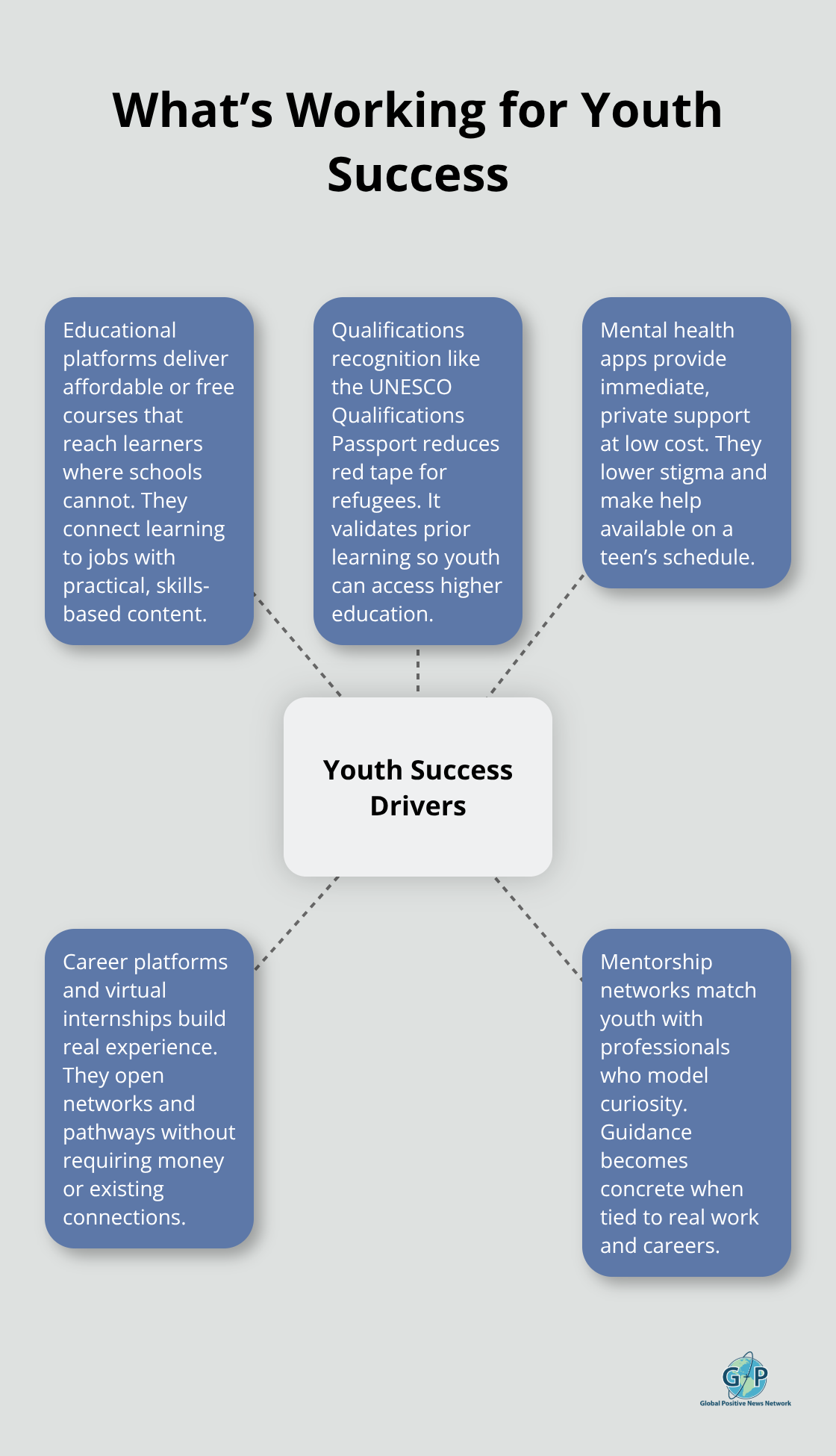
Educational technology platforms reach young people in places traditional schools cannot. UNESCO reports that approximately 272 million youth globally remain out of school, yet platforms like Khan Academy and Coursera fill gaps with affordable or free courses. In Chad, UNESCO-supported programs trained around 43,000 young people in non-formal basic education linked to actual trades, with the majority of beneficiaries being women. These programs deliver measurable results by connecting learning directly to employment opportunities.
The Qualifications Passport, another UNESCO initiative, helps refugees and vulnerable migrants recognize prior learning and access higher education, removing bureaucratic barriers that once made education impossible for displaced youth. What makes these tools effective is their focus on removing friction. When a young person in a rural area accesses a coding course without traveling to a city, or when a refugee’s previous education finally receives recognition, the barriers shrink dramatically.
Mental Health Apps Address Real Crises
Mental health and wellness apps address a real crisis that young people face. Young people experience unprecedented anxiety and depression, yet therapy remains inaccessible for many due to cost or stigma. Apps like Headspace, Calm, and Woebot offer immediate support at a fraction of traditional therapy costs. They reduce the shame barrier-a teenager can check in with a mental health resource privately, on their own schedule, without judgment or delay.
Career Development Tools Build Real Pathways
Career development platforms like LinkedIn Learning and Forage connect youth with professionals in their fields of interest. Forage offers free virtual internships where young people gain real experience without relying on unpaid internships that only privileged families can afford. These tools work because they are practical and accessible. A student from a low-income background can now build a portfolio, learn industry skills, and connect with mentors without needing existing connections or money.
The data supports this approach: platforms offering hands-on, real-world experience see significantly higher engagement and job placement rates than generic learning tools. What matters most is that these innovations treat youth not as passive consumers but as active builders of their own futures, offering them agency over their learning and career paths. This shift toward youth empowerment sets the stage for understanding how community programs and mentorship networks amplify these opportunities even further.
Youth Empowerment in Action
Leadership Skills Through Real Decision-Making Power
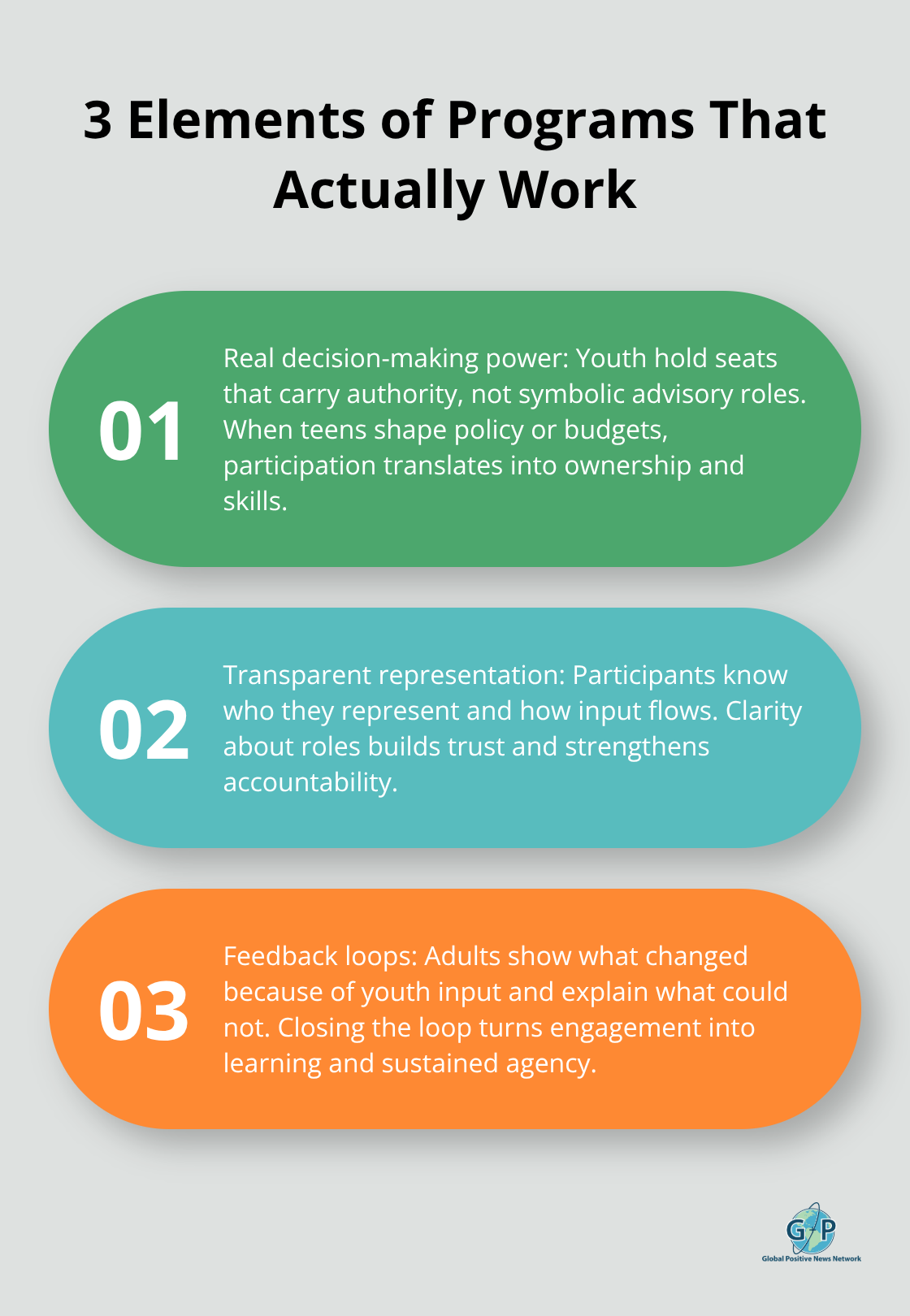
Community programs that build leadership skills operate on a simple principle: young people need structured opportunities to practice decision-making in low-stakes environments. The SDG 4 Youth & Student Network, established by UNESCO, places youth members directly on the SDG 4 High-Level Steering Committee, where they shape global education policy rather than simply observe it. This matters because only about one in three governments legally require youth engagement in education policymaking, according to the 2026 Global Education Monitoring Youth Report. Programs that work demand three concrete elements: youth hold actual decision-making power, not advisory roles; transparent representation so participants understand their influence; and clear feedback loops showing how their input changed outcomes. When these conditions exist, young people develop agency.
The 14th UNESCO Youth Forum in October 2025 brought together young people to influence education practice and policy directly, proving that youth lead effectively when given real authority.
Employment Pathways Through Social Enterprise
Social enterprises create employment pathways where traditional markets fail. In Chad, UNESCO-financed initiatives paired skills training with actual job opportunities, reaching around 43,000 young people in non-formal education linked to trades. The key difference between effective programs and those that disappear: they embed youth support into national systems rather than operating as isolated projects. This means training teachers, strengthening education management systems, and designing programs so they survive beyond initial funding. When youth support becomes part of how a country delivers education, young people benefit from sustained investment rather than temporary initiatives.
Mentorship That Models Curiosity
Mentorship networks function most effectively when they remove specific barriers rather than offer vague guidance. Forage connects young people with professionals through free virtual internships, eliminating the cost barrier that makes unpaid internships accessible only to privileged youth. Research from PISA 2022 data shows that intellectual curiosity boosts mathematics learning engagement in adolescents, with stronger effects for students from under-resourced backgrounds. Mentors amplify this by modeling curiosity itself and asking pedagogical questions that prompt thinking rather than providing answers. The most powerful mentorship programs pair youth with professionals who actively demonstrate how curiosity drives their own work, transforming abstract learning into concrete career possibility.
These real-world examples reveal a consistent pattern: youth thrive when adults shift from controlling their development to supporting their agency. The next section examines how parents and educators can actively create the conditions that allow this transformation to happen.
How Adults Can Spark Youth Innovation
Create Environments Where Failure Teaches
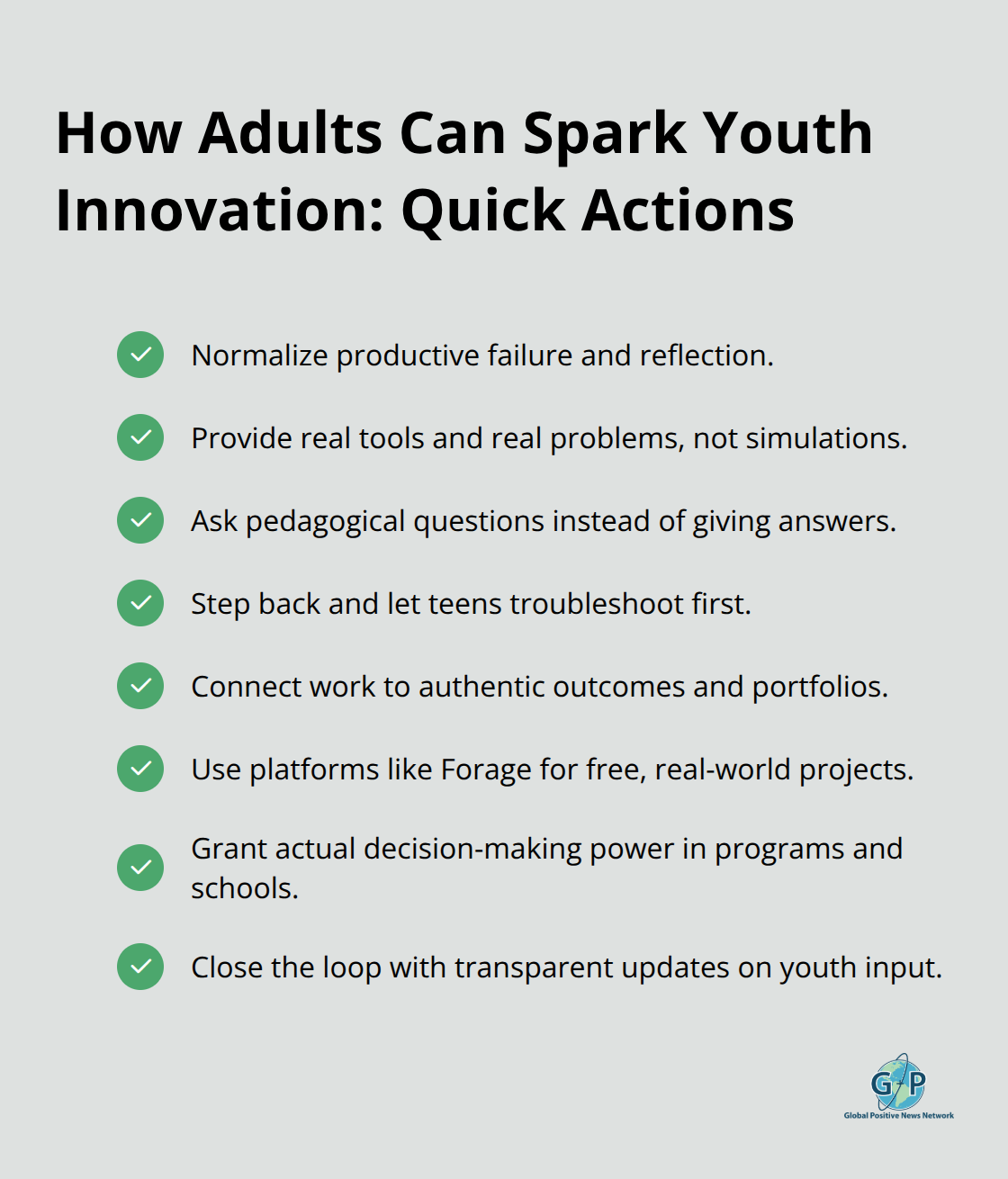
Adults must actively create environments where failure becomes information rather than shame. This means structuring activities so young people experiment with low consequences-a failed STEM project teaches more than a perfect one completed under adult direction. Research shows that young people tend to avoid taking risks that could lead to failure and often refrain from analyzing their failures, being unwilling to accept the reality of failing. The implication is stark: adults who ask pedagogical questions and model curiosity themselves produce far more growth than those who provide answers.
This requires deliberately stepping back. When a teenager builds a coding project, the adult’s role is to ask what they would test next, not to fix the code. When a young person faces a setback in a virtual internship, the conversation should focus on what they learned, not consolation. This mindset shift feels uncomfortable because it requires tolerating temporary inefficiency and frustration in service of genuine learning.
Provide Access to Real Tools and Real Problems
Adults must provide access to real tools and real problems, not simulations of them. Young people can tell the difference between a practice problem and work that actually matters. Platforms like Forage offer free virtual internships where students solve real company challenges, and this matters precisely because the stakes feel authentic. Research on Korean adolescents from PISA 2022 data shows that intellectual curiosity directly boosts mathematics learning engagement, with stronger effects for students from under-resourced backgrounds. When adults connect learning to genuine outcomes-a portfolio that attracts employers, a project that solves a community problem, research that contributes to something larger-curiosity activates differently than with abstract exercises.
Parents and educators should actively seek these real-world connections rather than defaulting to textbook exercises. A science project investigating soil quality in a local garden produces more engagement than a worksheet about soil composition. A young person designing a social media campaign for a nonprofit learns marketing principles faster than analyzing case studies.
Grant Youth Actual Decision-Making Power
Adults must grant youth actual decision-making power, not advisory roles. The 2026 Global Education Monitoring Youth Report found that only about one in three governments legally require youth engagement in education policy. This gap reveals how often adults consult young people without meaningfully implementing their input. Real innovation happens when a teenager sits on a school committee that allocates budget, when a young person shapes the curriculum they will study, when their voice directly changes outcomes.
This requires transparency about how youth input shaped decisions and clear communication about what could not be implemented and why. When these conditions exist-real failure tolerance, genuine tools and problems, actual decision-making power-young people develop the agency that transforms curiosity into sustained growth.
Final Thoughts
The hopeful innovations for youth we’ve explored throughout this post share one defining characteristic: they treat young people as agents of their own futures rather than problems to be solved. When educational platforms remove barriers, when mentorship networks connect youth with professionals, and when community programs grant real decision-making power, something shifts. Young people stop waiting for permission and start building.
This transformation matters because the stakes are high-approximately 272 million youth globally remain out of school, facing limited access to quality education and unclear career paths. Yet the solutions already exist and operate in classrooms, on platforms, and in communities right now. Parents can shift from controlling their child’s learning to asking questions that spark curiosity, educators can create space for failure and provide access to real problems that matter, and community members can mentor young people and model how intellectual curiosity drives meaningful work.
These actions compound across communities and generations. When one adult grants a teenager genuine decision-making power, that young person develops agency that extends far beyond that single moment. Visit Global Positive News Network to explore more stories of positive change and join a community committed to spreading hope for young people everywhere.