

Most people know that gratitude matters, but few actually practice it consistently. A daily positivity journal transforms that knowledge into real change by giving you a structured way to reflect on what’s working in your life.
At Global Positive News Network, we’ve seen how writing down positive moments rewires your thinking patterns and strengthens your mental resilience. This guide shows you exactly how to start and maintain the habit.
Why Daily Positivity Journaling Actually Works
Gratitude journaling delivers measurable results because it forces your brain to process emotions differently than thinking alone. Research from Lyubomirsky, King, and Diener shows that gratitude practice links to higher wellbeing and may influence physical health indicators like cardiovascular health and immune function. When you write about what you’re grateful for, you activate your left hemisphere, which handles analytical thinking while you explore emotions simultaneously. This dual processing makes writing more powerful than simply reflecting in your head. A study by Pennebaker and Beall found that expressive writing about meaningful emotional experiences for 15 to 20 minutes reduced doctor visits over six months and improved mood. The effect isn’t small or theoretical; people who journal consistently report tangible shifts in how they handle stress and setbacks.
Your Brain Rewires Through Regular Writing
Neuroscience evidence shows regular writing rewires your brain through strengthening prefrontal cortex connections and improving executive function. Each time you journal daily, you literally build better neural pathways for emotional regulation and decision-making. Affect labeling-the practice of naming emotions in writing-reduces amygdala activation and emotional reactivity, according to research from UCLA by Lieberman and colleagues. This means when you write down that you felt frustrated at work or anxious about a deadline, your brain actually calms down during processing. Daily practice enhances emotional vocabulary and granularity, helping you distinguish subtle emotional states over time instead of lumping everything into vague categories like stressed or tired.

Dr. James Pennebaker’s longitudinal findings indicate that 30 or more days of consistent journaling improve mood stability, self-awareness, values clarity, decision-making, and resilience.
Consistency Trumps Duration
Daily reflection for 10 to 15 minutes produces meaningful improvements in mood, stress management, and goal achievement compared with sporadic writing. A Harvard Business School study by Di Stefano and colleagues found that daily reflection practice lasting 5 to 15 minutes boosts performance and strengthens emotional regulation. The key is showing up regularly rather than writing lengthy entries occasionally. Short daily commitment makes positivity journaling feasible for busy mornings and fits into real life without requiring hours of your time. When you write without editing-allowing stream-of-consciousness and fragments-the benefits remain the same because grammatical quality doesn’t predict the gains. What matters is that you engage with your thoughts and feelings consistently enough for your brain to rewire its default patterns.
Now that you understand why this practice works at a neurological level, the next step is learning how to actually start-and what format works best for your life.
How to Start Your Positivity Journal Today
The biggest mistake people make is waiting for the perfect journal or the perfect moment. Start with what you have right now. If you own a notebook, use it. If you prefer typing, open a document on your computer or phone. Consistency matters far more than whether you write by hand or on a keyboard, so the medium that you’ll actually use daily is the right choice. Handwriting does offer unique cognitive benefits because it engages different neural pathways than typing, but if handwriting feels like a barrier, type instead. Apps like Day One, Reflectly, and Five Minute Journal boost consistency because they send reminders and sync across devices, which removes friction from your routine. Google Docs works equally well if you prefer simplicity and easy archiving. The format question isn’t about finding the optimal tool; it’s about removing obstacles between you and the page.
Choose Your Time and Anchor It to Habit
Morning journaling sets a positive trajectory for your entire day because you prime your brain to notice opportunities and interpret events more constructively. Spend 10 to 15 minutes after you wake up, before checking your phone or email. If morning doesn’t fit your schedule, evening reflection works well for processing a full day and consolidating memories into long-term storage. Some people journal during their commute using voice-to-text, which takes about 5 minutes and maintains consistency without adding screen time. The specific time matters less than pairing journaling with an existing habit. Attach it to something you already do daily, like drinking your morning coffee or brushing your teeth before bed. This habit-stacking approach, backed by behavioral research, makes the practice automatic within three to four weeks. Set a timer for your first week to keep yourself accountable and prevent journaling from expanding beyond its intended duration.
Answer Three Questions That Drive Real Change
Your first week should focus on three straightforward prompts that require no overthinking. Ask yourself: What happened today that I’m grateful for, no matter how small? What did I learn today about myself or the world? What’s one small action I can take tomorrow?
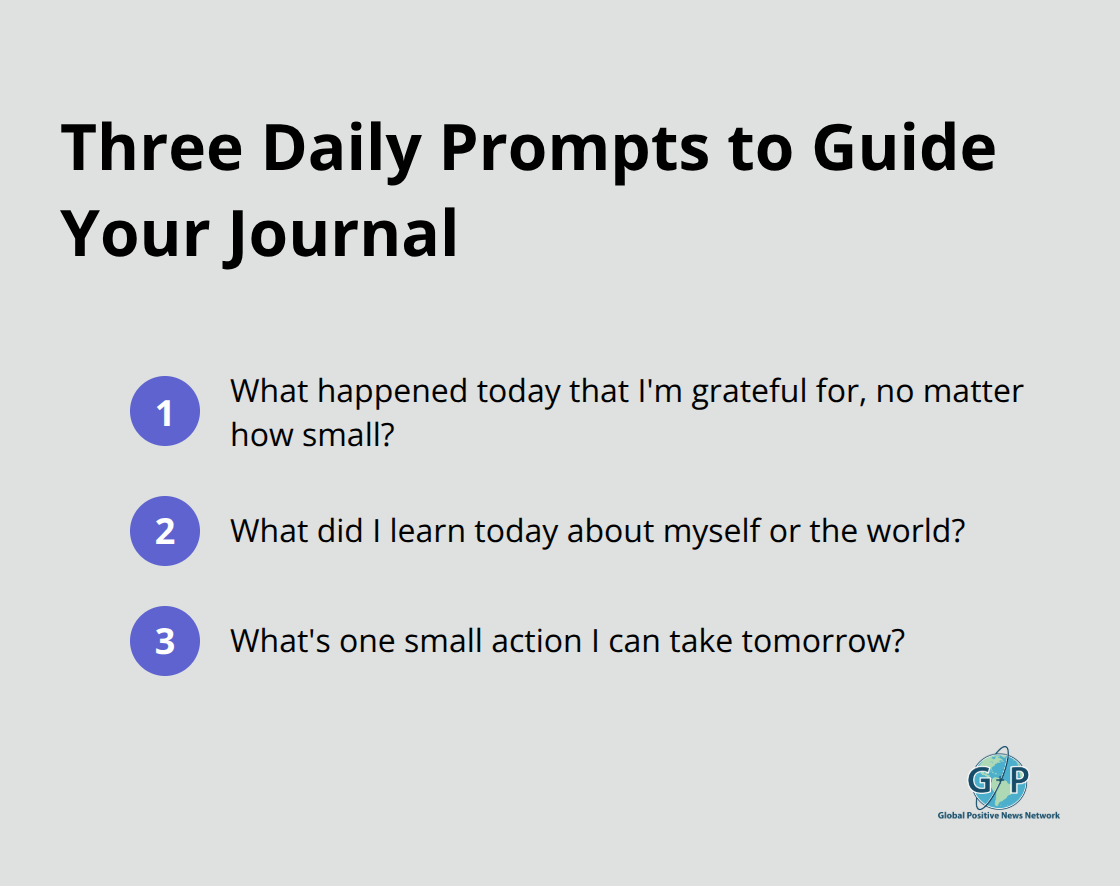
These three questions activate the neural pathways that research shows improve mood and emotional regulation without overwhelming you with endless options. Write answers in three to five sentences per question. Imperfect, messy entries count just as much as polished ones. After seven consecutive days, you’ll notice patterns emerging about what genuinely lifts your mood versus what you think should make you grateful. That observation is where real change begins, and it happens naturally through repetition rather than analysis.
Track What Emerges in Your First Week
Once you complete your first seven days, patterns surface that reveal your authentic sources of wellbeing. You might discover that small wins at work matter more to you than you realized, or that time with specific people consistently boosts your mood. These insights (which emerge from your own data, not from generic advice) guide your next phase of journaling. You’ll start to notice which prompts resonate and which ones feel forced, allowing you to customize your practice. This personalization transforms journaling from a task into a conversation with yourself that actually reflects your life.
The foundation is now in place. With your format chosen, your time blocked, and your first week complete, you’re ready to move beyond basic prompts and build a sustainable rhythm that fits your real schedule and personality.
Building Momentum Without Burnout
The transition from your first week to month two determines whether journaling becomes a permanent habit or fades into another abandoned practice. Morning journaling remains the strongest choice because it sets your mental frame before daily stressors arrive, but research shows timing flexibility matters less than consistency. A study by Di Stefano at Harvard Business School found that people who reflected at the same time each day showed 22.8% performance gains, regardless of whether that time was 6 AM or 6 PM. The critical factor is anchoring your journaling to an existing routine so your brain treats it as non-negotiable.

If you currently drink coffee every morning, your journal sits beside the cup. If you shower at night, you write immediately after.
This removes the friction of deciding when to journal, which is where most people derail. Set a phone alarm for the first month specifically labeled Journal Time, not as a reminder to journal but as a signal that this 10 to 15 minute block is protected. After 30 days, the behavior becomes automatic enough that the alarm becomes unnecessary, though some people keep it indefinitely because the external trigger prevents backsliding during stressful weeks.
Navigate the Critical Week Two Slump
Resistance typically peaks around day 14, when the novelty wears off but the habit hasn’t solidified yet. This is the exact moment people convince themselves they’re too busy or that journaling isn’t working. The solution is ruthlessly honest: if you miss a single day, you write the next day without self-judgment. Research on habit formation shows that occasional misses don’t destroy a habit, but two consecutive days off creates a pattern your brain interprets as permission to stop.
Pennebaker’s longitudinal research indicates that the real benefits emerge after 30 days of consistent practice, not before, which means weeks two and three feel unrewarding even though your brain is rewiring itself neurologically. During this phase, shift your focus from how you feel to what you notice. Are you remembering small positive moments more easily? Did you catch yourself interpreting a setback differently than usual? These micro-shifts precede the mood improvements, so tracking them keeps motivation alive when feelings haven’t shifted yet. Write these observations directly into your journal as a separate line: I noticed I remembered the coffee conversation from this morning without prompting. This meta-awareness of change happening reinforces the behavior even when the emotional payoff hasn’t arrived.
Track Progress Without Obsession
Progress tracking works best when you measure what actually matters rather than imposing external metrics. A simple checkmark system on a calendar shows your streak, which activates the same reward circuitry that makes habits stick, but don’t let the streak become the goal. If you miss a day, you cross it off and start again without shame. Apps like Daylio and Habitica visualize progress and award points, which appeals to certain personality types but can backfire if the game becomes more important than the reflection itself.
The more valuable tracking method is rereading your entries weekly, which takes about 10 minutes and reveals patterns that raw data cannot. After two weeks of writing, you’ll spot what genuinely lifts your mood versus what you thought should. After a month, you’ll see recurring obstacles and how your thinking about them shifts. This pattern recognition is where journaling compounds its benefits. You’re not just processing emotions in the moment; you’re building a personal dataset that teaches you how your mind actually works, not how you assume it works.
Evolve Your Practice When It Stalls
If you reach week four and feel like you’re repeating the same prompts and observations, your practice needs evolution, not abandonment. This is the point where many people quit because they mistake plateauing for failure. Instead, add one new element to your routine. If you’ve been using the same three questions, introduce a fourth: What assumption did I make today that turned out wrong? Or: Who did I help, even in a small way? One new prompt per week prevents staleness without overwhelming your practice.
Another adjustment is changing your medium. If you’ve been typing, try handwriting for one week to engage different neural pathways. If you journal in the morning, experiment with evening reflection for three days to see if different timing surfaces different insights. These small shifts reactivate the novelty that sustains habit formation. The most powerful adjustment is inviting accountability without making it public. Tell one person you trust that you’re journaling daily and that you’ll report your streak to them weekly. This external commitment strengthens the internal one, which is why people who journal with a partner or in a group maintain the habit longer than solo practitioners. Your journaling should feel like a conversation with yourself, not a performance for an imaginary audience.
Final Thoughts
Daily positivity journaling works because it transforms abstract knowledge about gratitude into concrete neural change. You’ve learned that 10 to 15 minutes of consistent writing rewires your brain, reduces emotional reactivity, and builds resilience through affect labeling and pattern recognition. The science is clear: expressive writing reduces doctor visits, improves mood stability, and strengthens decision-making when practiced for 30 or more consecutive days.
Your next step is simple. Choose your format today, anchor journaling to an existing habit, and commit to the three-question framework for your first week. Don’t wait for the perfect journal or the ideal moment-the medium you’ll actually use daily is the right choice, whether that’s a notebook, app, or document. Set your timer for 10 to 15 minutes, write without editing, and trust that your brain rewires itself even when you don’t feel immediate results.
As you deepen your practice beyond the first month, revisit your entries weekly to spot patterns about what genuinely lifts your mood. Introduce new prompts when your routine feels stale, and consider sharing your streak with someone you trust to strengthen accountability. Your daily positivity journal becomes a personal dataset that teaches you how your mind actually works, not how you assume it works, so visit Global Positive News Network to explore resources that support your journey toward greater wellbeing and purpose.