

Tough times test us in ways we don’t expect. Most people think resilience means pushing through without feeling anything, but that’s a myth.
At Global Positive News Network, we’ve found that emotional resilience strategies work best when they’re grounded in real techniques, not wishful thinking. This guide shows you exactly how to build resilience that actually holds up when life gets hard.
What Emotional Resilience Actually Is
The Real Definition of Emotional Resilience
Resilience is the process and outcome of successfully adapting to difficult or challenging life experiences, especially through mental, emotional, and behavioral adjustment. It’s not about suppressing feelings or pretending everything is fine. Research from the American Psychological Association shows that resilient people tolerate emotional distress like anxiety and sadness better and rebound more quickly. The key difference is this: resilience lets you feel what you’re feeling while still moving forward with your life.
Yale Medicine’s research involving over 4,000 health care workers and their families identified that resilience depends as much on external factors-your environment and support system-as it does on your inner traits. This means you can strengthen resilience regardless of your starting point.
Resilience vs. Toxic Positivity
One critical distinction separates resilience from toxic positivity. Staying positive often means forcing yourself to see the bright side before you’ve processed the pain. Resilience means accepting what happened, acknowledging how it affects you, and then deciding what to do next. The difference matters because denial, while it might shield you temporarily, actually hampers your ability to adapt and solve problems if it persists.
When you practice acceptance instead, you focus on what you can control and let go of what you cannot. Yale’s town halls with stressed workers showed that people who practiced this acceptance-taking things one day at a time and distinguishing between controllable and uncontrollable factors-experienced measurable improvements in their ability to cope.
The Skills Behind Faster Recovery
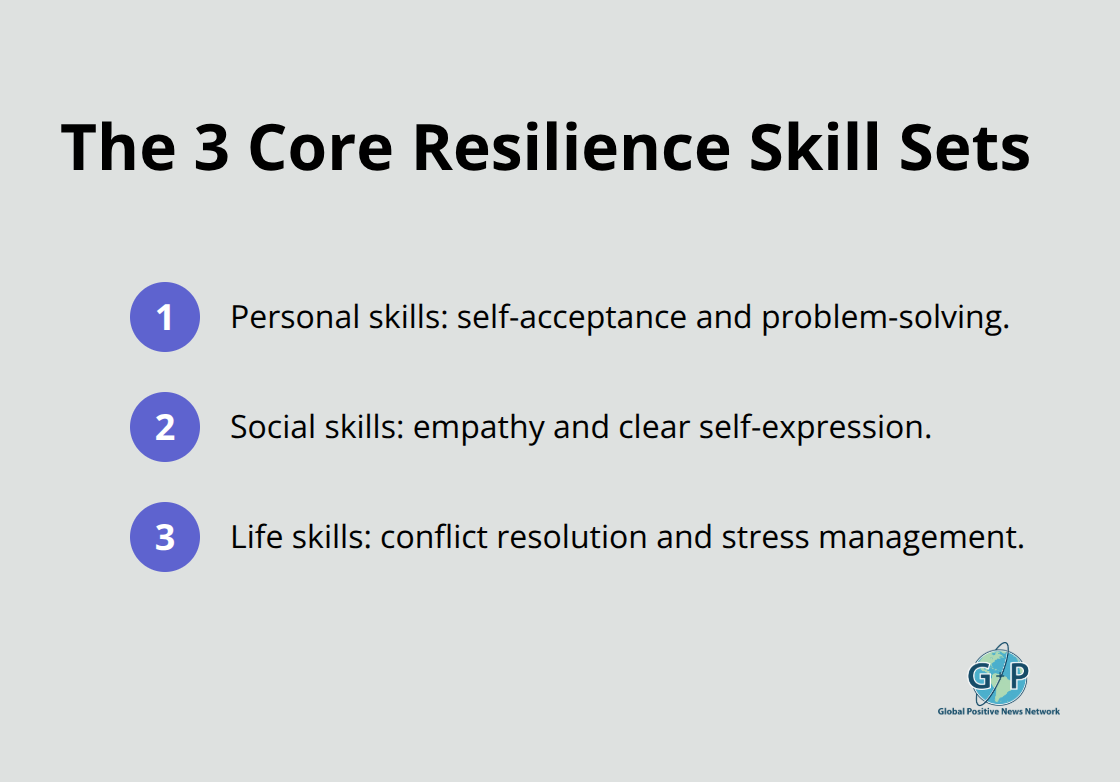
Why some people bounce back faster comes down to specific skills they’ve developed, not innate talent. Dr. Harry Barry identifies three core skill sets: personal skills like self-acceptance and problem-solving, social skills like empathy and self-expression, and life skills like conflict resolution and stress management. The American Psychological Association’s research confirms that resilience is trainable. Regular practice in cognitive reappraisal-reframing how you interpret difficult situations-strengthens emotional regulation and reduces stress responses.
Physical factors matter too. The CDC recommends about 150 minutes of moderate-intensity activity weekly, which is consistently linked to lower anxiety and depression. The NIH emphasizes that seven to nine hours of sleep per night supports emotional regulation, while poor sleep heightens stress and irritability. Social connection acts as a buffer against stress, lowering your risk of anxiety and depression.
Tools That Work in the Moment
One practical tool that accelerates resilience is grounding techniques. When acute stress peaks, paced breathing at four to six breaths per minute reduces your physiological arousal within minutes, according to the Mayo Clinic. These aren’t abstract concepts-they’re measurable, learnable skills you can practice starting today. The specific strategies you’ll use to build these skills depend on your situation, which is why the next section walks you through the most effective approaches that work across different types of tough times.
Three Strategies That Actually Stop the Stress Spiral
Build Connections That Matter
Strong relationships act as your first line of defense when stress peaks, and the research leaves no room for doubt. Strong social support buffers stress and lowers your risk of anxiety and depression. Yale Medicine’s study of over 4,000 health care workers and their families found that those who actively built social connections experienced measurable improvements in their ability to cope with crisis. Face-to-face contact works best because human connection significantly boosts mood and resilience more than text or email ever will. If in-person contact isn’t possible, phone calls and video conversations maintain social support effectively. You can expand your network proactively through group activities, community gatherings, or language-specific forums that match your background. Equally important: you must recognize which relationships drain your energy rather than restore it, and limit time with people who magnify your problems instead of helping you solve them.
Use Grounding Techniques to Reset Your Nervous System
Grounding techniques work because they interrupt your nervous system’s stress response in real time. When acute stress peaks, paced breathing at four to six breaths per minute reduces physiological arousal according to research. You can practice this right now by breathing in for four counts, holding for four, and exhaling for six. This method produces immediate, measurable results rather than vague promises about feeling better eventually.
Protect Your Mental Energy Through Boundaries
The NIH emphasizes that you must set boundaries to protect your mental energy and prevent chronic stress accumulation. This means saying no to commitments that overload you, limiting your exposure to distressing news and social media, and maintaining consistent sleep and eating schedules. Yale’s research showed that people who set work boundaries through flexible scheduling and regular emotional check-ins experienced significant relief from fatigue and anxiety. Self-care routines like outdoor time, exercise, and mindfulness practices function as resilience infrastructure, not luxuries.
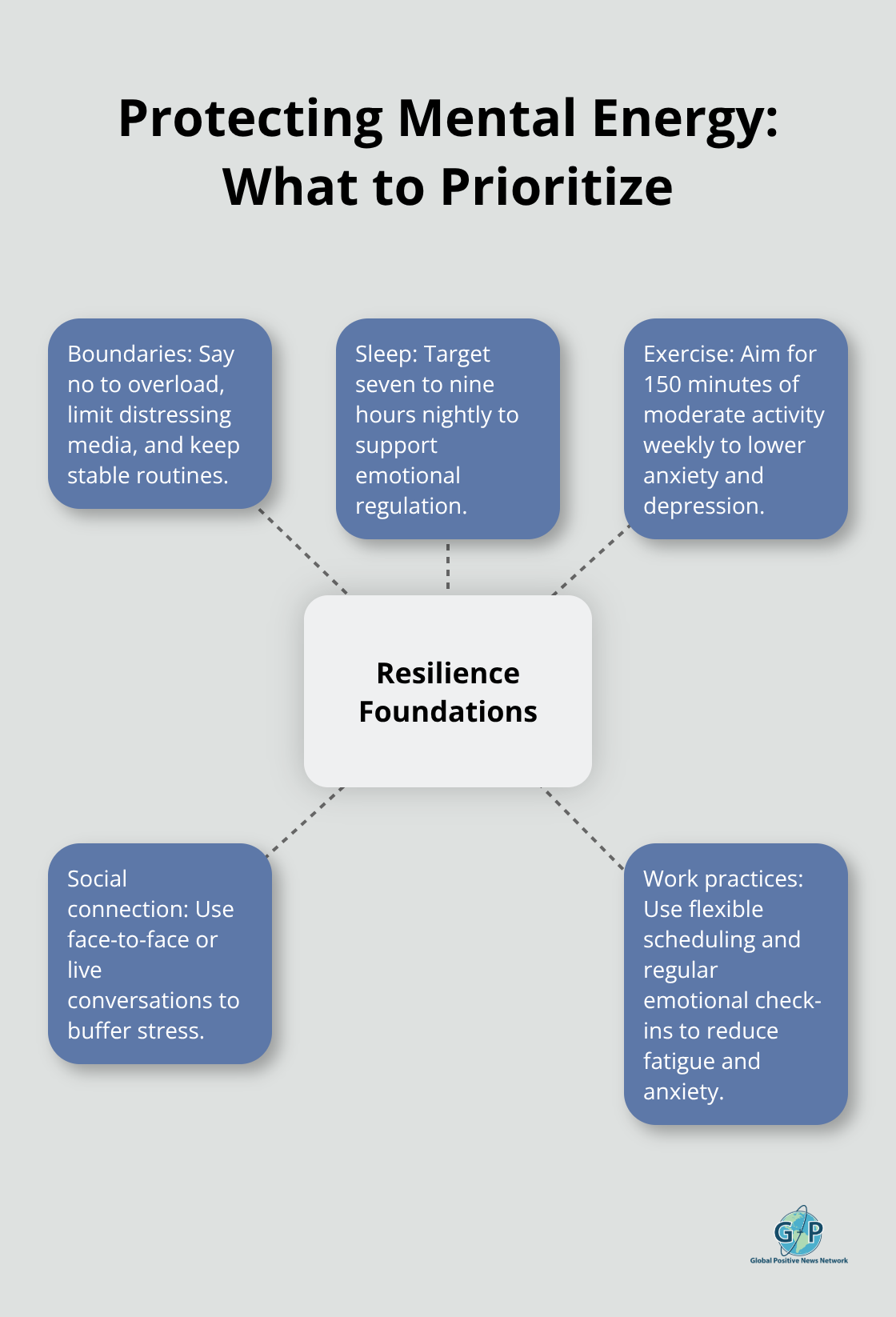
The CDC recommends 150 minutes of moderate-intensity activity weekly, which is consistently linked to lower anxiety and depression. You should target seven to nine hours of sleep per night, as the NIH confirms that adequate sleep supports emotional regulation while poor sleep heightens stress and irritability. These physical foundations matter because they determine whether your mind can access the emotional flexibility you need when challenges arrive.
How Resilience Works When It Matters Most
Build Your Network Before Crisis Hits
During a genuine crisis, the strategies that work are the ones you’ve already practiced. Yale Medicine’s research revealed a critical pattern: people who had established social routines before stress peaked recovered faster than those who tried to build connections after crisis hit. This means your network isn’t something you construct when you need it-you construct it now, in normal times, so it’s available when everything falls apart. The workers who experienced the most dramatic improvements were those who scheduled regular check-ins with colleagues and friends before burnout set in, not after. When crisis arrives, you lack the mental energy to initiate new relationships or repair damaged ones, so the foundation matters enormously.
Measure Your Progress With Concrete Tools
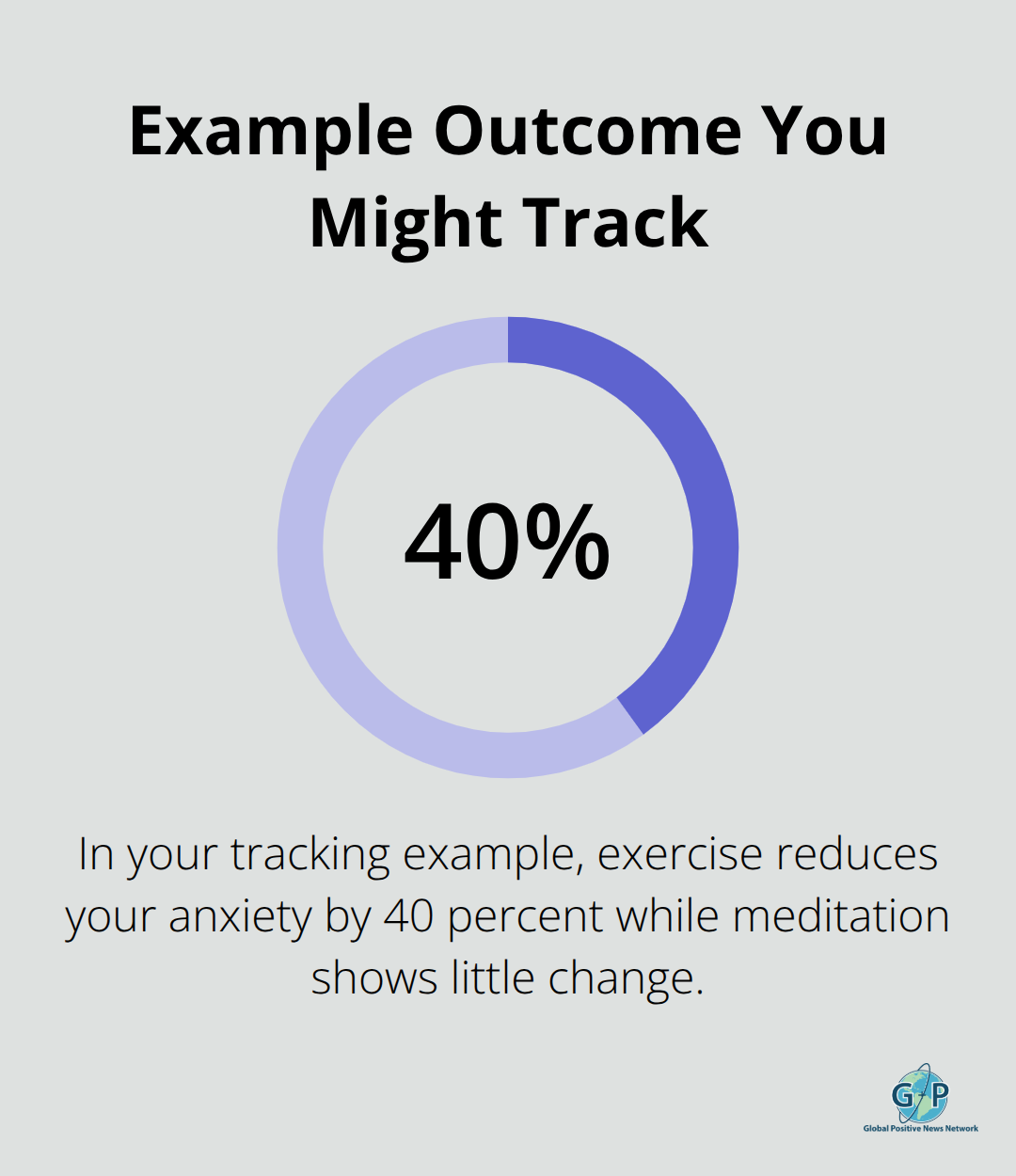
Real-world application requires specific tools, not motivation. The Perceived Stress Scale gives you a concrete way to measure whether your current strategies actually work or whether you need to adjust your approach. You score your stress level before implementing changes, then track it weekly to see measurable progress. This removes guesswork from resilience building. Journaling about your mood, triggers, and which coping strategies produced results helps you identify patterns that generic advice misses-you might discover that exercise reduces your anxiety by 40 percent while meditation barely moves the needle, or vice versa.
The CDC’s recommendation of 150 minutes of moderate-intensity activity weekly works because it’s specific enough to track and because research consistently links it to lower anxiety and depression. Set a target that matches your life, whether that’s three 50-minute sessions or six 25-minute walks, then measure whether you hit it. Tools like habit-tracking apps transform resilience from an abstract goal into a measurable system. The NIH confirms that seven to nine hours of sleep per night supports emotional regulation, so tracking your sleep duration reveals whether poor sleep amplifies your stress response. These concrete metrics replace vague promises with evidence you can see yourself.
Train Your Nervous System Through Daily Practice
Small daily habits compound because they train your nervous system to respond differently to stress. Paced breathing at four to six breaths per minute takes three minutes and produces measurable physiological changes according to Mayo Clinic research, yet most people never practice it until crisis forces them to. Practicing it daily for two weeks rewires your nervous system so that when acute stress arrives, your body already knows how to calm itself. Setting one boundary per week-saying no to one commitment, turning off notifications after 7 p.m., or scheduling one meal without screens-accumulates into a resilience infrastructure that protects your mental energy.
Harvard Health Publishing emphasizes that establishing a regular routine and predictable daily structure reduces anxiety during uncertainty, which means your morning schedule and evening wind-down routine aren’t luxuries but essential resilience tools. The difference between people who maintain resilience through long stress periods and those who collapse often comes down to this: the resilient ones protected their sleep, their exercise, and their social time through non-negotiable daily habits, treating these as medical necessities rather than optional self-care.
Final Thoughts
Emotional resilience strategies work because they rest on measurable practices, not motivation. You establish your support network before crisis hits, practice grounding techniques until they become automatic, and protect your mental energy through consistent boundaries. The CDC’s 150 minutes of weekly exercise, the NIH’s seven to nine hours of sleep, and paced breathing at four to six breaths per minute all produce measurable results because they’re grounded in physiology, not wishful thinking.
Starting your resilience journey today means choosing one concrete action, not overhauling your entire life. You pick one boundary to set this week, schedule one social connection, or practice paced breathing for three minutes daily. You track it, measure whether it works, and adjust based on what the data shows rather than what generic advice suggests.
Visit Global Positive News Network to explore stories of people who’ve built resilience through real challenges and discover resources that support your journey. Your tough times don’t define your resilience-your daily choices do.