

Self-doubt holds back millions of people from reaching their potential. At Global Positive News Network, we believe daily affirmations for beginners offer a straightforward path to building genuine confidence.
This guide walks you through proven techniques, real affirmations you can start using today, and practical routines that actually stick.
What Affirmations Actually Do to Your Brain
Affirmations work because they interrupt the cycle of rumination that keeps people stuck. Research shows that subclinical depression rumination patterns involve rumination as an important cognitive risk factor for onset and relapse of depression. Healthy participants, by contrast, treated threats as temporary and solvable.
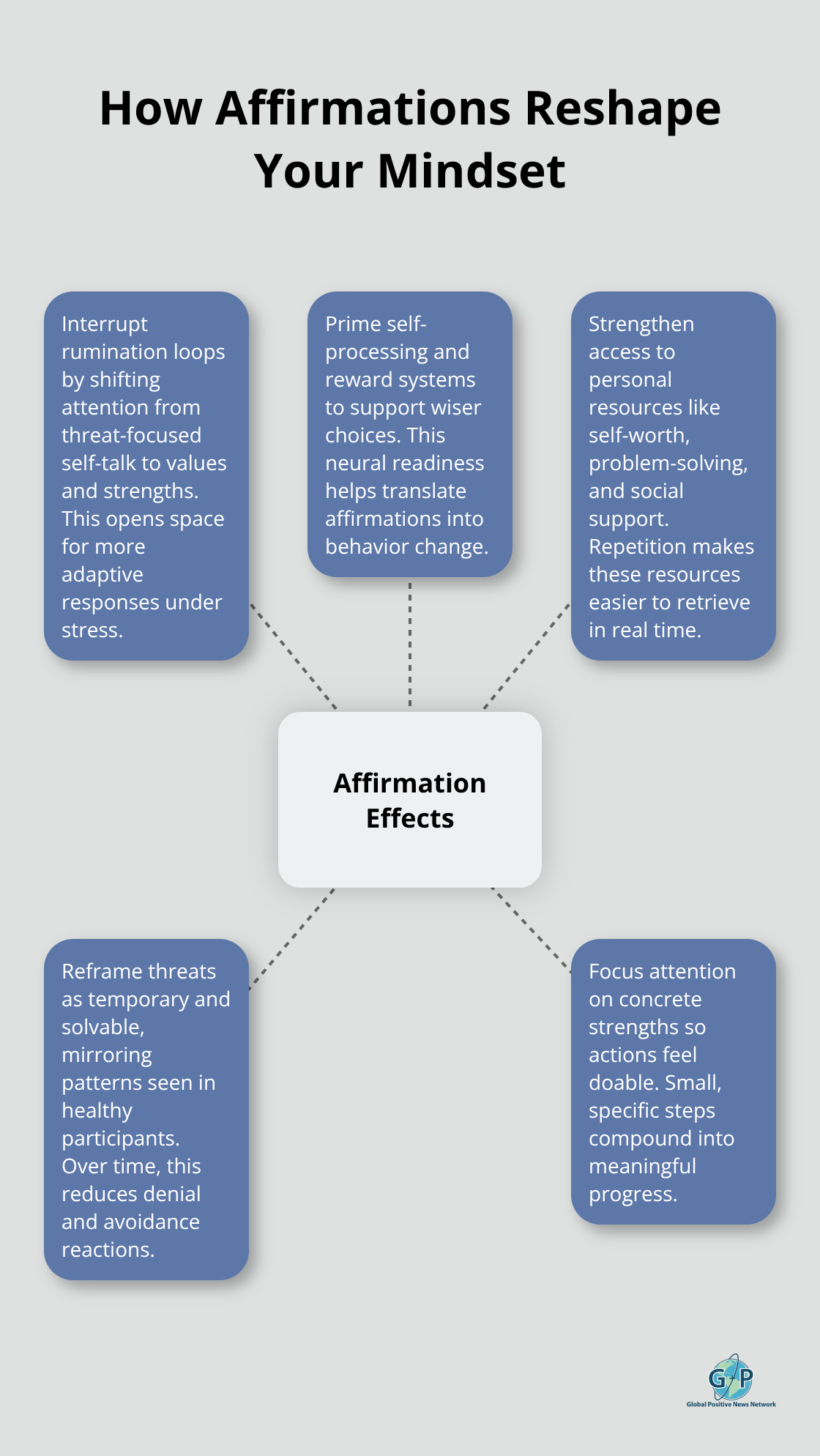
Neuroimaging research published in PNAS by Falk and colleagues shows that self-affirmation activates brain regions involved in self-processing and reward, which means your brain literally responds to positive self-statements by strengthening neural pathways that support better decisions and behavior change. When you repeat an affirmation, you train your brain to access self-worth and personal resources more readily, the same way healthy people naturally do.
Why Negative Thinking Patterns Stick
Most people don’t realize that rumination and negative self-talk aren’t character flaws-they’re learned patterns your brain defaults to under stress. Subclinically depressed individuals showed poor awareness of their own strengths and resources, which meant they couldn’t tap into them when threats appeared. Affirmations work because they rebuild that awareness. Research from Creswell and colleagues demonstrates that self-affirmation interventions reduce rumination by promoting reflection on personal values or positive self-attributes, essentially giving your brain alternative pathways to follow. The key is specificity: generic affirmations like “I am confident” do little because your brain recognizes them as hollow. Affirmations tied to actual strengths or values-“I handle financial pressure by making one small decision at a time”-work because they’re grounded in reality and give your brain something concrete to reinforce.
The Practical Difference Between Healthy and Stuck Mindsets
Healthy participants reframed adversity as growth and accessed positive cognitions immediately, while subclinical participants defaulted to denial and avoidance. This difference isn’t innate-it’s a skill you build through repetition. Affirmations close that gap by training you to notice threats earlier, respond with creativity instead of panic, and remember your actual resources. Subclinical participants commonly experienced decreased self-esteem and maladaptive thinking patterns, but these patterns reversed when they actively affirmed personal strengths. A daily practice is enough to start; consistency matters far more than duration. The most effective affirmations are tailored to your current challenges, not generic Pinterest quotes. If you struggle with money anxiety, an affirmation about financial capability works better than a generic self-worth statement. Your brain learns what you repeatedly tell it, and affirmations accelerate that learning by focusing your attention on evidence of your own capability.
How Specificity Changes Everything
Vague affirmations fail because your brain demands evidence. When you tell yourself something concrete-tied to a real strength or a specific situation you face-your mind accepts it and builds on it. Subclinical participants in the research lacked access to their own resources, but affirmations that name those resources (purpose, kindness, relationships, capability) activate them. The difference between “I am worthy” and “I am worthy of the effort I put into my relationships” is the difference between a statement your brain dismisses and one it acts on. Affirmations work best when they reflect your actual life and experiences rather than aspirational fantasies. This is why the next section focuses on affirmations you can customize to your real challenges-because generic statements won’t stick, but affirmations rooted in your specific situation will transform how you respond to pressure.
Affirmations That Match Your Real Struggles
Self-doubt stems from specific situations, not abstract weakness. A person anxious about money needs different language than someone wrestling with relationship fears. Research from Tiwari and colleagues in BMC Psychiatry 2025 found that subclinically depressed individuals reported threats most often in health, financial conditions, employment, and relationships. This matters because your affirmations must address your actual pressure points. If finances trigger rumination, a generic statement like “I am worthy” accomplishes nothing. Instead, use “I handle financial pressure by making one small decision at a time” or “I can address money stress without panic.” These affirmations work because they name the specific threat and pair it with a concrete capability.
Identify Your Pressure Points First
Start by identifying which domain drains your confidence most. Write down the specific situations that trigger rumination or self-doubt for you. Then craft language that acknowledges the challenge while asserting your capacity to navigate it.
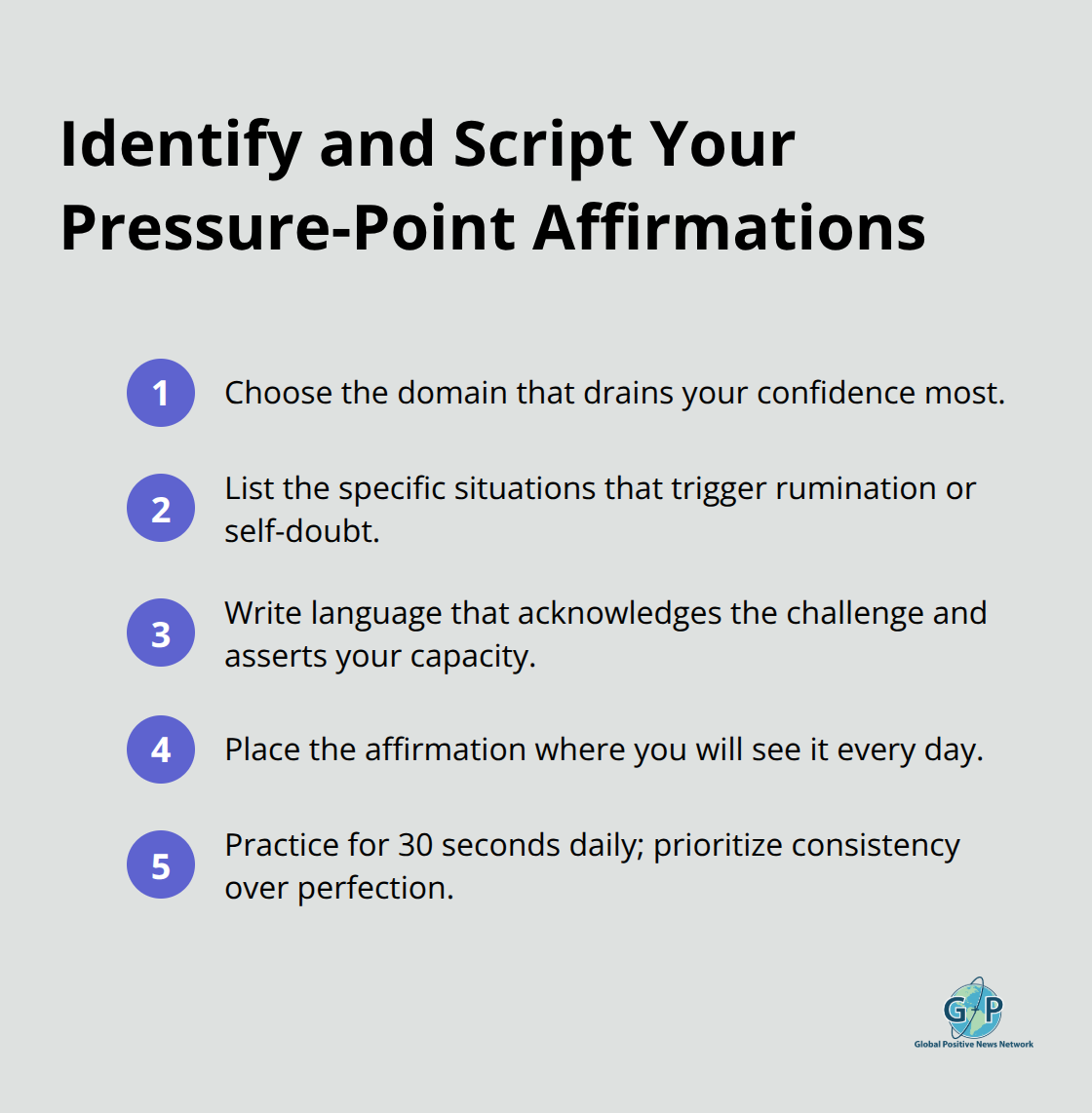
Place this affirmation where you see it daily-your phone notes app, a sticky note on your bathroom mirror, or your car dashboard. The 30-second daily practice is enough; what matters is consistency over perfection.
Build Confidence From What You Actually Do Well
Healthy individuals in the same research accessed positive cognitions and self-resources including purpose, close relationships, kindness, and community service. These aren’t personality traits you either have or lack; they’re evidence of real capability you already demonstrate. Your affirmations should name them explicitly. If you’ve maintained a friendship through conflict, say “I show up for people I care about.” If you’ve completed a difficult project at work, say “I solve complex problems with focus and creativity.” If you’ve supported someone through hardship, say “I have the strength to help others while protecting my own wellbeing.”
These statements work because they’re grounded in behavior you’ve already proven. The research shows that subclinical participants lacked awareness of their own strengths, which meant they couldn’t access them under pressure. Your job is to make those strengths visible and retrievable. Write down three concrete things you’ve accomplished or qualities you’ve demonstrated in the past month. Convert each into a present-tense affirmation that names the specific capability. Use these three affirmations for one full week before rotating in new ones. Rotation prevents your brain from dismissing them as stale repetition.
Practice When Pressure Is Lowest
Affirmations work best when you practice them before crisis arrives, not during it. A person who waits until anxiety peaks to start affirming self-worth fights an uphill battle. Instead, pair your affirmations with an existing routine when your mind is calm. Morning routines work well-say your affirmations while brushing your teeth or drinking coffee. The brain becomes more receptive to new messaging when stress hormones aren’t flooding your system. If mornings don’t fit your life, choose another anchor: lunch break, your commute, or the moment you sit at your desk.
The specific time matters far less than consistency. One affirmation repeated daily for a month builds stronger neural pathways than five affirmations repeated sporadically. Track your practice with a simple check mark on a calendar or a note in your phone. After about a month, check in on whether your rumination patterns have shifted or whether you access your strengths more readily under pressure.
Adjust Language to Match How You Actually Talk
If the affirmations still don’t feel authentic, adjust the language to match how you actually talk. If cheery statements feel forced, start with neutral affirmations like “My challenges are temporary and I can find a way through” before gradually shifting toward stronger positivity. Your brain accepts language that sounds like you far more readily than corporate-speak. This personalization transforms affirmations from abstract exercises into tools that your mind actually uses when pressure arrives.
Building Your Affirmation Practice Into Daily Life
Anchor Affirmations to Habits You Already Have
The difference between affirmations that transform your mindset and affirmations that fade into background noise is consistency in affirmation practice, not complexity. Most people fail at affirmation routines because they treat them as separate tasks rather than anchoring them to existing habits. The most practical approach is to attach your affirmations to something you already do every single day-brushing your teeth, making coffee, sitting at your desk, or your commute. When you practice affirmations during these moments, your brain doesn’t have to remember a new task; it simply adds affirmations to an existing neural groove.
Researchers from Creswell and colleagues found that self-affirmation interventions reduce rumination most effectively when practiced consistently over time, which means a 30-second routine you actually maintain beats a 10-minute routine you abandon after two weeks. The timing itself matters less than the anchor. If you’re a morning person, practice while brushing your teeth or drinking your first coffee. If mornings feel rushed, anchor affirmations to your lunch break, your commute, or the moment you close your laptop at the end of the workday.
Choose Times When Your Mind Is Calm
The key is selecting a time when your mind is calm and not flooded with stress hormones-this is when your brain becomes most receptive to new messaging. Your brain rejects corporate-speak but accepts language that mirrors your actual voice. If upbeat statements feel false, start with neutral language like “My challenges are temporary and I can find a way through” before gradually shifting toward stronger positivity.
Track your practice with a simple calendar check mark or phone note. After about one month, assess whether you notice shifts in how quickly you access your strengths under pressure or whether rumination patterns have shortened. If your affirmations still feel inauthentic after a few weeks, adjust the wording to sound like you rather than forcing cheeriness into language that doesn’t match how you actually talk.
Select Tools That Eliminate Friction
Tools matter only insofar as they remove friction from your practice. Some people succeed with sticky notes on their bathroom mirror or dashboard. Others use their phone’s Notes app to store affirmations and review them during downtime. A few people maintain a dedicated affirmation journal, though research suggests a simple written list you review daily works just as well. The Good Trade offers a starting point with 99 affirmations you can browse and customize rather than starting from scratch.
Apps designed for affirmations often add unnecessary complexity and push notifications that can feel intrusive-your existing phone notes app or calendar reminders work fine. What matters is that your chosen method requires minimal effort to access. If reviewing affirmations takes more than 30 seconds, you’ll skip it on difficult days when you need it most. Store your affirmations where friction is lowest: your phone home screen, your bathroom mirror, or a note in your car.
Rotate Affirmations Weekly to Stay Fresh
Rotation prevents your brain from dismissing affirmations as stale after two weeks. Choose three affirmations tied to your specific pressure points and use them for one week, then swap in three new ones the following week. This keeps your practice fresh without overwhelming you with too many statements at once. Rotating affirmations weekly aligns with how positive emotional states trigger lasting changes in brain structure and function, helping interrupt rumination patterns before they deepen.
Final Thoughts
Starting daily affirmations for beginners doesn’t require perfection or elaborate systems. The research is clear: consistency beats complexity, and affirmations tied to your actual challenges outperform generic statements every time. Your brain learns what you repeatedly tell it, and when you anchor affirmations to existing habits and practice them during calm moments, you build neural pathways that activate your strengths under pressure.
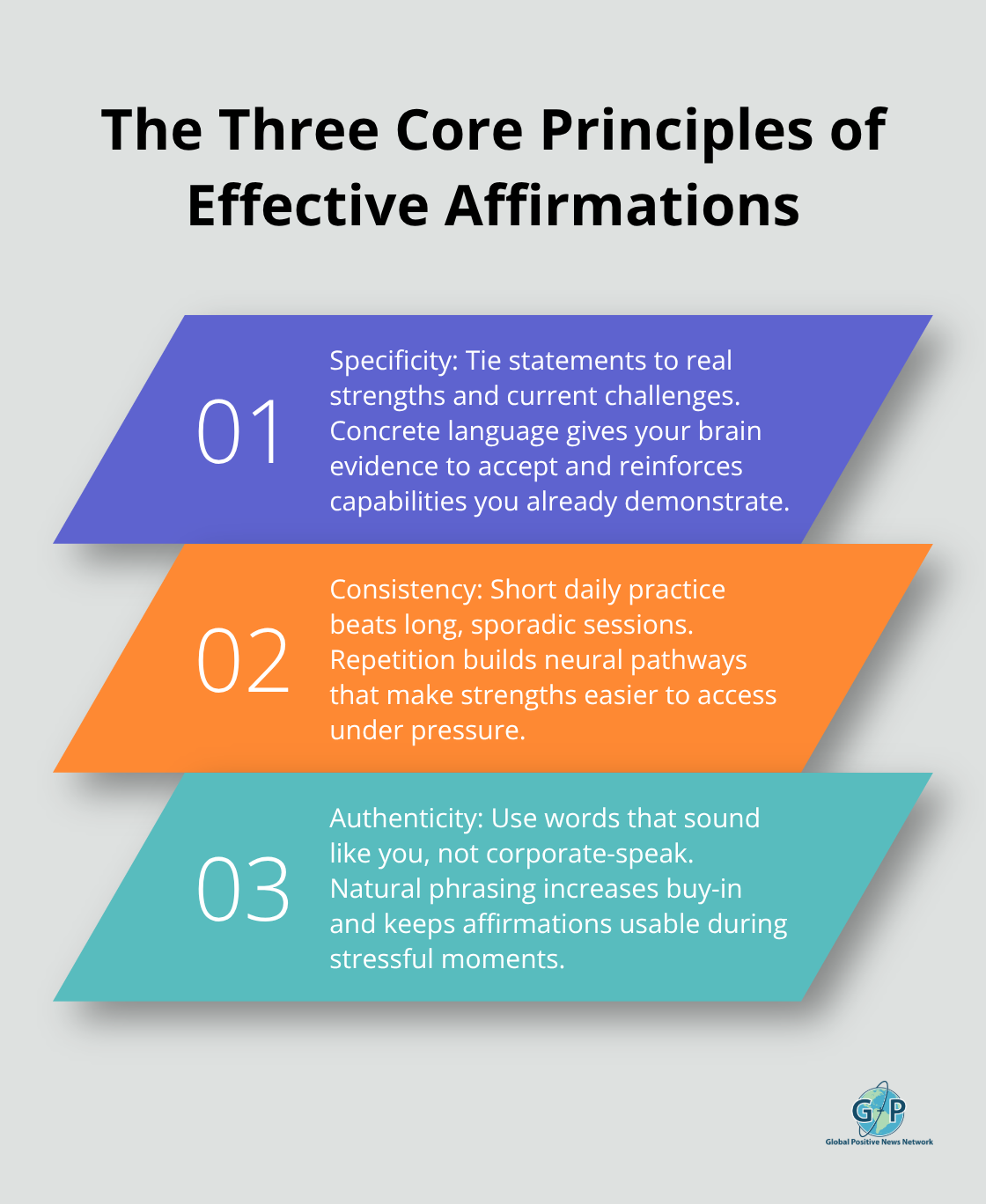
The three core principles that make affirmations work are specificity, consistency, and authenticity. Specific affirmations address your real pressure points rather than abstract weakness, consistency means practicing for 30 seconds daily rather than abandoning a 10-minute routine after two weeks, and authenticity means using language that sounds like you, not corporate-speak that your brain dismisses. Affirmations work best alongside professional support if you’re managing depression or anxiety, since this tool supplements rather than replaces mental health care.
Commit to one week with three affirmations tied to your biggest challenge and track your practice with a calendar check mark or phone note. After one month, assess whether you notice shifts in how quickly you access your strengths or whether rumination patterns have shortened. We at Global Positive News Network believe that building confidence is a practice, not a destination, and your affirmation practice is one of those actions that compounds into lasting change.