

Grassroots technology is reshaping how neighbors solve problems together. At Global Positive News Network, we’ve seen community empowerment innovations transform ordinary people into problem-solvers, without requiring expensive tools or technical expertise.
The most powerful changes happen when communities take control of their own digital futures. This blog post explores how local tech initiatives are breaking down barriers and building stronger neighborhoods from the ground up.
What Makes Grassroots Tech Truly Effective
Grassroots technology works because it addresses immediate, tangible neighborhood challenges without requiring expensive infrastructure or specialized knowledge. The difference between failed community tech projects and thriving ones comes down to solving problems people actually face.
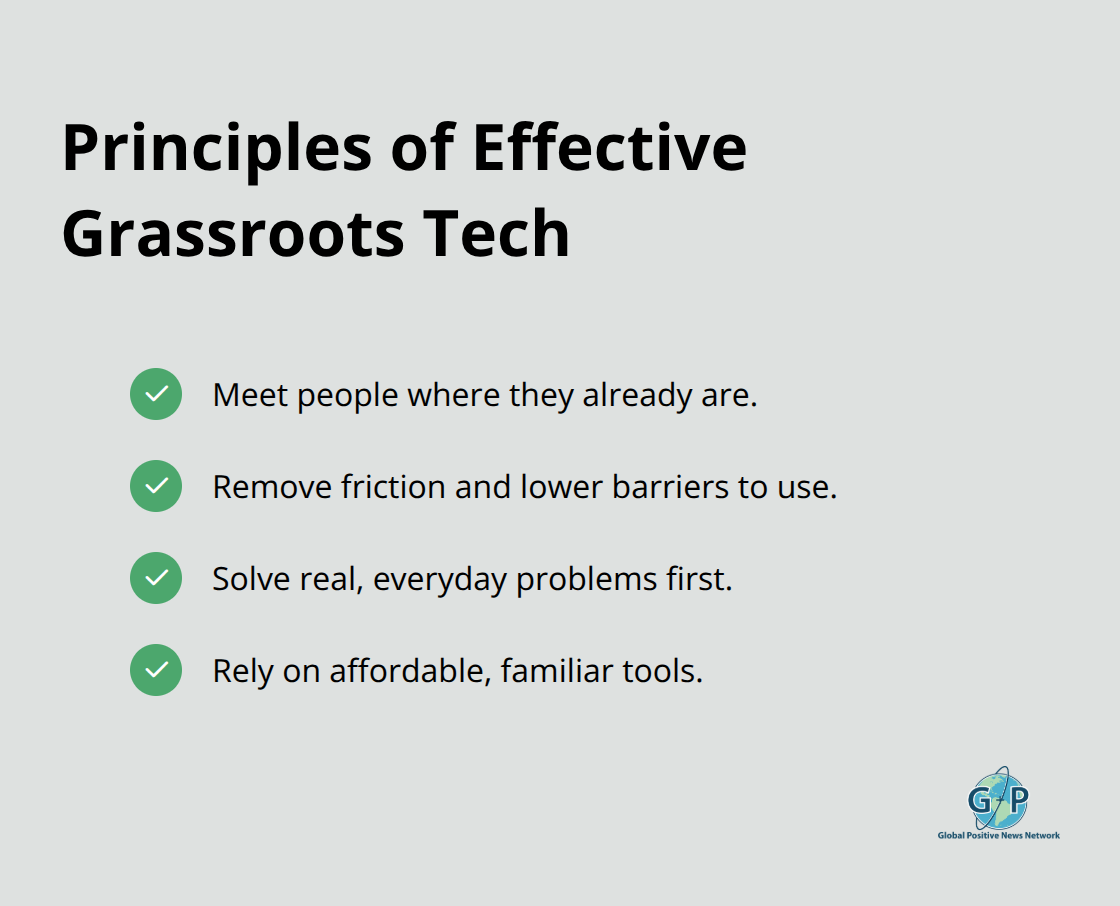
When Darli AI launched its WhatsApp-based advisory service in March 2024, it didn’t ask farmers to download new apps or buy devices. Instead, it met 110,000 farmers across Ghana and Kenya on a platform they already used, providing pest management and crop rotation guidance in 27 languages (including 20 African languages). That principle defines effective community tech: remove friction, meet people where they are, and solve real problems with affordable tools.
Bridges to Prosperity demonstrates this same approach with pedestrian bridges in 21 countries. Rather than imposing top-down infrastructure solutions, they used AI-enhanced planning to identify exactly where communities needed bridges, documenting over 75 million miles of unmapped waterways to accelerate local infrastructure delivery. Over 450 bridges now exist because technology served the community’s actual priorities, not external agendas.
Affordability Without Compromise
Community tech succeeds when cost barriers disappear entirely. Squirrel AI Learning in China charges families a fraction of traditional tutoring costs while delivering adaptive, personalized instruction to students who couldn’t otherwise access quality education. Sophie’s Kitchen’s algae-based protein costs just US$2 per kilogram while requiring only 0.02 hectares of land, making nutrition accessible in Southeast Asia without demanding agricultural resources communities don’t possess.
Effective grassroots solutions price themselves for the communities they serve, not for markets with disposable income. When technology remains expensive, it reinforces existing inequalities rather than breaking them down. Desert Control’s liquid nano-clay enables farmers in arid regions to retain soil moisture for agriculture, costing pennies per application while expanding what’s possible on land previously considered worthless. These aren’t charity projects dressed up as innovation-they’re economically viable solutions that happen to serve underserved populations because the problem-solving started with their constraints, not despite them.
Accessibility Means Inclusion from Day One
Technology that requires technical expertise or advanced literacy excludes the people who need it most. Nigeria’s indigenous AI keyboard, covering nearly 180 African languages, demonstrates that language inclusion isn’t an afterthought-it’s foundational infrastructure. When government and civic actors deliver information in people’s native languages, entire populations gain access simultaneously.
Digital citizen engagement platforms like CitizenLab enable residents to participate in local decision-making directly, increasing civic participation without demanding technical fluency. The most successful community tech projects treat accessibility as a core feature, not an optional add-on. Waggl’s anonymous employee feedback system works because it removes barriers to honest communication, letting workers share concerns without fear of retaliation.
Community Ownership Builds Trust
When communities control their own data and shape their own narratives, they build trust in the technology itself. Cartography and drone mapping in Nigeria’s Makoko produced community-owned datasets that residents used to advocate for climate adaptation services-the technology empowered local voices rather than replacing them with expert interpretations. This shift from passive users to active stakeholders transforms how neighborhoods approach their most pressing challenges, setting the stage for understanding how communities can sustain these innovations long-term.
Community Tech Solving Real Neighborhood Problems
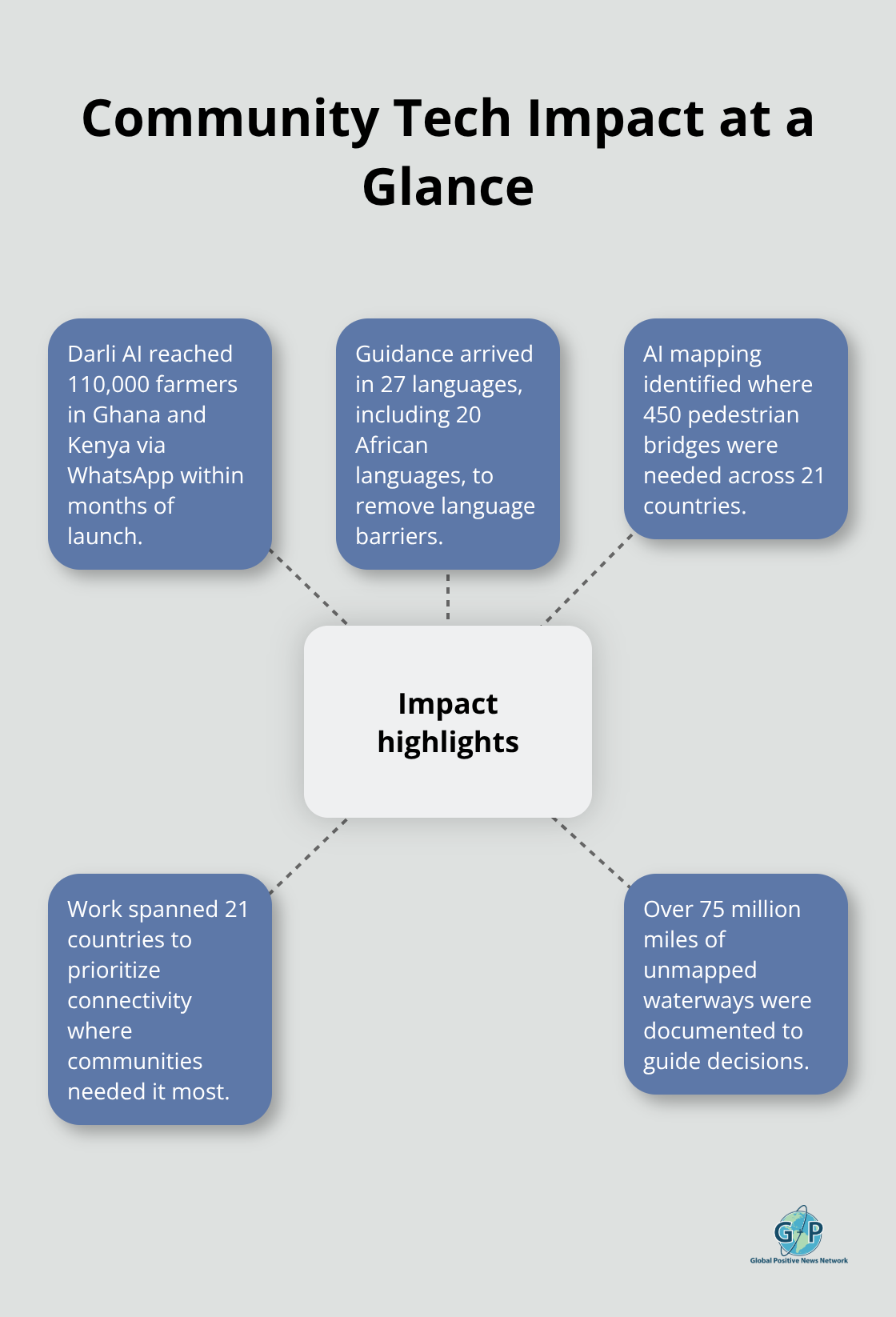
Darli AI’s WhatsApp service reached 110,000 farmers across Ghana and Kenya within months of its March 2024 launch because it solved an immediate problem farmers faced daily. Agricultural advisors weren’t accessible in rural areas, so the platform delivered pest management guidance, crop rotation strategies, and fertilizer recommendations directly through a messaging app farmers already used, all in 27 languages including 20 African languages. This model works because it doesn’t ask communities to change their behavior or adopt unfamiliar platforms-it arrives where people already spend their time. Bridges to Prosperity applied the same principle to infrastructure by using AI mapping to identify exactly where 450 pedestrian bridges were needed across 21 countries. Rather than guessing which communities needed connectivity most, they documented over 75 million miles of unmapped waterways and let data guide construction decisions. Communities in Bolivia and Africa participated in planning their own infrastructure, making the technology serve local priorities instead of imposing external solutions.
Where Technology Meets Existing Community Spaces
The strongest grassroots tech initiatives integrate into infrastructure people already rely on. Nigeria’s indigenous AI keyboard, supporting nearly 180 African languages, didn’t create a new platform-it enhanced existing government and civic communication systems so non-English speakers received information without intermediaries. CitizenLab’s digital citizen engagement platforms work within local government structures, letting residents weigh in on neighborhood decisions without demanding technical expertise. Waggl’s anonymous feedback system operates inside workplaces employees already navigate, removing barriers to honest communication about working conditions. These tools succeed because they strengthen what communities already possess rather than replacing it.
Knowledge Sharing Without Gatekeepers
Peer-to-peer knowledge networks eliminate the middleman between people who know solutions and people facing problems. Teacherly’s collaborative lesson-sharing platform lets teachers access tested strategies from peers solving identical classroom challenges, while Squirrel AI Learning’s adaptive tutoring delivers personalized instruction at prices families can actually afford instead of forcing them toward expensive private tutoring. When knowledge flows horizontally between community members rather than vertically from experts, information spreads faster and adapts to local context automatically. The cost difference matters enormously-Squirrel AI’s model makes quality education accessible to families in poverty, while traditional tutoring pricing guarantees exclusion. Communities that control their own knowledge systems respond faster to local problems and build capacity residents can maintain independently.
Why Local Control Transforms Tech Adoption
Communities that own their data and shape their own narratives build trust in the technology itself. Cartography and drone mapping in Nigeria’s Makoko produced community-owned datasets that residents used to advocate for climate adaptation services-the technology empowered local voices rather than replacing them with expert interpretations. This shift from passive users to active stakeholders transforms how neighborhoods approach their most pressing challenges. When residents participate in decisions about which problems technology should solve, adoption rates climb and long-term sustainability improves. Successful neighborhood initiatives demonstrate how communities overcome practical barriers that still prevent many neighborhoods from accessing these powerful tools.
What Stops Communities From Adopting Grassroots Tech
Digital Divides Require More Than Hardware
Digital divides remain the most stubborn barrier communities face, and they’re rarely solved by simply providing hardware. When Calyx Institute examined connectivity challenges, they found that affordable access alone doesn’t work-people need devices, reliable service, and the confidence to use them simultaneously. Calyx’s Internet Membership Program addresses this by pairing mobile hotspots with ongoing support, recognizing that a device sitting unused because someone doesn’t know how to operate it solves nothing. The real barrier isn’t technology itself; it’s the gap between what exists and what communities actually know how to use.
Training programs must start before people touch devices, not after. Squirrel AI Learning succeeded in China partly because adaptive tutoring removed the intimidation factor-the platform learns from individual students rather than forcing everyone through identical lessons, which meant families with limited tech experience could navigate it naturally. Studies show that when non-technical users feel lost, they abandon tools entirely rather than asking for help.
Building Confidence Through Community Education
Calyx’s approach through community partnerships in New York City demonstrates how education transforms adoption rates: they funded CryptoHarlem to expand digital privacy education in neighborhoods where residents had zero exposure to cybersecurity concepts, starting with conversations about why privacy matters before teaching technical implementation. Without this foundation work, even excellent tools fail because communities don’t understand what problem they’re solving. Education that meets people where they are-in their neighborhoods, in their languages, at their skill level-turns skeptics into confident users who then teach others.
Sustainable funding models Determine Long-Term Survival
Funding models determine whether grassroots tech survives beyond initial enthusiasm or becomes sustainable infrastructure. Calyx’s Sepal Fund offers exactly what grassroots organizations actually need: professional development and resources to build capacity instead of treating every project as temporary. This multi-year commitment lets organizations hire staff, test approaches, and build capacity.
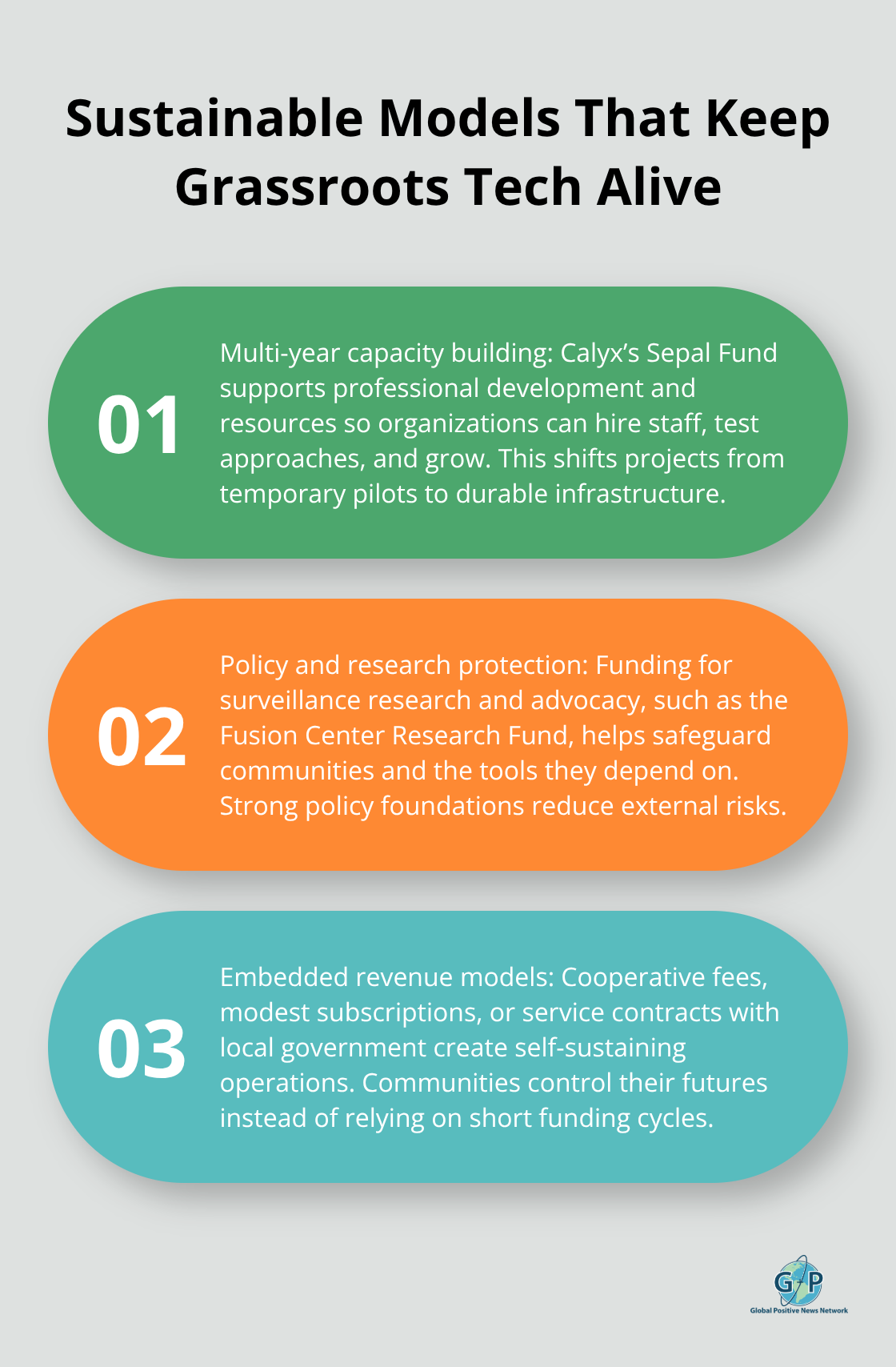
Calyx also funds surveillance research and policy advocacy through the Fusion Center Research Fund, because sustainable tech requires legal and policy protection alongside tools. Communities shouldn’t rely on charity; they need revenue models embedded into their solutions. The most resilient grassroots initiatives generate income through their own operations-whether through cooperative membership fees, modest subscription tiers for advanced features, or service contracts with local government-so they control their own futures rather than depending on external funding cycles.
Demonstrating Impact Attracts Partners and Resources
Bridges to Prosperity secured government partnerships and donor commitments precisely because they could demonstrate measurable impact: 450 bridges serving documented communities, not hypothetical beneficiaries. Communities building grassroots tech should prioritize showing concrete value to potential funders and partners immediately, because vague promises about future impact won’t sustain projects through the inevitable difficult months when adoption climbs slowly and technical problems emerge unexpectedly. Real numbers-lives affected, problems solved, costs saved-convince decision-makers to invest in scaling what works.
Final Thoughts
Grassroots tech innovations reshape neighborhoods by placing problem-solving power directly into community hands. When technology serves real neighborhood needs, costs stay low, and communities control their own futures, adoption accelerates and impact compounds. Darli AI reached 110,000 farmers because it arrived on WhatsApp in their native languages, while Bridges to Prosperity built 450 pedestrian bridges because communities participated in deciding where infrastructure mattered most.
Community empowerment innovations work when residents build their own digital infrastructure and develop skills that extend far beyond the initial project. They learn to identify problems, test solutions, and iterate based on feedback. They gain confidence that their voices shape decisions affecting their lives. They discover that technology serves them rather than controlling them.
Start by identifying one specific problem neighbors face repeatedly-something that wastes time, costs money, or prevents people from participating fully in neighborhood life. Pair any new tool with education that builds confidence before expecting adoption, secure sustainable funding through revenue models embedded into the solution itself, and connect with organizations like Calyx Institute that fund grassroots tech development and provide professional support alongside financial resources. Explore stories of communities taking control of their digital futures and join the movement toward neighborhoods where technology serves everyone.