

Black inspirational quotes carry weight because they come from lived experience and hard-won wisdom. At Global Positive News Network, we believe these words offer more than motivation-they provide a roadmap for building genuine positivity in your life.
This guide shows you how to tap into the power of Black inspirational quotes and make them part of your daily practice.
Why Black Inspirational Quotes Hit Differently
The Weight of Lived Experience
Black inspirational quotes carry force because they emerge from specific historical struggles and concrete achievements that shaped entire movements. These words come from people who faced systemic barriers and chose action over despair. Frederick Douglass wrote that there is no progress without struggle-a statement that reflects centuries of lived reality, not abstract philosophy. Rosa Parks’ observation that a made-up mind diminishes fear came from her decision to stay seated on a bus in 1955, knowing the exact consequences she would face. Malcolm X’s insistence that you cannot separate peace from freedom was rooted in his direct experience navigating racism and seeking autonomy. When you read these quotes, you encounter not motivational platitudes written by someone comfortable, but the distilled wisdom of people who had to build positivity under conditions designed to crush it.
How Your Brain Responds to Authentic Affirmation
This authenticity matters because neuroscience shows that self-affirmation activates your brain’s reward and valuation circuits most powerfully when it connects to your future goals and personal values. A 2015 study published in PNAS found that participants who reflected on future-oriented value affirmations showed greater activation in the ventral striatum and ventromedial prefrontal cortex-the brain regions responsible for perceiving value and motivation. Those neural changes predicted real behavioral shifts one month later, with stronger activation linked to measurable reductions in sedentary behavior. Quotes that prompt you to imagine positive future states tied to your core values trigger deeper neural engagement than generic motivational phrases.

Specificity Creates Universal Power
The universality of Black inspirational quotes lies in their specificity, not their generality. Oprah Winfrey’s statement that you should never be limited by other people’s limited imaginations speaks directly to anyone who has internalized doubt from external voices, yet it emerged from her particular journey as a Black woman navigating media and wealth. Langston Hughes’ call to hold fast to dreams resonates across cultures and circumstances because it addresses a human need that transcends race, but it carries additional weight because Hughes wrote from a position where his dreams faced active discouragement by systems around him. This combination of specific historical grounding and universal human relevance makes these quotes work harder than motivational content that skips the hard parts.
Matching Quotes to Your Real Challenges
When you use a Black inspirational quote in your daily life, you anchor yourself to both a particular history and a timeless principle. The practical application is straightforward: select quotes that reflect challenges you actually face, not abstract ideals. If you struggle with self-doubt, Nikki Giovanni’s reminder to treat yourself as a being worthy of respect and to insist others do the same gives you a concrete standard to measure against. If you navigate change, Susan L. Taylor’s perspective that crises are opportunities to shed old habits and grow provides a reframing tool you can return to repeatedly. The most effective quotes are those that answer a specific question in your life right now-and that specificity is what makes them work across different communities and circumstances.
Making Black Inspirational Quotes Part of Your Routine
The difference between reading a powerful quote and actually changing your life with it comes down to deliberate practice. A quote you encounter once and forget does nothing. A quote you return to repeatedly becomes a tool that reshapes how you think and act. Neuroscience confirms that the brain’s reward circuits activate most strongly when you connect a quote to your future goals and reflect on it over time. This means the work is not in finding the perfect quote-it’s in building a system that keeps you returning to quotes that matter.
Pair quotes with concrete daily actions
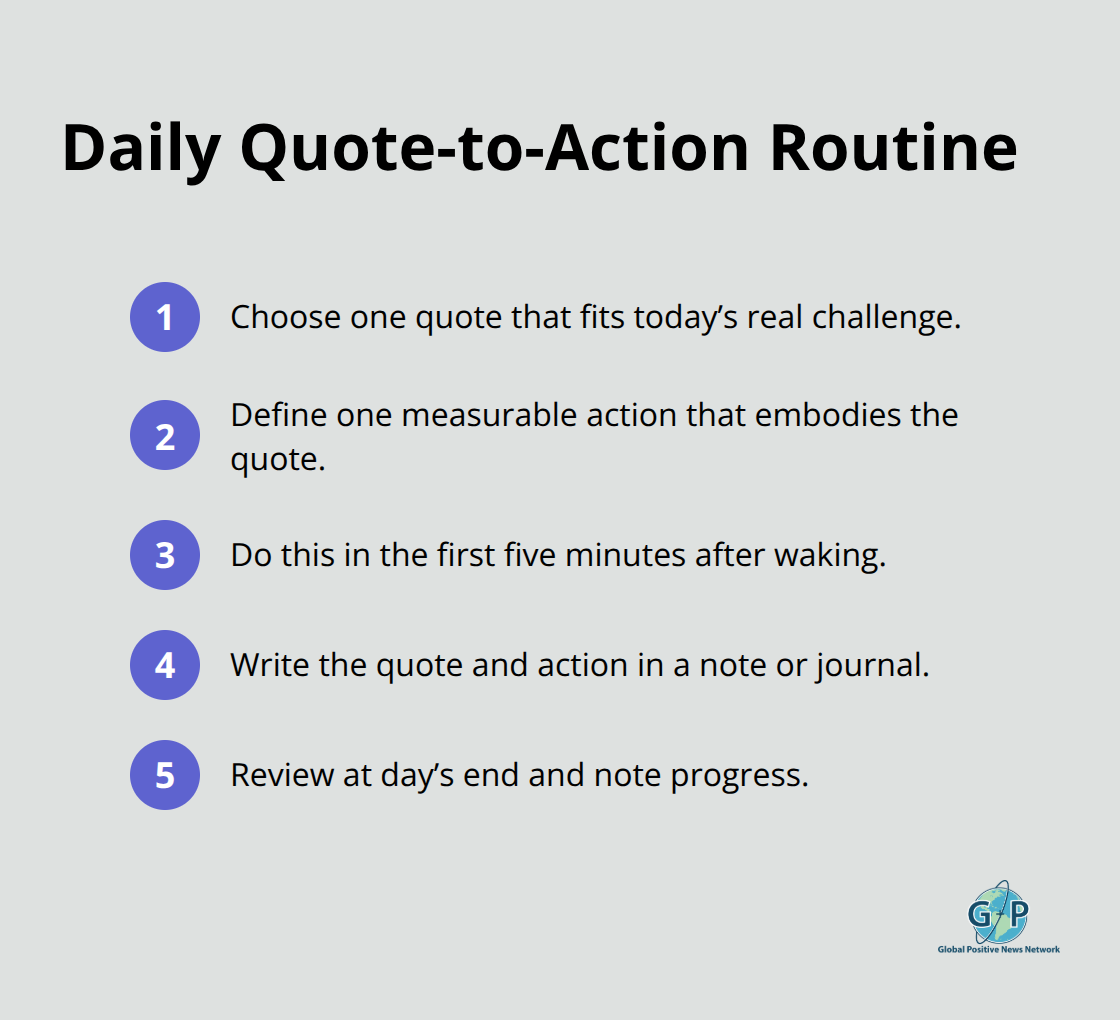
The most practical approach is to connect a Black inspirational quote with a specific action you will take that day. Not a vague intention like being positive, but something measurable. If you choose Frederick Douglass’ statement that there is no progress without struggle, your action might be to take one step today that pushes against a barrier you face-applying for that job, having a difficult conversation, or starting that project you have delayed. If you select Kamala Harris’ words that even in dark times we not only dream, we do, your action is to pair one hopeful goal with one concrete step toward it today. The pairing matters because quotes without action remain abstract.
Research on self-affirmation and behavior change found that participants who reflected on future-oriented value affirmations and then took aligned actions showed measurable shifts in their behavior within a month. Set this practice for the first five minutes after you wake up. Write the quote and your intended action in a note or journal. This takes three minutes and anchors your entire day around something that moves you forward.
Share quotes within reciprocal communities
Posting quotes on social media to a passive audience rarely changes anything. The real power emerges when you share quotes within groups where people actually respond and build on each other’s thinking. This could be a small group chat with friends, a weekly email to colleagues, or a community forum focused on personal growth. Accountability and reciprocal engagement strengthen the neural circuits that make affirmations stick.
Choose one quote per week and share it with a specific group, then ask them what action they took because of it. This transforms a quote from something you consume into something you create meaning around together. If you are part of a workplace or community group, propose a rotating quote-sharing practice where each person brings one quote and shares why it matters to them personally. This builds collective momentum and ensures people encounter diverse voices rather than the same repeated quotes.
Place visual reminders at moments of friction
The most effective visual reminder is not a generic poster but a quote placed where you will encounter it during moments of friction or doubt. Place a quote on your bathroom mirror that addresses your most common morning struggle. Place one on your desk that you see when you face a task that triggers avoidance. Place one on your phone’s lock screen that you see before opening email or social media. The visual placement matters more than the quote itself.
Environmental cues trigger behavior change more reliably than motivation alone. Use a simple image and text-nothing elaborate. If you work with others, suggest creating a shared space where team members rotate posting quotes. This creates a communal visual environment and signals that positivity is a collective value, not an individual indulgence. The key is specificity: your visual reminders should address the exact moments where you most need to shift your thinking or behavior.
Track which quotes actually move you forward
Not every quote will resonate with you, and that’s expected. Some quotes inspire immediate action while others feel distant from your life. The quotes that work are the ones you return to repeatedly and that prompt real change in how you behave. Start tracking which quotes you actually use and which ones you forget. After two weeks, you will notice patterns-certain voices, certain themes, certain framings that stick with you more than others.
This data matters because it tells you what your mind responds to. If you find yourself returning to quotes about freedom and autonomy, build your collection around that theme. If quotes about resilience and recovery resonate more deeply, prioritize those. This personalization ensures your quote practice stays alive rather than becoming another abandoned habit. The most powerful quotes are the ones that match your actual values and challenges, not the ones that sound impressive or popular.
Now that you have built a daily practice around Black inspirational quotes, the next step is understanding which voices and messages will sustain your momentum over time.
Which Black Voices Should Guide Your Daily Practice
Match Voices to Your Actual Challenges
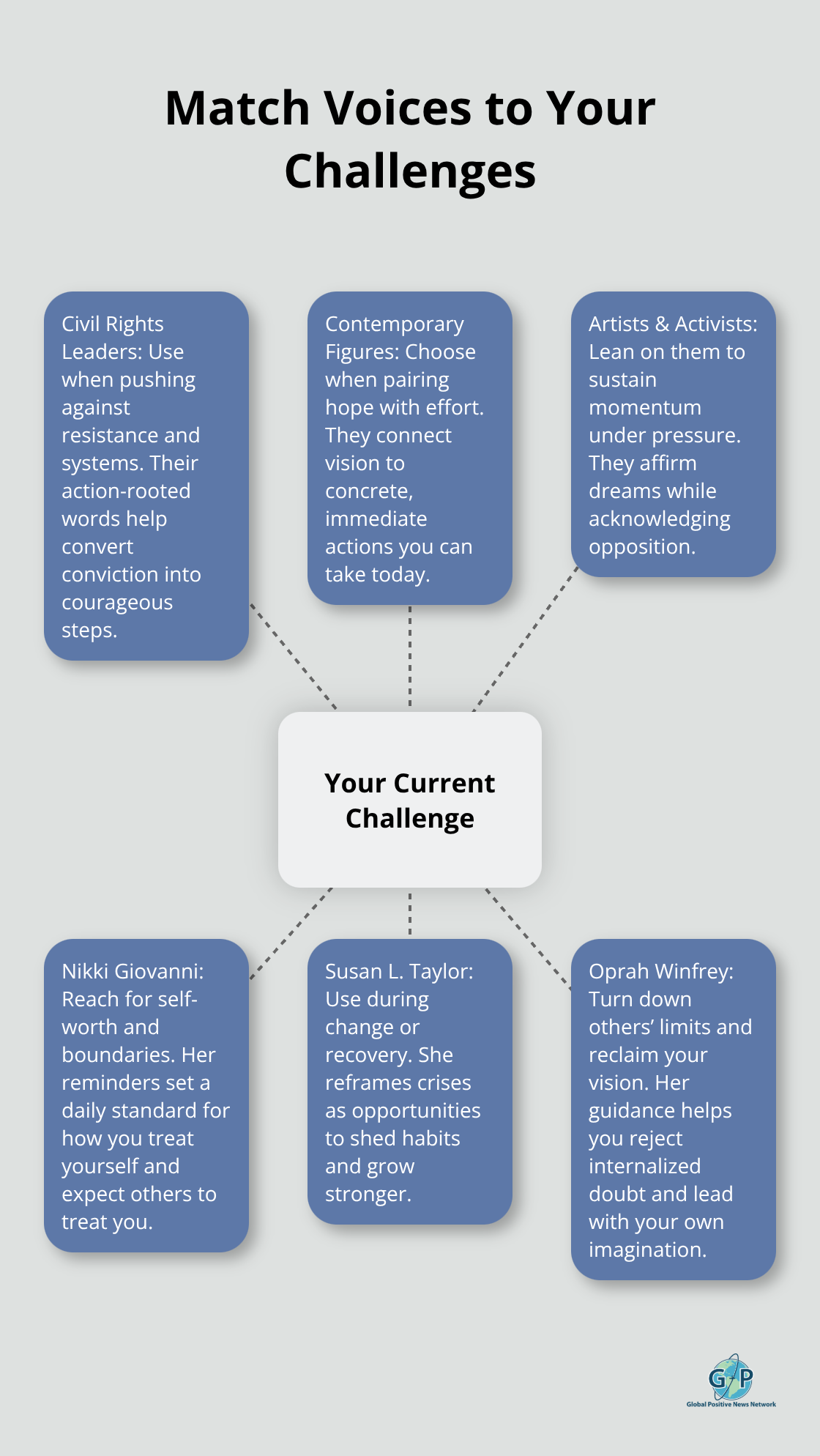
The most practical approach to using Black inspirational quotes is to build your collection around voices that address the specific barriers you face. Frederick Douglass’s statement that there is no progress without struggle works best if you actively push against resistance-applying for advancement, starting a difficult project, or confronting a system that limits you. Rosa Parks’ observation that a made-up mind diminishes fear applies directly when you face a decision you have postponed and need to move forward despite uncertainty. Malcolm X’s insistence that you cannot separate peace from freedom matters most if you reclaim your autonomy in relationships, work, or personal choices. The error most people make is collecting quotes that sound powerful without asking whether they address something real in your current life. Instead, match the voice to the work.
If you struggle with self-doubt about your worth, Nikki Giovanni’s reminder to treat yourself as worthy of respect and insist others do the same gives you a daily standard to measure against. If you navigate significant change or loss, Susan L. Taylor’s perspective that crises are opportunities to shed old habits and grow into something better provides a reframing tool you can return to when circumstances shift unexpectedly. Oprah Winfrey’s warning against being limited by other people’s limited imaginations works when you have internalized external doubt and need to reclaim your own vision. The quotes that actually change behavior are those that answer a specific question in your life right now-not the ones that sound universally inspiring but feel abstract to your actual situation.
Civil Rights Leaders: Grounding Positivity in Action
Civil rights leaders like Rosa Parks and Malcolm X grounded their words in concrete action and lived consequence, which is why their quotes translate into behavior change more reliably than generic motivation. Their statements carry weight because they emerged from decisions that cost them something. When you use a Rosa Parks quote, you anchor yourself to someone who sat down knowing the exact consequences she would face. This specificity activates your brain’s reward circuits more powerfully than abstract inspiration alone.
Contemporary Figures: Pairing Hope With Effort
Contemporary figures like Kamala Harris and Shonda Rhimes frame positivity as something paired with effort and real-world steps rather than passive feeling. Harris’s statement that even in dark times we not only dream, we do connects hope directly to action, which research confirms activates your brain’s reward circuits more strongly than affirmation alone. Shonda Rhimes’ observation that hard work turns dreams into reality removes the fantasy element and anchors positivity in effort, which means people who use her quotes are more likely to take concrete steps rather than wait for motivation to arrive.
Artists and Activists: Sustaining Momentum Against Opposition
Artists and activists like Langston Hughes and Ella Baker offer quotes that address how to sustain momentum when systems work against you. Hughes’ call to hold fast to dreams matters because it acknowledges that dreams face active pressure and discouragement-his quote is not about dreaming in a vacuum but about protecting your vision despite opposition. Ella Baker’s directive to give light and people will find a way translates into the practical action of sharing knowledge or mentoring others, which creates a feedback loop where helping others reinforces your own positivity and sense of purpose.
Build Your Collection With Intention
Select voices that match the specific work you are doing rather than collecting broadly. If you work in a field where you face systemic barriers, prioritize civil rights leaders. If you manage a team or community, prioritize contemporary figures and activists who frame positivity as collective action. Track which voices you return to repeatedly over two weeks-that pattern shows you which perspectives your mind actually uses to navigate your challenges.
Final Thoughts
Black inspirational quotes work because they connect you to voices that transformed struggle into wisdom. When you use these quotes consistently, you anchor yourself to a lineage of people who built positivity under conditions designed to prevent it. The power lies in the specificity-a quote that addresses your exact challenge today changes how you think and act far more than a generic statement ever could. Research confirms that future-oriented affirmations tied to your personal values activate your reward circuits and predict measurable behavior change within weeks.
The real growth happens when you move beyond reading quotes to building them into your daily decisions. Pair a quote with a concrete action, share it with people who will respond and build on it, and place it where you will see it during moments of doubt. This deliberate practice rewires how your brain processes challenges and opportunities. Positivity black inspirational quotes become most powerful when they become communal rather than individual, transforming a moment of inspiration into collective momentum.
Start with one voice that matches your current challenge and use it for two weeks. We at Global Positive News Network believe that uplifting stories and voices create the conditions where positivity takes root and spreads. The quotes you choose to live by shape not only your own resilience but also the environment you create for others.
Having a hard day?
The 2 Minute Hope Reset is a short free guide with three small practices for the days that feel heavy. Two minutes each, nothing to keep up with.
Get the free guideExplore more positive news:
Enjoying stories like this?
Global Positive News Network is reader-supported. If you’d like to support the mission, you can visit the Official GPNN store.